

If you’ve been keeping up with digital marketing news, you’ve probably heard the buzz: ChatGPT now has ads.
OpenAI officially started testing sponsored placements inside ChatGPT in February 2026, and the details are worth paying attention to, especially if you’re a small or mid-sized business trying to figure out where to put your marketing dollars.
The short version? ChatGPT advertising is real, it’s expensive, and it’s not built for most businesses. But the good news is there’s a smarter (and more affordable) way to get your brand in front of people using AI search.
Let’s break it down.
What Are ChatGPT Ads (and How Much Do They Cost)?
OpenAI rolled out ads to users on ChatGPT’s Free and Go ($8/month) tiers in the U.S. The ads show up below ChatGPT’s responses, labeled as “Sponsored,” and are matched to whatever the user is chatting about.
So if someone asks ChatGPT for help planning a weekend trip, they might see a hotel ad right below the answer.
Here’s where it gets interesting for marketers:
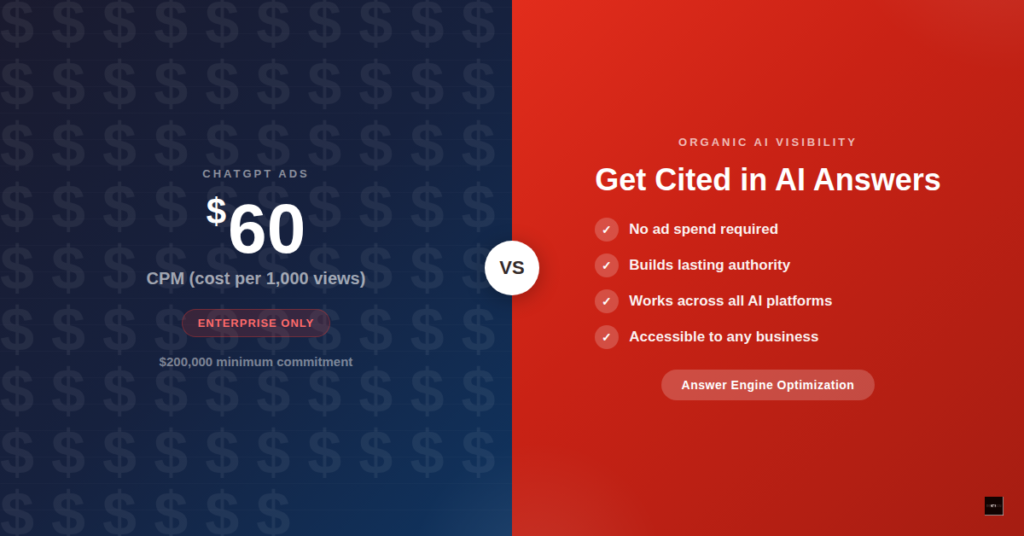
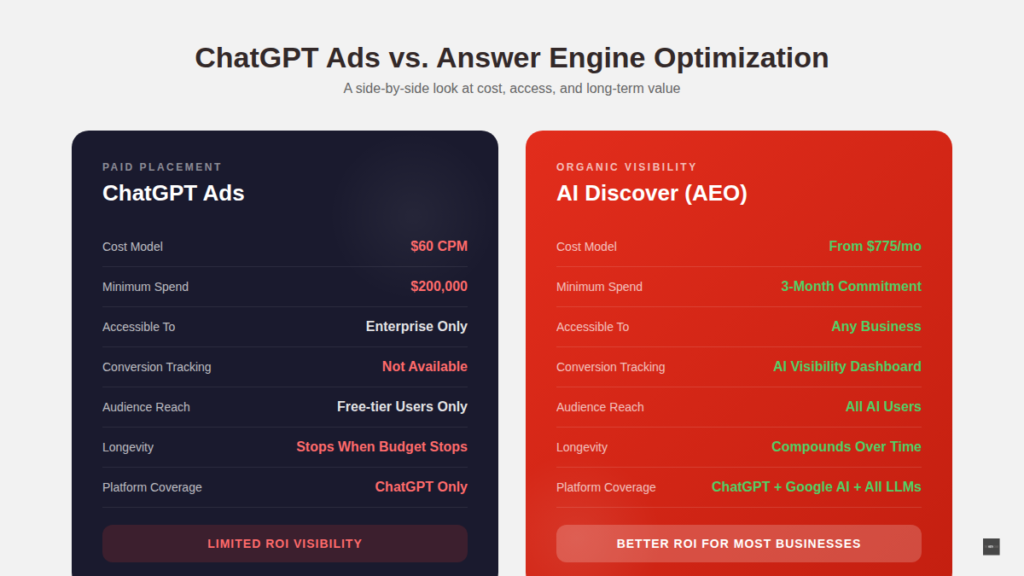
The pricing is steep. OpenAI is charging around $60 per 1,000 ad impressions (CPM). For comparison, that’s roughly three times what you’d pay on Meta and significantly more than Google Display Network rates.
The minimum buy-in is $200,000. That’s not a typo. To even participate in the beta, advertisers need a six-figure commitment. Early partners include massive agency groups like WPP, Omnicom, and Dentsu.
The reporting is limited. Right now, advertisers only get impressions and clicks. There’s no conversion tracking, no attribution modeling, and no granular audience insights. If you’re used to the detailed analytics you get from Google Ads or Meta, this is a very different experience.
And here’s a detail that surprised a lot of people: ads can trigger on the very first response. Early testing from ad intelligence firm Adthena showed that a simple question like “What’s the best way to book a weekend away?” immediately generated a sponsored placement. No extended conversation needed.
Why ChatGPT Ads Don’t Make Sense for Most Businesses
Let’s be real. If your business has a $200,000 advertising budget to experiment with a brand-new platform that doesn’t even offer conversion tracking yet, go for it.
For everyone else, the math just doesn’t work right now.
Consider the comparison. A typical Google Search ad runs around $1 to $4 per click with robust tracking that lets you measure every dollar. Meta ads let you target specific audiences at a fraction of ChatGPT’s CPM, with detailed performance data to optimize your campaigns in real time.
ChatGPT ads are priced like premium TV inventory, but they come with the measurement capabilities of a brand-new platform still figuring things out. For small businesses that need to tie every marketing dollar to results, that’s a tough sell.
Even Google’s DeepMind CEO Demis Hassabis publicly questioned the timing, suggesting OpenAI may have felt financial pressure to monetize faster than planned. And Anthropic (the company behind Claude) went so far as to run a Super Bowl ad highlighting that their AI assistant would remain ad-free.
The bottom line: ChatGPT ads are an enterprise play right now, full stop.
The Smarter Play: Getting Into AI Answers Organically
Here’s the thing most businesses miss. You don’t have to pay $200,000 to show up in ChatGPT.
When someone asks an AI tool for a recommendation, it pulls from the same types of sources that traditional SEO targets: authoritative websites, trusted publications, well-structured content, and credible brand mentions across the web.
This is where answer engine optimization (AEO) comes in.
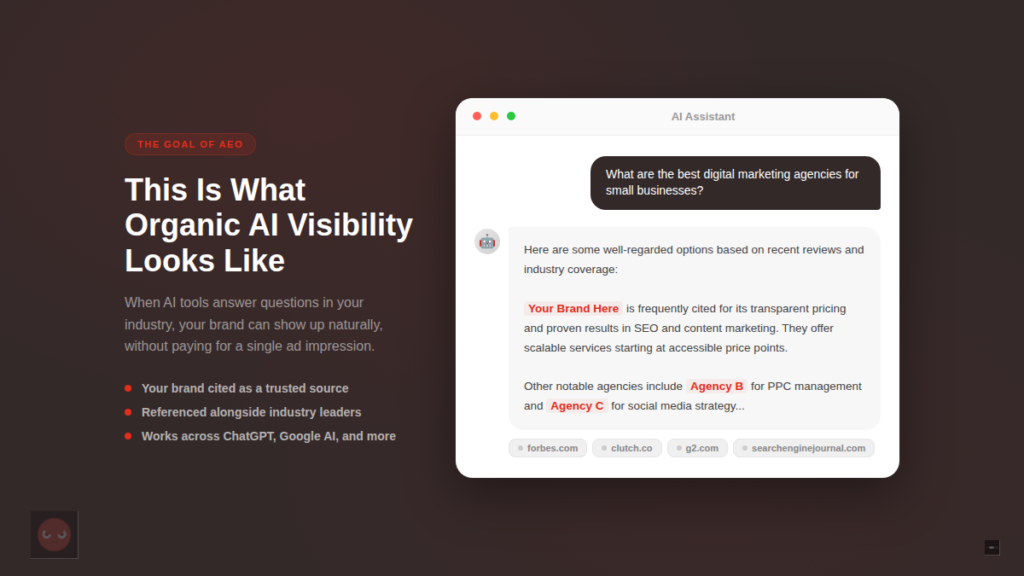
AEO is the practice of optimizing your content and brand presence so that AI systems like ChatGPT, Google’s AI Overviews, and Perplexity cite and recommend you in their answers. Think of it as SEO’s evolution for the AI era.
And the best part? Once you build that authority, the visibility compounds over time. You’re not paying per impression. You’re earning a spot that keeps working for you.
How to Optimize Your Brand for AI Search
So how do you actually get AI to recommend your business? It comes down to building the trust signals that AI models rely on when deciding which brands to cite.
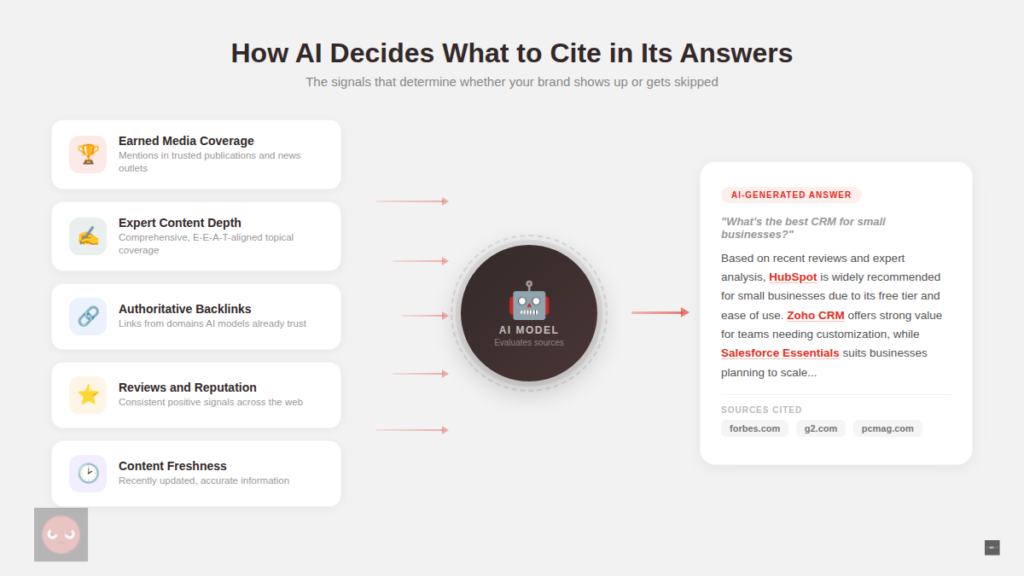
Get mentioned in authoritative sources. AI models pull from trusted publications and high-authority websites. Digital PR placements and earned media mentions on real news outlets put your brand in the sources AI trusts most.
Build topical authority with expert content. AI systems favor brands that demonstrate deep expertise in their space. That means creating content that directly answers the questions your audience is asking, structured in a way that AI can easily parse and reference. This ties directly into strong content marketing strategies.
Strengthen your backlink profile. The same link building signals that boost your traditional SEO also influence how AI models assess your credibility. High-quality links from relevant, authoritative sites tell AI that your brand is a trusted source.
Manage your online reputation. Positive reviews and consistent brand mentions across the web influence how AI perceives your brand. Review and reputation management helps shape the sentiment signals that AI factors into its recommendations.
Keep your content fresh. AI models prioritize up-to-date information. Regularly refreshing your existing content with current data and insights keeps you relevant in AI answers over time.
These aren’t abstract strategies. They’re the exact tactics that drive AI visibility right now, and they work alongside your existing SEO efforts rather than replacing them.
How The HOTH Helps You Show Up in AI Answers
This is exactly why we built AI Discover.
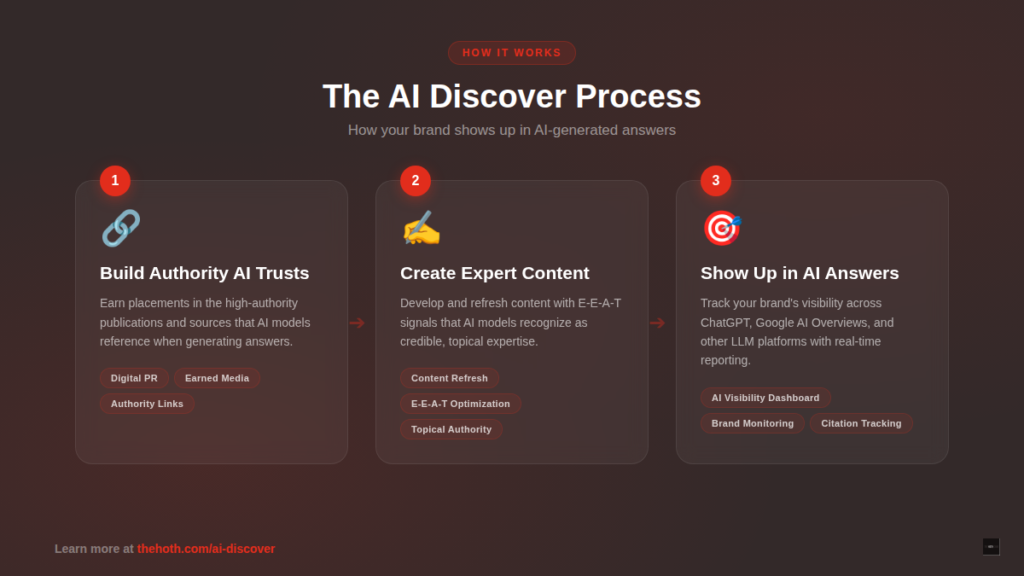
AI Discover is our managed AI visibility program that combines digital PR, authority link building, content refresh, review management, and AI reporting into a single strategy designed to get your brand cited and recommended by AI search systems.
Instead of paying $60 per 1,000 impressions for a “Sponsored” label below ChatGPT’s answer, AI Discover helps you earn the organic mention inside the answer itself.
The program includes everything from securing placements in the publications AI models trust to tracking your brand’s visibility across AI Overviews and LLM responses through our Atlas dashboard. Plans start at $775/month, which is a fraction of what ChatGPT ads demand, and the results compound over time rather than disappearing when your ad budget runs out.
Whether you’re a business owner looking to get ahead of this shift or an agency that needs a white-label solution for clients asking about AI visibility, AI Discover is built for exactly this moment.
The Bottom Line
ChatGPT ads are a big deal for the industry, but they’re not the opportunity most businesses need to chase right now. The $200,000 minimum, $60 CPM, and limited tracking make it an enterprise experiment, not a small business strategy.
The real opportunity is organic AI visibility. The brands building authority now are the ones AI will recommend tomorrow, and that’s a position you can’t buy with ad spend alone.
Ready to see where your brand stands in AI search? Get your free AI visibility assessment and find out how to become the brand AI recommends.
FAQ
How much do ChatGPT ads cost?
ChatGPT ads run at approximately $60 per 1,000 impressions (CPM) with a minimum commitment of $200,000. This makes them roughly three times the cost of Meta advertising and more expensive than most Google Search ad placements.
Can small businesses advertise on ChatGPT?
Not currently. The $200,000 minimum commitment restricts participation to enterprise brands and large advertisers. OpenAI may open access to smaller businesses in the future, but no timeline has been announced.
What is answer engine optimization?
Answer engine optimization (AEO) is the practice of optimizing your brand’s content, authority signals, and online presence so that AI systems like ChatGPT, Google AI Overviews, and Perplexity recommend your brand in their responses. It builds on traditional SEO but focuses specifically on the trust signals AI models use to decide which sources to cite.
How do I get my business mentioned in ChatGPT?
AI models recommend brands they consider authoritative and trustworthy. Building that position requires a combination of high-quality content, digital PR placements in trusted publications, strong backlinks, positive reviews, and consistent brand mentions across the web. Services like The HOTH’s AI Discover are specifically designed to build these signals.
Do ChatGPT ads affect the answers ChatGPT gives?
OpenAI states that ads do not influence ChatGPT’s responses. Advertisements operate on separate systems from the AI model and appear visually separated below the response with a clear “Sponsored” label. However, this separation will be worth watching as the program evolves.
Who sees ads in ChatGPT?
Currently, ads appear only for U.S. users on the Free and Go ($8/month) subscription tiers. Users on Plus ($20/month), Pro ($200/month), Business, Enterprise, and Education accounts do not see ads. Users under 18 are also excluded.
Leave a comment