
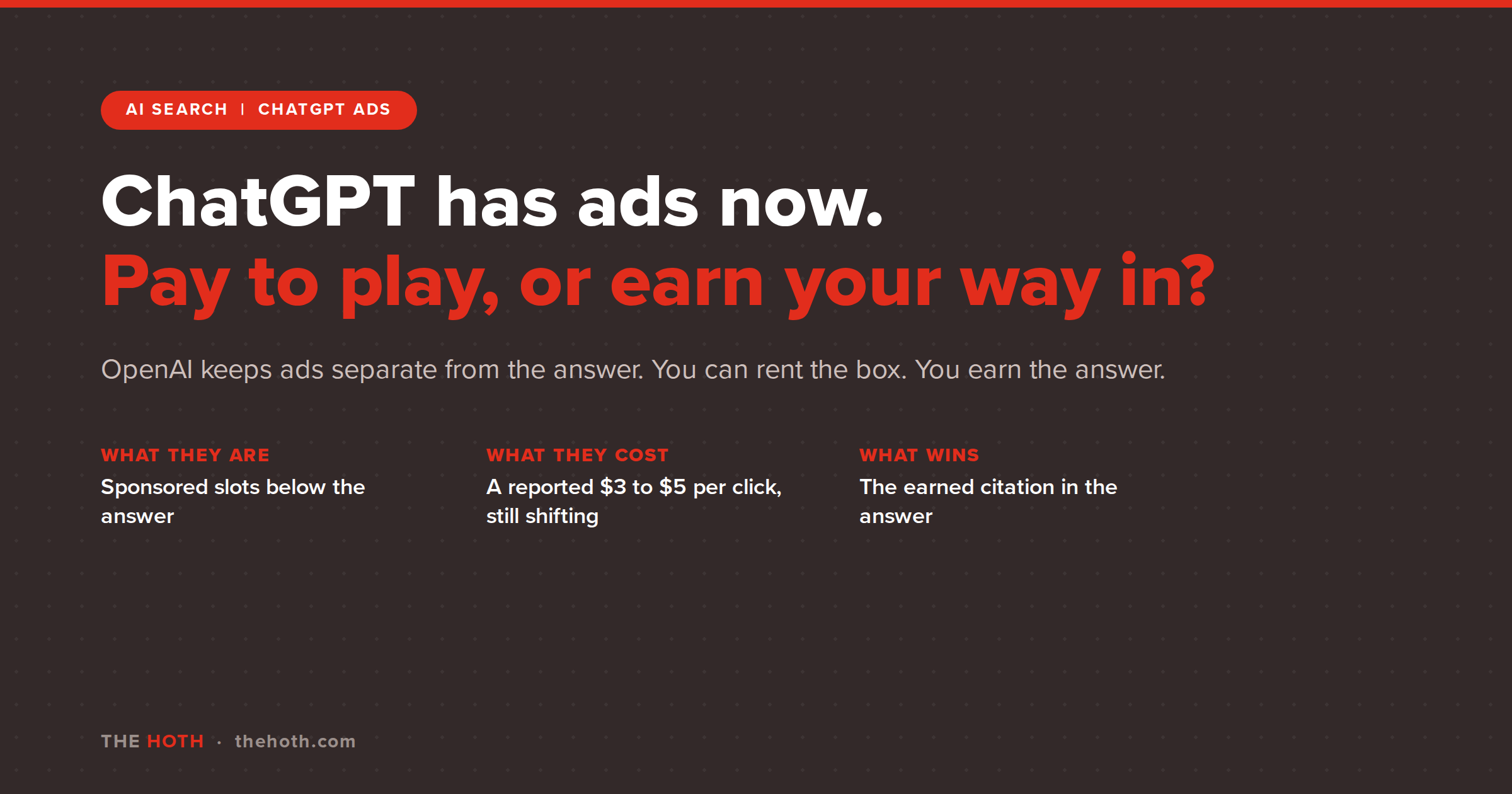

ChatGPT now shows sponsored ads below its answers for Free and Go users, and OpenAI has added product-feed ads that build campaigns straight from your catalog. But ads sit separate from the answer and don’t influence it, so the recommendation inside ChatGPT’s response is still earned, not bought.
The thing marketers spent two years predicting is here: ChatGPT has ads. OpenAI began testing them in early 2026 and has been expanding quickly since, rolling out to more countries, opening up self-serve tools, and most recently adding product-feed ads that turn a retailer’s catalog into campaigns automatically.
For brands, it all comes down to one question: do you pay for the sponsored slot, or earn your way into the answer itself? This guide covers what ChatGPT ads are, how they work, what they cost, and why, for most businesses, being named in the answer still beats buying the box beside it.
What are ChatGPT ads?
ChatGPT ads are sponsored placements that appear below ChatGPT’s responses for logged-in adult users on the Free and Go tiers, starting in the US and expanding to more countries. They’re clearly labeled as sponsored, matched to your conversation, and, per OpenAI, do not influence the answers ChatGPT gives.
OpenAI started testing ads in ChatGPT in early 2026, beginning in the US and later expanding to markets including Canada, Australia, New Zealand, the UK, Mexico, Brazil, Japan, and South Korea. Plus, Pro, Business, Enterprise, and Education subscribers don’t see ads at all.
OpenAI has also drawn clear lines around where ads can show. They aren’t served to users it identifies as under 18, and they aren’t eligible near sensitive or regulated topics like health, mental health, or politics. The company calls its guiding principle answer independence: ads are visually separated from the organic answer, and they don’t change what ChatGPT tells you. That single design choice is the whole story for marketers, and we’ll come back to it.
How do ChatGPT ads work?
ChatGPT matches ads to the topic of your conversation, your past chats, and your previous ad interactions, then shows the most relevant one below the answer. Advertisers receive aggregate performance data only, not your conversations or personal details.
If you’re asking ChatGPT for help planning a dinner, you might see a sponsored listing for a meal kit or grocery delivery under the response. The match is based on the topic, not on handing your chat to the advertiser. OpenAI keeps conversations private from advertisers, who only get aggregate numbers like views and clicks.
On the buying side, OpenAI has moved from a six-figure, agency-gated pilot toward a self-serve Ads Manager at ads.openai.com. Reporting on the beta describes cost-per-click bidding with recommended starting bids around $3 to $5 a click, a CPM option alongside it, a relevance-weighted auction, and a Conversions API for tying clicks to real outcomes. The exact rules have been shifting throughout the beta, so treat any specific number as a moving target.
Product-feed ads: the newest piece
In mid-2026, OpenAI added product-feed ads to ChatGPT. Retailers connect a product catalog, and ChatGPT automatically generates sponsored listings from product names, images, and attributes, the same way shopping campaigns work on Google. OpenAI told advertisers that feed-based ads have been among the strongest performers in the beta, and reporting cited one global direct-to-consumer brand that doubled its click-through rate and cut its cost per click in half after switching to feed ads.
Here’s the detail most brands miss. The same structured product data that powers these ads is also what ChatGPT uses to recommend products organically inside its answers. One feed, two doors. A clean, well-described catalog helps you whether you’re paying for placement or earning it, which is a preview of the bigger point.
What do ChatGPT ads cost?
ChatGPT ad pricing is still shifting during the beta. Reported cost-per-click starts around $3 to $5, the earliest pilot required six-figure commitments, and OpenAI has been steadily lowering the barrier toward a self-serve model open to more businesses.
The honest answer is that nobody should quote you a firm rate card yet. What’s clear is the direction: OpenAI started with a high-commitment, invitation-style pilot and has been opening access, adding CPC bidding and feed automation that look a lot like Google and Meta. What’s also clear is the nature of the spend. An ad is rented attention. The moment your budget stops, your placement disappears. That’s the contrast that matters when you compare it to earning your way into the answer.
Pay to play vs. earn your way in
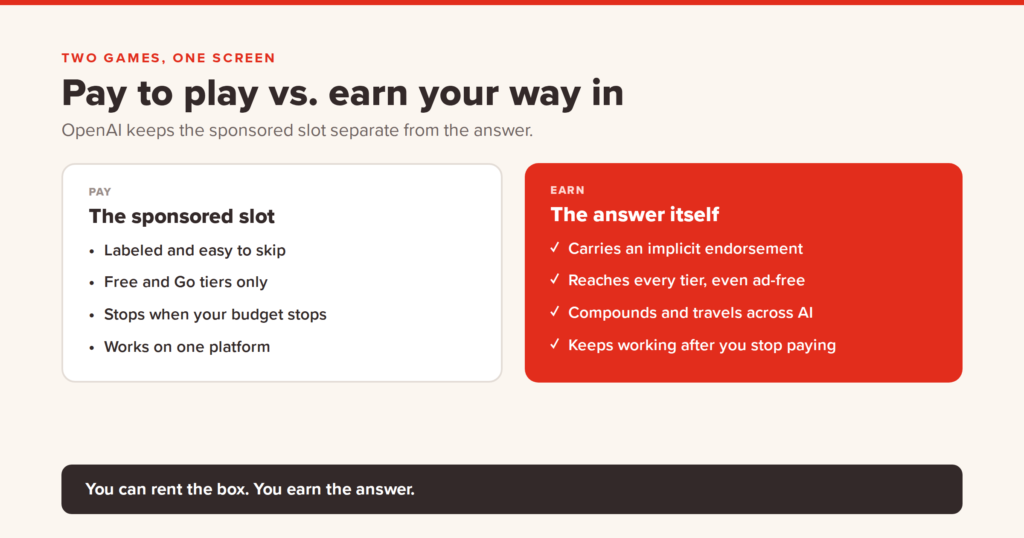
You can pay to rent a labeled sponsored slot below ChatGPT’s answer, but you can’t pay to appear inside the answer itself. OpenAI keeps ads separate from and unable to influence its recommendations, so the brands ChatGPT names in its response earned that spot.
This is the line that changes everything. When someone asks ChatGPT a question like what’s the best option for X, the brands it names in the answer are there because the model trusts them, not because they bought the spot. OpenAI has been explicit that ads are labeled, separated, and don’t change the answer. So there are two completely different games being played on the same screen: the sponsored box you can rent, and the recommendation you have to earn.
For most businesses, the earned recommendation is the bigger prize. Here’s why.
People trust the answer, not the ad
A sponsored label tells users the placement was paid for, and they discount it accordingly. The brand ChatGPT names inside its answer carries something an ad can’t buy: an implicit endorsement from the tool the user already trusts. Those users also tend to be further along in their decision by the time the brand reaches them.
Ads only reach two tiers
Ads show up for Free and Go users. Plus, Pro, Business, Enterprise, and Education subscribers don’t see them. A lot of your highest-value customers, and most B2B buyers, sit on those paid tiers, which means the only way to reach them inside ChatGPT is to be named in the answer. No amount of ad budget puts you in front of an ad-free user.
Earned visibility compounds and travels
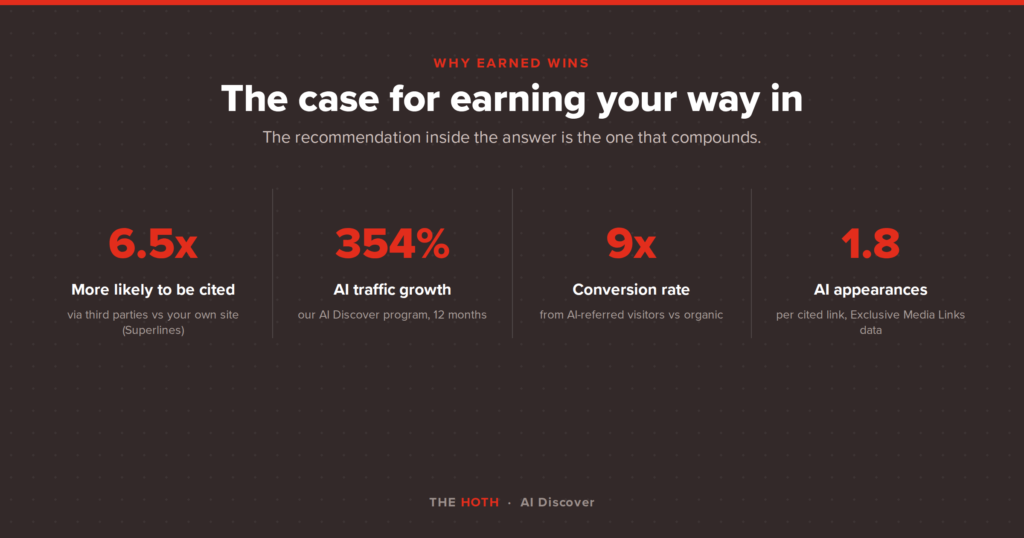
A sponsored slot works in one place, on one platform, for as long as you pay. An earned citation works across ChatGPT, Google’s AI Overviews and AI Mode, Perplexity, and Gemini, and it keeps working after you stop spending. Our own data on Exclusive Media Links shows the pattern: citations compound over time, each cited link earns close to two AI appearances on average, and a single placement can get cited across multiple languages. That’s reach you can’t rent.
Ad inventory is limited by design
OpenAI deliberately keeps ads away from a lot of moments: sensitive topics like health and politics, sessions with users under 18, temporary or logged-out chats, and image-generation conversations. An earned recommendation faces none of those walls. If your brand is the trusted answer, ChatGPT can name you in places an ad is never allowed to appear.
How to earn your way into ChatGPT’s answers
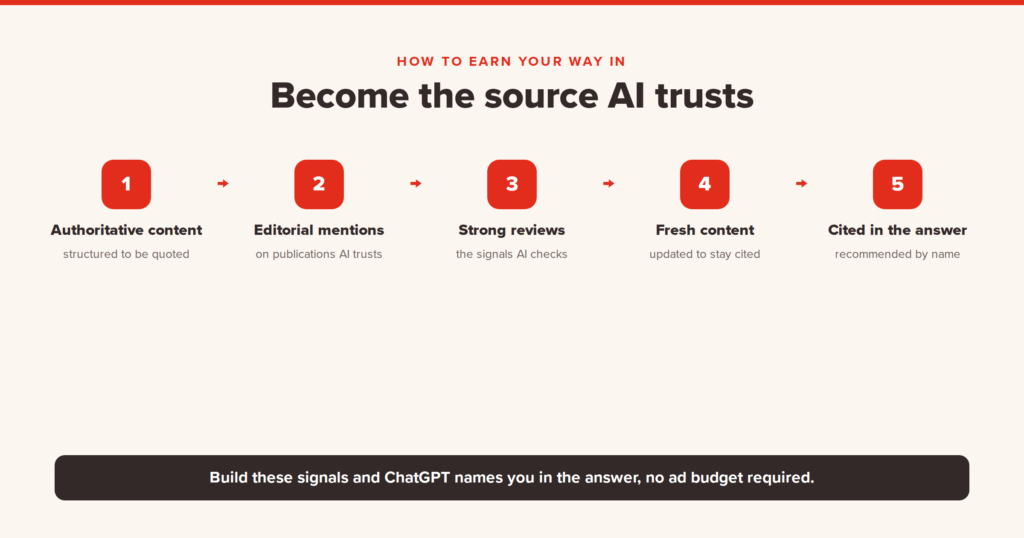
To get cited in ChatGPT, build the trust signals AI models use to choose their sources: authoritative, well-structured content, editorial mentions on publications AI trusts, strong reviews, and consistent brand mentions across the web.
AI tools don’t rank ten blue links. They pick a small set of sources they trust and synthesize an answer. Getting into that set is a matter of building the right signals, and they overlap heavily with good SEO.
- Publish content that leads with the answer and is structured for extraction, so models can lift a clean, quotable response. Our guide to generative engine optimization walks through the format.
Earn editorial mentions on publications AI trusts. Research from Superlines found brands are roughly 6.5 times more likely to be cited in AI answers through third-party sources like publications, reviews, and forums than through their own website. That’s why digital PR and earned media do so much of the heavy lifting for AI visibility.
Build a strong review profile, since AI systems check reviews before recommending a business, and keep your content fresh. In our own program, pages that got quarterly refreshes earned 502% more ChatGPT referral traffic over twelve months than static pages. And remember the product-feed point: the same clean structured data and authority that earns the citation also makes any ads you do run cheaper and more effective. One feed, two doors, again.
The smarter play for most businesses
If you’d rather have a team build that authority for you, AI Discover is our managed AI visibility program. It combines digital PR, authority link building, content refresh, and review management with AI reporting through our Atlas dashboard, all aimed at earning the organic mention inside the answer rather than renting a box beneath it. Plans start at $775 a month, a fraction of what ChatGPT ads demand, and the results compound instead of vanishing when a budget runs out.
In our own program, that approach has driven 354% AI traffic growth and 9x conversion rates from AI-referred visitors over twelve months. For targeted citations on the high-authority news sites AI pulls from most, Exclusive Media Links place your brand inside evergreen articles on vetted US news domains, the exact properties feeding AI answers. If you want the full picture of how the managed program works, here’s what AI Discover is and how it’s measured.
None of this means you should ignore ads. If you sell products and your feed is clean, ChatGPT ads can be a useful new channel worth testing. The point is sequencing: earned visibility is the foundation, it reaches the tiers ads can’t, and it keeps paying off long after a campaign ends.
Frequently asked questions
What are ChatGPT ads?
They’re sponsored placements shown below ChatGPT’s answers for Free and Go users in supported countries. They’re labeled as sponsored, matched to the conversation, and kept separate from the answer itself.
How much do ChatGPT ads cost?
Pricing is still evolving in the beta. Reported cost-per-click starts around $3 to $5, and the earliest pilot required six-figure commitments before OpenAI began opening a self-serve model. Expect the numbers to keep changing.
Can you pay to be recommended in ChatGPT’s answers?
No. OpenAI says ads do not influence ChatGPT’s answers, and they’re visually separated from them. You can buy a sponsored slot, but the recommendation inside the answer is earned through the trust signals AI models use to pick sources.
Who sees ChatGPT ads?
Logged-in adult users on the Free and Go tiers in supported markets. Plus, Pro, Business, Enterprise, and Education users don’t see ads, and ads aren’t shown to users under 18 or near sensitive topics.
What are product-feed ads in ChatGPT?
They let retailers connect a product catalog so ChatGPT automatically generates sponsored listings from each item, similar to Google Shopping. The same structured product data also feeds ChatGPT’s organic product recommendations.
Should I run ChatGPT ads or focus on getting cited?
Both can work, but for most businesses earned visibility comes first. It compounds, it travels across AI platforms, and it reaches the ad-free tiers. If you want a head start on being the brand ChatGPT names, see how to get your brand featured in AI tools like ChatGPT.
The bottom line
ChatGPT ads are real, and for ecommerce brands with a clean feed they’re worth watching. But OpenAI drew a hard line between the ad and the answer, and the answer is where trust and most of the value live. The brands ChatGPT recommends earned their way in. Build that authority and you win the citation today while making any ads you run perform better tomorrow.
Want to be the answer instead of the ad? Book a call and we’ll map out how to get your brand cited where your customers are already asking.
Leave a comment