

Introduction
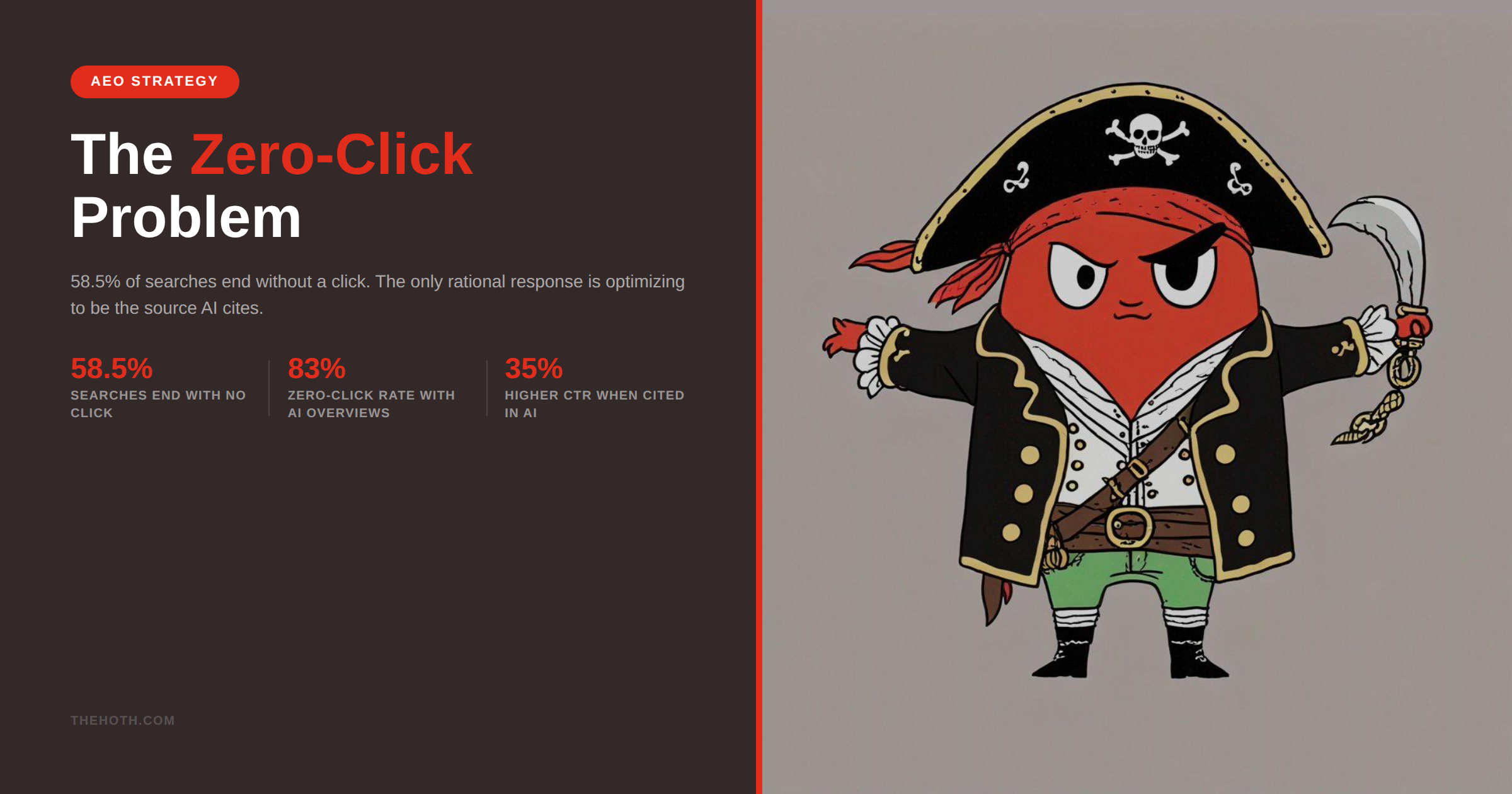
Here’s a number worth sitting with: 58.5% of Google searches now end without a single click. Not a click to a competitor. Not a click to an ad. No click at all.
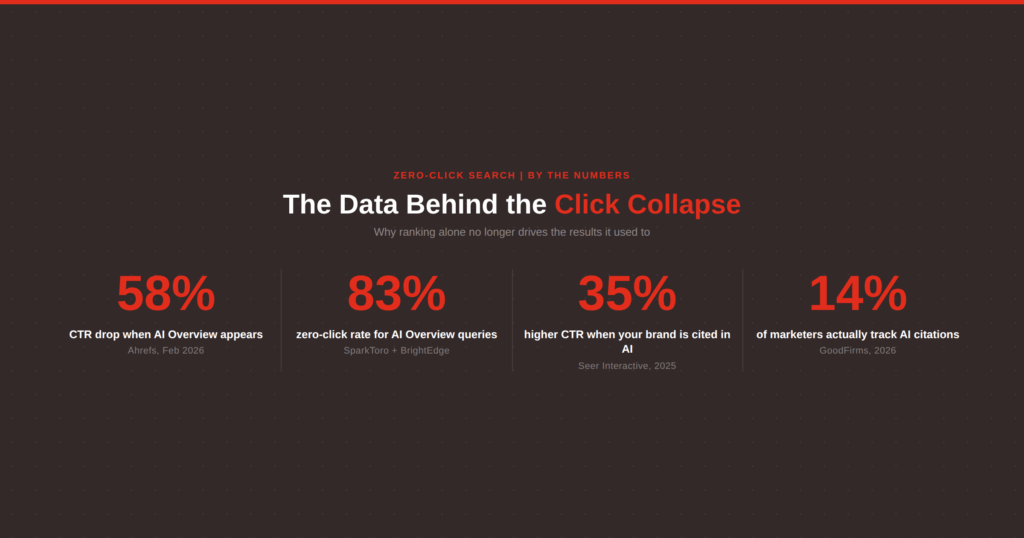
That figure comes from SparkToro and Datos research published in 2024, and it has been trending upward ever since. When a query triggers a Google AI Overview, the zero-click rate jumps to 83%. In AI Mode, it hits 93%.
For most businesses running SEO programs, this creates an uncomfortable question: if more than half of all searches never result in a click, what exactly are you optimizing for?
The answer has to change. And that’s not a pessimistic take. It’s a practical one.
The businesses that figure this out earliest are going to have a significant advantage. Those that keep optimizing purely for ranked position while the click economy erodes are going to wonder why their traffic keeps falling even as their rankings hold. This post is about why that happens, and what the rational strategic response actually looks like.
What Zero-Click Search Actually Means
A zero-click search is any search session that ends on the results page. The user typed a query, Google answered it, and the user left without visiting any website.
This isn’t new. Featured snippets and knowledge panels have been absorbing clicks for years. What changed is scale. Google AI Overviews, which began rolling out broadly in 2024 and have expanded aggressively since, now appear in roughly 48% of all Google searches globally according to BrightEdge. And when they appear, they don’t just reduce clicks. They restructure the entire search interaction.
The Pew Research Center studied 68,879 real queries and found that users clicked results only 8% of the time when AI summaries appeared, compared to 15% without them. That’s not a marginal change. That’s a fundamental shift in how search works.
And the acceleration is steep. Ahrefs measured AI Overviews reducing CTR for the top-ranking result by 34.5% in April 2025. By February 2026, that figure had climbed to 58%. Nearly double in eight months.
The Broken Assumption at the Heart of Traditional SEO
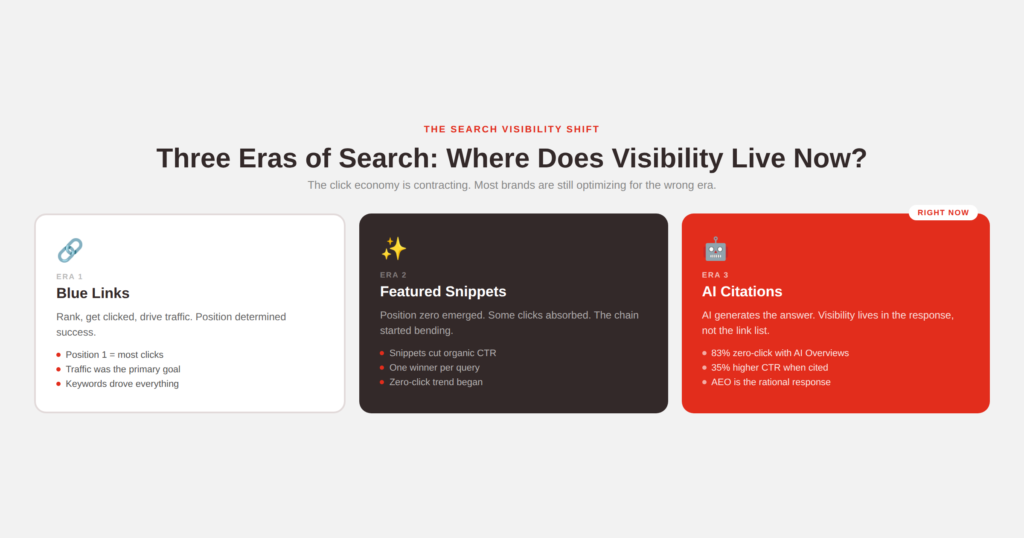
Traditional SEO is built on a logical chain: rank higher, get more clicks, get more traffic, drive more revenue. Every metric in the standard SEO toolkit, organic traffic, click-through rate, impressions, is designed to measure performance along that chain.
Zero-click search breaks the chain at the second link.
You can rank first and get almost no clicks. The Seer Interactive study of 25.1 million organic impressions across 42 organizations found that when Google shows an AI Overview, only 6 out of 1,000 users click on an organic result. Position 1 used to mean winning. In an AI Overview world, it often means being the most visible source that nobody visits.
This is the part that makes the conversation uncomfortable for SEO practitioners. Rankings are not worthless. Technical SEO still matters. Content quality still matters enormously. But if the goal of all that work is to drive clicks, and clicks are structurally declining, then optimizing purely for rankings is like optimizing a storefront that fewer and fewer people are walking past.
Gartner’s projection makes the trajectory clear: they predict 50% or more of organic search traffic to websites will be gone by 2028. Whether that specific number proves accurate or not, the direction is not in dispute.
The Paradox: More Searches, Fewer Clicks
Here’s the thing that gets lost in the doom framing: Google is not losing users. In 2025, Google averaged over 101 billion monthly visits, up from 84 billion in 2024. People are searching more than ever. The problem is not that search is dying. The problem is that search is no longer primarily a traffic channel.
This is actually the key reframe. If you accept that search is increasingly an attention and awareness channel rather than a click channel, then the strategic question changes completely. You’re no longer asking ‘how do I rank so people click on me?’ You’re asking ‘how do I show up in the answers people receive so they remember and trust my brand?’
And that is exactly the question Answer Engine Optimization is designed to answer.
What AEO Actually Is (and What It Isn’t)
AEO, or Answer Engine Optimization, is the practice of optimizing your content, brand signals, and authority so that AI systems cite and recommend you when generating answers. Not ranking in a list. Not appearing in a sidebar. Being woven directly into the answer itself.
This is not a replacement for SEO. It is the natural evolution of what SEO was always trying to accomplish: getting your brand in front of the right people at the right moment. AEO just acknowledges that ‘the right moment’ now often happens inside an AI-generated response rather than in a list of blue links.
What makes this interesting strategically is the data on what happens when you do get cited. Seer Interactive found that brands cited within AI Overviews achieve 35% higher organic CTR and 91% higher paid CTR compared to brands that are not cited. The zero-click environment does not eliminate clicks entirely. It concentrates them on the sources that AI systems have already validated as trustworthy.
There’s also the downstream effect. Samsung was able to attribute 28% of its direct brand searches to increased zero-click AI exposure. Better.com measured a 41% improvement in brand recall after optimizing for AI search visibility. The click is being replaced, at least partially, by direct brand search, which is a far higher-intent signal anyway.
Why AEO Is Built on the Same Foundation as SEO
The most important thing to understand about AEO is that it doesn’t require you to throw out your SEO strategy. It requires you to extend it.
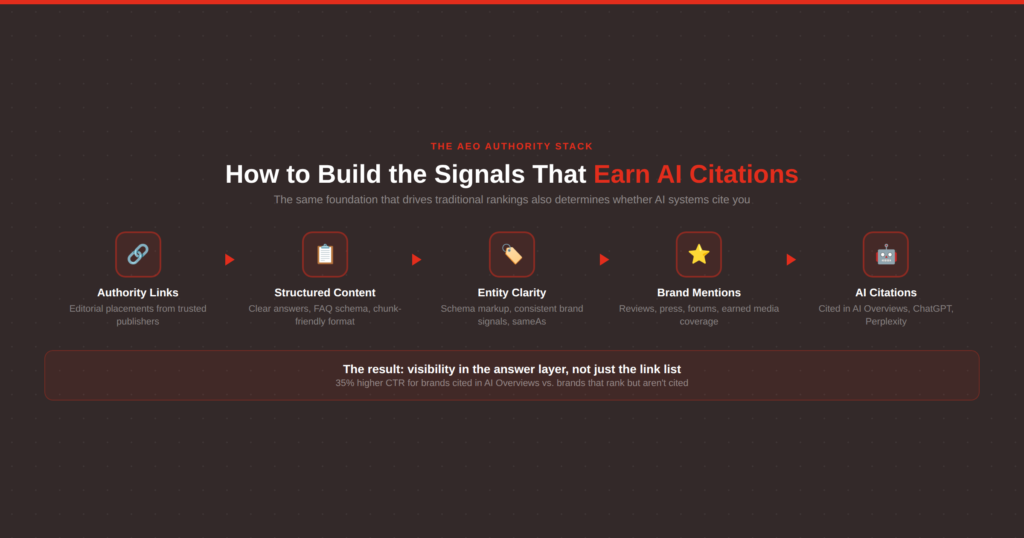
AI systems cite the sources they do because of signals that will look familiar to any SEO practitioner:
- Domain authority and backlink profile: High-authority links from relevant, trusted sources remain the primary credibility signal for AI systems, exactly as they are for Google’s ranking algorithm.
- Topical authority: AI systems favor sources that cover a subject comprehensively and consistently. The content cluster strategy that builds topical authority for Google also builds it for LLMs.
- Entity clarity: If AI models can clearly identify what your brand is, what it does, and who it serves, they’re more likely to cite it confidently. Structured data, consistent NAP information, and schema markup all contribute here.
- Content structure: AI systems extract and summarize content. Pages that are structured with clear headings, direct answers, and FAQ sections are easier to parse and more likely to be cited.
- Brand mention consistency: Appearing across authoritative third-party sources, editorial coverage, reviews, and industry publications builds the co-occurrence patterns that teach AI models to associate your brand with your category.
The Venn diagram overlap is real. The work you do to build SEO authority is largely the same work that builds AEO citability. The difference is intent and measurement, not tactics.
The Measurement Problem Is Real, But Solvable
One of the genuine challenges with AEO is that the standard measurement stack doesn’t see it. Google Search Console doesn’t report AI Overview impressions. GA4 doesn’t log citations. If a potential customer sees your brand recommended in a ChatGPT response and then searches directly for you three days later, that shows up as direct traffic, not AI-sourced.
This creates a measurement gap that makes it easy for organizations to underinvest in AEO. The ROI looks invisible because the attribution doesn’t exist yet in most analytics setups.
According to a GoodFirms 2026 survey, only 14% of marketers are currently tracking AI citation visibility, despite 43% naming AI search optimization as a core 2026 strategy. That gap between stated priority and actual measurement is where most organizations are losing ground without knowing it.
The solution is to expand what you measure. Brand search volume in Google Search Console is one of the most reliable proxy signals: if people are searching your brand name directly, it often means they encountered your brand somewhere else first, and AI citations are an increasingly common source. Direct traffic trends, share of voice in AI tools, and branded anchor text patterns all contribute to a fuller picture.
HOTH’s own AI Discover service is built specifically for this problem: auditing your current AI citation visibility across Google AI Overviews, ChatGPT, and Perplexity, identifying where you’re showing up and where you’re absent, and mapping the specific actions that will move the needle.
What This Looks Like in Practice
The strategic shift doesn’t require rebuilding your marketing from scratch. It requires a deliberate expansion of what you’re optimizing toward.
For content
The content that performs in zero-click search and in AEO is content that is genuinely useful and structured for extraction. This means clear answer blocks at the top of sections, FAQ schema on pages that address common questions, specific and accurate data that AI systems can cite with confidence, and coverage depth that signals topical authority rather than thin keyword-matching.
For link building
Link building remains the foundation of authority for both Google and AI systems. The shift is toward editorial quality over volume: a feature in a high-authority industry publication builds more AI citability than a dozen directory links. Earned media placements, digital PR campaigns, and outreach to relevant publishers all directly feed the trust signals that determine AI citation probability.
We measured this internally. Distributing content across a wide range of authoritative publications increased AI citations by up to 325% compared to publishing only on your own site (Stacker, December 2025). The distribution strategy that earns AI visibility is not fundamentally different from the link building strategy that earns rankings. It’s just more deliberate about the type and breadth of sources targeted.
For brand presence
AI systems learn your brand’s topical neighborhood from the consistency of how you appear across the web. Review platforms, industry directories, press mentions, and community discussions all contribute to the co-occurrence patterns that teach LLMs what your brand does and who trusts it. This is where HOTH’s Earned Media service and Review and Reputation Management products become AEO investments, not just SEO or conversion tactics.
The Results When You Get This Right
HOTH ran a campaign specifically designed to build AI search visibility using these exact levers: authoritative link building, earned media distribution, structured content, and entity optimization. The results were significant: a 354% increase in AI-driven traffic and a 9x improvement in conversion rate from that traffic compared to traditional organic.
The conversion rate difference is worth emphasizing. AI referral traffic converts at rates that dwarf standard organic traffic, with some studies showing a 23x difference. The reason is intent context: a user who found your brand recommended in an AI answer has already received a third-party endorsement. They arrive warmer and with higher confidence. Fewer clicks, but dramatically better clicks.
That’s the argument for AEO in a sentence: the zero-click world doesn’t eliminate the value of visibility. It redefines where that visibility happens and concentrates its value in a smaller number of higher-quality interactions.
How The HOTH Can Help
The HOTH’s AI Discover service gives you a clear baseline on where you currently appear in AI answers and where your competitors are showing up instead. It identifies the specific gaps driving your absence from AI-generated responses and maps out the actions that will close them.
From there, HOTH X managed SEO handles the ongoing authority-building work that feeds both traditional rankings and AI citability: link outreach, content development, earned media, and entity optimization all running in parallel.
If you’re ready to start measuring your AI visibility and building toward it strategically, book a free strategy call and let’s look at where you stand right now.
Wrapping Up
The zero-click trend is not a problem you can optimize your way out of with better title tags and faster page speed. It’s a structural shift in how search works, and it requires a structural response.
That response is AEO: the deliberate effort to become the source AI systems cite when they answer the questions your customers are asking. Not instead of SEO, but as its natural extension into a world where the answer layer has moved above the link layer.
The businesses that treat this shift as an opportunity rather than a threat are the ones building authority now, while most of their competitors are still optimizing for a click economy that is quietly contracting. The window to get ahead of this is still open. It won’t be indefinitely.
Leave a comment