
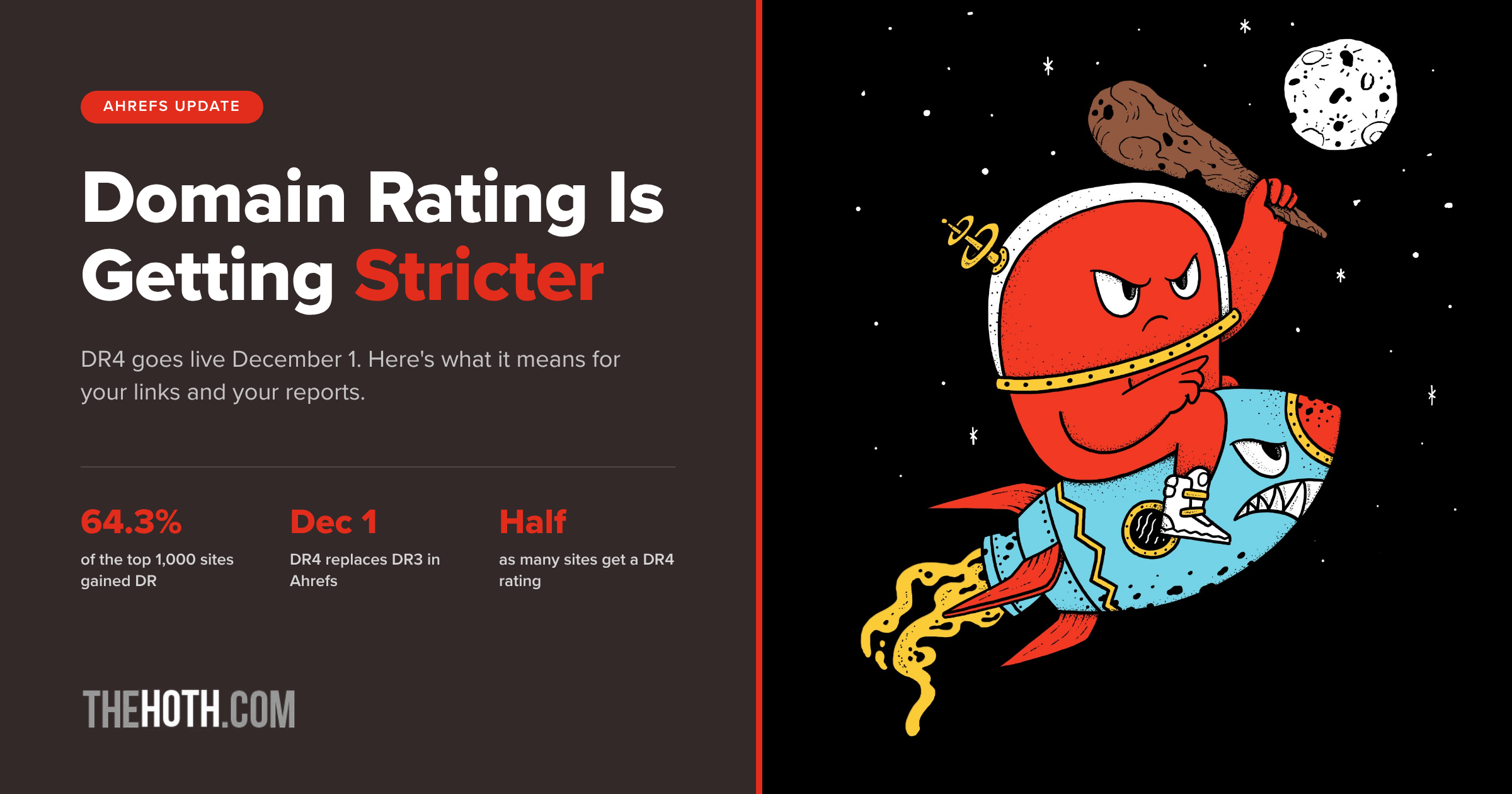

Ahrefs DR4 is the fourth version of Domain Rating, rolling out in the Ahrefs interface on December 1, 2026. It weights links from sites that earn real organic traffic more heavily, gives subdomains their own scores, and cuts the scores of spam domains. Your DR may move, but your backlinks and your Google rankings haven’t changed. The sites DR4 rewards are the same trafficked, credible sites that AI search tools pull from.
If you check Domain Rating every week, you’re about to see some numbers you didn’t expect.
Ahrefs is replacing the model behind its best-known metric. Some sites will climb. Some will slip a few points. A handful of spammy domains and free subdomain sites are about to lose most of their score overnight.
None of that changes a single link pointing at your site. What it changes is how those links get scored, and that matters if you buy links, sell links, report on links, or just like watching your own number go up.
It also matters for AI search. ChatGPT, Perplexity, and Google’s AI Overviews lean on the same kinds of sources DR4 now favors: real publications with real readers. So this update is a useful lens on where both your rankings and your AI visibility come from.
In this guide, you’ll learn exactly what’s different in DR4, why a lower score isn’t a penalty, what the update tells you about which links are worth paying for, how it connects to AI visibility, and how to get your reports ready before December 1.
What Is Ahrefs DR4?
DR4 is Ahrefs’ new Domain Rating model. Like the old version, it scores the strength of a site’s backlink profile on a 0 to 100 logarithmic scale. Unlike the old version, it only lets a smaller, higher-quality pool of sites influence those scores.
Domain Rating has always been a link-based metric. Ahrefs describes it as a measure of how strong a website’s backlink profile is compared to every other site in its database, and its original Domain Rating explainer is clear that it doesn’t factor in things like content quality or domain age.
That hasn’t changed. What has changed is which links count, and how much.
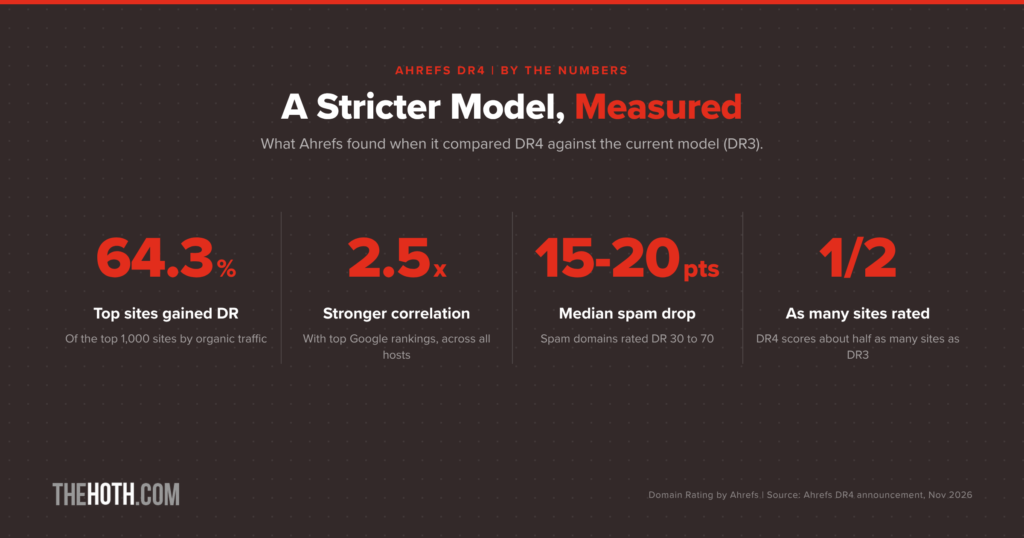
According to the Ahrefs DR4 announcement, the new model has two headline updates: a smaller pool of domains that can affect DR, and individual ratings for subdomains. Ahrefs also says DR4 correlates more strongly with Google ranking positions than the current model (DR3) when you look across all hosts and subdomains.
Here’s the timeline you need to know:
- Now: You can preview DR4 scores through Ahrefs’ free Domain Rating API.
- December 1, 2026: DR4 replaces DR3 in the standard Ahrefs interface.
- Shortly after: DR3 stays available through the API for a limited time, so you can still compare.
What Exactly Is Changing in DR4?
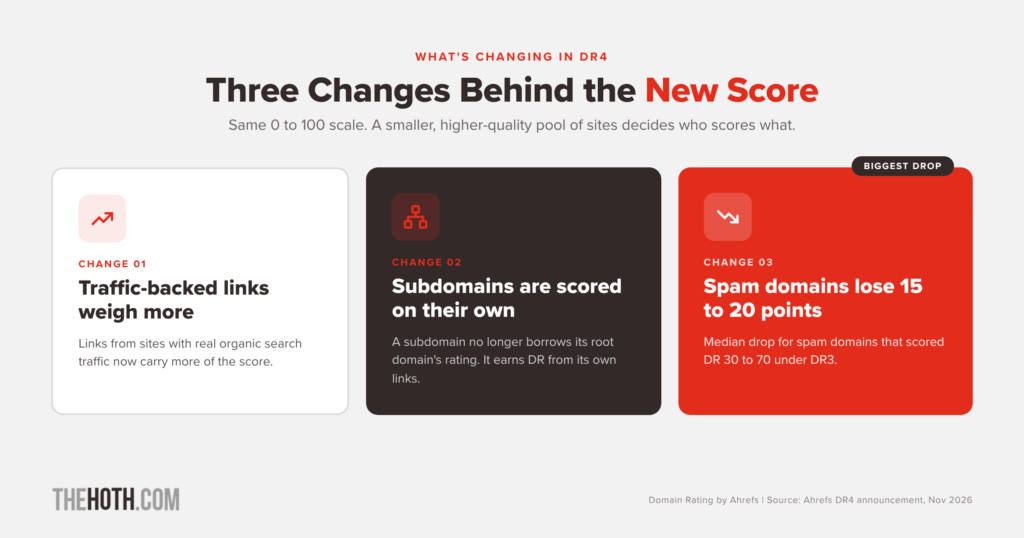
Three things change: links from sites with organic search traffic carry more weight, subdomains stop inheriting their root domain’s score, and domains labeled as spam lose a large share of their rating.
1. Traffic-backed links count for more
DR4 is still calculated from links. But Ahrefs now puts more weight on links from sites (and subdomains) that it estimates get real organic search traffic.
The result is a much smaller pool. Ahrefs says the number of sites with a DR4 score is roughly half the number that had a DR3 score. Fewer sites have a rating, and fewer sites can pass rating to anyone else.
Think about what that filters out. A site that exists only to host outbound links, with no readers and no rankings of its own, used to be able to push your DR up. Under DR4, it mostly can’t.
2. Subdomains get their own scores
Under DR3, most subdomains simply borrowed the score of their root domain. A free site spun up on a website builder could show up looking like a DR 90 property, even with almost no links of its own.
Under DR4, every subdomain is scored on the links pointing to it. Some of the examples Ahrefs published:
| Site | DR3 | DR4 |
| help.ahrefs.com | 91 | 75 |
| blogs.microsoft.com | 96 | 89 |
| blogs.oracle.com | 93 | 86 |
| A sample site on hostingersite.com | 92 | 1.9 |
| A sample site on notion.site | 92 | 0 |
3. Spam domains take the biggest hit
Ahrefs started labeling spam domains in 2025 using a curated list, then switched to a machine learning model in January 2026. DR4 builds that detection into the score itself.
The impact is concentrated. Ahrefs reports that spam-labeled domains with DR3 scores between 30 and 70 saw the largest drops, with a median decline of roughly 15 to 20 points. Non-spam domains stayed close to flat across most score ranges.
If you’ve ever come across a “DR 50” site with no real readers and no rankings of its own, this is the part of the update aimed squarely at it.
Did Your DR Drop? Here’s What It Means
A lower DR4 score is not a penalty, isn’t a verdict on your content, and doesn’t affect your Google rankings. It means Ahrefs now sees fewer high-quality, traffic-backed links pointing to your site than DR3 credited you for.
Three things to keep in mind before anyone panics:
DR is not a Google ranking factor. It’s a third-party estimate. Google’s own guide to its ranking systems explains that those systems are designed to work at the page level, with site-wide signals contributing but never guaranteeing how any one page ranks. Google does use link analysis, including PageRank, but it runs its own systems on its own data. A number in Ahrefs changing on December 1 doesn’t move a single ranking on December 2.
DR is relative and logarithmic. Your score depends on everyone else’s, and the higher you go, the harder each point gets. Ahrefs’ own example: moving from 84 to 85 takes far more than moving from 54 to 55. A two-point dip at DR 70 is small.
Your competitors are moving too. Ahrefs recommends checking your closest competitors’ DR4 scores before drawing conclusions. If everyone in your space slipped a few points, your relative position may not have changed at all.
If you want a deeper refresher on how DR compares to other authority metrics, our breakdown of DA vs DR covers how each one is calculated and where each one comes up short.
Who Gains and Who Loses Under DR4?
Sites with real traffic and earned links mostly gain. In Ahrefs’ test of the top 1,000 sites by organic traffic, 64.3% saw DR rise, 15.8% stayed the same, and 19.9% dropped, with a median drop of just 4 points.
That top 1,000 sample tells you who DR4 is built to reward: sites that people search for and that other trafficked sites link to. Ahrefs puts the average decrease at 7.3 points.
The big losers are the sites that were riding someone else’s authority. The clearest example Ahrefs gives is github.io, GitHub’s free hosting domain, which drops 32 points. GitHub’s main site is scored separately, and strong individual projects hosted there keep strong scores of their own.
We ran our own domain through the DR4 preview, too. Our site, thehoth.com, moves from DR 75 to DR 78. We’re not sharing that to brag (okay, maybe a little). We’re sharing it because it lines up with what Ahrefs found: a backlink profile built from editorial links on sites that earn their own traffic tends to hold up, and often improves, when the scoring gets stricter.
DR3 and DR4 scores for thehoth.com checked via the Ahrefs free Domain Rating API on November 10, 2026. Domain Rating by Ahrefs.
What Does DR4 Mean for Link Building?
DR4 makes a link’s DR a better signal of real quality, because inflated scores from spam domains and borrowed subdomain ratings largely disappear. Links from relevant sites with real organic traffic are the ones that keep their value.
Here’s the part we’ve been saying for years, and it’s nice to see a metric catch up: the number on a link was never the point. What matters is whether the site behind it is real, relevant, and read by actual people.
DR3 had a blind spot that made it easy to game. Ahrefs’ own explainer admits that large volumes of low-quality links could push DR up, and that some sellers built businesses on inflating it. DR4 closes a lot of that gap. Which means if you vet links the right way, the new scores mostly confirm what you already knew.
When you evaluate a link opportunity after December 1, look for:
- Organic traffic of its own. This is the exact signal DR4 now leans on. A site Google already sends visitors to is a site worth a link from.
- Topical relevance. A niche-adjacent site in your industry beats a high-DR site with nothing to do with you.
- A real root domain or a strong standalone subdomain. Be wary of placements on free hosting platforms or website builders. Their DR3 scores were often borrowed.
- No spam label in Ahrefs. Ahrefs flags spam domains in its backlink reports. If a prospect carries that label, skip it.
- An editorial home for the link. Contextual links inside real articles are what readers, search engines, and AI search tools pay attention to.
- A footprint in AI answers. If a site already gets cited in AI Overviews or ChatGPT responses for topics in your space, a mention there does double duty. Tools like Ahrefs Brand Radar show which domains AI platforms cite most.
That’s how we approach link building for clients. Take a moving company we worked with in 2025, competing locally against national chains with DR scores of 50 and above. Instead of chasing volume or flooding the homepage, our team built 210 backlinks from 39 credible, niche-adjacent domains like real estate blogs and home service sites, spread across individual service pages to avoid over-optimization.
The result: a 39% jump in organic traffic value to $12.6K, 21 new keywords in the top 3, and 97 top-3 keywords overall. The same campaign also earned the client more than 35 new AI citations across platforms like ChatGPT and Perplexity. Those are the kinds of links DR4 is designed to credit, because they come from sites with readers of their own, and they’re the kinds of sources AI tools reach for.
Want more on what separates a strong placement from a weak one? Our guide to high-authority backlinks walks through the link types that build real authority.
Does DR4 Affect Your AI Search Visibility?
Not directly. AI search tools don’t read Ahrefs scores. But DR4 rewards the same thing AI visibility depends on: links and mentions from credible, trafficked sites. In an Ahrefs study of 75,000 brands, DR correlated with AI Overview visibility, and branded web mentions correlated about twice as strongly.
Google says there’s no special trick to showing up in its AI features. Its guide to AI features and your website states that AI Overviews and AI Mode have no extra requirements beyond normal Search eligibility: your page needs to be indexed and eligible to show with a snippet. Google also explains that these features can run several related searches behind the scenes (it calls this query fan-out) and pull supporting links from across those results.
Translation: the pages that earn visibility in classic search are the pool AI answers draw from. And the links that help pages rank are the editorial, trafficked links DR4 now scores most heavily.
But links aren’t the whole AI story. When Ahrefs analyzed AI Overview visibility across 75,000 brands, the factor with the strongest correlation was branded web mentions, at 0.664. Branded anchors came in at 0.527. Domain Rating landed at 0.326, and the raw number of referring domains at 0.295. Ahrefs is careful to note these are correlations, not proof of cause, but the pattern is hard to miss.
| Factor (Ahrefs, 75K brands) | Correlation with AI Overview visibility |
| Branded web mentions | 0.664 |
| Branded anchors | 0.527 |
| Branded search volume | 0.392 |
| Domain Rating | 0.326 |
| Referring domains | 0.295 |
| Number of backlinks | 0.218 |
What that tells you: a strong backlink profile helps, but being talked about on credible sites helps more. A brand mention on a trafficked industry publication feeds your rankings, your DR4 score, and the sources AI tools summarize, all at once.
That’s why we pair link building with HOTH Earned Media and Digital PR for clients who care about AI visibility. Links build authority. Mentions on real publications build the brand recognition AI answers reflect.
How Should You Read SEO Reports After December 1?
Treat December 1 as a reset point. Record DR3 and DR4 side by side now, compare against competitors, and report on referring domains, traffic, and rankings alongside DR instead of relying on DR alone.
If you run an agency or report on SEO to a boss or a client, December is going to bring questions. A site that showed DR 62 in November might show DR 58 in December, and someone will want to know what went wrong.
Nothing went wrong. The ruler changed. Here’s how to keep the conversation calm:
Don’t compare DR3 to DR4 as if they’re the same metric. A November score and a December score were calculated two different ways. Any chart that runs across December 1 needs a clear note marking the switch.
Separate the site from the score. A link placed in October on a site that showed DR 50 is still the same link, on the same site, with the same readers. If that site’s DR4 number reads differently, the link itself hasn’t changed. What’s changed is how Ahrefs grades it.
Lead with outcomes. Ahrefs suggests that if you report on DR, you include scores across multiple sites so you can show how backlink profiles compare. We’d go further: pair DR with referring domains, organic traffic, keyword rankings, and AI visibility. AI citations and brand mentions in AI Overviews, AI Mode, ChatGPT, and Perplexity are quickly becoming the metrics clients ask about first, and none of them move when an Ahrefs score gets recalculated.
Credit the source. If you publish DR numbers in client-facing reports or public content, Ahrefs’ Domain Rating license asks for a visible “Domain Rating by Ahrefs” credit. It’s a small thing that saves an awkward email later.
What Should You Do Before DR4 Goes Live?
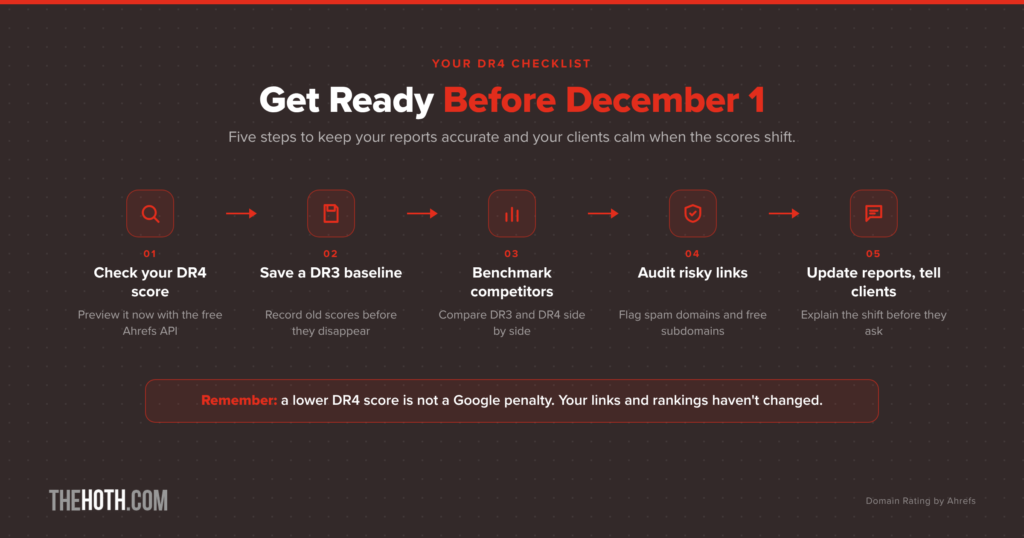
Before December 1, check your DR4 score through the free Ahrefs API, record a DR3 baseline, benchmark your competitors, audit any links from spam-labeled domains or free subdomains, record an AI visibility baseline, and give clients a heads-up.
- Check your DR4 score now. Ahrefs’ free Domain Rating API accepts a version parameter. It returns DR3 by default, and adding version=dr4 to the request returns the new score. You’ll need a free Ahrefs API key.
- Save a DR3 baseline. Pull your current score and your key competitors’ scores before the switch. Once DR3 leaves the interface, you’ll want that record.
- Benchmark competitors on both versions. If your whole market shifts together, your relative position matters more than the raw number.
- Audit your backlink profile. Filter your backlinks in Ahrefs for spam-labeled domains and placements on free hosting subdomains. These are the links most likely to lose value in DR4, so they’re worth knowing about.
- Update your reporting templates. Add an annotation for December 1 and make sure DR is reported next to traffic, rankings, and referring domains.
- Add an AI visibility baseline. While you’re snapshotting DR, record where your brand shows up in AI answers for your core topics. If your DR4 number dips but your AI citations keep climbing, that’s a story worth telling.
- Tell your clients first. A two-line note before December 1 lands far better than an explanation after they spot a lower number on their own.
Build Links That Hold Up When the Metrics Change
Metrics get updated. Ahrefs is on its fourth version of DR, and it won’t be the last. The links that survive every version are the ones placed on real sites that real people read.
That’s the standard behind HOTH Link Outreach. Our team writes the content and secures manual placements on authoritative sites, and our Link Outreach Pro tier is built around traffic-qualified sites with real audience reach, the same signal DR4 now rewards. If you need maximum credibility, Platinum Links put you on premium editorial sites, and HOTH Earned Media gets your brand into real publications that both search engines and AI tools trust.
Want to see where your brand stands in AI answers right now? AI Discover tracks and grows your visibility across AI search platforms, so you can measure the part of authority that DR was never built to show.
Rather hand the whole thing off? HOTH X managed SEO pairs link building with content, technical fixes, and reporting that explains what changed and why.
Frequently Asked Questions About Ahrefs DR4
When does Ahrefs DR4 go live?
DR4 rolls out in the standard Ahrefs interface on December 1, 2026. You can preview DR4 scores now through Ahrefs’ free Domain Rating API by adding version=dr4 to your request.
Is Domain Rating a Google ranking factor?
No. Domain Rating is a third-party metric created by Ahrefs. Google runs its own link analysis systems, and a change to your DR score has no effect on your Google rankings.
Why did my DR go down in DR4?
DR4 gives more weight to links from sites with organic traffic, scores subdomains separately, and reduces the scores of spam domains. If some of the sites linking to you belong to those groups, your DR4 score can come in lower even though your backlinks haven’t changed.
Does Domain Rating affect AI Overviews or ChatGPT?
Not directly. AI tools don’t use Ahrefs metrics. But in Ahrefs’ study of 75,000 brands, DR showed a moderate correlation with AI Overview visibility, and branded web mentions showed a much stronger one. Earning links and mentions on credible, trafficked sites helps both.
Can I still see my DR3 score after December 1?
For a short time, yes. Ahrefs says DR3 scores will remain available through its API for a limited period after DR4 launches in the interface. Save a baseline now so you have a record.
Why does my subdomain have a different DR than my main site?
Under DR4, subdomains no longer inherit their root domain’s score. Each subdomain is rated on the backlinks pointing to it, so a blog or help center on a subdomain may score lower than the main site.
The Bottom Line on DR4
DR4 doesn’t change how Google sees your site. It changes how one popular tool estimates the strength of your backlinks, and it does that by getting stricter about which links count.
If your links come from relevant sites with real traffic, the new scores will likely back you up. If they came from spam networks or borrowed subdomain authority, DR4 is going to show it.
And remember the bigger picture. The same credible, trafficked sites that DR4 rewards are the sources AI search tools pull from. Build your authority there, and you’re building for Google, for AI answers, and for whatever version of DR comes next.
Either way, now’s the time to check your score, save your baseline, and make sure your next round of links and mentions is built to hold up. If you want a second set of eyes on your backlink profile and AI visibility before December 1, book a call with our team.
Leave a comment