

*Your boss wants numbers. Your client wants to know if SEO is worth it. And honestly, you just want to know if what you’re doing is working.*
SEO ROI has always been a hard sell. Organic results don’t come with a receipt. You can’t point to a single dollar spent and trace it directly to a sale the way you can with a paid ad. That ambiguity has frustrated marketers and confused stakeholders for years.
But here’s the thing: in 2026, SEO delivers more measurable value than ever before. The tools have improved. The attribution models are smarter. And there’s a whole new dimension of ROI that most businesses are just starting to track: AI visibility.
This guide breaks down how to calculate SEO ROI, which metrics actually matter, how the rise of AI search has expanded what “return” even means, and how to present all of it in a way that gets buy-in.
What Is SEO ROI?
*Before you can prove the value of SEO, you need to agree on what value means.*
SEO ROI is the return you get from your investment in organic search, expressed as a percentage. The classic formula looks like this:
SEO ROI = ((Value of Organic Conversions – Cost of SEO Investment) / Cost of SEO Investment) x 100
Simple enough on paper. The tricky part is filling in those variables accurately, because both your “value” and your “cost” are harder to pin down than they first appear.
That said, the core concept holds: every dollar you put into SEO should produce more than a dollar in value. And for businesses that play the long game, it typically does, by a wide margin.
According to research cited across the industry, SEO typically delivers a 22:1 average return when campaigns are executed well. Compare that to PPC, where you stop getting results the moment you stop paying, and SEO starts to look like a very different kind of asset.
How to Calculate SEO ROI (Step by Step)
Step 1: Add Up Your SEO Costs
Your true SEO investment includes more than your agency retainer or tool subscriptions. Count everything:
- Agency or freelancer fees
- In-house staff time (content writing, technical work, strategy)
- SEO tools (Ahrefs, Semrush, Google Search Console, etc.)
- Content creation and design costs
- Link building investments
*Most businesses undercount their SEO spend. If your team spends 10 hours a week on content, that time has a dollar value. Include it.*
Step 2: Track the Value of Organic Conversions
This is where it gets nuanced. “Value” depends entirely on your goals.
For ecommerce businesses, value = direct revenue from organic sessions.
For lead-gen businesses, value = number of leads x average deal value (or average close rate x lifetime customer value).
For SaaS companies, value = trial signups or demo requests attributed to organic, multiplied by conversion-to-paid rate.
Use Google Analytics 4 to set up conversion events tied to organic traffic. If you haven’t already, this is the single most important technical setup for tracking SEO value.
Step 3: Factor in Assisted Conversions
Here’s a scenario most SEO tracking misses entirely: a prospect finds your blog post through organic search, reads three articles over two weeks, then converts after clicking a retargeting ad.
The retargeting ad gets the credit. But SEO did the heavy lifting.
Assisted conversions account for this. In GA4, look at the “Paths” report under Advertising to see how organic search contributes to conversions even when it isn’t the final click.
If you only look at last-touch attribution, you will consistently undervalue your SEO.
The KPIs That Actually Predict SEO ROI
*Not all metrics are created equal. Some are genuinely useful. Others are just numbers that look impressive until someone asks what they mean for revenue.*
Here are the KPIs worth tracking, organized by what they tell you:
Traffic and Visibility Metrics
Organic sessions: The baseline. How many people found you through search? Track month-over-month and year-over-year.
Keyword rankings: Where do you rank for your target keywords? More importantly, are you moving in the right direction?
Search visibility / share of voice: A rank tracker shows this as a percentage. If the line trends up after you launch an SEO campaign, that’s clear evidence it’s working.
Click-through rate (CTR): If you rank #3 but your CTR is lower than expected, your title tag or meta description may need work.
Conversion and Revenue Metrics
Organic conversions: The money metric. Tie these directly to revenue wherever possible.
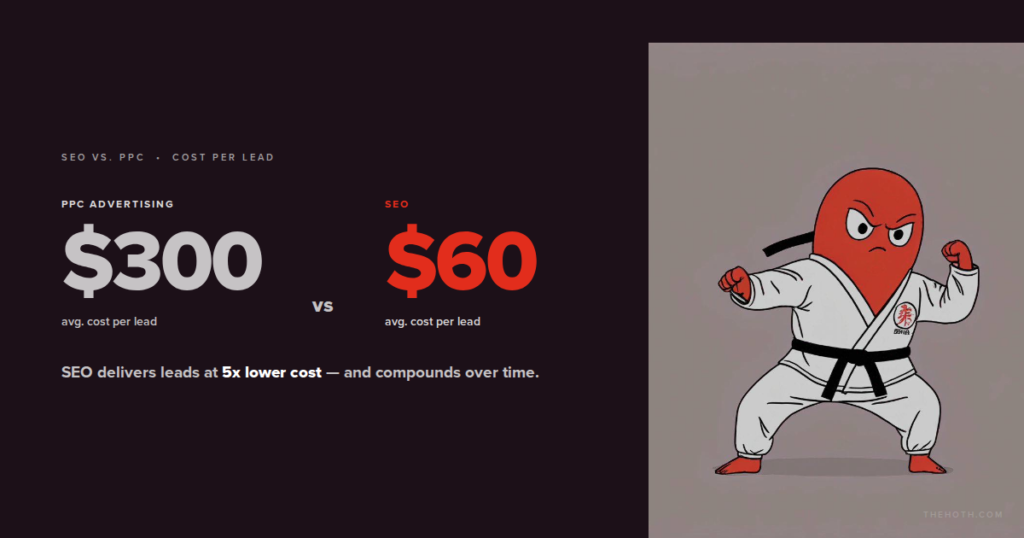
Cost per lead (CPL) from organic: Effective SEO campaigns typically produce a CPL of $30-$60. PPC often runs $150-$300. That gap makes the ROI case for SEO almost automatically.
Revenue attributed to organic: In GA4, you can see direct revenue from organic sessions. For lead-gen, multiply leads by average deal size.
Authority and Trust Metrics
Domain authority / domain rating: A proxy for how trustworthy your site appears to search engines. Higher DA correlates with better rankings over time.
Backlink profile growth: New referring domains signal that your content is earning trust. A growing backlink profile is a leading indicator of future ranking improvements.
Branded search volume: If more people are searching directly for your company name over time, your SEO content is building real brand awareness, even if it’s hard to attribute directly.
The New Dimension of SEO ROI: AI Visibility
This is the part of SEO ROI that most businesses aren’t measuring yet, but should be.
*The search landscape has fundamentally changed. Google’s AI Overviews, ChatGPT, Perplexity, and Gemini are now answering questions directly, without sending users to your website. So does SEO still pay off in a world of zero-click answers?*
Yes. But the ROI shows up differently.
AI Citations as a New Form of Organic Value
When an AI tool recommends your brand, cites your content, or mentions your company in a generated response, that’s exposure with no ad spend behind it. It builds brand recall, drives direct traffic, and influences purchase decisions, even when no click happens.
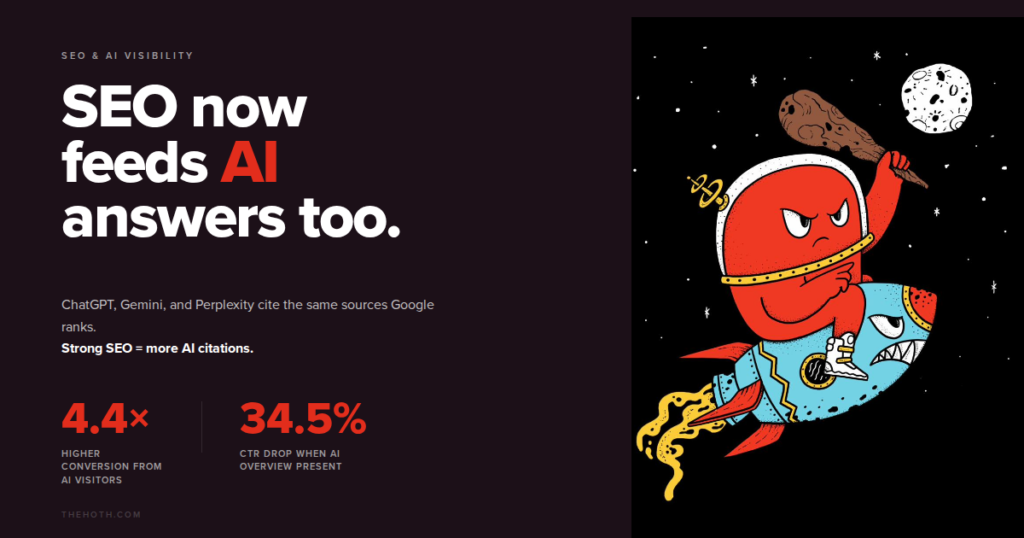
Research from Semrush found that one LLM visitor converts at 4.4x the rate of a traditional organic visitor. The traffic may be lower in volume, but the intent is significantly higher.
Brands that appear consistently in AI-generated answers are building what you might call “invisible influence”: trust and familiarity that compounds over time, often showing up as increases in direct traffic and branded search, even when the AI citation itself isn’t tracked.
How to Measure AI Visibility
This is an emerging practice, but here’s where to start:
- Track your brand mentions across AI platforms (ChatGPT, Perplexity, Gemini, Google AI Mode) using tools like Ahrefs’ Brand Radar or BrightEdge’s AI Catalyst
- Monitor citation share: how often does your brand appear in AI-generated answers compared to competitors?
- Look for correlated upticks in direct traffic and branded search whenever AI visibility increases, these are your “invisible influence” signals
- Track secondary conversions: newsletter signups, demo requests, and resource downloads that coincide with AI visibility growth
If you want help auditing your current AI visibility baseline, HOTH AI Discover provides a comprehensive view of where your brand currently shows up (and where it doesn’t) across AI search platforms.
Why SEO ROI Compounds (and Why That Matters)
*This is the argument that separates SEO from every other marketing channel.*
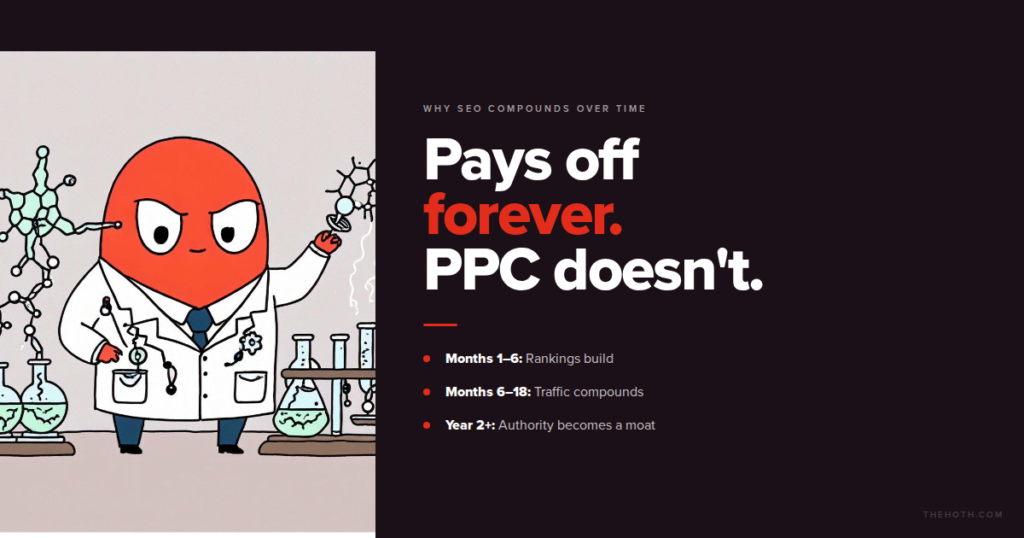
When you run a paid ad campaign and stop paying, your visibility disappears overnight. When you build organic rankings, they persist. A piece of content you publish today can generate traffic, leads, and revenue 12, 24, or 36 months from now, with no additional ad spend.
That compounding effect means the true ROI of SEO is almost always understated in short time windows. A campaign that looks expensive in month 3 often looks like the best decision you ever made by month 18.
The math works in your favor over time because:
- Content accumulates authority as it earns links and engagement
- Rankings for secondary and long-tail keywords grow alongside your target keywords
- Brand awareness built through organic content reduces customer acquisition costs across all channels
- AI platforms increasingly cite established, authoritative content, creating a compounding visibility loop
Common Mistakes That Distort Your SEO ROI Measurement
1. Only Looking at Last-Touch Attribution
If your analytics only count conversions from the final click, SEO will always look undervalued. Organic search rarely “closes” the deal in isolation, but it frequently starts the relationship. Set up multi-touch attribution in GA4 and look at assisted conversions.
2. Measuring Too Early
SEO is a 6-to-12 month investment before you see meaningful results for competitive keywords. If you’re calculating ROI at 60 days, you’re doing yourself a disservice. Set realistic timelines upfront, and track leading indicators (rankings movement, crawl health, backlink growth) while you wait for lagging metrics (conversions, revenue) to follow.
3. Ignoring Brand Awareness Value
Organic content drives brand awareness at scale, but it’s nearly impossible to assign a dollar figure to someone who recognized your brand name in a search result and came back later as a direct visitor. It still has value. Track branded search volume as a proxy.
4. Not Tracking AI Visibility at All
If AI platforms are increasingly answering questions your prospects are asking, and your brand isn’t showing up in those answers, you’re leaving compounding visibility value on the table. This is the emerging blind spot in most SEO ROI frameworks.
How to Present SEO ROI to Stakeholders
*The formula is useful. The story is what gets buy-in.*
When presenting SEO ROI to a CMO, founder, or client, lead with business outcomes, not channel metrics. Nobody cares about your domain authority. They care about leads, revenue, and growth.
Here’s a simple framework for the presentation:
- Start with the business goal (more leads, lower CPL, market share growth)
- Show where organic sits in the conversion funnel, including assisted conversions
- Present CPL from organic vs. paid as a direct comparison
- Show the compounding trajectory: what the investment looks like at 6, 12, and 18 months
- Add AI visibility data as a forward-looking indicator of where brand equity is being built
This reframes SEO from “a slow, hard-to-measure channel” to “a compounding asset with both short-term and long-term returns.”
What Good SEO ROI Actually Looks Like
Benchmarks vary by industry, but here are general reference points:
CPL from SEO: $30-$60 on average (vs. $150-$300 for PPC)
Average ROI for well-executed SEO: 22:1 over a sustained campaign
Timeframe to positive ROI: 6-18 months for most businesses, faster for low-competition niches
Content lifespan: Evergreen content can generate returns for 2-5 years with periodic updates
*The businesses that struggle to show SEO ROI are almost always the ones that measured too early, tracked the wrong metrics, or stopped before the compounding effect kicked in.*
How HOTH X Helps You Track and Prove SEO ROI
Knowing what to track is one thing. Actually having the infrastructure to track it, report on it, and act on the data is another.
HOTH X is our fully managed SEO service that includes dedicated strategy, execution, and reporting. Your account team tracks ranking movement, organic traffic trends, conversion data, and now AI citation metrics through AI Discover, so you always have a clear picture of your SEO ROI across both traditional and AI search.
Every month, you get reporting that connects the SEO work being done to the business outcomes you care about, not just keyword rankings in a spreadsheet.
The Bottom Line
SEO ROI has never been zero-click easy to calculate, but it has always been worth calculating. Organic search is one of the only marketing channels that builds compounding value over time, costs less per lead than any paid alternative, and now contributes to brand visibility across an entirely new generation of AI-powered search engines.
The businesses that win in 2026 will be the ones that stopped thinking of SEO as a line item and started treating it as infrastructure. And the ones that start measuring AI visibility alongside traditional SEO metrics will have a significant head start on proving the full scope of their return.
*Ready to see what your SEO is actually worth?* Talk to the HOTH team and we’ll show you how to build an SEO strategy with ROI you can actually measure and report.
Dig Deeper
Looking to expand your SEO knowledge? Check out these related resources:How to Track Your SEO Results | SEO Forecasting: Predict Traffic and Revenue Growth | SEO Attribution: Why Organic Deserves More Credit
Leave a comment