
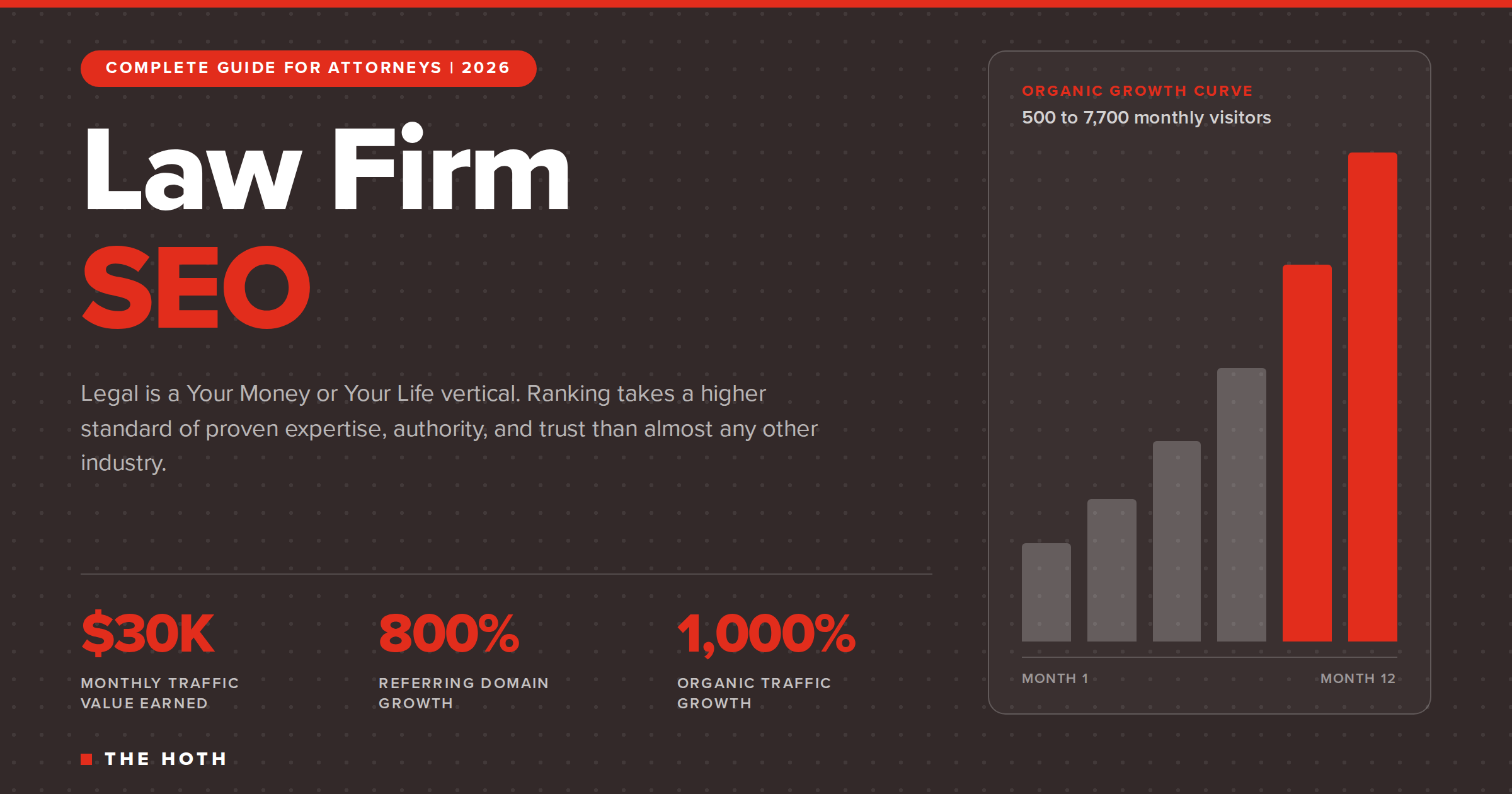

Law firm SEO is the work of getting a legal practice to show up when people search for an attorney, across Google’s organic results, the local Map Pack, and now AI answers. Because legal sits in the Your Money or Your Life category, search engines and AI models hold law firm websites to a higher standard of demonstrated expertise and trust than almost any other industry.
A click on “personal injury lawyer near me” can cost more than $100 in Google Ads. Solo practitioners and hundred-attorney firms compete for the same handful of positions. And AI tools now answer legal questions directly, often without sending anyone to a website at all.
That combination makes organic visibility more valuable for law firms than for almost any other business. It also makes it harder to earn.
This guide covers what makes legal search different, the four pillars a working campaign is built on, how to earn AI citations alongside rankings, and the mistakes that quietly cost firms the most.
What is law firm SEO?
Law firm SEO is the practice of improving a legal website’s visibility in search results and AI answers so prospective clients find the firm when they are actively looking for representation. It combines technical site health, practice area content, authoritative backlinks, and local signals.
The terminology varies. Lawyer SEO, attorney SEO, and legal SEO all describe the same discipline. What separates it from generic SEO is not the tactics but the standard those tactics have to meet.
A plumbing company can rank with competent content and reasonable links. A law firm cannot. Legal content is subject to a higher bar, and the sites that clear it tend to look different from the ones that do not.
Why is SEO harder for law firms than for other industries?
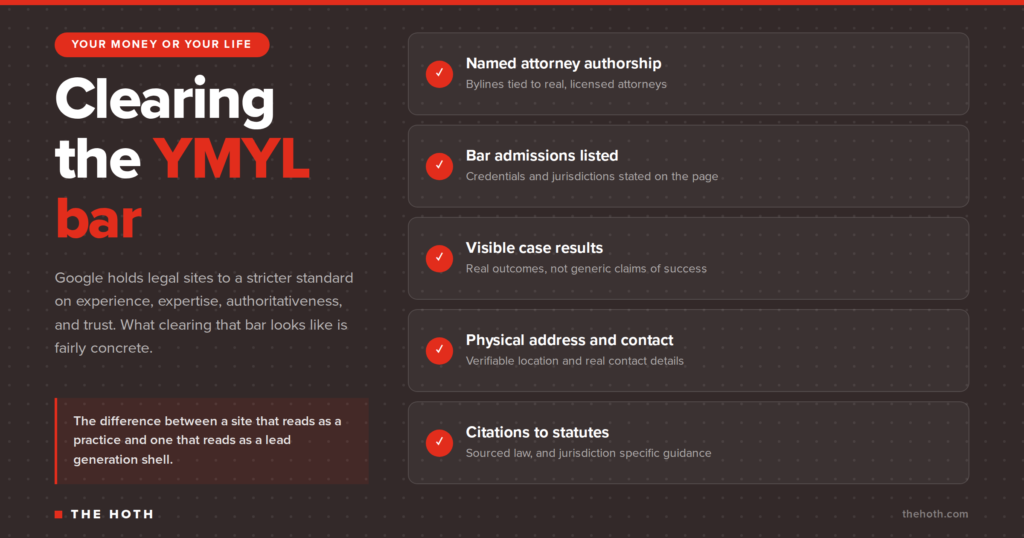
Legal falls under Your Money or Your Life, the category Google applies to topics that can materially affect someone’s health, finances, or legal standing. Sites in this category are evaluated more strictly on experience, expertise, authoritativeness, and trustworthiness.
Practically, that raises the bar in three places.
Authorship has to be real. Attorney bios need credentials, bar admissions, and case history. Content needs to be written or reviewed by licensed attorneys, and it needs to say so.
Links are scrutinized more closely. A thin backlink profile built from directories and low-quality placements does more damage on a legal site than on a commercial one.
Technical problems compound. Because the trust bar is higher, a legal site with crawl errors and slow pages struggles more than an ecommerce site with the same issues would.
We saw this directly with an employment law firm whose partners had 250 years of combined experience and had recovered over $1 billion for workers. None of that authority was reaching Google. A technical audit found crawlability problems, broken links, and speed issues suppressing the whole site. After the fixes and a link building push, domain rating climbed two points within three months and traffic followed. The full case study walks through the diagnosis.
What clearing the bar looks like in practice is fairly concrete. Named attorney authorship with bar admissions listed. Visible case results. A physical address and real contact details. Citations to statutes and sources. Content that reflects jurisdiction rather than generic national advice.
None of that is exotic. It is the difference between a site that reads as a practice and one that reads as a lead-generation shell, and both Google and the AI systems now citing legal sources are increasingly able to tell them apart.
The higher bar is not a reason to skip SEO. It is a reason to do it properly.
Is SEO worth it compared to paid ads for law firms?
For most firms, yes. Legal keywords are among the most expensive in paid search, so organic rankings that hold position compound in value in a way that per-click spend never does.
The comparison is easiest to see in traffic value, which estimates what a firm’s organic traffic would have cost through ads.
One personal injury firm we worked with grew from roughly 500 monthly visitors to more than 7,700, worth over $11,000 a month in equivalent paid traffic. Getting into the top 10 for “law firm” in their city was estimated to require around 310 backlinks, and they started with fewer than 50 referring domains. Closing that gap was the entire first phase. The case study covers the sequence.
Another personal injury firm had been spending heavily on television with modest returns and almost no online lead flow. Within months they ranked for over 2,000 relevant legal keywords with consistent monthly traffic value, without per-click costs.
The tradeoff is time. Ads produce leads the day they turn on. SEO produces leads that keep arriving after you stop paying for them.
What are the four pillars of law firm SEO?
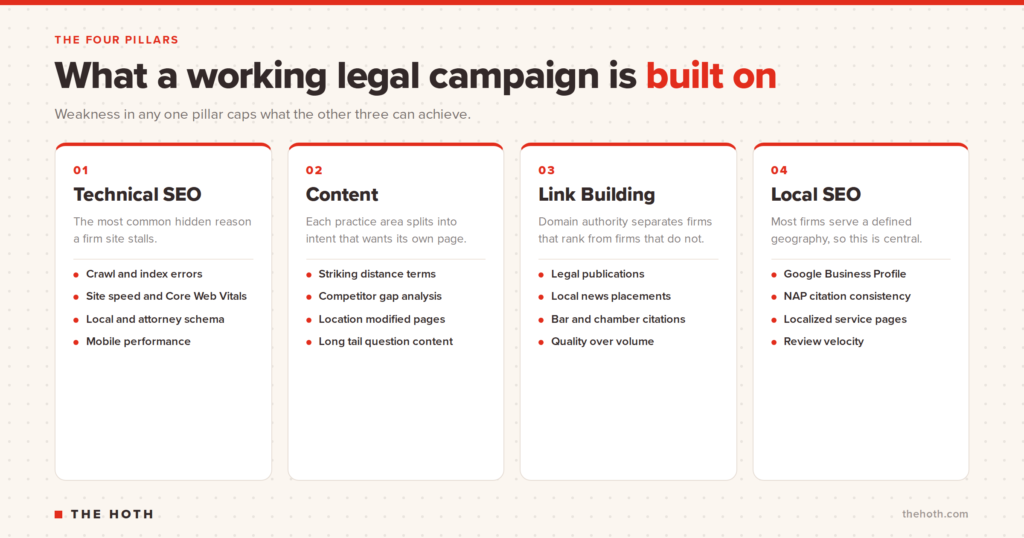
A working legal campaign rests on technical health, practice area content, authoritative links, and local signals. Weakness in any one of them caps what the other three can achieve.
Technical SEO
Technical problems are the most common hidden reason a law firm site stalls. The issues we find most often:
- Slow load times from oversized images or heavy JavaScript
- Crawl errors keeping key practice area pages out of the index
- Broken internal links wasting link equity
- Missing or misconfigured schema, particularly for local and attorney markup
- Weak mobile performance, which matters because most legal searches happen on phones
Every Managed SEO campaign opens with a technical audit for this reason. Fixing the foundation first makes everything after it work harder.
Keyword research and content
Legal keyword research needs more nuance than most verticals, because the same practice area splits into commercial, local, and informational intent that each want a different page.
Start with keywords already in striking distance. Terms sitting in positions 4 through 30 can often be moved to page one with on-page work and a few supporting links. That builds momentum while the longer work runs.
Find the competitor gaps. A gap analysis surfaces terms competitors rank for and you do not. For one Texas firm, that analysis turned up 2,852 keywords they were not targeting, many tied to a practice area they actively worked in.
Target location-modified terms deliberately. “Employment lawyer in Sacramento” and “DUI attorney Chicago” are where intent concentrates. Each deserves a real page, not a mention inside a generic services page.
Answer the long-tail questions. Queries like “how long do I have to file a personal injury claim in Texas” come from people with an actual legal problem. That content builds topical authority and feeds AI citations at the same time.
Link building
Backlinks remain decisive in legal search, where domain authority separates firms that rank from firms that do not.
The goal is contextual placements on authoritative, relevant sites: legal publications, local news, bar associations, chambers of commerce. Volume alone does not work here, and on a YMYL site it actively hurts.
One personal injury firm began with 45 referring domains. A sustained link outreach campaign grew that to 500, an 800% increase, and traffic went from 300 to more than 5,000 monthly visitors, equivalent to roughly $30,000 a month in paid search. The case study has the timeline.
For a California employment firm, we used our media network to land a placement in the LA Times at domain rating 92. A single link at that level signals authority to Google and to the AI systems deciding which firms to cite.
Local SEO
Most firms serve a defined geography, which makes local visibility central rather than supplementary.
Google Business Profile. Usually the first thing a prospective client sees. Complete NAP details, listed practice areas, current photos, and actively managed reviews.
Citation consistency. Name, address, and phone identical across directories. Inconsistency erodes trust signals and is often invisible until someone audits it.
Localized pages. “Motorcycle accident attorney in Phoenix” as its own page, not a line inside a broader page.
Reviews. A ranking factor for the Map Pack and a conversion factor once someone lands on the listing.
How do you rank for specific practice areas?
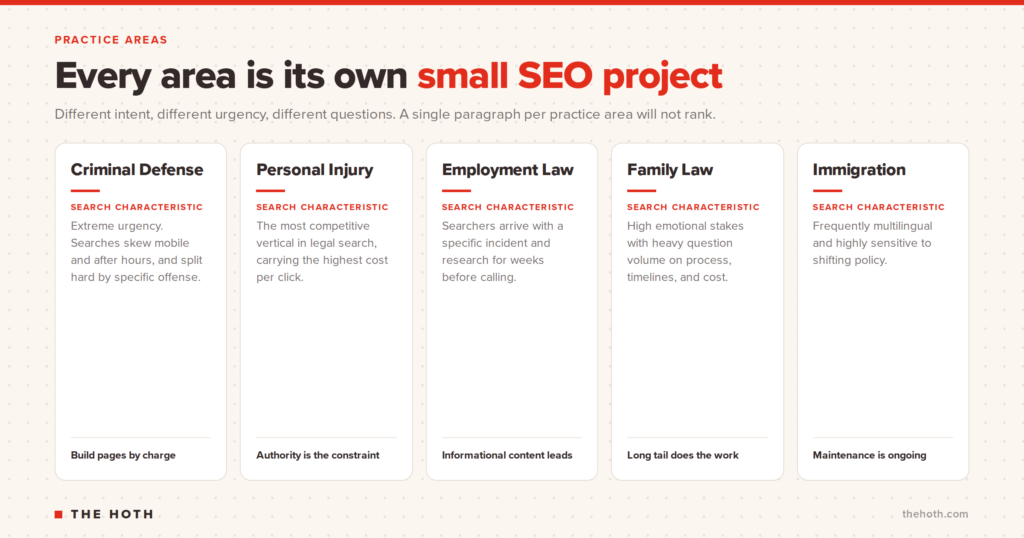
Each practice area needs its own page targeting its own commercial and local terms, because the searcher behind “criminal defense attorney” has different intent, different urgency, and different questions than the one searching “estate planning lawyer.”
The firms that rank broadly are usually the ones that stopped treating practice areas as a list and started treating each as its own small SEO project.
Criminal defense. Urgency is extreme and searches skew mobile and after hours. Terms split hard by offense, so pages built around specific charges tend to outperform a single overview page. Long-tail queries about court process and penalties pull real volume.
Personal injury. The most competitive vertical in legal search, with the highest CPCs. Winning usually requires accident-type pages combined with sustained link building, since domain authority is the constraint.
Employment law. Searchers arrive with a specific incident and often research for weeks before contacting anyone. Informational content does heavy lifting here.
Family law. High emotional stakes and heavy long-tail question volume around process, timelines, and cost.
Immigration. Frequently multilingual, and highly sensitive to policy changes, which makes content maintenance an ongoing requirement rather than a one-time build.
The common thread is depth. A single paragraph per practice area will not rank against firms that gave each one a real page.
How do law firms show up in AI search?
Law firms earn AI citations by publishing content that directly answers the questions prospective clients ask, structuring it so models can extract it cleanly, and building the third-party mentions that establish the firm as a recognized entity.
Traditional rankings get you into Google’s results. They no longer guarantee you appear in the answer someone reads instead of the results.
Answer questions directly. Content that opens with a clear response to “what should I do after a car accident” is far more extractable than content that builds to the answer over six paragraphs.
Use structured data. FAQ and Attorney schema help models identify which parts of a page are answers.
Build entity authority. AI systems form a model of your firm: practice areas, jurisdiction, credibility. Consistent mentions across news coverage, legal directories, and local publications shape that model over time, which is where earned media and citations do work that on-page changes cannot.
Publish experience-based content. Case results, attorney perspectives, and real outcomes carry weight that generic legal explainers do not.
A motorcycle accident firm we partnered with built authority in a hyper-competitive, heavily regulated niche and saw gains in traffic, keywords, and AI citations together within 90 days. That dual visibility is what a modern legal campaign should be aiming at. Our managed AI visibility program exists to build exactly those signals.
What does a winning campaign timeline look like?
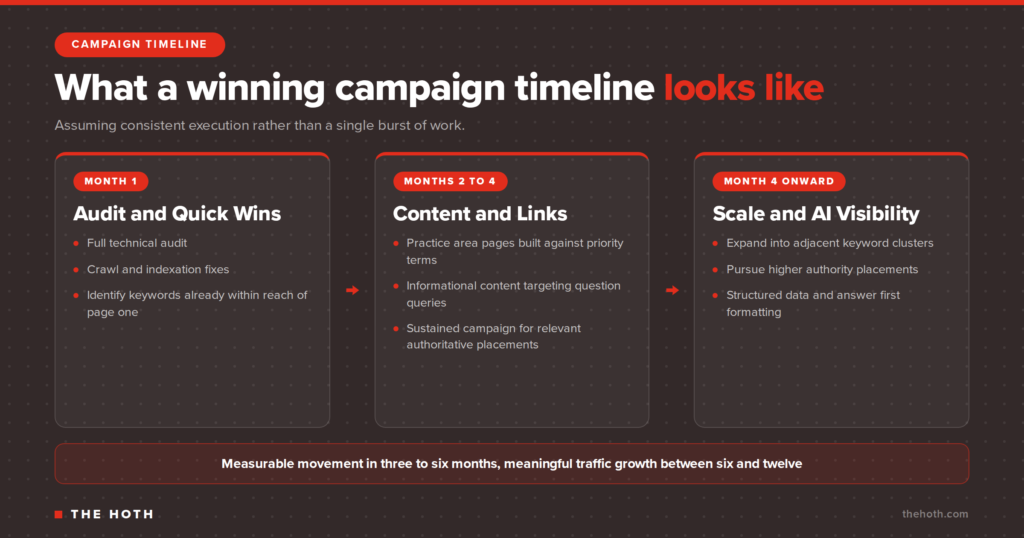
Most law firms see measurable movement in three to six months and meaningful traffic growth between six and twelve, assuming consistent execution rather than a single burst of work.
Month 1: audit and quick wins. Full technical audit, crawl and indexation fixes, and identification of keywords already within reach of page one.
Months 2 to 4: content and links. Practice area pages built out against priority terms, informational content targeting question queries, and a sustained link campaign focused on relevant authoritative placements.
Month 4 onward: scale and AI visibility. Expand into adjacent keyword clusters, pursue higher-authority placements, and optimize for citation through structured data and answer-first formatting.
One employment law firm grew traffic more than 1,000% through this sequence, including a keyword that moved from position 51 to position 9 after the page was optimized and supported with links. The case study tracks it month by month.
How do you measure law firm SEO?
Track qualified lead volume and traffic value rather than raw traffic, because a legal campaign that doubles visitors without changing signed cases has not worked.
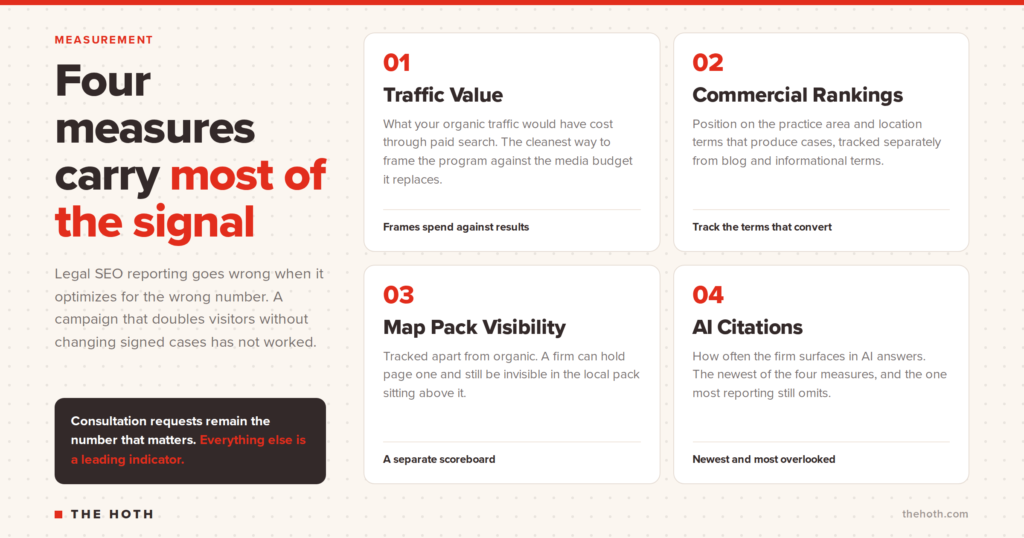
Legal SEO reporting goes wrong when it optimizes for the wrong number. Four measures carry most of the signal.
Traffic value. What your organic traffic would have cost through paid search. In legal, where clicks run high, this converts SEO gains into a figure that maps to the media budget it replaces.
Rankings on commercial terms. Position on “personal injury lawyer [city]” matters more than position on a general informational post. Segment your tracking so practice area and location terms report separately from blog terms.
Map Pack visibility. Track separately from organic. A firm can hold page-one organic and still be invisible in the local pack that sits above it.
AI citations. How often the firm surfaces in AI answers for the questions clients ask. This is the newest measure and the one most reporting still omits, which means most firms cannot tell whether they are gaining or losing ground there.
Consultation requests remain the number that matters. Everything above is a leading indicator of it.
What law firm SEO mistakes cost the most?
The expensive mistakes are thin practice area pages, skipped technical audits, chasing link volume over quality, and stopping the campaign before compounding starts.
Thin practice area pages. A paragraph per service will not rank in a YMYL vertical. Each area needs a page that covers the topic thoroughly and answers the questions prospective clients bring with them.
Skipping the technical audit. Sites that have never had one almost always have fixable problems suppressing performance.
Buying link volume. A hundred low-quality links will hurt a legal site more than help it. One placement on a real news outlet outweighs dozens of directory listings.
Stopping at 90 days. Firms that maintain a steady content and link cadence for six to twelve months see compounding returns. Firms that stop early pay for the foundation and never collect on it.
Treating AI visibility as optional. AEO is not a replacement for SEO. It is the part of the work that determines whether you appear in the answer or only in the results below it.
How The HOTH helps law firms
We have run campaigns across personal injury, employment, criminal defense, family law, and immigration. Managed SEO gives a firm a dedicated campaign manager running technical work, content, links, and local SEO as one program.
A sample of results:
- A Texas firm grew from 500 to 7,700 monthly visitors in under a year
- A personal injury firm went from almost no organic presence to 2,000+ ranking keywords
- A California employment firm reached 5,600+ keyword rankings, 120 top-three positions, and $7,400 in monthly traffic value
- A personal injury firm grew referring domains 800%, generating traffic equivalent to $30,000 a month in paid search
You can browse the full set on our case studies page.
Frequently asked questions
How long does law firm SEO take to work?
Most firms see measurable results in three to six months, with larger traffic gains between six and twelve. Timeline depends on the starting condition of the site, market competitiveness, and how consistently the campaign runs.
How much does law firm SEO cost?
It scales with scope and market. Competitive metro markets require more investment than regional ones. Managed campaigns are structured around budget and goals rather than sold as a fixed package.
Is SEO worth it for a small law firm?
Often more so than for large firms, because legal PPC clicks can exceed $100 and organic rankings keep producing after the spend stops. The constraint is patience rather than budget.
What is AEO and do law firms need it?
AEO is optimizing content to appear in AI-generated answers from tools like ChatGPT, Perplexity, and AI Overviews. As legal research shifts toward those tools, firms optimized for citation hold a visibility advantage over firms that only rank.
Do I need a legal-specific SEO agency?
Not necessarily, but you need one that understands YMYL standards, legal competitive dynamics, and what demonstrated expertise looks like to Google. Vertical experience matters more than vertical exclusivity.
What is the difference between law firm SEO and local SEO for lawyers?
Local SEO is a component of law firm SEO focused on the Map Pack, Google Business Profile, and location-specific pages. Most firms need both, since organic and local results answer different searches.
Where to start
If your firm has never had a technical audit, start there. It is the cheapest way to find out whether the problem is your content or the foundation underneath it.
If the foundation is sound and rankings still are not moving, the constraint is almost always authority, which means links and third-party mentions rather than more content.
Want to know which one is holding your firm back? Book a call and we will map where you stand against the firms currently outranking you.
Leave a comment