


Are you targeting popular prompts with your content, or are you still focused on classic search keywords?
If you’re still stuck in ‘keyword mode,’ your content may not be as visible for longer, natural language prompts.
Also, you’re likely missing out on the top-quality traffic that comes from AI search platforms. Research shows that AI traffic converts at higher rates than organic visitors.
Don’t get us wrong; keyword research still matters in a big way, but prompt research is now equally as important, if not more.
Here’s a quick breakdown of the difference:
- Search keywords use shorthand and focus on important phrases, like ‘best Nike shoes’ and ‘pizza places near me.’
- Prompts use natural language and represent how people normally talk to other humans, like ‘I’m starting a new business. Which project management software is best for a startup?’
As you can see, prompts include more context, specific details, and explicit intent.
Translation?
Driving visitors to your site from relevant AI prompts brings extremely valuable traffic to your site.
In this guide, we’ll teach you how to conduct prompt research so that you can start capitalizing on AI search queries related to your business.
Why SEO Keywords are Only Half the Puzzle Now

SEO keywords are by no means dead; they’re just incomplete.
Here’s why.
Online search behavior is shifting to conversational-style questions instead of short fragments.
Thanks to AI-powered search platforms like Perplexity, users are able to ask nuanced questions like, “Which running shoes reduce knee pain and provide lower back support?”
This is in stark contrast to how classic Google searches operate, where the same user might simply look up a simple phrase like ‘best running shoes.’
From there, they’d rely on the results to provide more nuanced information, like which shoes are best for reducing knee pain.
In other words, AI search has given users the freedom to be more specific about what they want to find.
As a result, user prompts are often rich with details and spell out the user’s true intent, like finding shoes that are easy on the knees (instead of just ‘finding the best shoes’).
From a marketing perspective, that means SEO keywords aren’t as valuable as relevant AI prompts.
Also, prompts exist upstream of search keywords, meaning your brand might not get surfaced if you don’t include precise phrases and concepts from the prompt.
For instance, if you sold running shoes that reduce knee pain but only optimize for ‘best running shoes,’ it’s highly likely that AI tools won’t surface your brand for prompts about shoes that reduce knee pain.
The product may be a perfect fit, but since the content never aligns with the way the question was asked, it’s practically invisible.
That’s why prompt research is something brands can no longer ignore.
Here’s a breakdown of the most important differences between classic keywords and modern search prompts:
| Key Elements | SEO Keywords | AI Search Prompts |
| Length | Short and concise, typically 2 – 5 words | Lengthy and conversational, can be 5 – 23 words (or longer) |
| Intent signal strength | Low to moderate. User search intent must be inferred from fragments. | High. User intent tends to be directly outlined in the prompt. |
| Context capture | Limited. They typically don’t convey qualifiers, constraints, or user conditions (like wanting to reduce knee pain). | Rich. Prompts usually include user preferences, constraints, and pain points. |
| Risk of misalignment | High. Broad, short keywords can miss nuanced intent. | Low. Prompts tend to capture precise query intent. |
| Visibility outcome | Ranked in the organic search results (10 blue links) | Visibility in generative AI Overviews and zero-click experiences |
Why Traditional Keyword Research is Still Important

Since AI prompt optimization captures more valuable traffic, should you just abandon your classic keyword research process?
The answer is no for a few reasons.
First, AI search systems still use traditional keyword matching.
Without getting too technical, keyword matching helps AI systems ensure the online sources they retrieve are actually relevant.
While they use vector search and cross-attention to understand meaning and context, these processes can sometimes venture off topic into something similar but not quite related to what the user wants.
Thus, AI systems use lexical keyword matching to ground the sources in the exact language from the prompt. That means researching popular search terms is still important for AI search optimization.
You can read our guide on the seven signals AI systems use to rank online sources to learn more about how this works.
Second, there are many areas where shorthand keyword research still shines, such as:
- eCommerce – Most of the time, users are looking for options instead of lengthy synthesized answers. Because of this, brief search phrases are preferred. Examples include product category pages (men’s shoes), branded searches (Nike shoes), and quick transactional queries (affordable CRM).
- Local business – With local searches, users want to check availability, read some reviews, and confirm locations, so their searches are quick and to the point (like ‘best dentist in Austin’ or ‘plumber near me’).
- Financial products – Regulatory language is standardized in the finance world, which is why shorthand is popular. Examples include ‘401k rollover’ and ‘high-yield savings account.’
- B2B tools with established categories – B2B buyers must go through a lengthy decision process, so they rarely make a purchase after a single session with an AI assistant. Also, repeat buyers know what they’re looking for (like ‘CRM software’), so shorthand works.
Also, AI Overviews have yet to dominate eCommerce and local searches, so it’s still worth heavily engaging in classic SEO.
For almost every other business, a combination of prompt research and keyword research works best.
How to Conduct Prompt Research for AI Search Optimization
Prompt research is still in its infancy, so there aren’t as many direct tools available as there are for keyword research.
By that, we mean there’s no public, massive, third-party database that collects real prompts from platforms like ChatGPT and provides volume, competition, and trend metrics.
However, that doesn’t mean that prompt research is impossible.
All it takes is:
- Some clever reverse engineering of traditional keywords
- A collection of popular natural-language queries
Here’s how to make it happen.
Start with classic keyword research
The first step is a familiar one.
You simply pull core topics, keywords, and intent the way you normally would, like on Ahrefs, Semrush, or GA4.
Look for keywords that are trending, have relatively high search volume, and low difficulty scores.
Also, find keywords that span all intents (informational, commercial, transactional) and stages of the sales funnel (top, middle, bottom).
For the purposes of this guide, we’ll research prompts in the photography space.
While doing some basic digging on Ahrefs, we noticed the keyword ‘photography and videography services.’
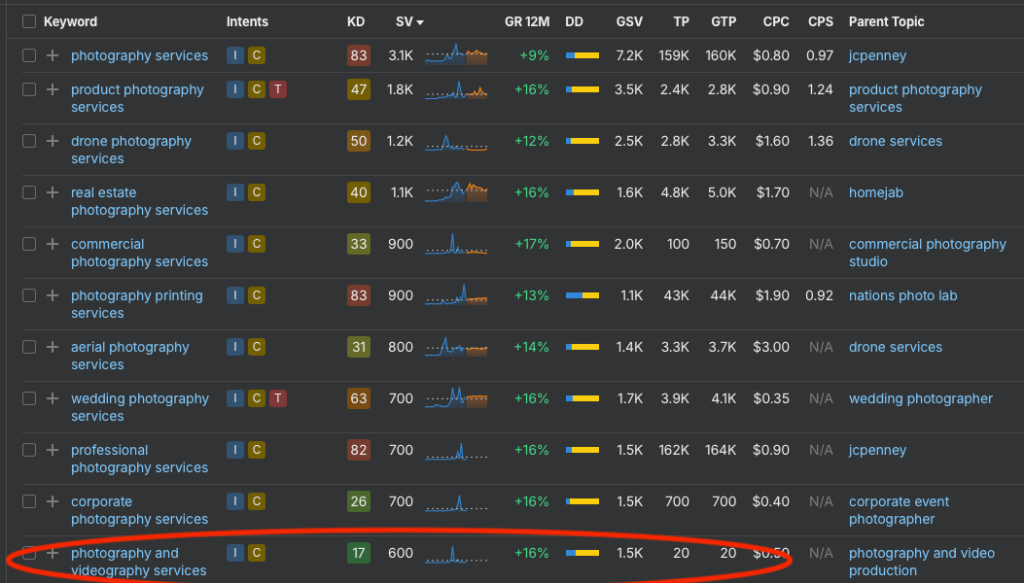
It has a decent search volume and low keyword difficulty (KD) score, so it’s a worthy target.
However, in its current form, it’s still a traditional SEO keyword and not a true AI prompt, so let’s take it a step further.
Mine real user language
If you want to construct effective prompts, then you need to mirror the language your target audience uses.
How can you do this?
One method is to search for the keywords you uncovered, and then check the People Also Ask section for longer, conversational-style queries:
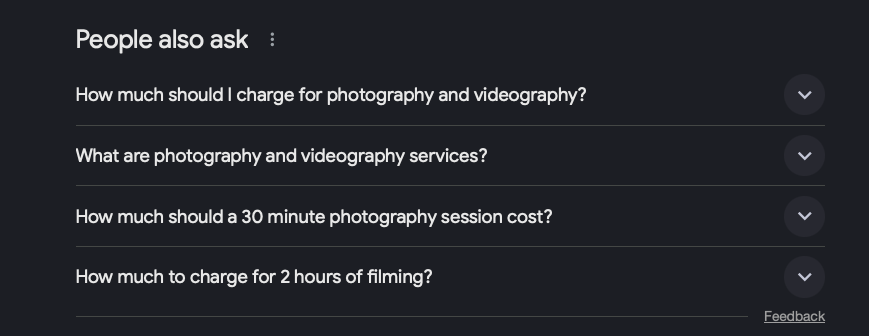
Remember, these are real queries people enter into Google and not random suggestions.
Reddit is another helpful resource for mining user language.
Find relevant threads (like r/WeddingPlanning for this example) and take note of the phrases used, questions asked, and specific details.
Here’s a great example:
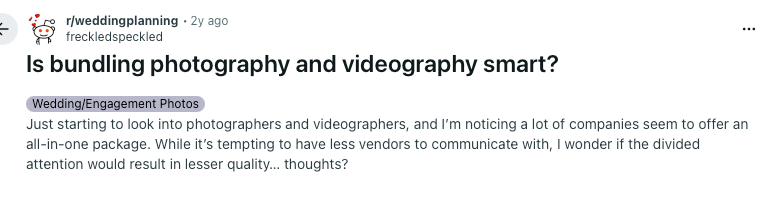
This post contains authentic consumer intent regarding photography and videography services. There are also real-world considerations like ‘all-in-one packages,’ ‘lesser quality,’ and ‘divided attention.’
These are the kind of paint-point driven phrases people enter into AI search tools.
Translate keywords into prompts
Next, you need to reverse-engineer the keywords you found into prompts by adding:
- User intent
- Natural language
- Context
- Modifiers
- Specifics
This will mimic the way people prompt tools like ChatGPT and Perplexity.
Here’s what that looks like using the keyword ‘photography and videography services’ as an example:
- Informational: How do photography and videography services work together for marketing? Is bundling photography and videography smart?
- Commercial: How much do photography and videography services cost for a corporate event? What are the best photography and videography all-in-one packages for small businesses?
- Transactional: Recommend photography and videography services for a 200-person conference under $10,000. Find photography and videography services near me that focus on quality and undivided attention.
Now, we have relevant prompts for each stage of the sales funnel.
The next step is to test the prompts in AI search tools and see which brands get cited.
Test prompts in AI systems
Here’s what happens when we enter the prompt ‘how do photography and videography services work together for marketing’ into Perplexity:
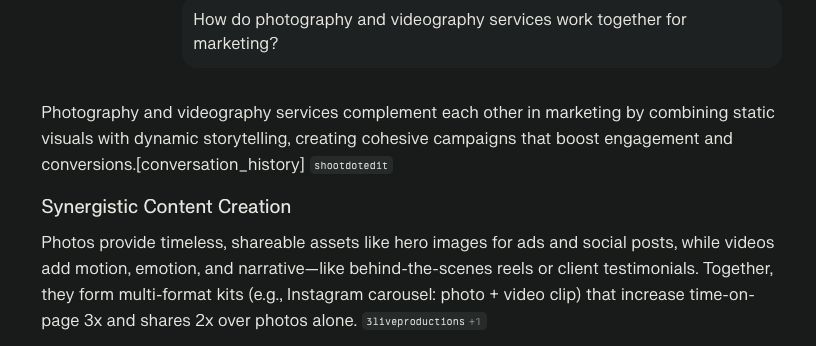
As you can see, it cites several sources alongside its synthesized answer. Viewing the Links tab also lets us view every source it considered when generating its response:

This method is how you can test the effectiveness of your optimization efforts. Play your cards right, and you should start appearing as a cited source for the prompts you target.
Build a prompt library
Lastly, you should group all your prompts together by intent (informational, transactional, etc.) and funnel stage (top, middle, bottom).
You’ll soon have a prompt library at your disposal, which will make the research and content creation process smoother and easier.
One final note: prioritize your prompt library by strategic value and not just search volume.
Think in terms of which prompts will have the most value to your business, and not which prompts stand to generate the most traffic.
Also, don’t neglect informational prompts, as they’re vital for spreading brand awareness and capturing prospects at the top of your sales funnel.
Wrapping Up: Prompt Research and Keyword Research
To summarize, SEO keywords aren’t obsolete, but they’re only half of the puzzle now. If brands want to continue to thrive online, adding prompt research is an absolute necessity.
Taking a best of both worlds approach will ensure you remain visible in the organic results while also capitalizing on nuanced intent and zero-click environments (which are growing rapidly).
Does your brand need help adapting to the modern search landscape?
Don’t wait to book a call with our team of experts to develop a cohesive SEO strategy based on your specific needs!
Leave a comment