

Getting cited in AI Overviews comes down to a handful of universal signals: lead with a clear answer, structure your content for extraction, build topical authority, and earn mentions on trusted third-party sites. But Google’s AI Overviews are only one engine. ChatGPT, Gemini, Claude, and Perplexity each pull from a different index, so winning citations now means optimizing for several systems at once.
When we first published this guide, getting cited in Google’s AI Overviews was the whole conversation. It still matters enormously, AI Overviews now appear on more than 40% of Google searches, but it’s no longer the only place your customers get answers. They’re also asking ChatGPT, Gemini, Claude, and Perplexity, and here’s the catch most brands miss: those tools don’t share a search index. A citation in one is not a citation in all.
This refreshed guide keeps the fundamentals that still work, then breaks down how each major engine sources its answers, with the 2026 data on prompt patterns that determine whether you even get a shot at being cited. Let’s start with what’s universal, then go engine by engine.
Why getting cited is now a multi-engine game
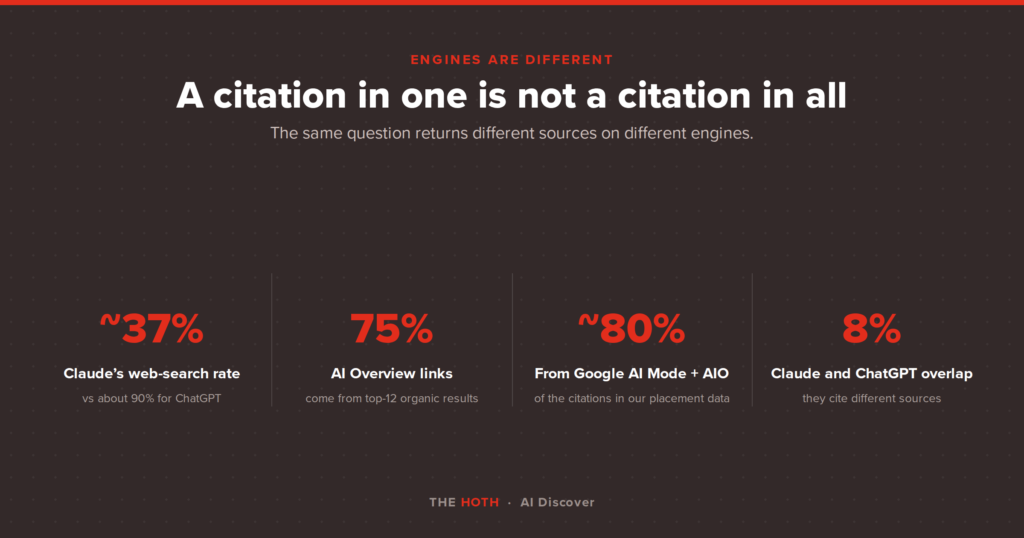
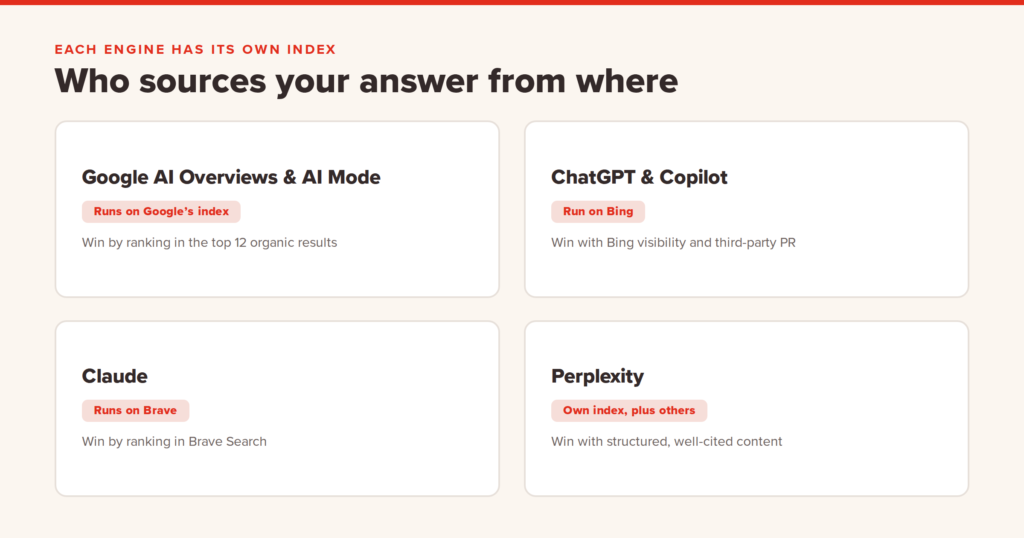
AI Overviews are the largest single AI answer surface, but citations are fragmented across engines that use different indexes. ChatGPT runs on Bing, Claude runs on Brave, and Google’s AI Overviews and AI Mode run on Google’s own index, so the same question can return completely different sources depending on where it’s asked.
The stakes keep rising. ChatGPT now has over 800 million weekly users and holds the majority of the AI search market, while Gemini has been growing more than 200% year over year. Inside any given answer, there are only about two to seven citation spots, far fewer than the ten blue links of classic search. And the visitors who do arrive convert: our own data shows AI-referred visitors convert at 9x the rate of standard organic traffic. The window is small, the traffic is valuable, and it’s spread across engines that each play by their own rules.
What every AI engine rewards
Across every AI engine, the same foundation wins citations: content that leads with a direct answer, is structured for machine extraction, demonstrates topical authority, and is validated by trusted third-party mentions and reviews. Get these right and you’re eligible everywhere before you optimize for any single engine.
Before the engine-specific tactics, build the foundation that travels across all of them.
- Lead with the answer. A language model scans for the clearest, most direct response to a query. A page that opens with “we’re a leading provider” answers no question and gets skipped. A page that opens with the actual answer gets cited. One audit of enterprise sites found roughly 80% opened with generic messaging and none were structured for AI citation.
- Structure for extraction. FAQ sections with direct answers, a clean semantic heading hierarchy (one H1, descriptive H2s), descriptive internal anchor text, and schema markup (FAQ, Article, Product) all hand the machine a citable unit. Our guide to answer engine optimization covers the formatting in depth.
- Build topical authority. AI tools cite sources that show consistent, validated expertise across a topic, not one-off pages. Pillar-and-cluster coverage is what earns that status, which we walk through in our guide to auditing topical authority.
- Earn third-party validation. Research from Superlines found brands are about 6.5 times more likely to be cited through third-party sources like publications, reviews, and forums than through their own website. Digital PR, earned media, and a strong review profile do real work here.
- Keep it fresh. AI systems favor current content. Our data shows pages refreshed quarterly earned 502% more ChatGPT referral traffic than static pages.
How each engine sources its answers
Here’s where strategy splits. Each engine retrieves from a different place, so the same content can win in one and vanish in another.
Google AI Overviews and AI Mode
Google’s AI Overviews and the newer AI Mode run on Google’s own index, powered by Gemini. They lean heavily on pages that already rank: research has found roughly 75% of AI Overview links come from pages in the top 12 organic results, so strong classic SEO translates directly into AI Overview visibility. In our own analysis of news-site placements, Google’s AI Mode and AI Overviews together accounted for nearly 80% of the citations we tracked, and AI Mode proved more willing than expected to cite mid-authority sources. To win here: rank in the top 12, structure content for extraction, and keep it fresh.
ChatGPT (and Copilot)
ChatGPT’s web search is powered primarily by Bing, plus OpenAI’s own crawler. It reaches for the web often, in roughly 90% of prompts, and cites sources inline. Because it leans on third-party validation heavily, brand mentions and coverage on trusted sites matter as much as your own pages. Microsoft Copilot also runs on Bing, so the two overlap. To win here: make sure you’re visible in Bing, invest in digital PR and brand mentions, and keep your key pages clearly structured.
Claude (powered by Brave)
This is the biggest shift since we first wrote this guide. Anthropic’s Claude added web search and, as Search Engine Land reported, its retrieval runs on Brave Search, now confirmed on Anthropic’s subprocessor list. The implications are unusual and worth understanding.
Claude appears not to re-rank results. It largely uses Brave’s top organic results as they are, with analyses finding its citations closely mirror Brave’s top listings. It also searches far less often than its peers, around 37% of prompts versus roughly 90% for ChatGPT, reaching for the web mainly on freshness, comparison, location, and “best” or “top” queries. And its citations overlap with ChatGPT’s only about 8% of the time, but with Google’s rankings around 64%. In practice, that means your Google SEO carries over to Claude better than your ChatGPT-specific work does, but Brave visibility is its own lever. Brave runs an independent index of more than 30 billion pages, and its crawler follows Googlebot rules, so if you block unfamiliar crawlers or carry a noindex tag, you’re invisible to both Brave and Claude.
To win on Claude: confirm your site is crawlable by Brave and submit it to Brave’s index, add Brave to your rank tracking, and build the comparison pages, “best X for 2026” guides, and local content that match the prompts Claude searches for. Because Claude’s behavior is relatively consistent, it’s one of the most optimizable engines once you know the lever is Brave.
Perplexity
Perplexity blends its own index with multiple external sources and cites prolifically, often listing many sources per answer. The universal foundation, structured, authoritative, well-cited content, carries the most weight here, along with the third-party mentions that signal credibility.
The 2026 prompt patterns that decide if you get cited
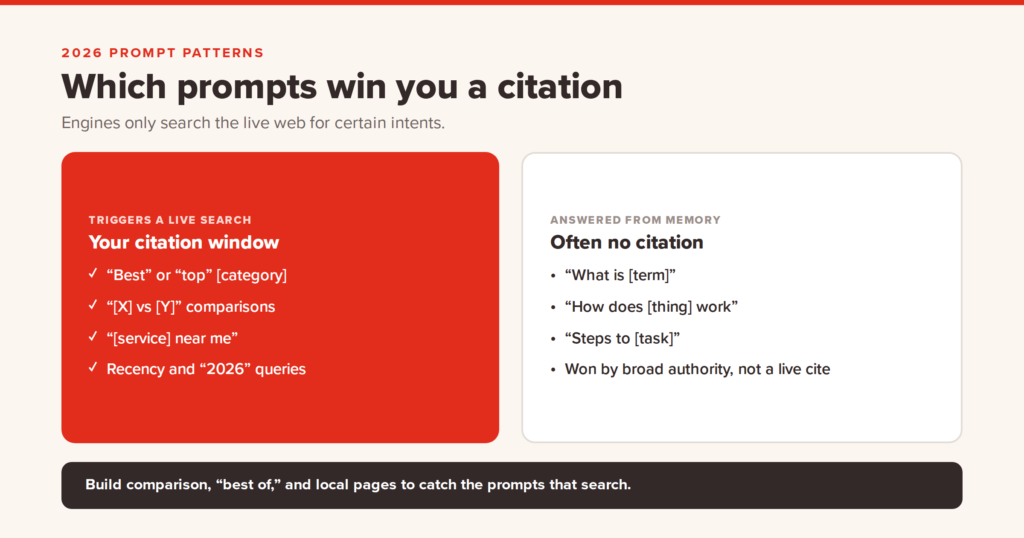
Most AI engines now fan a single user prompt out into multiple sub-queries, and they only search the live web for certain intents. Comparison, “best,” “near me,” and recency prompts trigger a web search and a citation opportunity, while “what is” and “how does” prompts are often answered from memory with no citation at all.
Two patterns from 2026 research should shape what you publish. First, query fan-out: engines like Google’s AI Mode and Claude break one question into several behind-the-scenes searches, then synthesize across them. You’re not competing for one query anymore, you’re competing for the cluster of sub-queries your topic generates.
Second, not every prompt triggers a search. Recency and commercial-intent prompts (“best project management tools,” “X vs Y,” “near me”) send the engine to the live web, which is your citation window. Definitional prompts (“what is,” “how does,” “steps to”) are frequently answered straight from the model’s training, with no citation to earn. The takeaway: prioritize comparison pages, “best of” guides, and locally focused content, and add explicit current-year signals to titles and headings, since fan-out queries often include the year. Those are the pages that catch the prompts engines search for.
Your engine-by-engine action plan
Put it together into a sequence.
- Build the universal foundation first: lead with answers, add FAQ and schema, tighten your heading structure, and shore up topical authority. This makes you eligible everywhere.
- For Google AI Overviews and AI Mode: earn top-12 organic rankings for your target queries and keep pages fresh.
- For ChatGPT and Copilot: confirm Bing visibility and invest in third-party mentions and digital PR.
- For Claude: make sure Brave can crawl you, submit to Brave, track Brave rankings, and build comparison and local content.
- Track each engine separately. A win on one doesn’t transfer automatically, so don’t assume your ChatGPT visibility means Claude or Google visibility.
How to track citations across engines
You can’t improve what you don’t measure, and traditional rankings don’t capture AI citations. Start by manually testing your highest-value prompts in each engine and logging where you appear and where competitors win instead. Then layer in a tracking tool. Our full walkthrough on tracking brand mentions across ChatGPT, Perplexity, and AI Overviews covers the options, including how to benchmark your share of AI voice against competitors.
Let us handle your AI visibility
Optimizing for several engines at once, each with its own index and citation logic, is a lot to manage in-house. AI Discover is our managed AI visibility program, built to earn citations across AI engines through digital PR, authority links, content optimization, and review management, with our Atlas dashboard tracking where you’re cited and where competitors are winning citations you should be earning.
If you want a clear picture of where you stand right now, book our AI Readiness Visibility Audit to see how your AI citations stack up against your competitors, or talk to our team about a plan built for your category.
Frequently asked questions
How do you get cited in Google’s AI Overviews?
Rank in the top organic results, structure your content so a machine can extract a clear answer, build topical authority, and keep pages fresh. Roughly 75% of AI Overview links come from pages already in the top 12 organic results, so strong SEO is the foundation.
Do different AI engines use different sources?
Yes. Google’s AI Overviews and AI Mode use Google’s index, ChatGPT and Copilot use Bing, Claude uses Brave Search, and Perplexity blends its own index with others. The same question can return different citations depending on the engine.
How does Claude decide what to cite?
Claude’s web search runs on Brave Search and largely uses Brave’s top organic results without re-ranking them. It searches the web in only about 37% of prompts, mainly for recency, comparison, location, and “best” or “top” queries, so ranking well on Brave is the most direct path to a Claude citation.
Does ranking on Google help with AI citations?
For Google’s AI Overviews and AI Mode, yes, directly. It also helps with Claude, whose citations overlap with Google rankings around 64% of the time. It helps less with ChatGPT, which leans on Bing and third-party sources.
What is query fan-out?
It’s when an AI engine breaks a single user prompt into multiple behind-the-scenes searches, then synthesizes across the results. It means you’re competing for a cluster of related sub-queries, not just one keyword.
How do I track AI citations?
Manually test your priority prompts in each engine and log where you appear, then use an AI visibility tool to monitor your share of citations over time. Track each engine separately, since visibility doesn’t transfer automatically between them.
The bottom line
Getting cited in AI Overviews still starts with the fundamentals: a clear answer, clean structure, real topical authority, and trusted third-party validation. What’s changed is that AI Overviews are now one engine among several, and ChatGPT, Claude, and the rest each retrieve from their own index. Build the universal foundation, then optimize and track each engine on its own terms, and you’ll show up where your customers are asking, not just where they used to search.
Want to see where you stand across every AI engine? Book a call and we’ll map your AI visibility and where to win citations first.
Leave a comment