
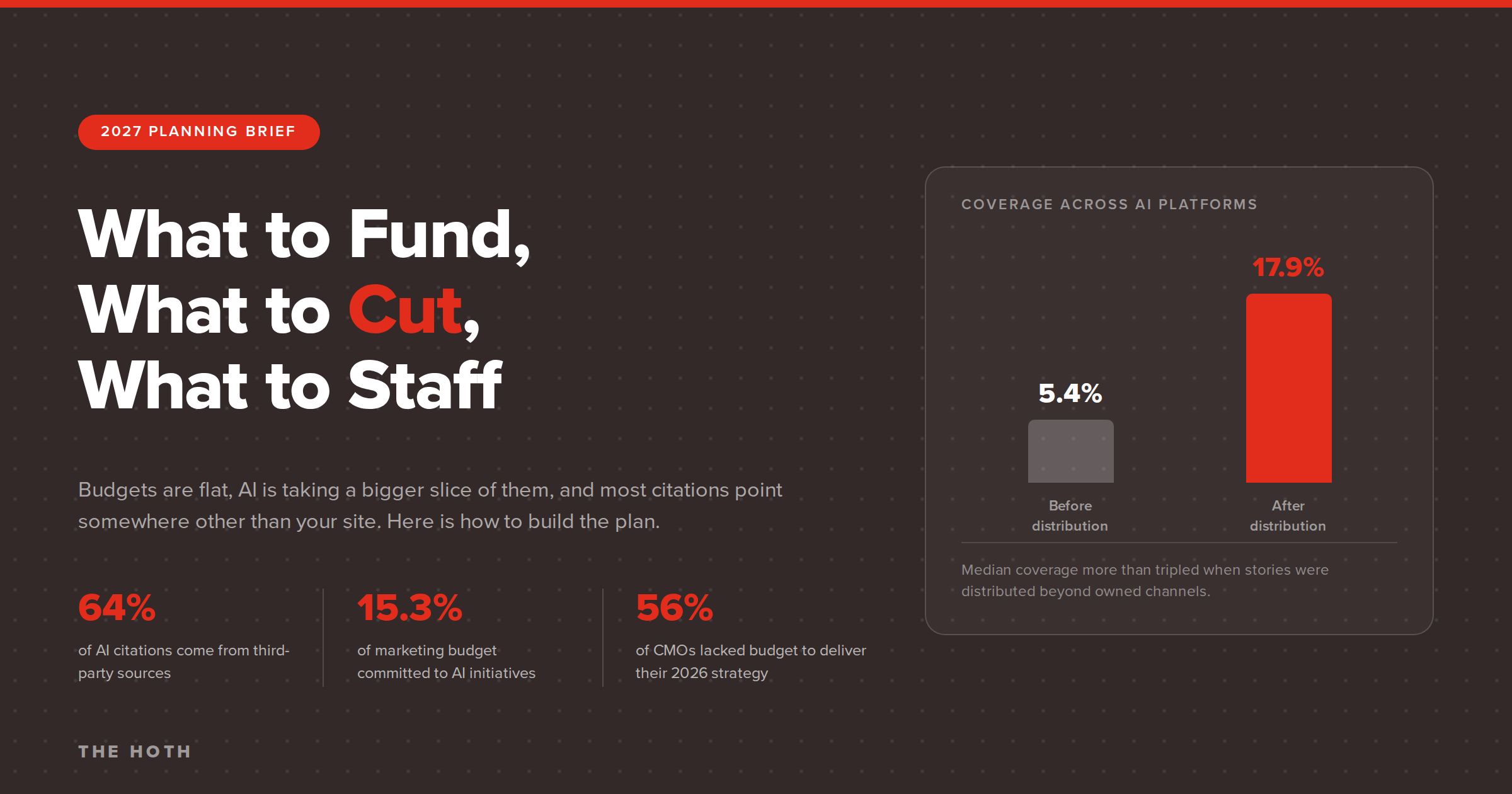

Planning for 2027 comes down to a decision most marketing teams have not made yet: how much of the budget moves from pages you own to places you do not control. Marketing budgets are effectively flat, AI initiatives are claiming a growing share of them, and the citations that put brands inside AI answers come mostly from third-party sources. This brief covers what to fund, what to cut, and what to staff.
Most planning documents published this time of year are predictions. This one is not. You do not need another list of things that might happen to search. You need to walk into a budget meeting with a number, a trade, and a name attached to each.
So this is a working document. It assumes you already believe AI search matters and are stuck on the harder question: what comes out of the plan to pay for it.
If you would rather have someone else build and run this plan, that is what HOTH X Managed SEO does. If you are building it in-house, keep reading.
What is different about the 2027 planning cycle?
The difference is that budgets are not growing while a new line item is. Gartner’s 2026 CMO Spend Survey puts marketing budgets at 7.8% of company revenue, with 15.3% of the marketing budget already going to AI initiatives. Anything you fund for AI search in 2027 has to be paid for by something you stop funding.
The Gartner 2026 CMO Spend Survey surveyed 401 marketing leaders across North America, the United Kingdom, and Europe between January and March 2026. Most respondents ran organizations above $1 billion in revenue, so treat the figures as an enterprise signal rather than a small-business one. The direction still holds at every size.
Three findings from it should shape your plan:
- Budgets moved from 7.7% of company revenue in 2025 to 7.8% in 2026. That is a rounding error, not a raise.
- 15.3% of the average marketing budget is already committed to AI initiatives. Among organizations with mature AI readiness, it is 21.3%.
- 56% of CMOs said they lacked the budget required to deliver their 2026 strategy, and 54% reported insufficient resources.
Put those together and the 2027 plan is a reallocation exercise wearing a growth costume. The AI line is getting funded either way. The only open question is what shrinks to make room.
That is good news for search, but only if you can answer a question your CFO is going to ask: where do the results of this spending show up? Which brings us to the number that should anchor the whole plan.
Where do AI citations come from?
Most AI citations point at somebody else’s website, not yours. In a March 2026 study covering 87 stories across 30 brands and eight AI platforms, 64% of AI citations came from third-party publisher sources, and stories distributed through news outlets earned a median 239% more citations than the brand’s own content alone.
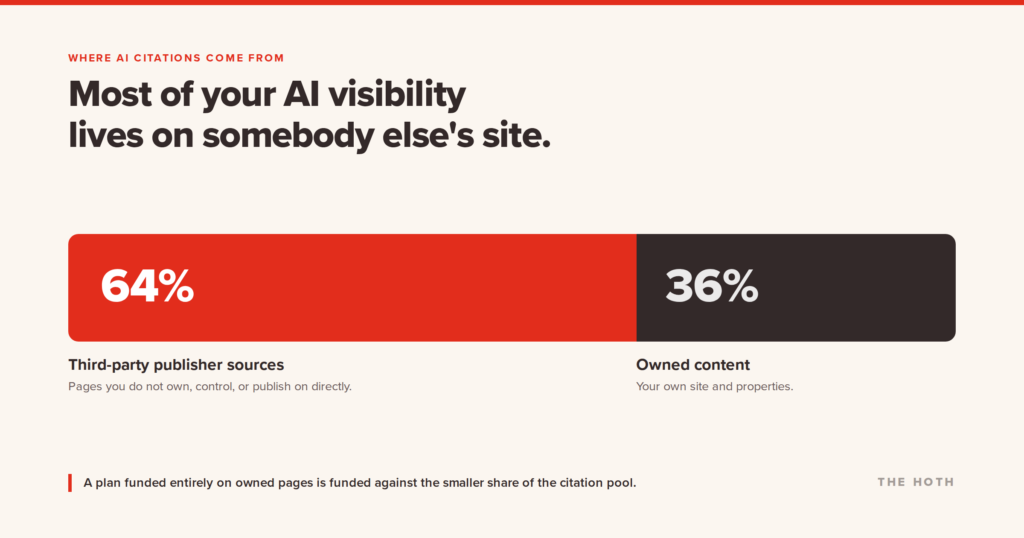
That study came from Stacker and Scrunch. Worth stating plainly: Stacker sells earned media distribution, so this is vendor research and the incentive runs in one direction. Read the numbers with that in mind. They are still the most specific public measurement of the owned-versus-earned split anyone has published, and the methodology is disclosed.
The supporting figures matter as much as the headline:
- 97% of distributed stories earned at least one AI citation, against 82% for owned content.
- Coverage across AI platforms rose from 5.4% to 17.9% at the median, which nearly tripled how consistently brands surfaced from one engine to the next.
- Distributed versions were 5.3 times more likely to be the only source of a story’s AI visibility than the brand’s own website.
The last one is the budget argument. If a third-party version of your story is five times more likely to be the sole reason an AI engine knows about you, then the money you spend making your own pages better has a ceiling that money spent elsewhere does not.
Our own campaign reporting points the same direction, though we would not call it proof. A packing and moving company came to us for link building, not for AI visibility. We built 210 backlinks from 39 credible, niche-adjacent domains, focused on service pages rather than overloading core location pages. Their organic traffic value climbed 39% to $12,600, they picked up 21 new keywords in the top three, and they earned AI citations across multiple platforms as a byproduct nobody had scoped. You can read the full moving company case study for the campaign detail.
The lesson is not that link building is secretly an AI product. It is that third-party presence pays into both channels at once, and most 2027 budgets are still splitting them into separate line items with separate owners.
Here is the test to run on your own draft plan. Add up everything in it that produces a mention on a website you do not control. Compare that share against the 64% figure. If your plan is 80% owned-property work, you have inverted the ratio that the evidence supports.
What should you fund in 2027?
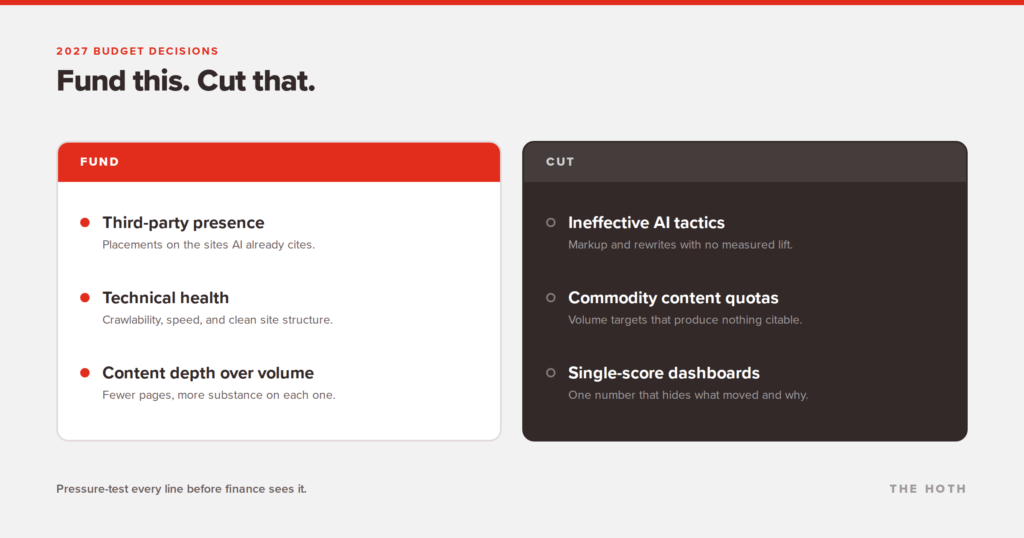
Fund three things in this order: third-party presence that produces citations, a technical foundation that lets those citations happen at all, and content depth rather than content volume. Everything else in the plan is negotiable.
1. Third-party presence
This is the citation supply, and it is the category most likely to be underfunded relative to what the data says it does. It covers Earned Media, Digital PR, and Exclusive Media Links, plus whatever review and reputation work applies to your category.
There is an organizational problem hiding in this line item. At most companies, press and search report to different people, run on different calendars, and get measured on different things. If AI engines are reading press coverage to decide what to say about you, that split is now a budgeting flaw rather than an org chart quirk.
The practical fix for 2027 is to stop scoping PR as brand spend and search as performance spend. Fund them from the same pool, brief them against the same set of commercially relevant questions, and hold them to a shared measure.
2. The technical foundation
Google is explicit that a page has to be indexed and eligible to appear in Search with a snippet before it can show up in AI Overviews or AI Mode. Its guide to optimizing for generative AI search treats crawlability, indexing, and page experience as the entry requirement, not an optimization.
An Australian fine jewelry retailer we work with shows what happens when that foundation breaks. The site was invisible to AI tools when the campaign started. A round of design changes then dropped organic traffic from 655 monthly visitors to 32. A technical audit found more than 4,000 pages that were crawled but never indexed, category pages hidden behind a load-more button that Googlebot cannot click, redirect chains across 85 URLs, and a broken sitemap.
After the fixes, traffic recovered to 592 monthly visitors, domain rating went from 1 to 20, and the site earned 54 AI citations: 27 from ChatGPT, 24 from Perplexity, and three appearances in Google’s AI Overviews. No press campaign, no new content program. The technical audit case study has the full breakdown.
Read that as a counterweight to the previous section. Some of your citations are already earned and simply blocked. Remediation releases them, and it is usually the cheapest line on the plan.
It is also the easiest line to cut, because nothing visibly breaks the quarter you defund it. That is exactly why it disappears from budgets and exactly why it should not.
3. Content depth over content volume
Google draws a line between commodity content and non-commodity content, and the distinction is worth quoting to your team. Commodity content is the sort of general-knowledge roundup that could have come from anyone. Non-commodity content carries a specific expert or first-hand take that goes past what is already available.
For 2027 that argues for fewer, better pages. Fund a content refresh program over a net-new volume program. Refreshing a dozen pages that already have some authority and updating them with current data, real experience, and clearer structure will do more than publishing forty posts that restate what is already indexed.
If your content plan for 2027 is a publishing quota, it is a 2019 plan.
What should you cut in 2027?
Cut the tactics Google has said do nothing, cut commodity content volume, and cut any tool whose only output is a single AI visibility score. None of the three will be missed, and together they usually fund the third-party line.
The tactics Google says to ignore
Google published a mythbusting section in its generative AI guidance that names specific practices as ineffective for Google Search and its AI features. If a vendor is billing you for any of these as an AI visibility service, that is a conversation for the renewal meeting.
- LLMS.txt files and other special markup. Google Search does not use them. Maintaining one neither helps nor hurts.
- Chunking content into small pieces for AI to parse. There is no required page length.
- Rewriting content specifically for AI systems. Models understand synonyms and intent without keyword variants.
- Seeking inauthentic mentions. Core ranking systems favor high-quality content and separate systems block spam.
- Overfocusing on structured data. No special schema is required for AI features, though structured data is still worth keeping for rich results.
That last one carries a caveat you should pass along before someone rips out your markup. Structured data is not an AI lever. It is still a Search feature lever, and it stays.
Commodity content volume
Producing separate pages for every possible variation of a query, largely to influence rankings or AI responses, falls under Google’s scaled content abuse policy. A high page count does not make a site higher quality. Cut the quota and move the money to the refresh program.
Single-number AI visibility dashboards
Raw citation counts scale with catalog size more than campaign quality. A 50-page site and a 20,000-page site are not comparable on a raw count, and a benchmark built on that number is measuring inventory.
Google also warns directly about third-party tools that claim access to internal ranking or AI systems. No third-party tool has that access. Keep the tools that help your workflow, and pair them with the Generative AI performance report in Search Console plus your own referral analytics.
What you track matters more than which vendor you pay to track it. If you want the reasoning behind that in more depth, our AI Discover reporting is built around a fixed prompt set rather than an aggregate score, for exactly this reason.
One warning on cutting. Technical health, brand mentions, and reputation signals all look optional on a spreadsheet and none of them are. The cut list above is deliberately narrow because most of what gets cut in a flat year should not be.
What should you staff in 2027?
Staff for three capabilities rather than three tools: someone who owns technical health, someone who owns third-party relationships, and someone who owns measurement. Gartner’s data says the binding constraint is process maturity, not software.
This is the part of the plan that gets skipped, and it is the part the survey data is loudest about. Seventy percent of CMOs say becoming an AI leader is a critical goal. Only 30% report mature or fully developed AI readiness capabilities, and 70% acknowledge their internal processes are not mature enough to implement and scale AI.
You cannot buy your way past that with more tools. More tools is what created it.
Three capabilities to name an owner for. Each can be a person, a share of a person, or a partner, but each needs a name next to it:
- Technical health. Someone who checks monthly that pages you are promoting are crawlable, indexed, and snippet-eligible, and who catches the redesign before it costs you 95% of your traffic.
- Third-party presence. Someone who owns publisher and press relationships and briefs them against commercial questions rather than announcements.
- Measurement. Someone who owns a fixed prompt set, tracks it over time, and can explain the difference between a citation and a session to the executive team.
If you cannot fund all three internally, buy the two hardest to hire for. Technical SEO and publisher relationships take years to build in-house and are available on contract immediately. Measurement is the one worth keeping close, because the person who owns the number ends up owning the strategy.
How do you pressure-test the plan before it goes to finance?
Run the draft through four questions. If you cannot answer each one with a number or a name, you have a wish list rather than a plan.
- What share of this budget produces a mention on a site we do not own? Compare it against the 64% figure. You do not have to match it, but you should be able to defend the gap.
- Can every page we plan to promote be crawled, indexed, and shown with a snippet today? Check before the money is committed, not after the campaign underperforms.
- What are we defunding to pay for the AI line? Name it in the document. If nothing is named, finance will pick for you.
- Who owns the number, and which number is it? One person, one primary metric, defined before the quarter starts.
Four questions is a low bar. Most 2027 plans will not clear it, which is the reason the ones that do will look unusually credible in the room.
What does the 2027 plan look like on one page?
Fund third-party presence, technical health, and content depth. Cut ineffective AI tactics, commodity volume, and score-based dashboards. Staff three owners. Measure a fixed prompt set alongside referral data.
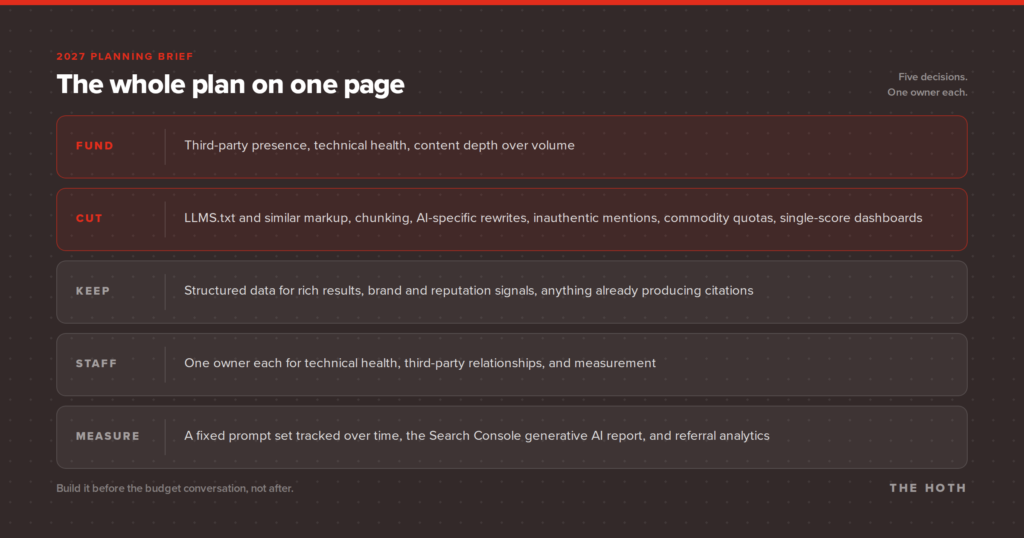
| Line | What goes in it |
|---|---|
| Fund | Third-party presence, technical health, content depth over volume |
| Cut | LLMS.txt and similar markup, chunking, AI-specific rewrites, inauthentic mentions, commodity content quotas, single-score dashboards |
| Keep | Structured data for rich results, brand and reputation signals, anything already producing citations |
| Staff | One owner each for technical health, third-party relationships, and measurement |
| Measure | A fixed prompt set tracked over time, the Search Console generative AI report, and referral analytics |
None of this requires you to believe search is over. It requires you to accept that the places search results get assembled from have widened, and that a flat budget cannot cover the old plan plus the new one.
If you want a second set of eyes on the plan before it goes up the chain, or you would rather hand the whole program to a team that runs this every day, book a call. We will walk your current allocation against what we are seeing across campaigns and tell you where we would move it.
Frequently asked questions about 2027 marketing planning
How much of a 2027 budget should go to AI search?
There is no single correct share, and any number quoted without knowing your category is a guess. The more useful framing is the split between work on properties you own and work that produces mentions elsewhere. Published research puts 64% of AI citations on third-party publisher sources, so a plan weighted heavily toward your own pages is worth revisiting.
Is AI search optimization separate from SEO?
Google’s position is that optimizing for generative AI search is optimizing for the search experience, and so it is still SEO. That matters for budgeting, because it argues against creating a separate AEO line item with its own owner and its own tooling. Fund one program that serves both surfaces.
What is the cheapest thing to fund first?
Technical remediation, in most cases. Pages have to be indexed and snippet-eligible before anything else in the plan can work, and blocked pages are common. Our technical audit work has released AI citations on sites that were previously invisible to AI tools, with no other change to the campaign.
Should we cut content production entirely?
No. Cut the quota, not the program. Google’s guidance favors unique, expert-led material over general-knowledge roundups, and a page count does not make a site more valuable. Most teams get more from refreshing existing pages that already have authority than from adding new ones.
How do we know if the plan is working before the year ends?
Pick a fixed set of commercially relevant prompts before the quarter starts and track them on a schedule, rather than checking a single aggregate visibility score. Pair that with referral analytics so you can see whether citations are producing sessions. A citation and a session are different things and should be reported separately.
Leave a comment