

Generative engine optimization is the practice of getting your brand cited inside AI-generated answers on ChatGPT, Google’s AI Overviews and AI Mode, Perplexity, Gemini, and Copilot. After a year of running campaigns built for AI visibility, across our own site and dozens of client domains, the clearest finding in our reporting is that there is no AI-specific hack. What changed is the mix of work and the order you do it in. The work itself did not change.
That is not the answer most people want. The market is full of tactics sold as AI-only levers: special files, chunked paragraphs, prompt-shaped headings. We tried the levers. What moved citations was the same set of things that has always moved organic performance, weighted differently and sequenced differently.
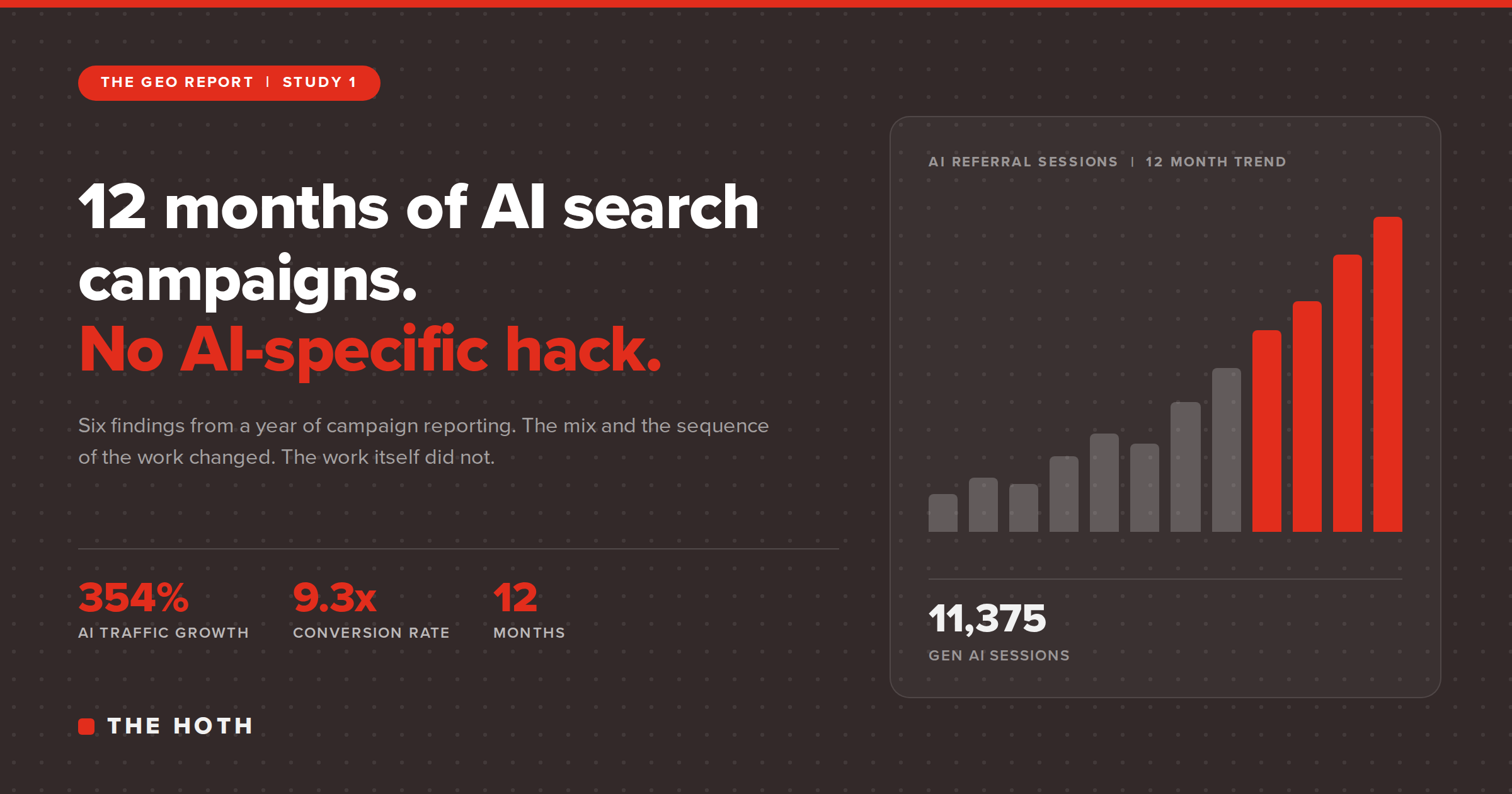
Our own site is the cleanest example. AI referral sessions grew 354% year over year, and that growth came from running the exact program we sell to clients for twelve straight months. No separate AI team. No separate budget line. The same AI Discover stack of digital PR, earned media, authority links, content work, and technical cleanup.
Below are six findings from that year, in the order we think they matter. Some of them are patterns rather than proofs, and we have said so where that is the case. We would rather give you a useful pattern with its limitations attached than a confident claim we cannot defend.
What is generative engine optimization, and what changed about the work?
Generative engine optimization, or GEO, is the work of earning citations and brand mentions inside AI-generated answers. It is not a separate discipline from SEO. Google’s own documentation says optimizing for generative AI search is optimizing for search, and the tactics that earn citations are the ones that already earned rankings.
The term comes from a 2023 paper by researchers at Princeton, Georgia Tech, the Allen Institute for AI, and IIT Delhi, published on arXiv and later presented at KDD 2024. Their headline result was that GEO tactics could raise visibility in generative responses by up to 40%. Their second result gets quoted far less often and matters far more: the effectiveness of those tactics varied by domain, which is why they argued for domain-specific optimization rather than one universal recipe.
Google has since taken a firmer position. In its guide to optimizing for generative AI features, Google Search Central states plainly that its generative features run on the same ranking and quality systems as the rest of Search, and it lists a set of popular AI tactics you can ignore for Google Search: llms.txt and similar files, chunking content into fragments, rewriting pages specifically for AI systems, and chasing inauthentic mentions.
Our campaign data lines up with that. The things that produced citations were editorial coverage, authority links pointed at the right pages, crawlable and indexable content, and real subject depth. What changed is that the ratio shifted. Off-page authority and earned coverage carry more weight in the mix than they did three years ago, and technical health is a gate rather than a tuning knob.
So the useful question is not “what is the AI tactic.” It is “which parts of the work do I fund first, and in what order.” That is what the rest of this post is about.
Why does product mix matter more than product volume?
In our campaign reporting, the composition of the stack tracked more closely with AI citation counts than the number of products running or the length of the campaign. Two campaigns with the same product count and very different mixes produced very different citation outcomes.
Two campaigns make the point.
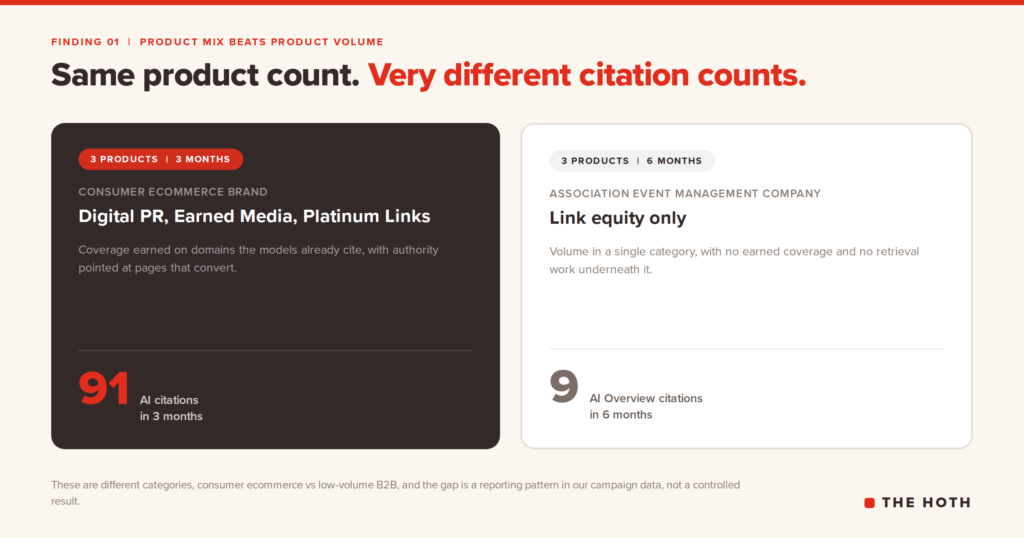
A spray tan ecommerce brand, Sjolie, ran three products for three months: digital PR, earned media, and platinum links. At campaign close, the reporting showed 91 AI citations, 666 additional organic visitors, and a domain rating gain of 3.
An association event management company ran three products for six months: platinum links, link outreach, and link insertions. Same product count, double the duration. The reporting showed 9 Google AI Overview citations, 71 additional visitors, 7 additional keywords, and 1 point of domain rating.
Same number of line items. Twice the runway. A fraction of the citation volume. The visible difference is the stack: one campaign combined digital PR and earned media with link equity, and the other bought link equity alone.
Here is the part we will not overstate. These are not comparable businesses. Sjolie is consumer ecommerce in a category with real search demand. Association event management is low-volume B2B, and there are simply fewer AI queries in that space to be cited in. Category demand may explain much or all of the gap. We are describing a pattern that shows up in our reporting, not a controlled experiment, and the Princeton finding about domain-specific variation is a good reason to hold it loosely.
What we will say is this: in every campaign we ran where earned editorial coverage was part of the mix, citation counts were higher than in campaigns of similar size and duration without it. If your budget forces a choice between more links and a mix that includes coverage, the mix is where we would put the money.
Can technical problems suppress citations you have already earned?
Yes. In one campaign, a technical audit alone produced 54 AI citations with no off-page product running at all. The authority was already there. Crawl and index problems were preventing it from being used.
A fine jewelry retailer came to us with a large catalog and a serious indexing problem: more than 4,000 pages sitting in a crawled-but-not-indexed state. We ran a technical SEO audit and remediation. No digital PR. No link building. No content program.
The outcome was 54 AI citations, traffic recovery above 1,750%, and a 19-point domain rating gain.
Read that carefully, because the causal story is narrower than it looks. The audit did not create authority. The site had authority and had earned the right to be cited. What it did not have was pages that engines could retrieve. Google’s documentation on AI features is explicit that a page has to be indexed and eligible to appear in Search with a snippet before it can show up in AI Overviews or AI Mode. If the page is not in the index, no amount of authority pointed at it will produce a citation.
This gives you a sequencing rule, and it is the most actionable thing in this post: audit before you buy authority. If you are spending on links and coverage while a meaningful share of your site cannot be crawled or indexed, you are paying to fill a bucket with a hole in it. The audit is cheap relative to the off-page spend it protects.
How long does it take to get cited when you are starting from zero?
Three to four months to first meaningful citations is the pattern that recurs across our campaign set, including for sites starting at domain rating 0 with no backlink profile.
The clearest test of this was a miniature cattle ranch: a farm experience and ecommerce business with no online presence to speak of. Domain rating 0. No backlink profile. No rankings on the commercial terms buyers were searching, in a category where AI tools were already answering questions and recommending competitors by name.
The stack was Exclusive Media Links, blogger outreach, blog content targeting buyer questions, and a full technical audit. In under four months:
- Domain rating moved from 0 to 6
- 47 referring domains
- Organic traffic went from 231 to 2,222 monthly visitors, an 862% increase
- 50 top-three rankings
- 181 AI brand mentions across four platforms
The site now ranks first on Google for “how much is a mini cow,” and Gemini recommends the business when someone asks that same question. It is also cited in Google AI Overviews on long-tail commercial queries in the category.
Two things are worth pulling out. First, a domain rating of 6 is not an impressive number in isolation, and the citations arrived anyway. Authority thresholds for AI citation appear to be lower than the ones people assume from organic ranking, particularly in categories where the competitive set is thin. Second, this campaign used Exclusive Media Links rather than volume link buying, which put a small number of editorially placed links on real publications instead of a large number of weak ones.
The three-to-four-month figure held across the rest of the set too, in both directions. Campaigns that reported meaningful citation volume at month two were unusual. Campaigns that had produced nothing by month six usually had a technical or targeting problem rather than a patience problem.
Where should you point authority to get cited?
At the pages that convert. Across every campaign in our set that produced results, authority was pointed at service pages, product pages, or category pages, usually alongside the homepage. No campaign that bought links to the homepage alone produced a result worth writing up.
The pattern is consistent enough to be worth stating flatly:
- The association event management campaign pointed at service pages
- Sjolie pointed at product pages and the homepage
- A South Carolina personal injury firm pointed at service pages and the homepage, with blog content supporting, and reported consistent growth across twelve-plus months
- Hunter & Everage, a legal practice handling personal injury and workers compensation, pointed at service pages across a five-product, six-month campaign, and reported more than 3,800 additional organic visitors and 95 additional keyword rankings
This is not a new idea in link building. What is new is why it matters more now. When an AI engine answers a commercial question, it is choosing which specific page to cite, and the page it cites is the page a buyer lands on. A homepage citation sends someone to your front door. A service page citation sends them to the thing they asked about, already most of the way through their decision.
The corollary is that your money pages need to be able to stand on their own as answers. If your service page is three paragraphs of positioning copy, there is nothing there for an engine to pull.
How does AI traffic change the ROI math?
AI referral traffic converts at a dramatically higher rate than standard organic, which changes what a citation is worth. On our own site, AI-referred visitors converted at 22.79% against 2.45% from standard organic, a 9.3x difference, at $259 revenue per user.
Start with the headwind, because it is real. Pew Research Center analyzed the browsing behavior of 900 US adults and found that users clicked a traditional search result in 8% of visits when an AI summary was present, against 15% when it was not. Clicks on the sources cited inside the summary happened in about 1% of visits. Fewer people are clicking.
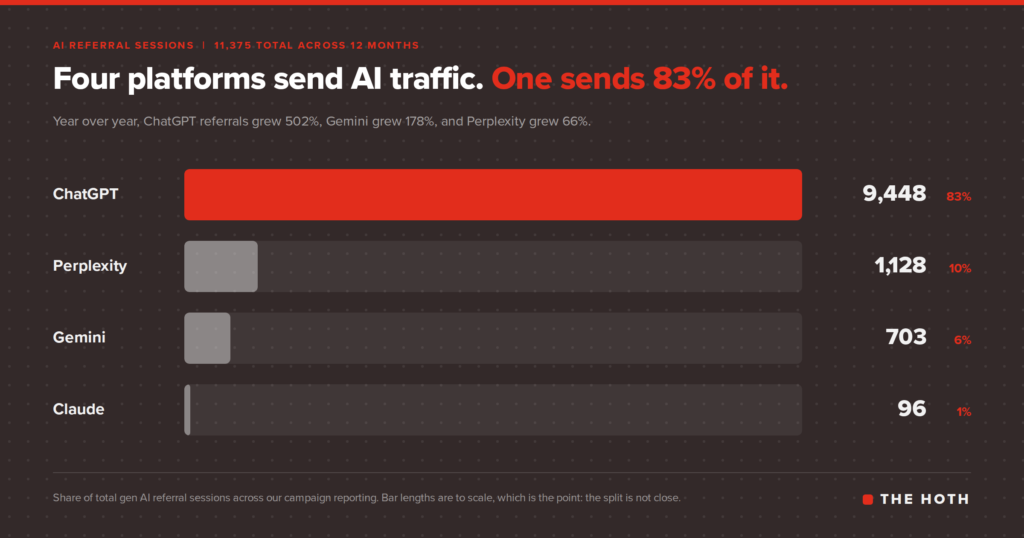
Now the other side. Over twelve months, our site recorded 11,375 generative AI sessions, up 354% year over year. The platform split was heavily concentrated: ChatGPT sent 9,448 of those sessions, 83% of the total and up 502%. Perplexity sent 1,128, or 10%, up 66%. Gemini sent 703, or 6%, up 178%. Claude sent 96, roughly 1%.
Those visitors converted at 22.79%. Standard organic visitors converted at 2.45%. Revenue per AI-referred user was $259.
We saw the same effect in lead quality. Our AI readiness funnel attracted leads whose sites carried 350% higher traffic value than leads from our traditional funnel, an average of $5,575 per month against $1,238, with an average domain rating of 22 against 17. The AI channel was not just converting better. It was bringing in larger prospects.
Put the two halves together and the math is different from what a raw traffic forecast suggests. You should expect fewer sessions per unit of visibility than the equivalent organic ranking would have produced three years ago. You should also expect each of those sessions to be worth considerably more, because a user who arrives after an engine named your brand in an answer has already been pre-qualified in a way a blue link never did.
If you are building a business case, model it on revenue per session rather than sessions. A channel that sends a tenth of the volume at nine times the conversion rate is not a small channel.
Do you need a separate budget for AI visibility?
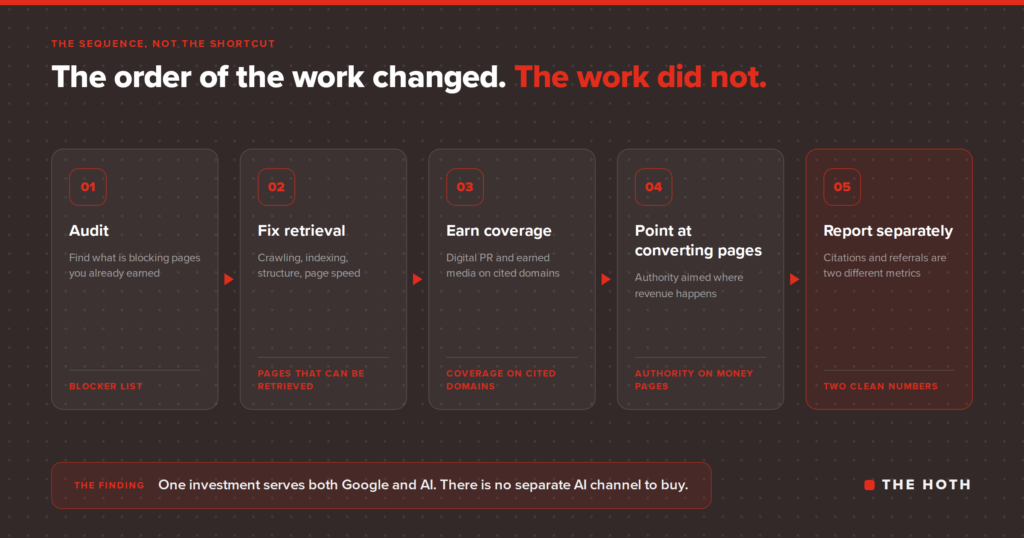
No. Every tactic in these campaigns served Google and AI search at the same time. Treating AEO or GEO as a separate line item means paying twice for one set of work.
Go back through the six findings and look at what produced the AI results.
Technical audits fixed indexing, which improved organic performance and made pages eligible for citation. Editorial coverage built brand entity signals that AI engines read and passed link equity that Google reads. Service page content deep enough to be cited was also content deep enough to rank. Exclusive Media Links built domain rating and put the brand in front of the publications engines treat as credible.
Not one of those tactics was AI-only. The ranch campaign case study puts it well: one investment, two discovery channels.
This is also the practical argument against the AI-specific product category that has grown up over the past two years. Google has said directly that llms.txt files are ignored by Google Search, that content chunking is not required, and that rewriting pages specifically for AI systems is unnecessary. Some of those items are cheap enough to do anyway, and other systems outside Google Search may read files Google does not. But none of them belong at the top of a budget. If a vendor’s AI offering is mostly a list of items on Google’s own ignore list, you are buying packaging.
The version we believe in is a single program that funds technical health, earned coverage, authority links, and content depth, and then reports on both channels. That is the shape of AI Discover, and it is the shape we would recommend even if you built it yourself.
How should you measure any of this?
Carefully, and with the understanding that citation share and referral share are two different metrics that will not agree with each other.
This deserves its own post, and it is getting one. For now, the single most important thing to know is that the number your dashboard reports as “AI visibility” is doing more interpretive work than it appears to.
A quick illustration from our own numbers. ChatGPT accounted for 83% of our AI referral sessions. That does not mean ChatGPT accounted for 83% of the places our brand was cited. Referral traffic only exists when a user clicks, and platforms differ enormously in how often they surface a clickable link at all. A platform can cite you constantly and send almost no traffic. Another can cite you rarely and send a steady trickle. Reporting one number as though it captures both will mislead you about where your visibility lives.
For now: track citations and referrals separately, expect them to tell different stories, and read any single-number visibility score with suspicion. Our guide to tracking your brand in AI covers the tooling. The deeper problem with visibility scoring is the subject of a follow-up study.
What should you do in the next 90 days?
Audit first, fix what blocks retrieval, then fund earned coverage pointed at pages that convert. In that order.
A practical sequence based on what worked:
- Run a technical audit before you spend anything on authority. Look specifically for crawled-but-not-indexed pages, blocked crawlers, and pages ineligible for snippets. This is the cheapest step and it gates everything after it.
- Pick the pages that make you money. Service, product, and category pages. Make sure each one answers the commercial question it targets in a way that could be lifted out and used as an answer.
- Fund earned coverage, not just links. Digital PR and earned media were present in every campaign in our set that produced strong citation counts. Link equity alone underperformed on that metric.
- Give it three to four months before you judge it. If month six produces nothing, look for a technical or targeting problem rather than adding spend.
- Refresh what already works. A content refresh cadence keeps cited pages current, and recency is one of the few things engines weigh consistently.
- Report citations and referrals as separate numbers. Do not let one stand in for the other.
Notice what is not on that list. There is no AI-specific tactic, because we did not find one worth your money.
Frequently asked questions about generative engine optimization
Is generative engine optimization different from SEO?
Not in practice. Google’s position is that optimizing for generative AI search is optimizing for search. In our campaigns, the tactics that earned AI citations were the same ones that improved organic performance, weighted differently. The mix shifted toward earned coverage and technical health. The underlying work did not change.
How long does it take to earn AI citations?
Three to four months is the pattern we see most often, including for sites starting from a domain rating of 0. Results before month two are unusual. If a campaign has produced nothing by month six, the cause is usually a technical or page-targeting problem rather than insufficient time.
Do I need llms.txt to get cited by AI?
Not for Google Search. Google Search Central has stated that it ignores llms.txt and similar files, and that they neither help nor harm visibility in Google Search. Other systems may read them. It is a low-cost item, not a strategy, and it should not be the centerpiece of anything you buy.
Which pages should I build authority to?
The pages that convert. Across our campaign set, results came from authority pointed at service, product, and category pages, usually alongside the homepage. Campaigns that built to the homepage alone did not produce comparable outcomes.
Is AI traffic worth pursuing if it sends fewer clicks?
On our numbers, yes. AI-referred visitors converted at 22.79% against 2.45% from standard organic, at $259 revenue per user. Model the channel on revenue per session rather than session volume, because the volume comparison understates it badly.
Can technical problems stop me from being cited?
Yes, and this is a common and fixable failure. A page must be indexed and eligible to appear in Search with a snippet before it can appear in Google’s AI features. One campaign in our set produced 54 AI citations from a technical audit alone, with no off-page work running, after fixing more than 4,000 crawled-but-not-indexed pages.
Which AI platform sends the most traffic?
For our site, ChatGPT sent 83% of AI referral sessions over twelve months, with Perplexity at 10%, Gemini at 6%, and Claude at roughly 1%. Your split will differ by category. Note also that referral share and citation share are different metrics and should be tracked separately.
The bottom line
The most useful thing we learned in a year of this work is how ordinary the answer turned out to be.
Fix what blocks retrieval. Earn coverage on publications that engines trust. Point authority at pages that convert. Go deep enough on the commercial questions that an engine has something worth lifting. Wait three to four months. Report what you see without rounding it up.
There is no separate AI channel to buy, and the vendors selling one are mostly selling packaging around work you should be funding anyway. What there is, on our numbers, is a channel that sends fewer visitors who are worth roughly nine times as much when they arrive.
If you want that program run for you rather than assembled in-house, AI Discover is the version we run on our own site and on the campaigns above. You can also see the full set of results in our case studies, or book a call to talk through where your own sequencing should start.
Leave a comment