
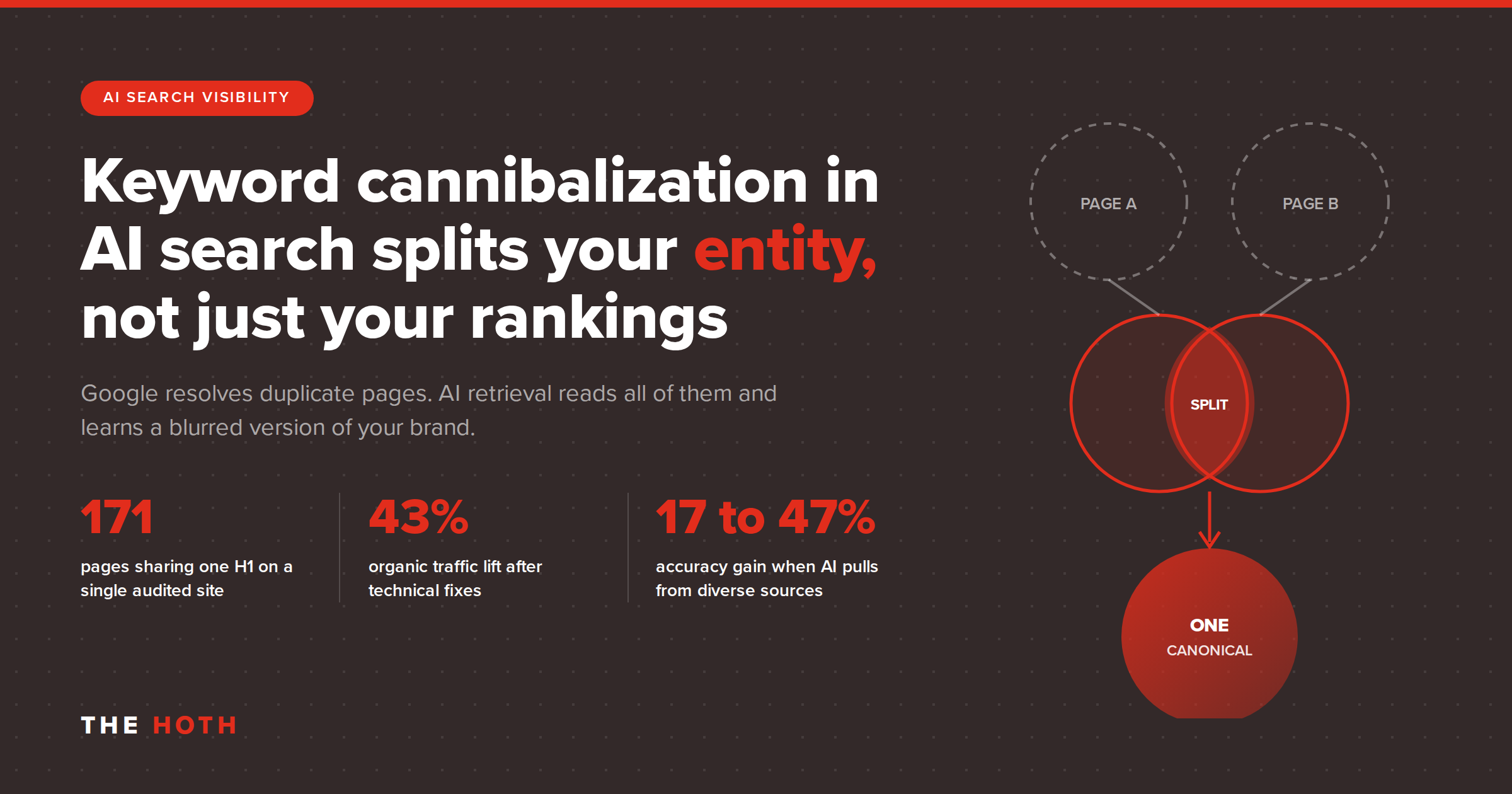

Keyword cannibalization happens when two or more pages on your site target the same query, forcing search engines and AI systems to choose between them. In Google, that split usually resolves itself over time as one page wins. In AI search, it does not resolve. The model simply learns a blurrier picture of what your brand knows, and blurry sources get cited less.
Most guides treat cannibalization as a rankings problem: two pages fighting for one spot, link equity divided, positions bouncing. That framing was fine when a ranking was the only thing at stake. It is incomplete now, because the same overlap that splits your rankings also splits your entity signal, and entity signals are what AI answer engines use to decide whether you are the source worth citing.
This post covers what keyword cannibalization is, why it does more damage in AI search than in a traditional SERP, how to find it on your own site, and how to fix it without throwing away pages that still earn traffic. If you would rather have someone else map the overlap, a Technical SEO Audit does exactly that as part of its header, canonical, and site structure review.
What Is Keyword Cannibalization?
Keyword cannibalization is when multiple URLs on one domain compete for the same search intent. Instead of one strong page, you have several weaker ones, and the search engine has to guess which one you meant to rank.
The word makes it sound dramatic. In practice it is usually accidental. A blog post from 2021 covers a topic, a refreshed version gets published under a new slug in 2024, and a product page picks up the same phrase in its title tag. None of those pages were written to compete with each other. They compete anyway, because search engines index URLs, not intentions.
It is worth separating three things people lump together under this term:
- True cannibalization: two pages target the same keyword and the same intent. One should not exist, or the two should be one.
- Intent overlap: two pages share a keyword but serve different intents, like a product page and a how-to guide. This is often fine, and sometimes strategic.
- Ranking flux: Google alternates which of your pages ranks for a query. This is a symptom of the first two, not a separate problem.
The first case is the one that hurts. And the reason it hurts more than it used to has to do with how answer engines read your site.
Why Is Cannibalization Worse in AI Search Than in Google Rankings?
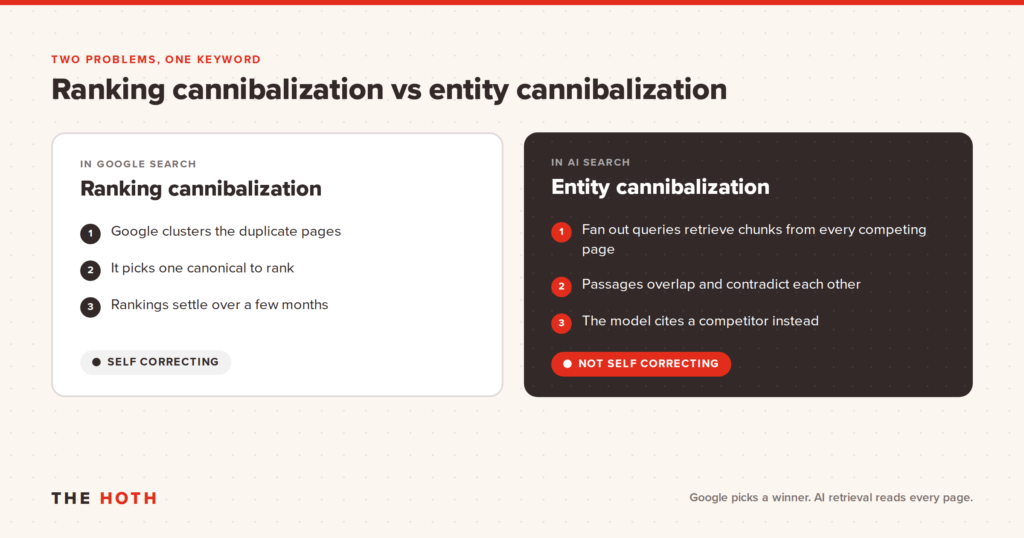
Ranking cannibalization is self-correcting. Google clusters near-duplicate pages, picks a canonical, and the loser fades. Entity cannibalization is not self-correcting. AI retrieval systems pull chunks from whichever of your competing pages match a prompt, and when those chunks disagree or repeat, your brand reads as an inconsistent source rather than an authoritative one.
Here is what happens on the traditional side. When Google indexes pages with the same or very similar primary content, it groups them and chooses the one it judges most complete as the canonical. That is the documented behavior in Google Search Central’s canonicalization guidance: the canonical becomes the main source for evaluating content and quality, and the duplicates get crawled less often. In other words, Google resolves the conflict for you. It may pick the page you would not have picked, and you may lose some link equity in the process, but over a few months the SERP settles on one URL.
AI search does not have that settling mechanism, for two reasons.
Retrieval pulls passages, not pages
Google’s own guide to optimizing for generative AI features describes AI Overviews and AI Mode as retrieval-augmented generation: the system retrieves pages from the index, reads specific passages from them, and composes an answer. It also describes query fan-out, where one user question is expanded into several related sub-queries, each of which retrieves its own set of results.
Now picture three of your pages that each cover “SEO for dentists” from a slightly different year, with slightly different numbers and slightly different recommendations. Fan-out queries will hit all three. The passages that come back overlap, contradict on the details, and none of them is the single clear statement the generator is looking for. A competitor with one definitive page supplies one clean passage. Guess whose sentence ends up in the answer.
Duplicate sources add nothing, diverse sources add a lot
This is not a hunch. A 2026 study from researchers at the University of Queensland and CSIRO on how retriever redundancy and diversity affect RAG answer quality tested exactly this. Feeding the generator duplicate or paraphrased copies of the same document did not significantly improve answer correctness. Feeding it diverse documents from different genres improved correctness by 17 to 47 percent. The model is built to prefer variety across sources, which means your second and third page on the same topic are not extra chances to be cited. They are noise the retrieval layer will try to filter out, and when it does, it may filter out the version you wanted.
That is entity cannibalization. It is not that your rankings drop. It is that the model’s internal picture of “what this brand says about X” gets averaged across several inconsistent pages, and averaged sources lose to precise ones. If you want the fuller mechanics of how AI systems build that picture, our post on why keyword coverage fails without entity coverage walks through it.
Google is now telling you not to do this
The same generative AI guide includes a line that should be pinned above every content calendar: creating separate content for every variation of how people might search, including fan-out queries, is an ineffective long-term strategy and, when done to manipulate results, violates the scaled content abuse policy. Google adds that a high quantity of pages does not make a site higher quality or more relevant. The old habit of spinning up a fresh URL for every keyword variant is now working against you on both fronts.
How Do You Know If Your Pages Are Cannibalizing Each Other?
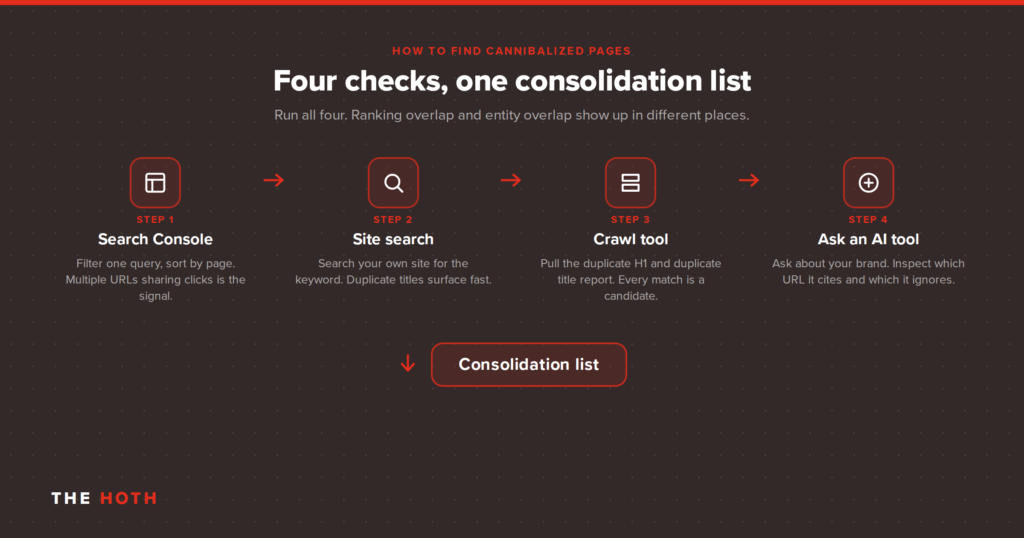
The clearest signs are a query where two or more of your URLs trade positions in Search Console, a site search that returns several near-identical titles, and AI tools that cite an outdated version of your page instead of the current one. Any one of these is worth a closer look; all three together means you have a consolidation project.
You do not need an expensive tool to spot it. Start with what you already have.
Google Search Console
Open the Performance report, filter to a single query, and switch to the Pages tab. If two or more URLs show impressions for that query, and especially if their average positions sit within a few spots of each other, they are competing. Repeat for your top 20 or 30 queries. Then flip it: filter to a single page and look at its queries. A page that ranks for a term you meant for a different page is a second flag.
A site search
Run a search restricted to your domain for your core terms. Scan the titles. Identical or near-identical titles on different slugs are the most common form of cannibalization and the easiest to catch. Pay attention to pairs like “guide” and “guide-2,” or a post and its refreshed twin published under a new URL.
Your crawl or rank tracking tool
Ahrefs, Semrush, and Screaming Frog all surface this in slightly different ways. In Ahrefs, filter Organic Keywords to a term and look for multiple URLs; in Screaming Frog, sort by title tag or H1 and look for duplicates. What you are looking for is the same in every tool: more than one URL for one intent.
The AI check
This is the step most guides skip. Ask ChatGPT, Perplexity, or Google AI Mode a question your site should answer, and look at which of your URLs gets cited. If the citation points at a page you replaced two years ago, or if the answer mixes numbers from two of your posts, the model is already showing you its blurred version of your brand. That is the cost of entity cannibalization made visible.
What Causes Keyword Cannibalization in the First Place?
Most cannibalization comes from four habits: refreshing a post by publishing a new one instead of updating the original, letting category and tag archives index alongside the posts they list, writing product and blog pages around the same phrase, and duplicating H1s and titles across templates.
Each of these has a technical fingerprint, and the fingerprint is often visible in a crawl before it shows up in rankings.
One technical audit for a residential and commercial glass company found 210 pages with multiple H1 tags and 171 pages sharing the exact same H1. That is not a content strategy problem in the usual sense. It is a template problem that produced hundreds of pages telling Google the same thing about themselves. After the header structure was cleaned up alongside redirect chain and image fixes, the site’s organic traffic rose 43 percent and its priority local keywords moved into the top three.
The other frequent culprits:
- Refresh-by-republish. The 2022 post stays live, the 2025 version goes up on a new slug, and both target the same term. Update in place instead. If the original has backlinks, that is where the refreshed content belongs. A Content Refresh is built for exactly this situation.
- Indexable archives. Category, tag, author, and date archives that list your posts can outrank the posts themselves for broad terms. Most sites should noindex them.
- Product versus blog overlap. A service page and a how-to post that both lead with the same keyword phrase. Differentiate the intent: one sells, one teaches, and the titles should make that obvious.
- Homepage creep. Trying to rank the homepage for a money keyword that a dedicated page also targets. We covered why that backfires in our post on homepage SEO.
How Do You Fix Keyword Cannibalization?
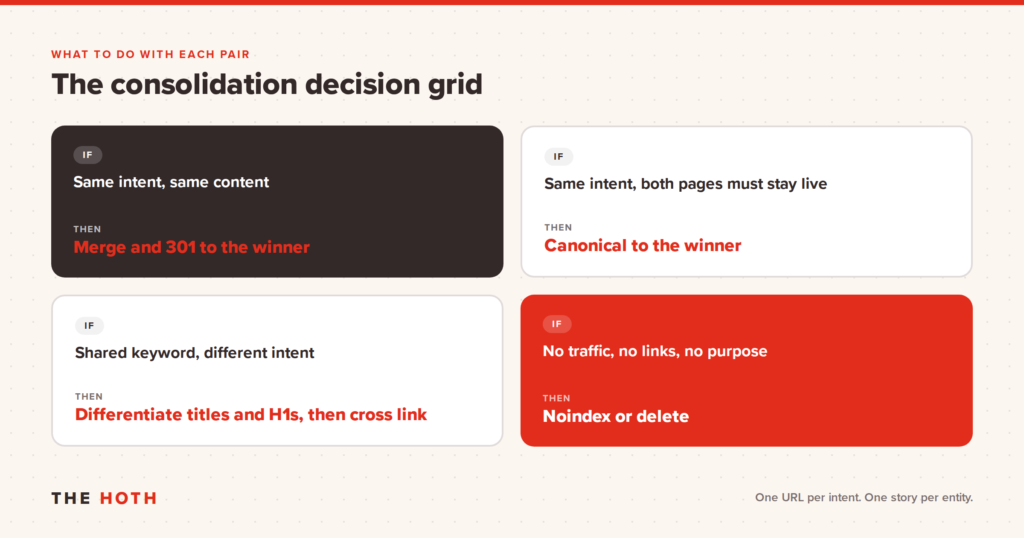
Fix cannibalization by deciding which URL should own each intent, then merging, redirecting, canonicalizing, or differentiating the rest. Consolidation with a 301 redirect is the strongest fix for true duplicates; a canonical tag works when both pages must stay live; rewriting for a distinct intent works when the overlap is only partial.
Resist the urge to delete first. Every competing page has some history: links, internal references, maybe a few citations. The goal is to concentrate that history on one URL, not discard it.
1. Choose the winner
For each overlapping group, pick the URL that should own the intent. Favor the page with the most backlinks, the best existing rankings, the most complete content, and the cleanest slug, roughly in that order. This is the page you will keep and improve.
2. Merge and redirect true duplicates
If two pages cover the same intent, combine the best material from both into the winner and 301 the loser to it. Update every internal link that pointed at the loser so it points at the winner. Then submit the winner for recrawl in Search Console. This is the fix that resolves both ranking and entity cannibalization, because there is now one passage set for the model to retrieve.
3. Canonicalize when both must stay live
Sometimes both pages need to exist for users, like a printable version or a regional variant. Add a canonical tag on the secondary page pointing at the winner. Remember the caveat from Google’s documentation: a canonical is a hint, not a rule, and Google may pick differently if it disagrees with your choice. Make the hint as strong as you can with consistent internal linking and a sitemap that only lists the canonical.
4. Differentiate when the overlap is partial
If the pages share a keyword but serve different jobs, rewrite them so the difference is unmistakable. Distinct titles, distinct H1s, distinct opening paragraphs, and internal links between them that explain the relationship (“Looking for pricing? See our service page.”) The clearer the split, the less the retrieval layer has to guess.
5. Prune what has no reason to exist
Thin archives, expired promotions, and orphaned drafts that picked up an index entry: noindex or remove them. This is the same logic behind our post on why content pruning is now an AEO signal, and it applies here for the same reason. Fewer, clearer pages give the model a sharper picture of who you are.
How Do You Prevent It Going Forward?
Prevention is a one-keyword, one-URL map that every new piece of content gets checked against before it is written. Add a quarterly duplicate-title crawl and a rule that refreshes happen in place, and most cannibalization never gets the chance to start.
Keep a simple spreadsheet: primary keyword, owning URL, intent, last updated. Before anyone briefs a new post, they check the map. If the keyword already has an owner, the new idea becomes an update to that page or a different angle with a different primary term. This one habit prevents more cannibalization than any tool.
Two more guardrails worth adding:
- Template checks. Whenever a theme or page template changes, crawl for duplicate H1s and titles. The glass company’s 171 identical H1s came from a template, not from a writer.
- AI spot checks. Once a quarter, ask an AI assistant your ten most important questions and note which of your URLs it cites. If the cited page is not the one on your map, you have drift to correct. Our guide to building an entity profile AI can find covers how to keep those signals consistent over time.
Where Does a Technical SEO Audit Fit?
A technical SEO audit catches the structural causes of cannibalization that a content review misses: duplicated H1s and titles across templates, conflicting canonical tags, indexable archive pages, and redirect chains that leak equity between competing URLs. Fixing those at the template level removes whole classes of overlap at once.
Most cannibalization is not a writing problem. It is a structure problem that shows up in writing. That is why the fix so often starts with a crawl rather than a content calendar.
The HOTH Technical SEO Audit reviews header structure, canonical and metadata setup, URL architecture, redirect chains, and indexing barriers across your entire domain, then delivers a prioritized report your developers can work from, or that our team can implement for you. It is priced at $1,000 as a one-time engagement, and it is the same audit that found the 171 duplicate H1s in the case above. If your site has been publishing for more than a couple of years, there is a good chance it has overlap you have never seen.
Frequently Asked Questions
Is keyword cannibalization a Google penalty?
No. There is no penalty for having overlapping pages. Google clusters duplicates and chooses one to show, which means the cost is lost visibility and split signals rather than a manual action. The scaled content abuse policy is a separate matter and applies when large numbers of pages are created primarily to manipulate results.
How do I check for keyword cannibalization for free?
Use Google Search Console. Filter the Performance report to one query and view the Pages tab; multiple URLs with impressions for the same query means they are competing. Pair that with a site search for your core terms and look for duplicate titles.
Does keyword cannibalization affect ChatGPT and AI Overviews?
Yes, and differently than it affects rankings. AI systems retrieve passages from multiple pages and prefer diverse, consistent sources. Several of your pages saying similar things with different details do not add up to extra credibility; they read as an inconsistent source, which lowers the chance any of them is cited.
Should I delete cannibalizing pages?
Usually merge and redirect rather than delete. Deleting throws away backlinks and internal link history. Combine the content into the strongest URL, 301 the others to it, and update internal links.
How long does it take to recover after fixing cannibalization?
Ranking consolidation typically shows within a few weeks to a few months as Google recrawls and reprocesses the redirects. AI citation changes are harder to time because each platform refreshes its retrieval sources on its own schedule; quarterly spot checks are the practical way to track it.
Conclusion
Keyword cannibalization used to be a tidy problem: two pages, one keyword, Google picks. In AI search it is an entity problem, and entities do not get picked. They get averaged. Every duplicate page you leave in place makes the model’s picture of your brand a little less sharp, and sharp sources are the ones that get cited.
Find the overlap, choose a winner for every intent, consolidate the rest, and put a map in place so it does not grow back. If you would like help with the structural side, book a call and we will scope the audit.
Leave a comment