

There is a strange thing happening on most business blogs right now. The content is still there. Google is still indexing it. The traffic is just quietly draining out month after month, and nobody can quite figure out why.
Part of the answer is obvious. Search engines have changed. The other part is less obvious but more important: AI search engines like ChatGPT, Perplexity, and Google’s AI Overviews are now pulling answers from a much narrower slice of the web, and that slice is heavily weighted toward fresh content. A post that ranked steadily for three years can quietly fall out of the citation pool inside a single quarter.
HOTH Content Refresh is built for this exact problem. Instead of writing new posts and hoping they pick up where the old ones left off, we update what you already have so it performs in modern search. This post breaks down what the service actually does, what it costs, who it is for, and what kind of results to expect.
Why Your Existing Content Is Losing Ground
Content decay is not a new idea, but the pace has changed. Five years ago, a well-optimized blog post might lose visibility slowly over two or three years. Today the timeline is much shorter, and the cause is not just Google.
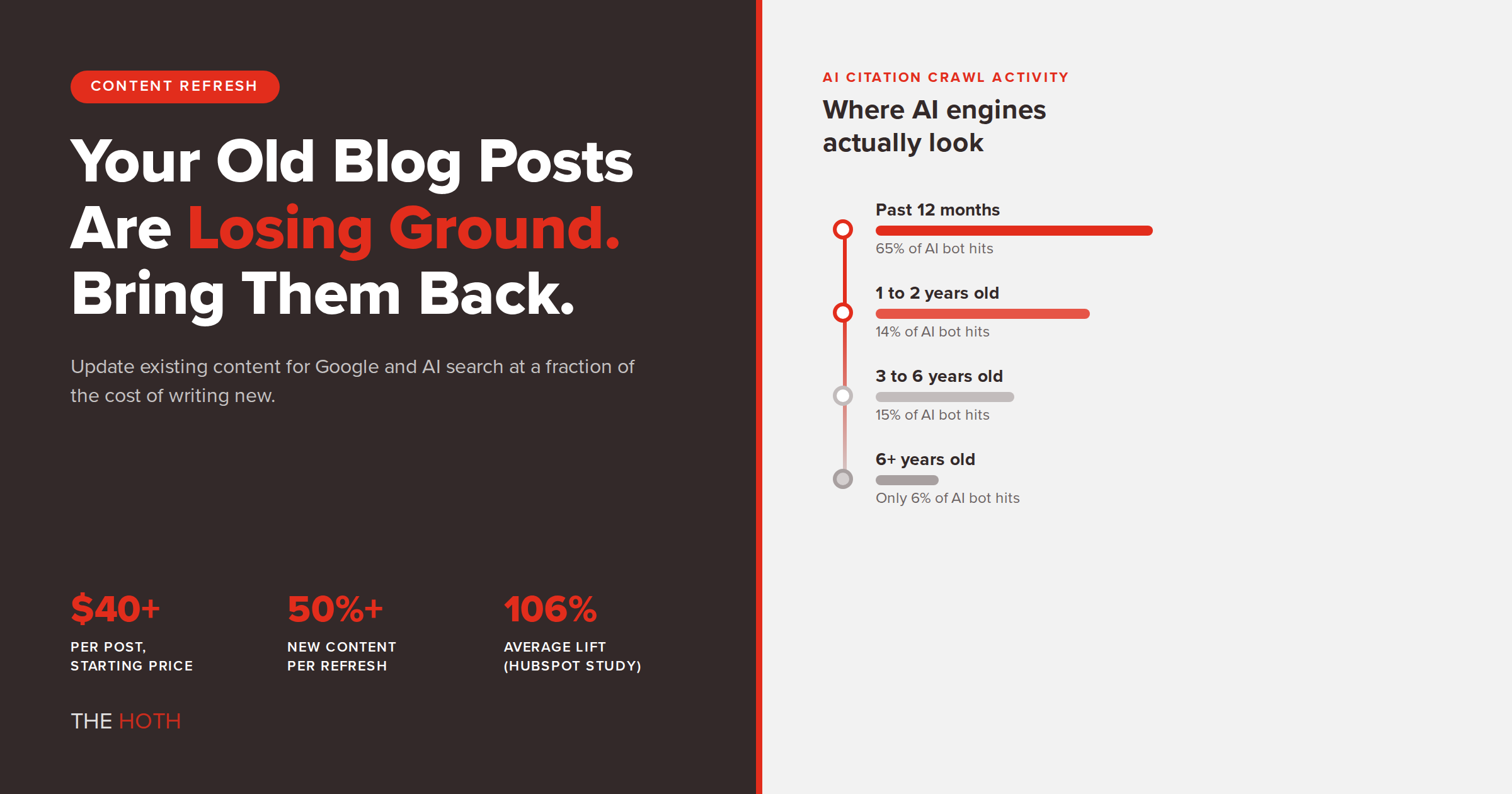
Recent research from Seer Interactive looked at more than 5,000 URLs being cited across ChatGPT, Perplexity, and Google AI Overviews. They found that 65 percent of all AI bot crawl activity targeted content published within the past year. Seventy-nine percent landed on content from the past two years. Only 6 percent of crawl hits went to content older than six years. If your most valuable posts are sitting at three or four years old with no updates, AI engines are not just ignoring them, they are actively spending less crawler time on them.
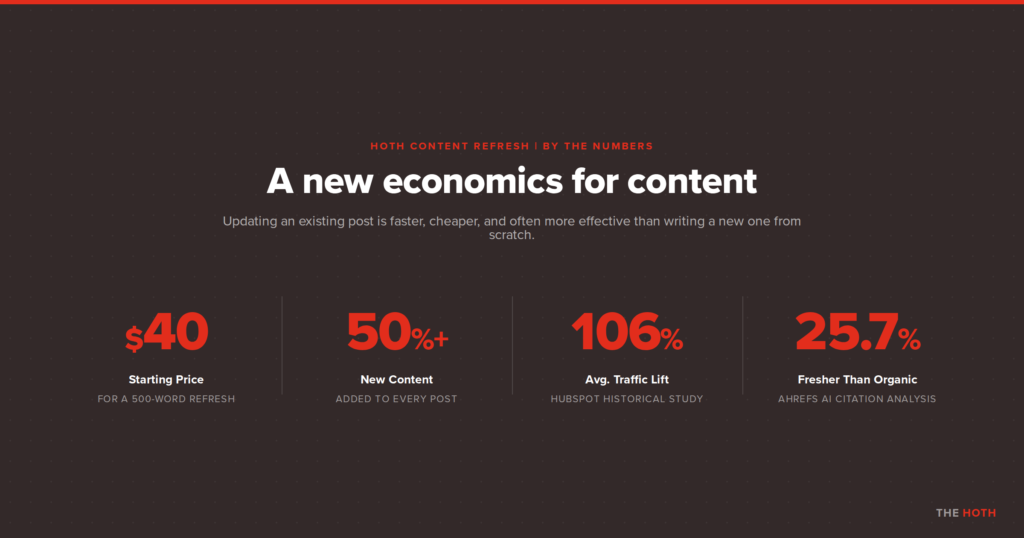
Ahrefs reached a similar conclusion from a different angle. Their analysis of 17 million AI citations across major platforms found that AI-cited content is, on average, 25.7 percent fresher than content cited in traditional Google organic results. Recency is not just one signal among many. It is one of the strongest predictors of whether AI engines will pull your page into an answer.
This is on top of the traditional Google ranking shifts that have been happening for years. Google’s recent core updates and the rise of AI Overviews have added urgency, but the underlying problem is older: content gets stale, citations break, the language of search shifts, and posts that used to rank in position three slowly drift back to position twelve. Page two of Google might as well be invisible, and AI engines often skip it entirely.
So you have two forces pulling your old content down at the same time. Traditional search demoting it for being out of date. AI engines deprioritizing it for being outside the recency window. The compounding effect is steeper than most marketers realize until they look at their analytics and notice that posts they paid good money to publish two years ago are now bringing in almost no traffic at all.
What HOTH Content Refresh Actually Does
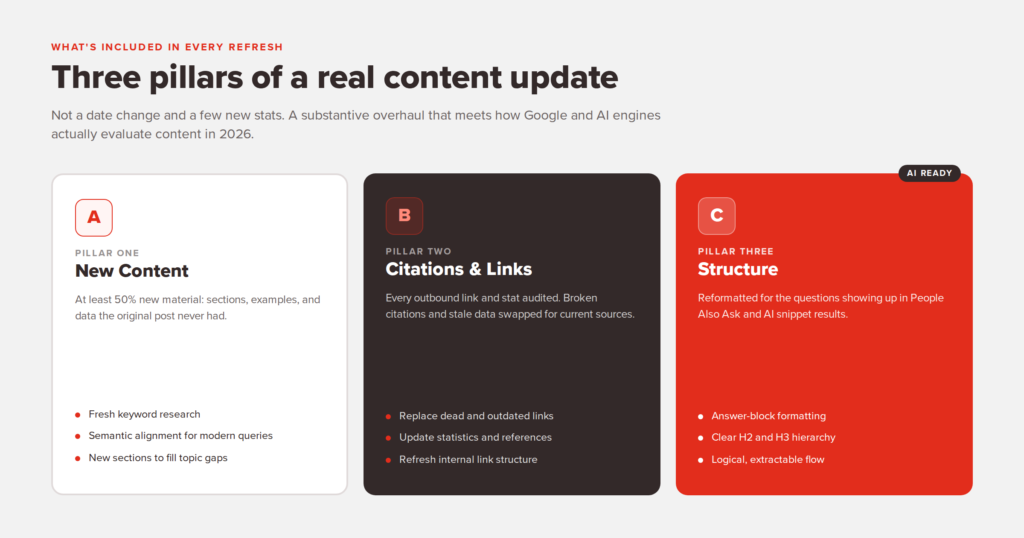
Content Refresh is a managed update service. You hand us a blog post, our strategists do the research, and we return a substantially updated version of that post optimized for both Google and AI search. It is not a light edit. Every refresh includes at least 50 percent new content, plus a long list of structural and citation improvements.
Here is what is included in every refresh:
- Fresh keyword research. We map your post to how people are actually searching today, including the conversational, question-based queries AI tools are built around.
- Citation and link modernization. We audit every outbound link and stat in the post, replacing broken citations and outdated data with current, credible sources. Clean citations help AI systems treat your content as a reliable reference rather than a stale document.
- 50 percent or more new content. We identify what your post is missing and expand it with new sections, examples, and data that did not exist when the original was written.
- Answer-optimized formatting. We restructure content to directly address the questions showing up in People Also Ask boxes and AI snippet results. Clear H2s, concise answer blocks, logical flow.
- Semantic keyword alignment. We bridge the gap between the terms your post was originally written for and the related language modern search engines use to understand topic coverage.
- Internal and outbound link updates. We update your link profile to reflect your current site structure and point to the most relevant external sources.
- A new image. Every refresh includes one new visual, either stock or client-provided.
- A full changelog. You get a summary of every change made, so you can brief your team or client on exactly what was updated.
You get the finished post back as a Google Doc or in a CMS-ready format, so the only thing left to do on your end is publish.
How Pricing Works
Content Refresh is priced by the word count of the original post you are updating, not by the work involved in researching it. That keeps things predictable and lets you budget across a queue of posts. Here is the current pricing:
- 500 words: $40
- 1,000 words: $70
- 1,500 words: $95
- 2,000 words: $125
To put that in context, a single fresh blog post written from scratch typically runs three to five times the cost of refreshing an equivalent piece. And refreshed posts re-index faster than new ones because they are already established URLs with existing backlinks, internal link equity, and crawl history. You are not asking Google to discover something new. You are asking it to re-evaluate something it already knows.
That economic gap is one reason historical optimization has become a core strategy at major content operations. HubSpot’s well-known historical optimization study found they were able to increase monthly organic search views to refreshed posts by an average of 106 percent, and more than double the leads those posts generated. That is the kind of compounding return that makes refresh work easy to justify when you stack it next to the cost of net-new content.
Who Content Refresh Is Built For
Content Refresh works best for businesses with an existing library of blog content that is no longer pulling its weight. A few situations where it tends to make a real difference:
HOTH Blogger Customers With Aged Posts
If you have been ordering HOTH Blogger content from us for a while, you almost certainly have posts that are six to twenty-four months old and starting to slip in the rankings. Those posts already have established URLs, some backlinks, and at least a baseline level of indexing. Refreshing them is significantly more efficient than writing new content on the same topics. We will start with HOTH Blogger posts because we already have the original briefs and context, but we can refresh content from any source.
Brands Building AI Search Visibility
If you are running an AI Discover campaign with us, Content Refresh is one of the highest-leverage levers in the playbook. AI Discover identifies which of your pages are getting cited in ChatGPT, Perplexity, and Google AI Overviews, which ones used to and don’t anymore, and where your competitors are showing up that you aren’t. Content Refresh is what you do with that intelligence: target the pages that have dropped out of the citation pool, refresh them with current data and AI-ready structure, and pull them back into rotation. Pair that with earned media placements to build the off-site authority signals AI engines weight alongside freshness, and you have a complete AI visibility stack.
Businesses Recovering From Traffic Drops
If you have noticed your overall organic traffic sliding over the last six to twelve months, the cause is rarely one big problem. It is usually dozens of older posts each losing a small amount of visibility, all at the same time. A targeted refresh program is one of the fastest ways to stabilize and reverse that pattern, because you are touching the exact pages that are bleeding.
What Refreshed Content Can Do: A Real Example
To see why updating existing content matters so much, look at what happens when a business actually has good content sitting on their site but is not getting full value from it.
A B2B client of ours ran a PDF generation library for the C# programming language. They had built an active blog that produced consistently well-written content for developers. The problem was visibility. They were ranking for some keywords, but most of their content was sitting in positions 4 through 30, which is a graveyard for organic traffic. Page two and beyond capture only a tiny fraction of clicks compared to page one.
Their content was not the issue. The issue was that the content needed to be optimized harder around how developers were actually searching, supported by additional authority signals, and structured to capture the easy-win keywords already within reach. We focused on those positions 4 through 30 specifically, because they represent posts that are close to ranking but need a push.
The results from that B2B campaign were dramatic: a 787 percent increase in organic traffic, more than 1,500 keywords ranking in the top 10, and thousands of valuable backlinks pointed at their most important pages. The campaign used link building heavily, but the foundation was the existing content already doing the work on the page. Without that content, links would have had nothing to amplify.
The lesson for Content Refresh is simple: the posts you have already published are an asset. They have URL history, some link equity, and topical relevance. The work of writing them is sunk cost. What is left is whether you let them keep aging or invest a small amount to bring them back into the visibility window.
Refresh vs. Rewrite vs. New Content: How to Decide
Not every old post should be refreshed. Some are better off rewritten from scratch. Some should be archived. And some topics simply need a fresh post rather than an update to an existing one. Here is a quick framework for sorting through your library:
Refresh When…
- The post still ranks for at least one or two relevant keywords, even if not in the top 10.
- The topic is still relevant to your business and your audience.
- The URL has accumulated some backlinks or internal link equity.
- The core structure of the post is still useful, even if specifics need updating.
Rewrite When…
- The original post is thin or low quality, and a refresh would not save it.
- The topic has shifted so significantly that the original framing no longer makes sense.
- Search intent for the target keyword has changed (informational vs commercial, for example).
Write New When…
- You have a clear topic gap with no existing post to refresh.
- You are entering a new product line or service area.
- You want to capture a high-volume keyword where competitors have stronger, more recent content than anything you have.
Most blogs benefit from a healthy mix. Refresh the bulk of your existing library on a rolling cadence. Rewrite the small handful of posts that are too far gone to save. Write net-new content for the gaps.
How to Prioritize Which Posts to Refresh First
If you have dozens or hundreds of old posts, refreshing all of them at once is not realistic. The smart approach is to start with the posts where a refresh is most likely to produce a measurable lift. A few signals to look for:
High-traffic posts that are slipping. Pull a list of your top organic landing pages from the last 12 months and look for any that show a clear downward trend over the last few quarters. These are the highest-leverage refresh targets because you already know the topic has demand and the post had momentum.
Position 4 through 20 keywords. Posts ranking just outside the top 3 are often the easiest to push into top positions with a refresh, because Google already considers them relevant. A modest improvement in content quality and freshness can move them several positions, which is where the real traffic lives.
Pages that used to win AI citations and don’t anymore. If you track AI visibility and notice specific posts that used to get cited and have dropped out, those are flashing red lights. The recency window has closed on them, and a refresh is often what pulls them back in.
Posts targeting keywords with high commercial intent. A 10 percent traffic improvement on a post that drives leads is worth more than a 50 percent improvement on a top-of-funnel awareness post. Prioritize where the dollars actually are.
Most clients work through their queue in waves of 10 to 25 posts at a time, refreshing the highest-priority pieces first and then circling back to lower-priority ones in the next wave. Over six to twelve months, that approach can effectively modernize an entire blog library at a fraction of the cost of net-new content.
Why This Matters More in 2026 Than It Did in 2020
The case for updating old content has been around for years. HubSpot has been writing about historical optimization since at least 2018. What has changed is the cost of not doing it.
Five years ago, a stale post might lose some traffic but still pull a baseline of visitors from long-tail Google searches. The penalty for letting it sit was small. Today, that same stale post is being filtered out of AI Overviews, dropped from ChatGPT and Perplexity citation pools, and demoted by a Google algorithm that increasingly prioritizes signal-rich, current sources. The penalty has grown enormous, and it is paid silently. You do not get an alert when ChatGPT stops citing you. You just disappear from a search channel that is becoming more important every quarter.
The work itself has also become more nuanced. Refreshing a post for 2026 is not just about updating the publish date and a few stats. It means restructuring for AI extractability, adding the schema and answer-block formatting that AI engines pull from, replacing citations with sources current enough to actually help your credibility, and aligning your language with how people are now phrasing questions to chat-based search. That is a real strategic effort, and it is not work most in-house teams have time to do at scale.
Getting Started With a Refresh Program
If you are thinking about putting a refresh program in motion, here is a clean way to start without overcomplicating it:
Audit first. Pull your top 50 organic landing pages from the last 12 months and overlay traffic trends, keyword positions, and last-updated dates. You will quickly see which posts are at risk and which are quietly bleeding already.
Pick a first wave. Choose 10 to 15 posts to refresh first. Mix in some high-traffic pieces showing decline, some position 4 to 20 posts with easy upside, and one or two commercial-intent posts where small improvements meaningfully affect revenue.
Set a baseline, then refresh. Record current organic traffic, top keyword positions, and (if you track it) AI citation presence before any post is updated. Refreshed posts typically start showing movement within 4 to 8 weeks as Google re-crawls them. AI engines often respond faster, since their indexes update more aggressively.
Iterate in waves. Once you have measurable results from your first batch, scale up. Most blogs benefit from a steady cadence of 5 to 15 refreshed posts per month rather than one giant push.
How HOTH Can Help
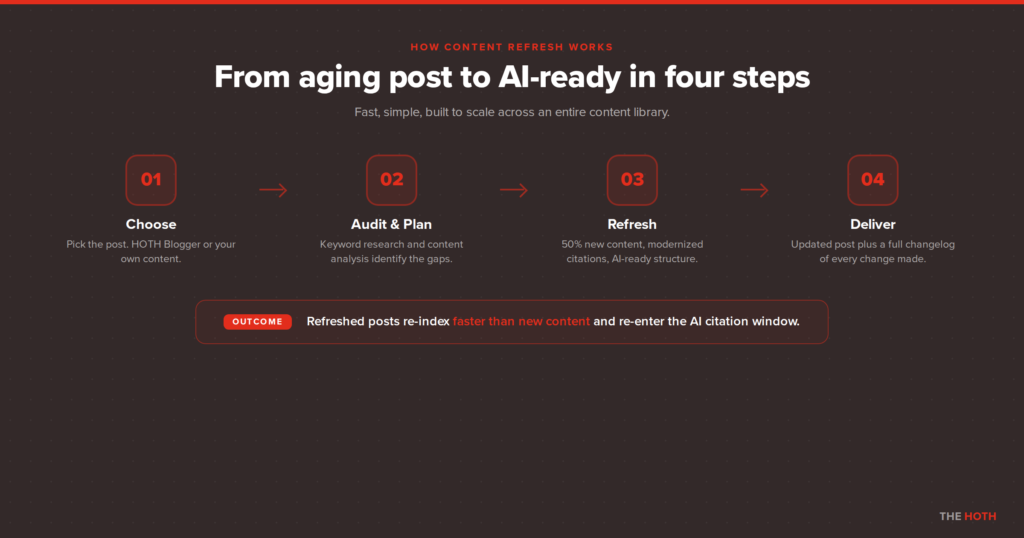
HOTH Content Refresh is built to take this work off your plate. You pick the posts. We do the keyword research, content analysis, expansion, citation cleanup, formatting, and image. You get back a Google Doc with the full refreshed post and a changelog explaining what was updated. Pricing starts at $40 for a 500-word refresh and tops out at $125 for a 2,000-word post.
If you are not sure which posts to prioritize, AI Discover is the natural starting point. It audits how your brand currently shows up across ChatGPT, Perplexity, and Google AI Overviews, identifies the pages that are losing citation share, and gives you a ranked list of refresh targets. From there, Content Refresh executes the updates. The combination is purpose-built for brands serious about AI visibility.
And if you would rather handle the refresh work yourself, our existing guide to re-optimizing old blog posts walks through the DIY version of the process. The work is the same. The question is just whether you want to do it in-house or hand it off.
Either way, the first step is a conversation about what your library looks like and where the biggest opportunities are. Book a free strategy call and we will walk through your existing content with you, point out the highest-priority refresh targets, and put together a plan that fits your budget and timeline.
The Bottom Line
Most businesses are sitting on a content library that is more valuable than they realize. The posts are there. The URLs have history. The work of writing them is already done. What is missing is the maintenance that keeps them performing in a search environment that has changed faster in the last two years than in the previous ten.
Content Refresh is the simplest way to do that maintenance at scale. It is cheaper than rewriting, faster than starting over, and aligned with how Google and AI search engines actually evaluate content in 2026. If you have any volume of older blog content on your site, the question is not whether to refresh it. It is just where to start.
Leave a comment