

If you don’t align your website with how AI understands content, you risk losing visibility on generative answer engines.
This can be true even if your content ranks well organically in Google’s classic ‘10 blue links’ setup.
Visibility on generative engines like ChatGPT and Google’s AI Overviews has only become increasingly more important since their introduction a few years back.
In fact, the mere presence of an AI Overview for a keyword plummets organic click-through rates by 58%, which has significantly and steadily increased from the original percentage, 34.5%, reported in April 2025.
That means AI-driven search features are continuing to overthrow organic search, so it’s crucial for marketers and site owners to adapt to AI now before the cost of playing catch-up becomes too great.
The good news?
AI visibility pays off big when done right.
Research shows that referrals from AI platforms convert 4.4x better than organic visitors, meaning visibility translates into high-quality leads.
Also, brands that earn consistent AI citations earn 35% more clicks than brands that don’t get cited (Seer Interactive 2025).
This guide will teach you how to refresh and restructure your content to feed AI systems clean, reusable answers.
How AI Understands Content: Why Bloated Pieces Don’t Get Cited

Large language models (LLMs) and traditional search engines do not process content the same way.
Google’s organic search relies on Googlebot, which crawls entire documents from top to bottom.
LLMs don’t operate like this. They break content into token-based chunks (typically 128 – 1024 tokens) during the indexing process.
At query time, they retrieve the most relevant ‘chunks’ or snippets, and ignore the rest.
For example, when answering a query like ‘what are the pros and cons of cloud gaming,’ an LLM might pull ‘pros’ chunks from site A, ‘cons’ chunks from site B, blend them in an original answer, and then cite both.
All this takes place without ever parsing the full articles.
Translation?
Content that’s formatted in clean, self-contained chunks gets cited the most.
In other words, each subheading should function as an independent ‘mini-article’ that can stand on its own without requiring any parent context.
Meandering, bloated content doesn’t chunk well, which can confuse LLMs and cause them to miss the point.
What does bloated content look like?

A major factor to watch out for is content bloat, which refers to anything that makes a page longer without making it clearer or more valuable.
Some common examples include:
- Low information density. LLMs don’t reward verbosity without depth, even if it’s clever. Avoid all generic fluff when composing content, and aim for a high information-to-word ratio. For each sentence, convey your point in as few words as possible.
- Repetition and redundancy. Avoid restating the same point across multiple sections, even if it’s worded differently. Once you’ve established the main idea of a section, move on to the next one. LLMs will view slightly rephrased sentences as redundant if they don’t add new facts, angles, or examples.
- Meandering structure. Do not weave multiple topics into the same section. Each subheading should remain tightly focused on one idea. For instance, if you have an H3 entitled ‘The Pros and Cons of Cloud Gaming,’ you shouldn’t begin with a long-winded history of the technology. List the pros and cons, and then move on.
- Formatting that’s unfriendly to chunking. Neither machines nor humans are fans of large, unbroken walls of text. Thus, your content should be separated into subheadings based on clear topical boundaries. For example, you could split the cloud gaming article into subheadings like ‘The History of Cloud Gaming,’ ‘The Pros and Cons of Cloud Gaming,’ and ‘How to Start Cloud Gaming Today.’ Also, ensure your subheadings contain clear titles and aren’t vague (avoid things like ‘More Info’ and ‘Conclusion’).
Bloated content is like kryptonite for AI search campaigns because it’s fundamentally at odds with the way LLMs ingest and reuse information.
Parsing, Compressing, and Reusing Content: How LLMs Operate

Next, let’s take a closer look at how LLMs retrieve, interpret, and reuse online content.
Instead of crawling or reading every word on a page, AI systems go through a multi-step process:
- Tokenize – The first step is to break text into tokens, which are pieces of words. Once tokenized, the model sees statistical patterns instead of ‘word meanings’ in the human sense. Because of this, longer, fluffier sentences contain more tokens and carry a weaker signal. Clean phrasing and sentence structure improve pattern recognition.
- Encode – Next, the model converts tokens into embeddings, which are high-dimensional vectors that encode semantic relationships (like that ‘cloud gaming’ is related to concepts like ‘latency’, ‘streaming’, and ‘video compression’).
- Compress – LLMs behave like lossy compressors of natural language patterns. However, compression is an emergent property of training and transformer processing, not something that happens during the tokenization or embedding process. Generic fluff, meandering intros, and vague adjectives get discarded during the compression process. Only meaningful content, like clear claims and structured lists, makes it through.
- Reconstruct – AI models do not copy direct paragraphs from the snippets they choose to cite. They reconstruct the linguistic patterns that they uncovered during the retrieval process. If your content has distinct phrasing, it’s more likely to influence the outputs. Also, well-structured content teaches the model how to format lists, compare concepts, and explain processes.
This process explains why stale, bloated content underperforms on AI search platforms, even if it ranks well organically.
In fact, research from Originality.ai shows that 52% of AI citations originate from outside the top-100 ranked organic results:
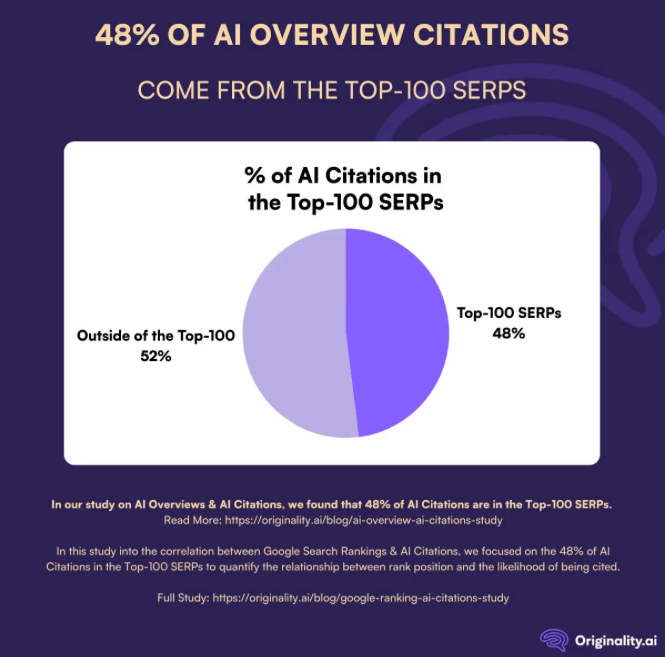
This is proof that structure beats pure rank for improving AI search visibility.
How to Keep AI Content Signals Clean and Compressible: Refresh and Optimization
Making your content AI-friendly is two-fold:
- Structuring new content that feeds clean signals to AI models
- Fixing what’s broken by refreshing stale, bloated content
If you’re starting from scratch, you can focus on step A.
However, if your site has lots of meandering, unfocused content, you’ll need to re-optimize it (or simply delete pages that no longer provide value).
Can you ignore old bloated content and just focus on creating new AI-friendly pieces?
The answer is no, and here’s why.
Index bloat can also impact AI search visibility, and it occurs whenever your domain has too much low-value content.
While there are no penalties for this, it negatively impacts visibility because low-quality content dilutes your site’s semantic clarity and retrieval signals.
LLMs look for coherent topical clusters when retrieving content, and index bloat causes entities to scatter and topical boundaries to blur.
That’s why it’s crucial to refresh your existing content if it doesn’t feature AI-friendly formatting.
Content refresh: Ridding your site of fragmented noise

A content refresh involves updating and reformatting key pieces from your content library.
Besides bloated content, stale content is another AI visibility killer.
Research shows that pages updated within 60 days are 1.9x more likely to get cited by LLMs. Stale content that’s over a year old typically gets ignored.
That means you need to keep your content as fresh as possible to earn the most AI citations.
Here are some tips for updating older pieces:
- Update all stats, tools, and screenshots to reflect the current year.
- Refresh timestamps on the page and in structured data.
- Check all internal and external links to ensure they still work (update sources if they’re too old).
These reformatting tips will aid with the chunking process:
- Align answers with questions. List the key stat or main idea within the first 50 words of each H2.
- Designate topical boundaries. If your articles don’t contain subheadings, split the piece into hard topical boundaries (pros and cons, how it works, etc.). Follow the proper subheading order (H2, H3, H4, etc.).
- One idea per chunk. Do not mix and match ideas between subheadings. Stick to the main idea presented in the parent heading, and don’t venture off topic.
- Add structured data. Your article chunks should contain schema types like FAQPage, Article, and HowTo to make your content machine readable.
The same optimizations apply to all the new content you plan to produce. Follow this structure, and you’ll wind up with tightly formatted content that delivers clean, compressible signals to AI systems.
| Do you have too much content to refresh or don’t have the time? Let our team of experts handle it for you with our Content Refresh service. |
Technical SEO: Laying the infrastructure AI needs

Lastly, technical SEO builds the highway system that delivers clean content chunks to AI models.
Whether you’re creating brand-new content or are giving old pieces a makeover, technical SEO plays a major role.
The core technical fixes for AI visibility include:
- Crawl budget optimization – You should remove thin or unnecessary pages, as they could be hogging your crawl budget. Prioritize high-value content above all else. Ask yourself, do you really need six guides covering the same topic? The leaner your website is, the more time Googlebot and LLMs will spend on your AI-ready chunks.
- Schema markup for clean chunk extraction – Structured data is massively important for AI search visibility. AI systems extract structured data 3 – 5x faster than parsing raw HTML, and it disambiguates your content so that LLMs can cite it with confidence.
- Page speed and core web vitals – Slow pages only get partial renders, which interferes with the chunking process. That means page speed still matters in a big way, and not just for your user experience.
Perfect content can be rendered completely invisible without airtight technical SEO, which is why it’s essential to include.
| Want to uncover your site’s technical issues without enduring any headaches? Our Technical SEO services have your back. |
Wrapping Up: How AI Systems Understand and Reuse Content
Chunkable content structure plays a similar strategic role in AI visibility that keyword density once did in classic SEO.
It’s the dominant optimization lever that makes AI citations a possibility.
Granted, you still need top-tier content that provides original insights and off-site trust signals like third-party brand mentions, but implementing the right formatting is table stakes.
Without it, even outstanding content can be filtered out as noise.
Do you want to populate your site with AI-friendly content that actually earns citations?
Sign up for AI Discover, our managed AI optimization service!
Leave a comment