

Your traffic is flat. Your keyword rankings look fine. But leads are up, branded searches are climbing, and your sales team keeps saying prospects already know who you are when they get on a call.
Something is working. Your standard SEO report just isn’t showing you what.
This is the new reality of measuring search performance in 2026. AI tools like ChatGPT, Perplexity, and Google’s AI Overviews are sending buyers to your brand before they ever click a link. That influence is real and it’s growing, but none of it shows up in a traditional keyword ranking report.
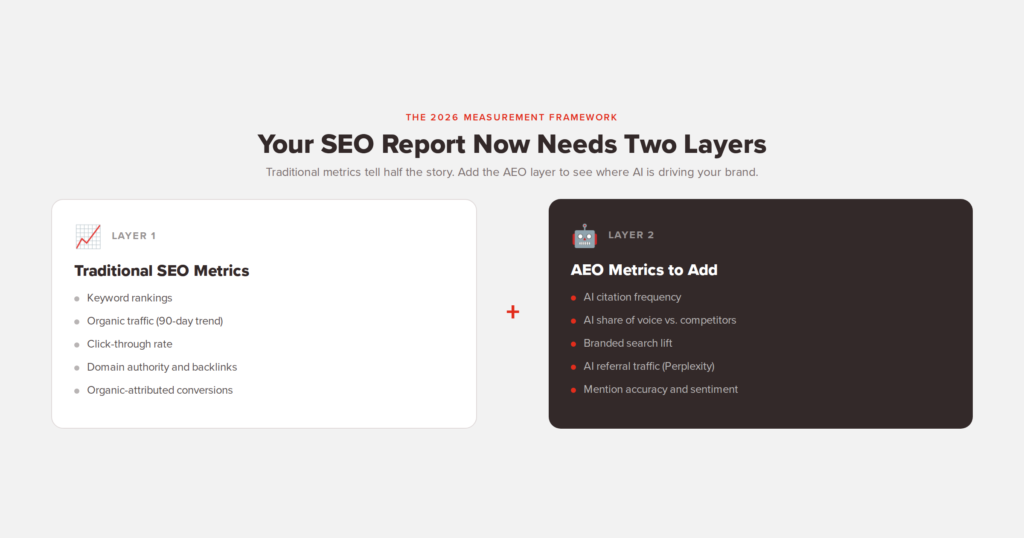
This guide walks through both layers of a complete 2026 measurement framework: the traditional SEO metrics you still need, and the AEO metrics you need to add alongside them to see the full picture.
Why Your SEO Report Now Needs Two Layers
Traditional SEO measurement was built for a world where visibility meant a click. You ranked, someone clicked, you tracked it. The loop was clean.
That loop is still valid, but it’s no longer complete. AI search adds a parallel channel where your brand can influence buying decisions without generating a single trackable click. A prospect asks ChatGPT which SEO agency to consider. Your name comes up. They remember it. Three weeks later they search for you directly. In a standard attribution model, that conversion looks like direct traffic, or a branded search, with no connection to the AI citation that started the journey.
The scale of this is no longer trivial. Semrush research found that visitors arriving from AI search platforms convert at 4.4 times the rate of traditional organic search visitors, likely because they arrive already informed and pre-qualified. If you’re not tracking where that influence comes from, you’re not measuring a significant and growing portion of what’s actually driving revenue.
The goal of this guide is to help you track both: the traditional channel you’ve always measured, and the AI visibility layer that’s operating alongside it.
Layer 1: Traditional SEO Metrics You Still Need
Before adding anything new, it’s worth being clear: traditional SEO metrics still matter. Rankings, traffic, and backlink data haven’t become irrelevant. They’ve just become insufficient on their own. Keep tracking all of these.
Keyword rankings
Position tracking tells you where you stand in organic search for your target terms. Google Search Console gives you average position data for free. Paid tools like Ahrefs and Semrush let you track specific keywords over time, including ones you’re not yet ranking for. Check this monthly at minimum, weekly for competitive terms.
Organic traffic
Raw session data from organic search in GA4 or Google Search Console. Look at trends over 90-day rolling windows rather than week-over-week to smooth out volatility. Segment by page type (blog, landing page, product) to understand which content is driving growth.
Click-through rate
CTR from Search Console shows you how often searchers click your result when it appears. A ranking holding steady but CTR falling often signals an AI Overview or featured snippet is absorbing clicks above you. Flag this early so you can evaluate whether you need to optimize for the feature rather than just the position.
Domain authority and backlink profile
DA or DR (depending on your tool) gives you a snapshot of your site’s overall link authority. Monitor referring domain count and the quality of new links earned each month. Both traditional search rankings and AI citation patterns are influenced by link authority, so this metric serves double duty in a 2026 reporting stack.
Conversions from organic
Connect your SEO performance to business outcomes: leads, form fills, calls, purchases. Without this, SEO remains a marketing expense rather than a documented revenue driver. Set up goal tracking in GA4 with organic search as a segment.
Layer 2: AEO Metrics to Add Alongside Them
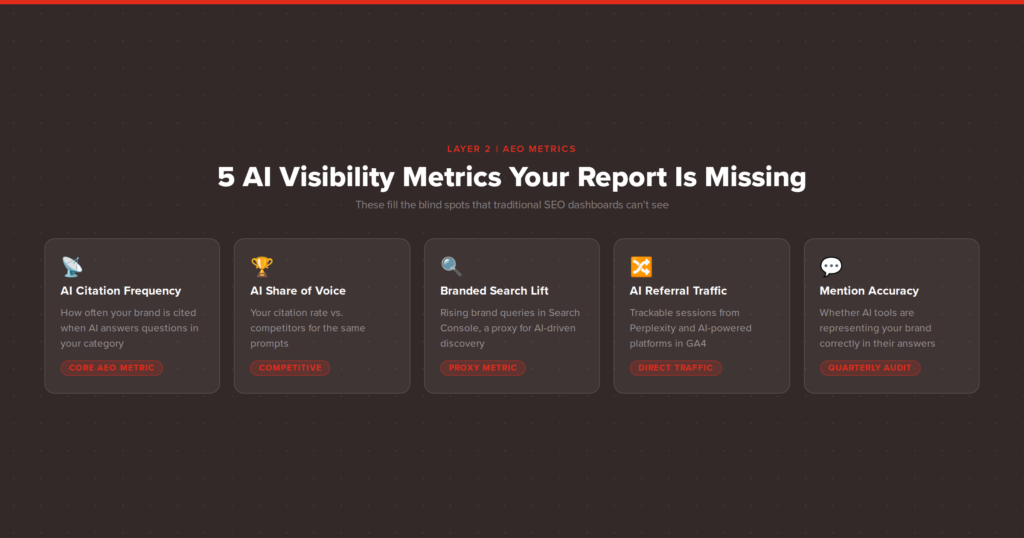
These are the metrics your current reporting stack almost certainly doesn’t include. None of them replace what’s above. They fill the blind spots.
AI citation frequency
How often does your brand get cited when AI tools answer questions in your category? This is the core AEO metric. To track it manually, build a set of 20 to 50 prompts that your target customers would actually ask — things like “what’s the best SEO agency for a law firm” or “how do I build backlinks in 2026” — and run them monthly across ChatGPT, Perplexity, and Google AI Mode. Log whether you’re cited, whether a link is included, and what position you appear in relative to competitors.
For automated tracking, platforms like Ahrefs Brand Radar, SE Ranking, and Semrush now have AI visibility modules that monitor brand mentions across AI platforms. These are still maturing but are worth including in your stack if you’re actively investing in AEO.
AI share of voice
Citation frequency tells you your absolute count. AI share of voice tells you how that compares to competitors for the same prompts. If ChatGPT cites your competitors on 60% of relevant queries and you appear on 15%, that’s your gap. This competitive benchmark is what turns AEO from a vague aspiration into a measurable performance target you can improve against quarter over quarter.
Branded search lift
This is the most underrated proxy metric for AI visibility impact. When AI tools mention your brand without a click, users often search for you directly later. A rising trend in branded search volume, trackable in Search Console by filtering to your brand name, is a reliable signal that your brand is being surfaced in AI answers even when you can’t directly attribute it. Track branded query volume monthly alongside your AEO efforts and look for correlation.
AI referral traffic
Perplexity and some other AI platforms do send trackable referral traffic. In GA4, filter your traffic sources to look for referrals from perplexity.ai, bing.com (which powers some AI responses), and other AI platforms. ChatGPT and Google AI Overviews generate less directly trackable traffic, but what arrives from Perplexity gives you a real data point on AI-driven discovery. Segment this traffic by conversion rate and compare it to your organic baseline.
Mention accuracy and sentiment
As your brand appears more in AI-generated answers, it’s worth occasionally auditing what those answers actually say. AI tools can misrepresent products, describe services inaccurately, or frame your brand in ways you’d want to correct. Run your brand name through ChatGPT, Perplexity, and Gemini quarterly and read the responses. Inaccuracies are a signal to update your content and structured data so AI systems have better source material to draw from.
Building a Reporting Stack That Covers Both
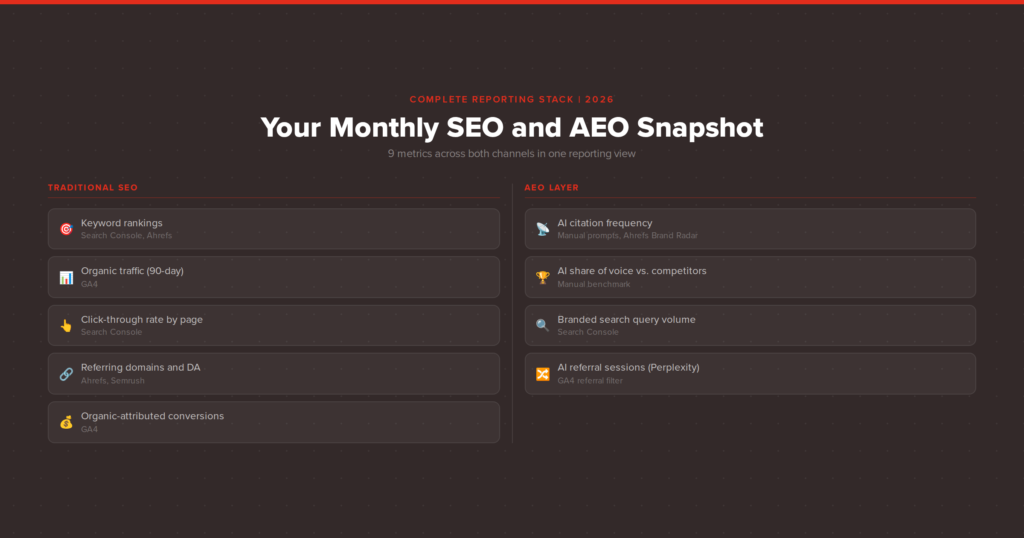
The practical challenge is that these two layers currently live in different tools. Traditional SEO data lives in Search Console, GA4, Ahrefs, or Semrush. AEO data requires a mix of manual prompt testing and dedicated AI visibility platforms. The goal is to bring key metrics from both into a single monthly reporting view, even if that means a simple spreadsheet alongside your existing dashboards. You can read more about setting up AI-specific tracking in our post on AI visibility reporting.
What a complete monthly snapshot looks like in 2026:
- Keyword rankings for core targets (Search Console or Ahrefs)
- Organic traffic trend, 90-day rolling (GA4)
- CTR by page, flagging any drops near AI Overview positions (Search Console)
- New referring domains and DA trend (Ahrefs or Semrush)
- Organic-attributed conversions (GA4)
- AI citation frequency across your prompt set (manual or platform)
- AI share of voice vs. top 2 to 3 competitors (manual benchmark)
- Branded search query volume trend (Search Console)
- AI referral sessions from Perplexity (GA4 referral filter)
Not every business needs all of these from day one. If you’re just starting to add the AEO layer, begin with branded search lift and a manual monthly prompt test. Those two alone will tell you more than most teams currently know about their AI visibility.
When to Bring in Managed Help
Building and maintaining this measurement framework takes time, and the AEO layer in particular requires ongoing attention as AI platforms update their citation behavior. If you’re running managed SEO with The HOTH, your campaign includes regular reporting on the traditional metrics above. And if you’re on AI Discover, the Atlas dashboard tracks your AI citation frequency, topic coverage, and competitor benchmarking automatically, giving you the AEO layer without building it from scratch.
For teams that want to understand their current AI visibility before committing to an ongoing service, the free AI Visibility Assessment is the logical starting point. It maps where you currently stand across AI platforms and identifies which categories of prompts your competitors are winning that you’re not.
You can book your AI Visibility Assessment here.
The Bottom Line
SEO measurement hasn’t become obsolete. It’s become incomplete on its own. The brands that will have a clear performance picture in 2026 are the ones tracking both layers: the traditional signals that show search engine performance, and the AEO signals that show AI visibility.
Start with what you have. Add the AI layer incrementally. And make sure your reporting reflects where your customers are actually discovering you, not just the channels you can most easily count.
If you want to know where your brand stands in AI search right now, get your free AI Visibility Assessment.
Leave a comment