

On AI-powered search platforms, your brand’s reputation is a first-rate ranking factor.
Wait, doesn’t a business’s reputation matter on regular search engines, too?
Yes, but it’s more of a proxy than a direct ranking factor.
Google’s organic search algorithm weighs a brand’s authority by analyzing its backlink profile.
At its core, it uses math to count the number of backlinks a website has, with each backlink counting as a ‘credibility vote.’
Backlinks coming from trusted domains count as stronger votes, but the system has no way of actually understanding a brand’s reputation. It only goes by ‘who links to you.’
E-E-A-T (experience, expertise, authoritativeness, and trustworthiness) signals also play a role, but Google’s algorithm can only approximate these using markup, pattern recognition, and domain-level metrics like backlink quality.
Compare that to AI search tools, which actually have the ability to process and fully understand natural language. To understand context, they use entity recognition, which connects text (like your brand name) to known entities in knowledge graphs.
In other words, AI models evaluate reputation semantically instead of mathematically.
To be fair, all machine learning ultimately runs on math, but today’s AI models can translate equations into genuine semantic understanding.
That means LLMs don’t just count links and recognize patterns; they actually understand what people are saying about you.
In this post, we’ll break down why having a strong brand reputation matters more than ever in AI search, including how to optimize for it.
The Role of Reputation in Search
First, let’s take a closer look at how brand reputation works on regular search engines like Google and Bing.
As we said, search algorithms use mathematical and metric-based systems to judge a brand’s credibility. These are mechanical methods that rely on the actions of other websites (linking to you, mentioning your brand) to gauge your trustworthiness.
Essentially, brand sentiment on classic search engines boils down to trust by association.
Algorithms lack the entity understanding and language processing necessary to understand whether a branded mention on The New York Times is positive or negative.
All they know is that a mention or a link from TNYT is extremely authoritative, so it will improve your brand’s reputation, even if the article slams you. Once again, it’s proof that search algorithms rely on math over meaning.
This also made it easy to manipulate search rankings.
If a website wanted to improve its keyword rankings, it could build large volumes of backlinks through shady practices like using PBNs (private blog networks) and link farms (a series of websites that link to one another).
While each link isn’t authoritative on its own, they can have an impressive compounding impact when there are hundreds or thousands of backlinks.
Google has gotten better at cracking down on spam over the years through various algorithm updates and the inclusion of machine learning, but some issues continue to persist.
These spammy tactics don’t work with AI-powered search tools, though, because LLMs don’t count links; they weigh reputation.
How AI Measures Brand Sentiment
Speaking of measuring credibility, LLMs have more than a few ways of judging a brand’s trustworthiness.
In particular, the primary ways AI models measure brand sentiment are:
- Analyzing brand mentions for context, relevance, and editorial quality
- Gathering user reviews from multiple platforms
- Gauging public perception through chatter on forums and social media
- Benchmarking the brand compared to competitors
Here’s a closer look at each one.
Brand mentions: What the internet has to say
Who’s talking about your brand? Where do you appear online that’s trustworthy? Are websites saying good or bad things about you?
These are all questions taken into consideration when LLMs evaluate a brand’s online presence. They will not only pay attention to the trustworthiness of the domain mentioning you, but also the surrounding context.
If a trusted news site or media outlet mentions your brand in a positive light, it will contribute to your brand’s perceived authority. Relevance is also super important here because it helps with entity association.
For example, if you sell fitness products and a site like Muscle & Fitness recommends them, LLMs will begin to associate your brand with fitness and fitness-related products.
If you build brand mentions and backlinks on irrelevant sites, like a financial blog, AI models will recognize them as off-topic, and they won’t contribute to your authority.
That means you want to stick to relevant, trusted websites that are topically-aligned with your niche.
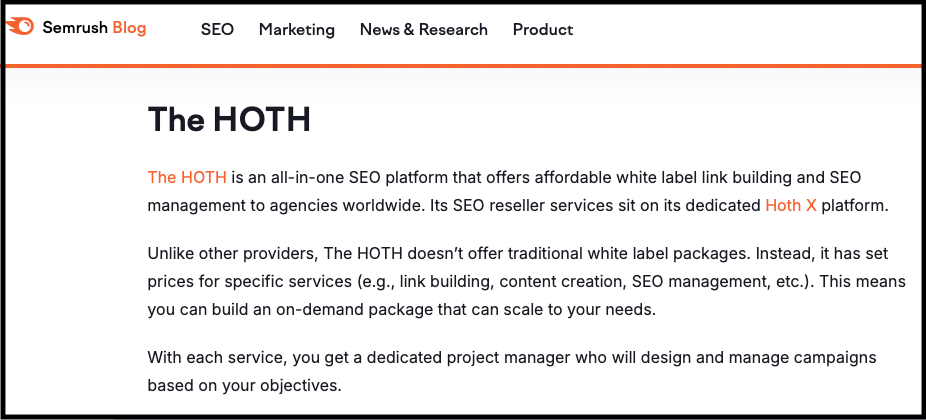
As an example, here’s one of our brand mentions on Semrush’s website, an SEO SaaS provider, so they’re right up our alley:
Also, when evaluating the trustworthiness of domains to target for brand mentions, you should abandon SEO staples like Domain Authority and Domain Rating.
These are third-party metrics that are hardwired to Google’s base search algorithm, and not the preferences of LLMs. As a result, they don’t work for AI search optimization.
Instead, ditch raw authority scores for helpfulness, content quality, and citation frequency.
LLMs trust websites that:
- Have established topical authority through a vast library of helpful content
- Get cited by other respected websites in their industry
- Publish expert-level content written by experienced authors
- Frequently update their content so that it’s fresh and accurate
These are the characteristics you should look for in the sites you target for brand mentions and backlinks.
| Need relevant, editorial backlinks and brand mentions? Our Digital PR service is the easiest and most effective way to generate both. |
User reviews: Do you walk the walk?

Besides what other brands are saying about you, LLMs also need social proof that you provide reliable products and services.
To do this, they’ll peek at your reviews on popular platforms like Google, Amazon, and Yelp. They will also check niche review sites if they apply, like Avvo and FindLaw for legal websites.
LLMs don’t just rely on average star ratings, either. They will also check each review’s comments to gain further insights.
Based on your reviews, brand mentions, and social chatter, LLMs will calculate a ‘virtual NPS’ (Net Promoter Score) for your business. This score determines how likely others are to recommend your brand, and it plays a significant role in whether your brand gets cited or not by AI tools.
Public perception: What does your audience think about you?

AI models don’t stop at evaluating user reviews. Instead, they take things a step further by seeing what your audience has to say about your brand across community channels like Reddit, Quora, and niche-specific forums.
Since they understand context, they know when users advocate or badmouth your brand.
That’s why it’s important to maintain a presence in community forums that pertain to your business. You don’t have to go nuts, just participate in some appropriate threads and respond to direct shout-outs (both positive and negative).
Competitive benchmarking: Are other brands more trusted?

Next, AI models want to know how you stack up to the competition. To gain an understanding of where you stand in the market, they’ll compare your reputation to other brands in your field.
By analyzing your competitor’s reviews and public sentiment, they’ll know if you’re over-performing or under-performing compared to related brands.
As you can imagine, having far fewer positive reviews than a direct competitor won’t bode well for your brand in terms of AI search visibility.
Translation?
The review race just got even more intense.
Besides building positive brand sentiment overall, you also have to outdo your peers, which can be easier said than done.
| Want to build a stronger reputation than your competitors? Check out our Review and Reputation Management service so that you can win the review race! |
The Cost of a Negative Reputation
Neglecting your reputation can wreck your visibility on AI-driven search tools.
Remember, if you aren’t working on your reputation, your competitors will be, so it’s crucial to maintain it, or you could get left behind.
Trust us, it’s a lot easier to bridge the gap if you’re only behind a few dozen reviews, not a few hundred.
Also, the more your reputation falls, the more you’ll lose entity trust with LLMs. Little by little, they’ll stop recognizing you as an authoritative entity in your field. As a result, you’ll lose visibility in Google’s AI Overviews and on AI search tools like Perplexity and Claude.
If the issue is left unresolved, it could lead to a long-term loss of brand authority, which you don’t want.
Your best bet is to improve your reputation now, since that’ll be ten times easier than trying to pull your reputation out of the gutter.
Optimizing Your Reputation for AI: A Checklist

The final step is tweaking your SEO strategy to improve your online brand sentiment. Here’s a series of checklist items for optimizing your reputation to appeal to LLMs:
Engage in digital PR – This is the best way to earn the type of brand mentions and backlinks you need to improve your AI visibility. Digital PR involves tactics like networking with online journalists, publishing original research, and conducting expert interviews. These are all fantastic ways to earn relevant brand mentions and backlinks with high editorial quality. To learn more, check out our ultimate digital PR guide.
Manage your review profile – You need at least one person on your team to actively manage your brand’s reviews on platforms like Google and Yelp. Make sure that you’re A) encouraging customers to leave reviews with reminders and incentives, and B) promptly responding to all negative reviews.
Be a part of your niche’s community – Members of your target audience will always be chatting and discussing brands on platforms like Reddit, and you can leverage this in your favor by becoming part of the discussion. For instance, if a Redditor shares a negative experience with your brand, actually responding and trying to resolve the issue can improve your reputation.
Audit your competitors’ reputations – Remember, AI models are going to constantly compare your sentiment to that of your competitors, so you’ve got to stay vigilant. Periodically check your top competitor’s reviews and comments on social media to gauge where you are in the market.
Own your brand’s narrative – All your mentions, reviews, and backlinks should tell a similar story. This reinforces entity recognition and builds trust with audience members. In particular, pay close attention to your brand’s presence on social media.
Build topical authority – You can’t earn lots of AI citations if you don’t have content for LLMs to cite. Also, AI models prefer to cite brands that have established topical authority by creating a large library of content on closely related topics. Our guide on mastering content clusters will teach you how to achieve topical authority, and it’s a very powerful position to hold.
Check all these boxes, and your brand will have a solid reputation, both with AI models and your target audience.
Final Thoughts: Reputation as a First-Class Ranking Factor
The days of relying on backlink volume to serve as your brand’s reputation are over now.
Instead, your brand sentiment must be genuinely positive in order to perform well on AI search tools.
That means making efforts to earn more positive reviews, interacting with your community, and keeping up with your direct competitors.
Want to improve your AI visibility while staying one step ahead of everyone else?
Sign up for AI Discover, our new AI search optimization product that’s backed up by real results!
Leave a comment