

Did someone recently leave a negative review for your business?
If so, you shouldn’t sweat it.
Negative reviews are something that occasionally occur for every business on the face of the planet.
What matters is how your brand responds to them.
If you respond quickly, professionally, and do your best to resolve the issue, you can shrug off a bad review with your reputation intact.
However, if the majority of your reviews are negative, that’s a different story.
These instances often require swift action and major operational changes to fix (and are worthy of ‘sweating it’).
Yet, if you’re like most businesses, you’ll only have to deal with negative reviews some of the time.
Moreover, with the right strategies in place, you can proactively avoid bad reviews while generating lots of positive ones.
Also, every negative review presents an opportunity for redemption.
If you show that you care and make an effort to resolve the situation, you may wind up converting an unhappy customer into a loyal brand advocate.
Keep reading to learn how to respond to bad reviews on Google, including ways to rectify negative experiences.
Why You Shouldn’t Ignore Negative Reviews

While you may want to shrug off unflattering reviews and pretend they never happened, this isn’t a good strategy.
Over time, users (and search engines) will notice your growing pile of unresolved complaints, which erodes trust and harms your reputation.
Instead, you should respond to negative reviews professionally and as soon as possible.
Besides losing trust, here are the top reasons why you shouldn’t ignore bad reviews.
#1: They don’t disappear
Even if you give your negative reviews the cold shoulder, that doesn’t mean they won’t continue to exist online.
Your bad reviews will remain on platforms like Yelp, Google, Facebook, and other platforms indefinitely.
Almost 95% of consumers read online reviews before trying new brands, so members of your target audience will undoubtedly stumble upon some of your less-than-flattering feedback.
The worst part?
If they see nothing but silence from your brand, it screams guilt, even if the review wasn’t truthful.
That’s why, like it or not, responding to negative reviews is a necessity, because it gives you the chance to:
- Correct honest mistakes
- Turn around negative experiences
- Clarify misconceptions, inaccuracies, or misinterpretations
- Push back against blatantly negative/false reviews
#2: Deleting negative reviews harms authenticity

If bad reviews can harm your rankings and reputation, why not just delete them?
The problem is that a total absence of negative reviews can actually backfire.
If your audience notices nothing but positive, unnaturally perfect reviews, they will suspect that you’re deleting all forms of criticism.
Consumers appreciate transparency, which is why they’re more likely to trust brands that have a mix of mostly positive and a few negative reviews.
The proof?
Research from the Spiegel Research Center at Northwestern University discovered that consumers trusted brands with average ratings of 4.2 and 4.5 stars the most.
Brands with perfect 5.0 scores receive lower conversion rates because consumers suspect that they’ve been censoring criticism and generating fake reviews.
#3: Negative reviews impact local SEO and GSO

If you want to appear in the Local Pack and rank well on Google Maps, you need a positive review profile.
Get too many negative reviews, and you won’t qualify to appear in the Local Pack (since Google only wants to recommend the best businesses).
Review volume also matters.
A study by Local SEO Guide and Semrush found a strong correlation between the amount of reviews a brand has and how well it ranks in the Local Pack.
That means you need lots of positive reviews, which reinforces the need for strong reputation management.
How to React to Negative Reviews
The way your brand responds to negative reviews actually matters more for your reputation than generating lots of positive reviews.
According to research, brands that respond to negative reviews see a 16% boost in customer advocacy, while brands that ignore complaints see their advocacy drop by 37%.
Why?
Because it’s easy to fake positive reviews.
Many businesses even incentivize patrons to leave good reviews, so their credibility can be easily diluted.
Yet, whenever a business receives a negative comment online, how they respond gives consumers a rare glimpse behind the curtain.
Does the business owner actually care about their customers’ experiences, or are they just cashing checks?
Radio silence screams the latter.
On the other hand, when people see your brand respond sincerely and resolve issues, they’ll do more than just forgive the bad experience; they’ll begin to trust you.
Let’s use this bad review to practice how you should respond to negative feedback:
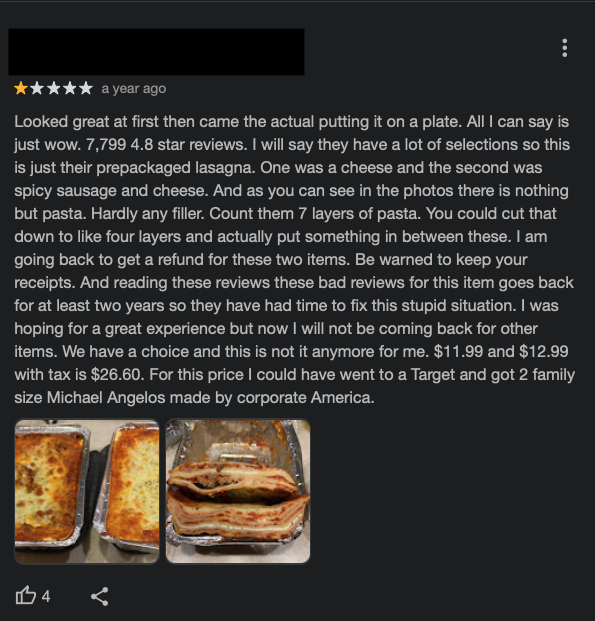
Imagine being the restaurant owner and reading this review first thing in the morning.
After spitting out your coffee in shock and frustration, you realize that you should respond as soon as possible to maintain your reputation.
Here are some pointers for doing just that.
Calm yourself before responding
Negative feedback can trigger emotional responses, so you should take a moment to destress before responding.
If the review makes you feel angry or personally attacked, remove yourself from the situation for a few minutes before responding. Understand that you shouldn’t take any negative review personally (even if you’re mentioned by name).
Once you’ve taken a deep breath or two, then you can insert yourself back into the situation and come up with a professional response.
Stay professional
Your reputation is literally on the line, so you should never argue or openly condemn the customer who left the review.
Professionalism wins the day here.
Your responses should be empathetic, polite, and cut to the heart of the issue. Don’t beat around the bush, as that reads as weakness.
Instead, address the issue directly and do what you can to resolve it.
React quickly and verify authenticity
While we don’t recommend that you respond the second after you read a negative review, you should aim to respond within 24 – 48 hours.
Waiting longer than that is enough time for some prospects to decide that your brand is untrustworthy.
A prompt response shows that your brand actually cares and doesn’t shy away from criticism, which is important.
Also, don’t take every negative review at face value.

Review bombs definitely exist, so you should take steps to verify that each review is from a real customer who had a bad experience.
You can do so by checking your order and service records to confirm that the customer actually interacted with your business. If you have cameras, you can use them to verify if certain incidents actually took place.
A sudden uptick in negative reviews in rapid succession is a sign of review spam, so double-check each review before submitting a response (more on how to delete fake negative reviews in a bit).
Move the conversation offline
Here’s a trick you can use for especially bad reviews. Respond quickly, but offer to continue the conversation via email or over the phone.
Why do this?
It provides you with a way to resolve the issue without leaving a public track record.
Your audience will still be able to see that you responded, and you won’t have to share any escalatory back-and-forths with the rest of the world.
Tips for Responding to Negative Reviews
Next, let’s practice how to respond to negative reviews in a way that’s professional, caring, and reflects well on your brand.
For inspiration, we’ll look at some real-world responses where businesses responded to negative feedback, and we’ll point out what they got right and what they got wrong.
Here’s a one-star review for a tire shop that prompted a direct response from the owner:
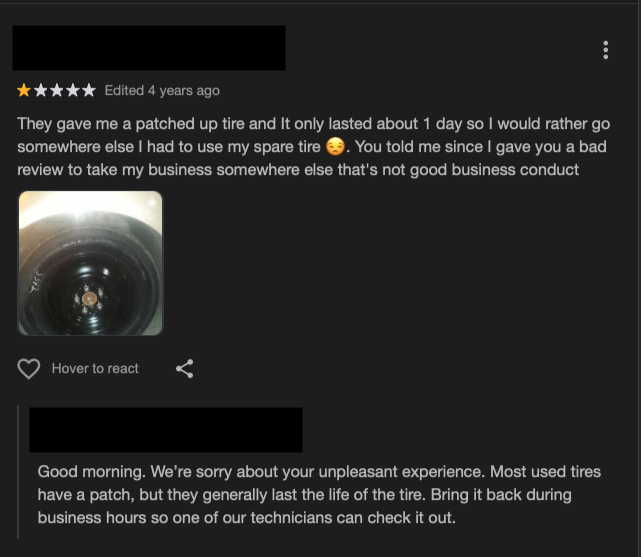
Here’s what they did right:
- They acknowledged the complaint.
- They provided context without getting defensive or dismissive.
- They maintained a professional tone.
- They offered a solution to resolve the issue.
Here’s what they did wrong:
- It’s never a good idea to tell customers to take their business elsewhere if they leave a bad review. Granted, this may or may not be true, but it’s still a bad look and should have been acknowledged in some way.
Let’s look at another example:
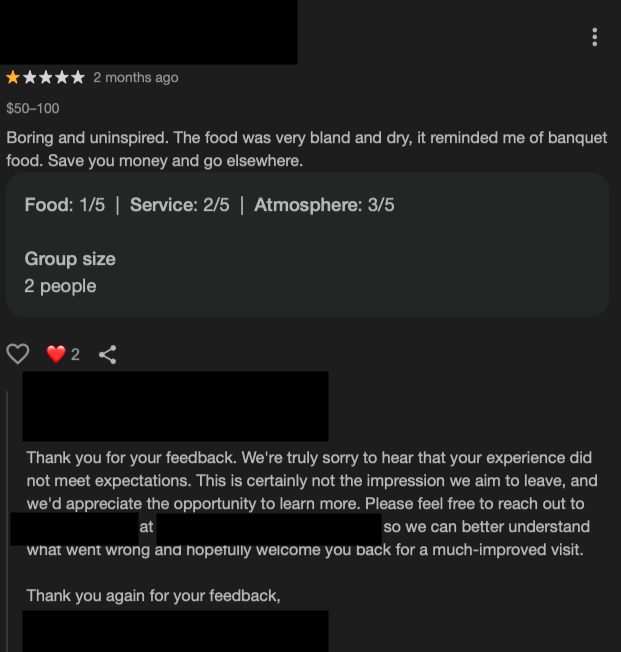
This is an excellent example of moving a conversation offline to resolve the complaint in private.
The restaurant owner provides their email address to keep the conversation going while hinting at a potential solution (via an improved visit next time).
One thing that would make the response even stronger is a more straightforward approach to a solution like offering a free item or coupon for their next visit.
Overall, they kept it professional, empathized with the customer, and took their feedback into consideration instead of trying to dismiss it.
Next, this review exemplifies why it’s so important to respond to negative reviews in a timely manner:
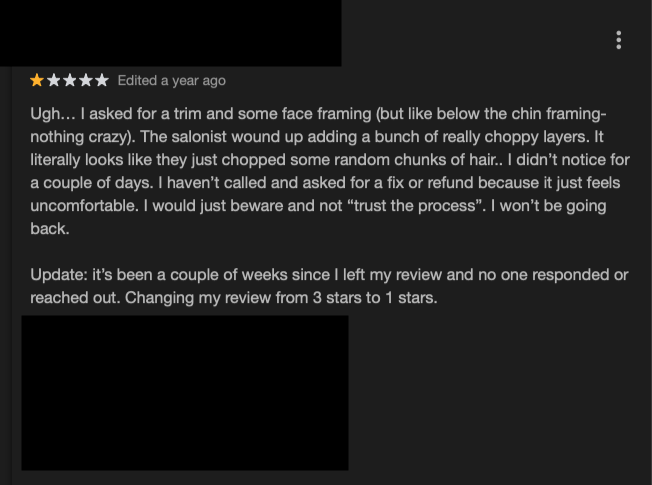
Notice that the reviewer says it had been several weeks since leaving her review, and she had not heard back from the business.
Because of this, she changed her 3-star review to an abysmal 1-star review, which is bad news for the hair salon’s reputation.
Not only that, but it’s likely that they lost her future business forever by not responding in time.
Negative review response template
If you’re drawing a blank on how to respond to a negative review or complaint, you can make use of this template (just be sure to personalize it for each issue):
Hello (reviewer’s name),
We appreciate you taking the time out of your day to provide us with feedback. We’re deeply sorry that your experience didn’t meet our high standards, and we’d like to do our best to rectify that.
This is not the type of service we want any customer to receive, and we certainly understand your frustration.
We feel that it’s our duty to make this right, so please reach out to us at (business email address) and one of our managers will help resolve the issue by (re-doing the service, replacing an item, inspecting the issue, etc.).
Your experience matters to us, and feedback like yours is what helps us improve. We’re committed to ensuring negative experiences like this don’t happen in the future for any of our customers.
Thanks again for bringing this issue to our attention, and we hope to earn back your trust.
(Business name, owner’s name)
When You Should Flag Reviews for Removal
There are times when removing negative reviews makes sense, but only in the case of review spam and review bombs.
In other words, you should only try to remove fake reviews that only exist to harm your reputation.
However, this can be easier said than done, as Google won’t always act on your removal request. To improve your chances, familiarize yourself with its prohibited and restricted content guidelines.
Deceptive content and behavior, like fake engagement and misinformation, are prohibited by Google, but you’ll need proof.
Here are some ways you can gather proof against fake reviews:
- Prove the reviewer was never a customer – Show that the reviewer had no actual order history or direct interaction with the reviewer took place (using cameras, receipts, and other records).
- Show discrepancies in the reviewer’s story or timeline – Find inaccuracies in the review’s story or timeline, and use your business’s evidence, like camera footage, to prove the review is false.
- Use IP addresses and geolocation data – If you have access to IP addresses or geolocation logs, you may be able to prove that the reviewer wasn’t near your business at the time they claimed the incident took place.
- Investigate the reviewer’s profile – Check to see if the reviewer’s profile is suspicious, like if they created it right before leaving you a bad review and then abandoned it.
Once you’ve done a little detective work, head on over to your Google Business Profile to manage your reviews.
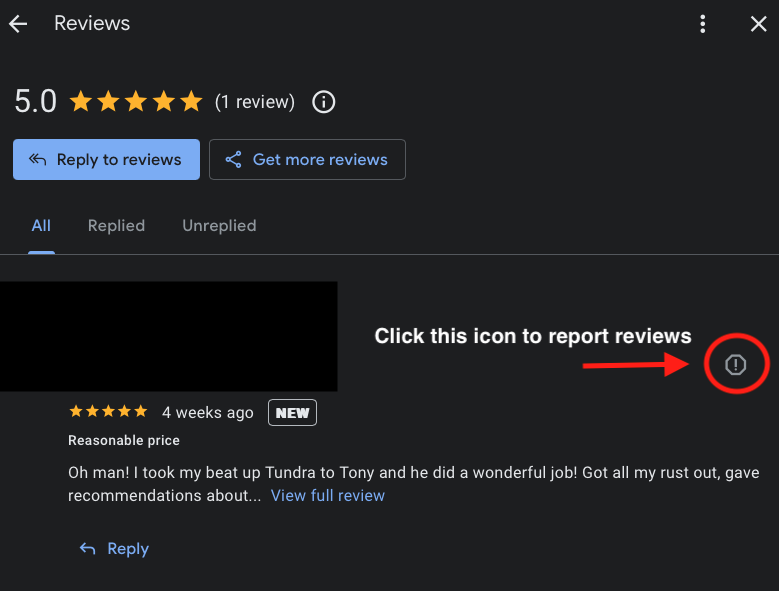
To report a review for removal, click on the icon that has an exclamation point encased in a circle. From there, you can flag the review as spam.
However, the process is not instantaneous.
First, Google will have to review your evidence. If they agree that the review is spam, they will remove it. This process typically takes a few weeks, so sit tight.
Closing Thoughts: Responding to Bad Google Reviews
In summary, the way you handle negative reviews can make or break your brand’s reputation.
Remember, not responding to bad reviews is the worst thing you can do. By responding professionally to critical feedback, you’ll salvage your reputation and build trust with your audience.
Do you not have the time or expertise to respond to reviews and manage your online reputation?
Our Review and Reputation Management service will help you build the trust you need to rank in Google’s Local Packs and appear in AI-generated summaries from tools like ChatGPT, so don’t wait to sign up!
Leave a comment