

When someone searches for your product or your competitors in Google today, the results page is a different animal than it was two years ago. There’s an AI Overview at the top. Forum threads in the middle. YouTube videos further down. And somewhere in that mix, actual editorial content from real publications. If your brand isn’t showing up in that editorial layer, you have a visibility problem that’s going to compound every quarter.
That’s the gap Exclusive Media Links (EMLs) are built to close. EMLs place your brand inside evergreen editorial articles on vetted U.S. news and media sites, the kind of domains that Google treats as authoritative and that large language models pull from when generating answers. The program is structured into two tiers with clear pricing and clear targets, so you can match the product to your budget and goals without guessing.
This post walks through exactly what EMLs are, how Gold and Silver tiers differ, why news-site citations matter more than ever in AI search, and how to tell if they’re the right fit for your campaign. You’ll also see real results from a client campaign to give you a sense of the kind of lift to expect.
What Are Exclusive Media Links?
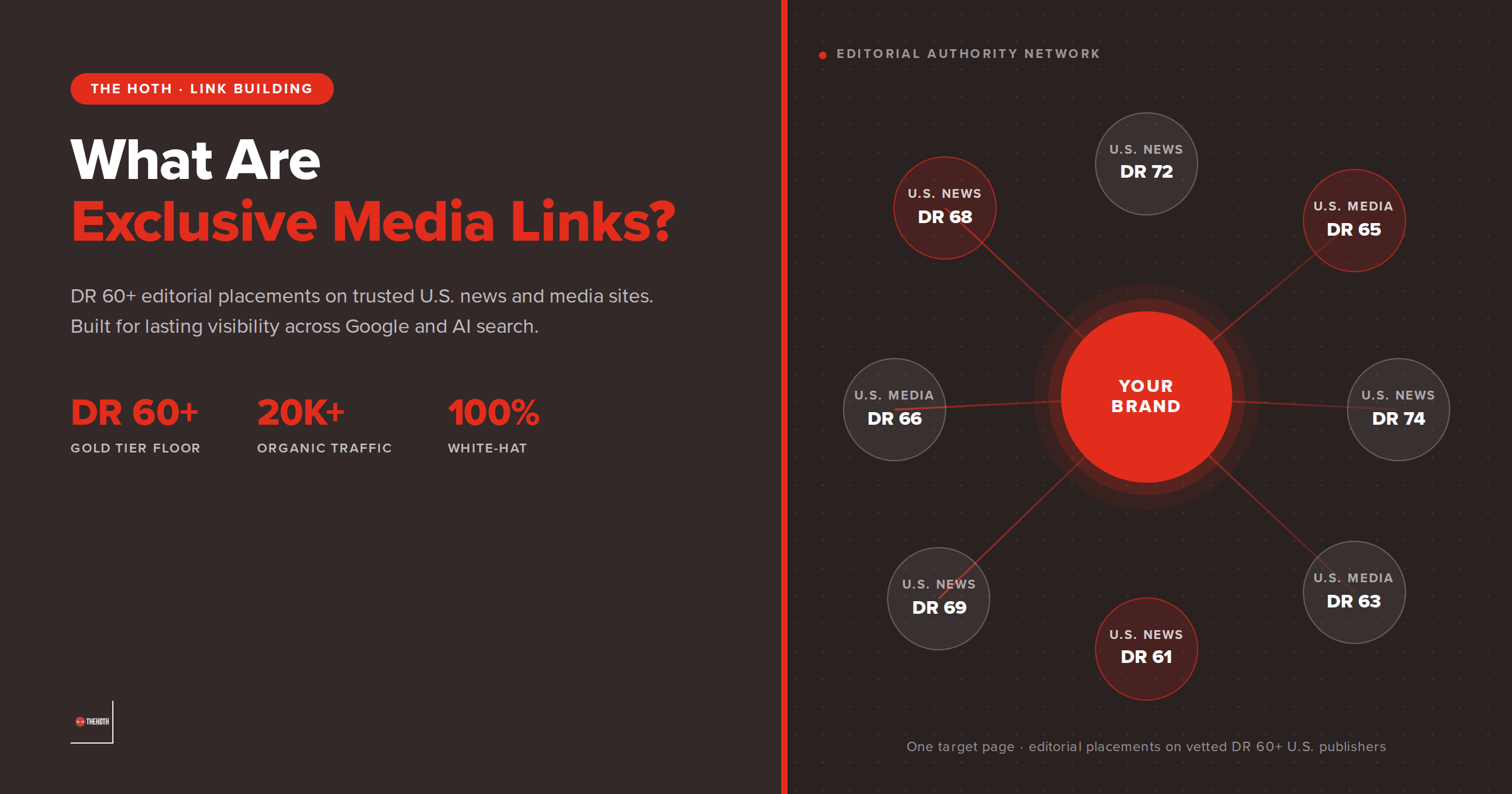
Exclusive Media Links are premium editorial placements on trusted U.S. news and media domains. Each link is embedded naturally inside a long-form, in-context article that your target page is a legitimate reference for. The content is written by an in-house editorial team, published on a real news property, and includes a dofollow link back to your site.
A few things make EMLs different from a standard guest post or link insertion:
- The sites are vetted U.S. news and media publications, not general-interest blogs.
- Every placement sits inside editorial content, not a sponsored section or advertorial block. There are no sponsored tags.
- Placements are dofollow, so the link passes authority.
- Inventory is private and exclusive. You won’t find the same sites offered by a dozen other vendors.
- The program is 100 percent white-hat. No PBNs, no link schemes, no tactics that create risk for your domain.
The inventory spans national publications and publishers across major U.S. metros. Specific sites and markets can’t be guaranteed, but the program is built so that every placement meets the tier’s DR and traffic floor. For bulk orders, there’s flexibility to discuss geographic preferences without committing to named outlets.
EML Gold vs. EML Silver: Which Tier Fits Your Campaign?
EMLs come in two tiers, and the right one depends on your budget, your domain’s current authority, and how aggressively you want to push into high-DR news placements.
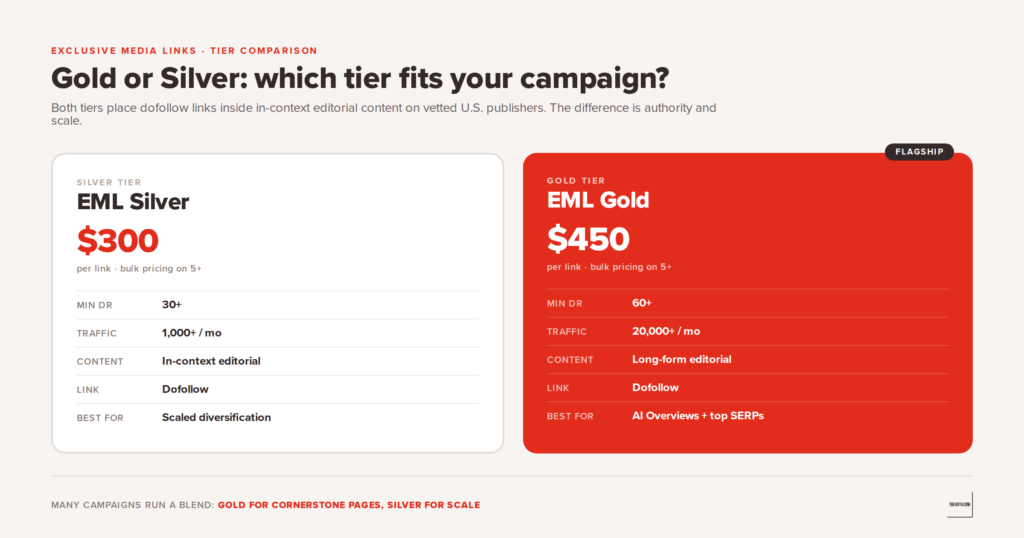
EML Gold: $450 per link
Gold is the flagship tier. Every placement lands on a site with a Domain Rating of 60 or higher and at least 20,000 organic monthly visitors. These are the kind of publications that LLMs have already trained on and that Google’s quality algorithms treat as authoritative by default. Content is long-form, in-context editorial, and the link is dofollow.
Use Gold when you’re competing for high-value commercial keywords, when your competitors already have news-site coverage, or when you’re specifically trying to break into AI Overviews and chatbot responses. One well-placed Gold link often does more for ranking and AI visibility than ten lower-tier placements combined.
EML Silver: $300 per link
Silver targets DR 30+ sites with at least 1,000 organic monthly visitors. Same in-context editorial content, same dofollow structure, same white-hat approach. The sites are smaller in scale but still legitimate media properties with real readership.
Silver is the workhorse tier. It’s how you scale a campaign without blowing the budget, how you diversify your link profile across more domains, and how you support Gold placements with a broader authority footprint. Many campaigns run a blend: a handful of Gold links on cornerstone pages, plus Silver links pointing to supporting content and secondary targets.
Why News-Site Links Matter More in the AI Search Era
Here’s what’s happened to search over the last 18 months: AI Overviews now appear on roughly 42 percent of keyword searches, up from about 16 percent in mid-2025. And when an AI Overview appears, the click-through rate on the top organic result drops by about 58 percent compared to pre-AI Overview baselines, according to Ahrefs’ analysis of 300,000 keywords. That’s not a small dip. That’s the majority of your traffic getting answered before the user ever scrolls.
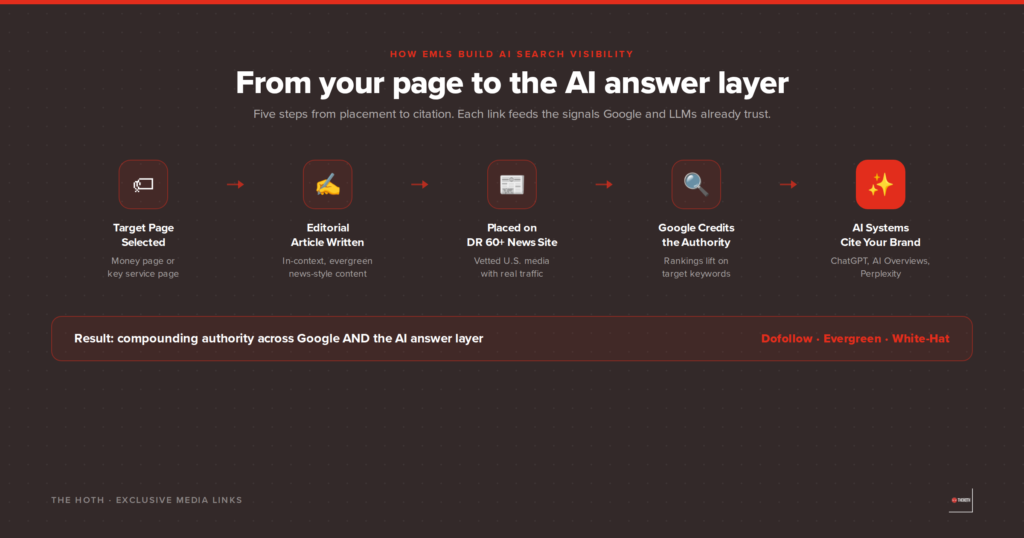
The brands that still show up in that environment are the ones being cited inside the AI answer itself. And when you look at what AI systems cite, a clear pattern emerges: third-party editorial sources dominate.
A March 2026 study from Stacker and Scrunch analyzed 87 stories across 30 brands and 2,600+ prompts on 8 AI platforms. The headline finding: distributing content through earned media channels produced a median 239 percent lift in AI search visibility compared to brand-owned content alone. Sixty-four percent of AI citations came from third-party publisher sources, and distributed versions were more than five times as likely to be the sole source of a story’s AI visibility. You can read the full study on Stacker.
Why does this happen? Because AI models weight source credibility heavily when deciding what to cite. The Reuters Institute Digital News Report 2025 found that when users want to verify whether something is true or false online, 38 percent say they go to a trusted news source first, making it the single most-used verification method. AI systems are trained on the same signals users respond to. A link sitting inside an established news publication carries weight that a link on a generic blog simply cannot replicate.
That’s the strategic case for EMLs. You’re not just buying a backlink. You’re buying a citation on a domain that feeds the AI answer layer, and that continues to pay out in referral authority as LLMs retrain and re-index over time.
What actually makes a news-site link work
Not every link on a news site pulls equal weight. A few factors separate placements that move rankings and AI citations from placements that just sit there:
- In-context editorial content. The article needs to read like real journalism or evergreen reference content, not a barely-disguised advertorial. Search and AI systems both penalize obvious sponsored-feeling content.
- Topical relevance. The piece should cover a subject where your target page is a legitimate source. A mortgage broker link inside a general news article about housing market trends makes sense. Inside a celebrity recipe roundup, it doesn’t.
- Evergreen shelf life. Articles tied to news cycles lose value quickly. Articles built around explainer topics, definitions, or ongoing guidance accrue value over months and years.
- Dofollow attribution. Nofollow news links still pass brand-mention signals, but dofollow is what meaningfully moves authority metrics and ranking strength.
- Publisher traffic and domain rating together. A DR 60 site with 20,000 monthly visitors behaves differently than a DR 60 site with 200 visitors, even though the metric looks similar. Real readership matters, because Google and AI systems use behavioral signals alongside authority scores.
The EML program is built around those five requirements as a baseline. That’s why the tier structure is DR and traffic-gated, and why every placement lives inside editorial content rather than a sponsored section.
How EMLs Fit Alongside Other HOTH Link Products
EMLs are one piece of the link ecosystem, and they work best when you understand how they contrast with adjacent products.
EMLs vs. Platinum Links
Platinum Links are DR 50+ editorial placements secured through relationship-driven outreach to publishers and editors. They’re not news sites specifically, and they’re priced for repeatable, scalable authority building. Use Platinum when you need volume at a strong quality floor. Use EMLs when you specifically need that news-site and media-property signal.
EMLs vs. Earned Media
HOTH Earned Media takes a different approach. Instead of placing one link on one vetted site, Earned Media creates a full editorial story and distributes it across 4,000+ U.S. publishers, with 50+ guaranteed pickups per campaign. The goal is wide coverage and brand-mention volume. EMLs, by contrast, are surgical: one high-DR placement per order, inside curated editorial content, on a vetted publisher that meets your tier’s floor. Many campaigns use both: Earned Media for breadth and entity signals, EMLs for high-DR anchors.
EMLs vs. standard link outreach
Traditional link outreach secures placements across a broad range of sites, priced based on Domain Rating, traffic, or a combination. It’s flexible and scales well. What it doesn’t guarantee is that the placement sits on a news or media domain specifically. EMLs narrow the inventory to vetted U.S. publishers with real editorial standards, which is what you want when the goal is AI citations and news-site authority specifically. Use outreach for general authority building. Use EMLs when the medium is the message.
When EMLs are the right call
EMLs are the right fit when you want:
- Dofollow placements on real U.S. news and media properties
- Editorial context, not a press release or wire syndication
- Predictable pricing per link rather than a monthly retainer
- A campaign pointed at U.S. publishers, whether national or regional in focus
- Link diversity that specifically strengthens your AI search footprint
What Real EML Results Look Like
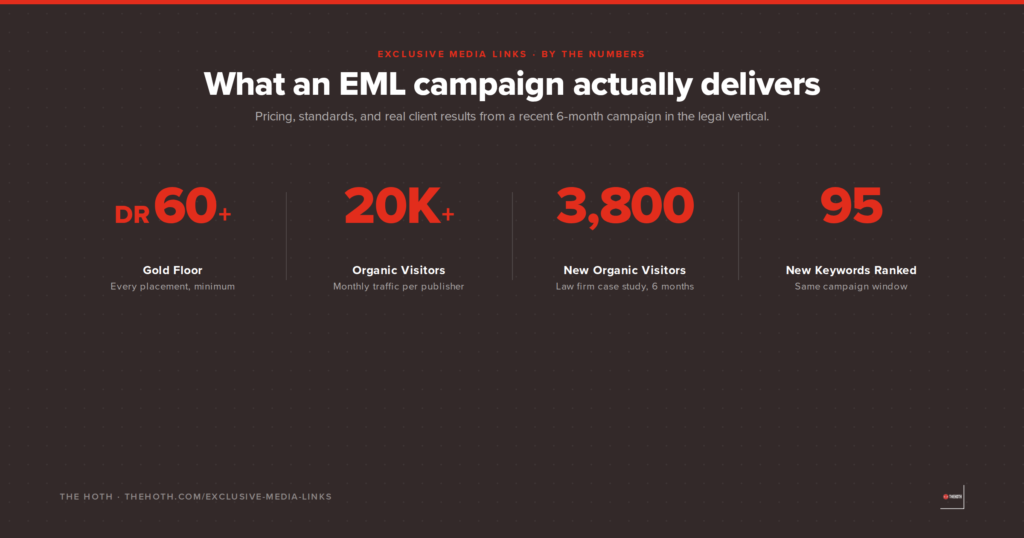
One of the clearest illustrations of how EMLs move the needle comes from a personal injury and workers’ compensation law firm in a competitive regional market. Legal is one of the most competitive verticals in SEO, and in that niche, every link has to do heavy lifting.
Over a six-month EML campaign, the firm saw 3,800 new organic visitors and 95 new keyword placements directly attributable to the EML push. In a space where a single qualified lead can be worth thousands of dollars, that kind of sustained traffic growth translates directly to revenue. The placements held their value over time too, since they sit in evergreen editorial content rather than news cycles that decay in a week.
That pattern, steady keyword and traffic growth compounding over a six-to-twelve-month window, is typical of what EML campaigns produce. You’re not buying a traffic spike. You’re buying authority that keeps working.
What kind of timeline should you expect?
The honest answer is that link products in general, and EMLs specifically, are a medium-term play. Google typically needs 60 to 120 days after a placement goes live to fully credit the authority signal, and AI systems re-index on their own cadence. Most campaigns start seeing keyword movement in the first 30 to 60 days, with meaningful traffic impact showing up between months three and six.
The brands that get the best results from EMLs treat them as part of a sustained program rather than a one-time purchase. Ordering three links in month one and then stopping will produce a blip. Ordering a consistent few links every month for six months produces compounding authority, which is what actually moves revenue.
How to Get the Most Out of an EML Campaign
A few practical notes on structuring an EML campaign so you actually get the lift the product is designed to deliver:
Point them at pages that can convert the traffic
EMLs send referral authority to whatever page you target. If that page is thin, slow, or unclear about what you do, the authority lift won’t turn into revenue. Before ordering, spend an afternoon making sure your target landing page has a clear offer, strong internal linking, and loads quickly.
Use natural, varied anchor text
The easiest way to waste a DR 60+ placement is to stuff it with exact-match commercial anchor text. Mix branded anchors, partial-match phrases, and natural language anchors that fit editorially. Your placement will read better, age better, and carry authority that Google doesn’t flag as unnatural.
Combine tiers strategically
A typical campaign blend might look like two Gold links pointing at your highest-value money pages, plus four to six Silver links spread across secondary targets and supporting content. That gives you concentrated authority where it matters most and diversified backing across the rest of your site.
Stack with AI visibility work
EMLs are one of the strongest individual inputs for AI citation performance, but they work even harder when paired with a broader AI visibility strategy. If you’re serious about showing up in ChatGPT, Perplexity, and AI Overviews, HOTH AI Discover is built specifically for that work, and EMLs feed right into it by providing the third-party citations AI systems lean on.
What You See When a Link Goes Live
One thing that trips people up with higher-tier link products is reporting. You spend $450 on a placement and want to know exactly what you got, where it went live, and how to verify the DR and traffic of the publishing site. That’s fair.
Every EML placement comes with a delivery report that includes the live URL, the publishing domain, the target page the link points to, the anchor text used, and the key site metrics (Domain Rating and estimated organic traffic) at time of publication. If you’re a reseller or agency, reports are white-labeled so you can forward them to clients under your own brand without friction.
That transparency matters for two reasons. First, it lets you verify the product delivered what you paid for. Second, it gives you the data you need to track which placements correlate with ranking movement over time, so you can lean harder into what’s working.
What EMLs Can’t Do
A fair post needs to tell you what a product isn’t, too. A few honest limits:
You can’t see the full site list before ordering. Inventory is private, which is part of what keeps the program exclusive. You can specify geographic preferences on bulk orders, but specific site guarantees aren’t part of the model.
You also can’t expect EMLs to fix a site with serious technical issues. If your pages aren’t indexable, your Core Web Vitals are in the red, or your content is thin, no amount of external authority will make up for what’s broken on-page. Fix the foundation first.
And EMLs aren’t the right tool for every niche. Some categories, including adult content, firearms, and certain regulated verticals, fall outside the program’s editorial guidelines. If you’re unsure, it’s worth asking before ordering.
Getting Started With Exclusive Media Links
If your campaign fits the profile, meaning a U.S.-focused brand in a competitive vertical, a target page that can convert referral traffic, and a budget that can support either a few Gold placements or a scaled Silver campaign, EMLs are one of the highest-leverage link products available right now.
The simplest way to figure out whether they’re the right fit for your campaign is to talk through your goals with a strategist who can look at your current link profile and recommend a tier blend. Book a free strategy call and we’ll walk through what a campaign would look like for your specific situation, including which pages to target, how many links to start with, and how EMLs might combine with other products to hit your goals faster.
The search landscape isn’t going to get simpler from here. AI Overviews will expand, chatbot use will grow, and the brands that invested in credible editorial placements early will be the ones cited in the answers your prospects see. EMLs are how you plant that flag.
Leave a comment