

Introduction
Ask most SEOs what semantic SEO means and you’ll get a definition. Ask them how to actually do it and the answer gets vague quickly.
That’s the gap this post is trying to close.
Semantic SEO is not a buzzword for ‘write about related topics.’ It’s a specific way of architecting your content so that search engines and AI systems understand what your brand is an authority on, not just what keywords appear on your pages. Done right, it’s one of the highest-leverage investments a content team can make. Done wrong, or just not done at all, it leaves rankings fragmented and AI citations completely out of reach.
In this guide, you’ll learn what semantic SEO actually means operationally, how to audit your current semantic footprint, how to build content architecture around concepts rather than keyword strings, and why this approach matters more now that AI systems are answering queries instead of just ranking results.
What Semantic SEO Actually Means
Semantic SEO is the practice of optimizing for meaning and context rather than individual keyword matches. Instead of asking ‘what keyword should this page target,’ it asks ‘what concept does this page represent, and how clearly does our site signal expertise on that concept?’
The distinction matters because Google’s algorithm has been evaluating content semantically since the Hummingbird update in 2013, and every major algorithm development since, from RankBrain to BERT to MUM, has pushed further in the same direction. Google doesn’t match your page to a query by checking whether it contains certain words. It evaluates whether your page genuinely represents a concept and whether your domain is an authoritative source on the broader topic that concept belongs to.
For AI systems, this evaluation is even more pronounced. When Google AI Overviews, ChatGPT, or Perplexity generates an answer to a query, it retrieves content from sources it has already classified as authoritative on the relevant topic. That classification happens at the concept level, not the keyword level. A page that semantically represents a topic comprehensively and accurately has a fundamentally different relationship with these systems than a page that just targets a keyword phrase.
The practical implication: your content strategy needs to be built around concepts and the relationships between them, not around keyword strings and search volumes.
The Difference Between Keyword SEO and Semantic SEO
The clearest way to understand semantic SEO is to see what it replaces.
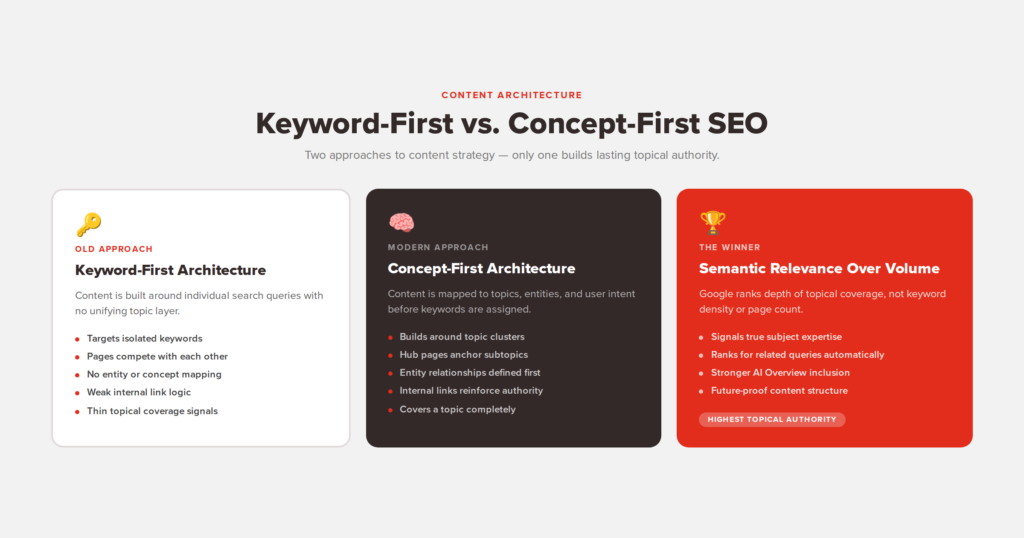
Keyword SEO: One page, one keyword, one intent
Traditional keyword SEO treats each page as a discrete unit targeting a specific phrase. You research a keyword, write a page optimized for it, build links to it, and measure its ranking for that phrase. The pages on your site are largely independent of one another from a strategic standpoint, connected mainly by internal links and navigation.
This approach worked reasonably well when search algorithms were primarily matching query strings to page content. It breaks down when algorithms evaluate topical authority, the degree to which your domain is understood as a genuine expert on a subject rather than a collection of pages targeting related phrases.
Semantic SEO: One concept, one cluster, layered depth
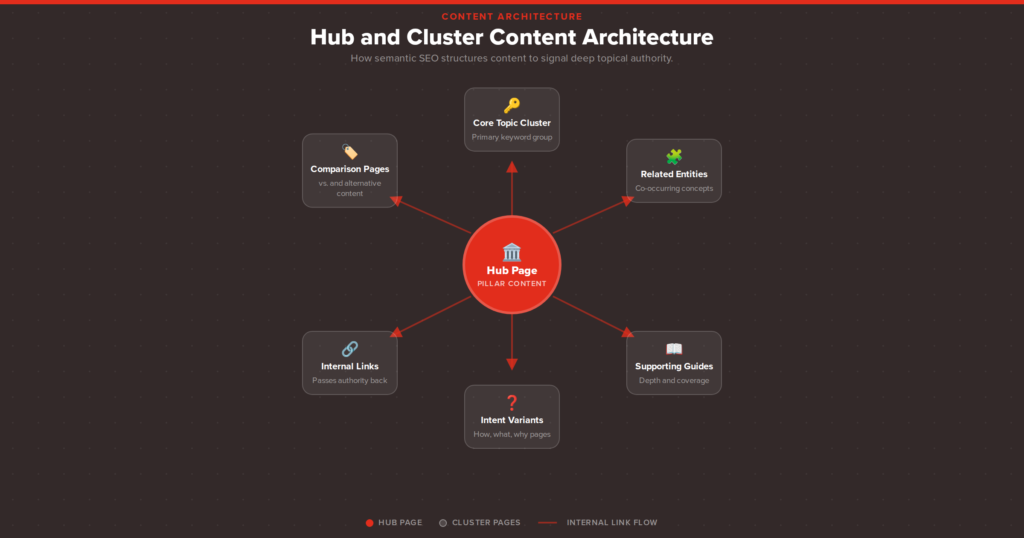
Semantic SEO builds content around concepts. Each concept has a central hub page that covers the topic comprehensively and a surrounding cluster of supporting pages that explore subtopics, answer related questions, and cover the concept from multiple angles. Every page in the cluster reinforces the hub, and the hub reinforces the cluster. The internal link structure mirrors the conceptual relationships between the topics.
The result is that Google and AI systems don’t just see individual pages. They see a semantic network that signals your domain understands a subject deeply and consistently. That signal is much more durable than ranking for a single keyword, and it directly feeds the kind of topical authority that determines AI citation eligibility.
According to SEMrush’s topic cluster research, sites that organize content around topic clusters achieve 38% more organic traffic than sites built around isolated keyword targeting. The compounding effect is real: each new page in a well-built cluster strengthens the authority signal for every other page in that cluster.
Semantic Neighborhoods: How Google and AI Systems See Your Content
One of the most useful mental models for semantic SEO is the concept of a semantic neighborhood. This is the cluster of concepts, entities, and topics that a search engine or AI system associates with a given subject.
When Google indexes your content, it doesn’t just log the keywords on your page. It places your page in a semantic neighborhood based on the concepts covered, the entities mentioned, and the way those concepts relate to one another. If your page about email marketing discusses open rates, deliverability, segmentation, A/B testing, and automation, it lands in the email marketing semantic neighborhood. If it discusses email marketing but spends half the post on social media strategy, the semantic signal is weaker and less precise.
AI systems use semantic neighborhoods when deciding what to cite. When a user asks ChatGPT or Perplexity a question about email deliverability, the system retrieves content from pages it has already classified as living in the email marketing semantic neighborhood and that have demonstrated authority within it. Pages with fragmented or off-topic content may rank for a keyword but still be absent from AI answers because they don’t sit cleanly within the relevant semantic space.
This is why one of the most powerful things you can do for both SEO and AEO is to be deliberately narrow about which semantic neighborhoods you want to occupy, and then cover those neighborhoods comprehensively.
How to Audit Your Current Semantic Footprint
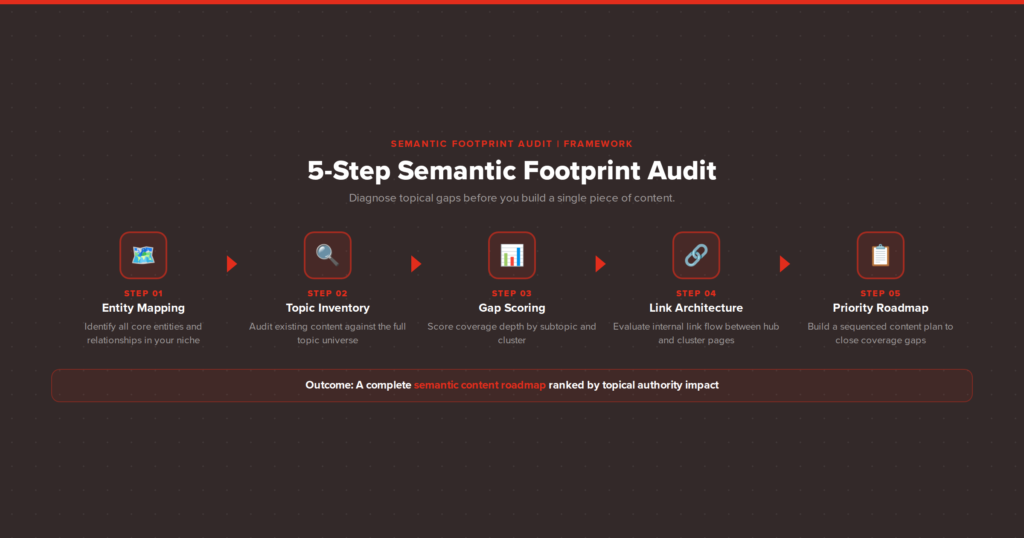
Before you can build a stronger semantic presence, you need to understand what your current footprint actually looks like. Here’s a practical approach.
Step 1: Identify your core concepts
Start by listing the 3-5 core concepts that your business needs to own in search. These aren’t keywords. They’re subjects. For an SEO agency, core concepts might be: link building, content SEO, technical SEO, local SEO, and AI search visibility. Each of these is a semantic neighborhood with dozens of subtopics, related questions, and entity relationships.
Step 2: Map your existing content to those concepts
Pull your top 50 pages by traffic and map each one to a core concept. You’re looking for two things: coverage gaps (subtopics within a core concept that you haven’t addressed) and semantic drift (pages that are supposed to belong to a concept but have drifted off-topic or cover too many concepts at once).
Step 3: Check your internal linking structure
Internal links are how you tell search engines which pages belong to the same conceptual cluster. Run a crawl of your site and check whether your pages about a given concept are actually linking to each other, and whether those links use anchor text that describes the conceptual relationship rather than generic phrases like ‘click here’ or ‘learn more.’
A well-linked semantic cluster should look like a web where every page connects to every other page in the cluster through a logical path. A keyword-first site typically looks like a collection of silos with little cross-linking.
Step 4: Audit your entity coverage
Within each of your core concepts, are you consistently mentioning the key entities that belong to that semantic neighborhood? For a post about link building, relevant entities include things like domain authority, referring domains, anchor text, PageRank, and specific tools like Ahrefs and Moz. If your content doesn’t naturally include the vocabulary that authoritative sources in your space use, your semantic signal is weak even if your keyword targeting is precise.
Building Semantic Content Architecture
Once you understand your current footprint, you can start building intentionally. Here’s how the architecture works in practice.
The hub page
Every concept cluster needs a hub page. This is your comprehensive, authoritative treatment of the core concept. It should cover the subject broadly enough to serve as the definitive resource on the topic, but structured with clear H2 sections that each connect to a supporting cluster page. The hub page’s job is to establish topical authority, not to answer every possible question in exhaustive detail. Leave the depth for the cluster.
The cluster pages
Cluster pages cover specific subtopics, questions, and angles that fall under the core concept. Each cluster page should: serve a distinct search intent, cover its specific angle in real depth, link back to the hub page with descriptive anchor text, link to other relevant cluster pages where appropriate, and use the vocabulary and entities that belong to the semantic neighborhood.
The SaaS company we worked with over 24 months is a good example of this architecture in practice. Their SEO underperformance wasn’t a keyword problem. It was a semantic architecture problem: core product pages existed in isolation, blog content was scattered across unrelated topics, and the internal link structure didn’t reinforce any coherent topical signal. After rebuilding the content architecture around product and use case concepts, with cluster pages covering every relevant subtopic and a strong internal link structure connecting them, the site saw a 314% increase in organic traffic and 500+ new Page 1 keyword placements. The same content effort, aimed more precisely at a semantic architecture, produced compounding results.
Co-occurrence: the vocabulary of your semantic neighborhood
One of the most underappreciated elements of semantic SEO is co-occurrence. This refers to the words, phrases, and entities that consistently appear together in authoritative content about a given topic. Google uses co-occurrence patterns to understand what a page is actually about, independent of its title or primary keyword.
Practically: read the top-ranking pages for your core concept and note the vocabulary they share. What tools do they mention? What related concepts appear consistently? What specific data points, studies, or frameworks keep showing up? Building that vocabulary naturally into your content places it more clearly in the correct semantic neighborhood.
This is also why LSI keywords (latent semantic indexing keywords) became a widely discussed concept in SEO, though the framing has evolved. The underlying principle, that semantically related terms strengthen topical signals, remains valid and is increasingly important as algorithms have grown more sophisticated.
Semantic SEO and AI Search: Why the Stakes Are Higher Now
Everything described above has been relevant to SEO for years. What has changed is how much it now matters for AI visibility.
AI answer engines don’t retrieve individual pages in isolation. They retrieve content from within semantic neighborhoods. When a user asks an AI system a question, the system identifies the semantic territory of the query and pulls content from sources it has already classified as authoritative within that territory. If your domain doesn’t have a clear, well-reinforced semantic signal for the relevant concept, you’re not in contention for the citation regardless of your keyword rankings.
Our own AI Discover service consistently finds that brands with fragmented content strategies, lots of keyword-targeted posts with weak conceptual coherence, have low AI citation rates even when they rank well in traditional search. The same signals that build semantic authority for Google are the signals that determine AI citation eligibility. Content that clearly belongs to a semantic neighborhood and covers it with depth and entity precision gets cited. Content that is targeting keywords without a semantic architecture largely doesn’t.
The B2B marketing firm we worked with illustrates the compounding nature of this well. Their content had decent keyword coverage but no semantic architecture. After restructuring around concept clusters with strong internal linking and entity-rich content, they saw a 187% increase in organic traffic and a 300% lift in Page 1 keyword rankings. More importantly, their AI citation rate improved alongside their organic performance, because the same work that built semantic authority for Google also built it for the AI systems pulling content for generated answers.
Practical Steps to Start Building Semantic SEO Today
Here’s where to start if you’re rebuilding your content strategy around semantic architecture.
- Pick one core concept to start. Don’t try to rebuild everything at once. Choose the concept most directly tied to your revenue and start there.
- Audit what you already have. Map your existing content to that concept and identify coverage gaps and semantic drift before creating anything new.
- Build or refresh the hub page. If you don’t have a comprehensive, well-structured hub page for the concept, that’s your first piece of new content. If you do have one, audit it for entity coverage and internal linking completeness.
- Create a coverage map for the cluster. List every subtopic, question, and angle that belongs to this semantic neighborhood. Prioritize by search intent and traffic potential, then build systematically.
- Fix the internal linking. Connect every cluster page to the hub and to each other where relevant. Use anchor text that describes the conceptual relationship, not generic phrases.
- Audit entity coverage. Make sure every page in the cluster uses the vocabulary that authoritative sources in your space use. Check what entities, tools, and concepts consistently co-occur with your target topic.
- Measure concept authority, not just keyword rankings. Track how many queries you rank for within the semantic neighborhood, not just your target keyword. A well-built cluster should earn rankings for dozens of related queries you never explicitly targeted.
How The HOTH Can Help
Building a semantic content architecture from scratch is significant work, especially if you’re also running a business or serving clients at the same time.
The HOTH’s managed SEO campaigns handle this end to end: concept mapping, content architecture planning, cluster development, internal link strategy, and the ongoing link building that reinforces topical authority externally. Our Content Refresh service is specifically built for the scenario where you have existing content that needs to be restructured into a coherent semantic architecture rather than rebuilt from scratch.
If AI visibility is the priority, AI Discover audits your current semantic footprint across Google AI Overviews, ChatGPT, and Perplexity, and identifies the specific gaps in your content architecture that are keeping you out of AI citations.
Wrapping Up
Semantic SEO is not a new idea, but it’s one that most content teams are still treating as an afterthought. The shift from keyword targeting to concept architecture is the most important strategic move available to any brand that depends on organic search.
The good news is that the work compounds. Every cluster page you add strengthens the authority of every other page in the cluster. Every internal link you build makes your semantic signal clearer. Every entity you cover accurately places you more definitively in the right semantic neighborhood. And increasingly, that neighborhood is where both Google rankings and AI citations are decided.
The brands that own a concept in AI search aren’t just ranking for keywords. They’re the recognized authority on a subject. That’s a fundamentally more durable position, and semantic SEO is how you build it.
Book a free strategy call and let’s map out what your semantic architecture should look like.
Leave a comment