

You can spend a lot of money on ads. You can publish great content. You can build backlinks through outreach.
But there is one type of visibility that money literally cannot buy: earned media.
When a reporter covers your brand, when a major outlet picks up your story, when credible publishers are citing you without being paid to do so that is earned media. And in 2026, it has become one of the most powerful forces in both SEO and AI-driven search.
This guide breaks down exactly what earned media is, why it matters more than ever, how it differs from other media types, and how to start building it for your business.
What Is Earned Media?
Earned media is any coverage, mention, or publicity your brand receives from a third party that you did not pay for or produce yourself.
It includes:
- News articles featuring your business or leadership
- Press coverage from journalists and editors
- Brand mentions in authoritative publications
- Syndicated stories distributed to media outlets
- Organic social shares from other accounts
- Podcast appearances and interviews
- Reviews on third-party platforms
The keyword here is earned. Unlike paid media (ads) or owned media (your blog, your social channels), earned media is granted to you based on credibility, newsworthiness, and trust. A journalist does not write about your brand because you paid them. A media outlet does not syndicate your story because you asked nicely. They do it because you have something worth saying.
That distinction is what makes earned media so valuable and so hard to replicate at scale.
Earned Media vs. Paid Media vs. Owned Media
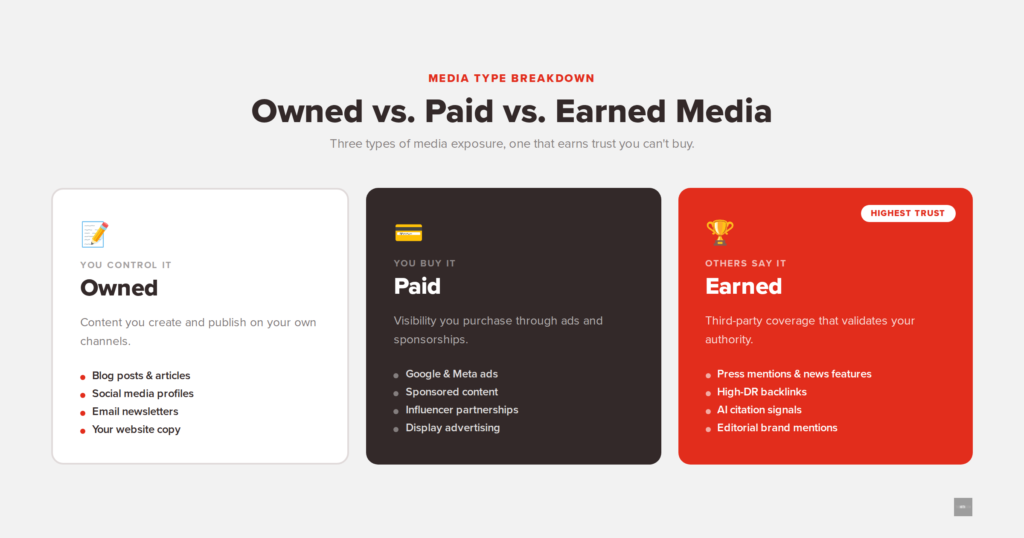
The marketing world typically divides content into three buckets. Understanding the difference helps you see where earned media fits in your strategy.
Owned media is anything your brand controls directly. Your website, your blog, your email list, your social media profiles are owned media. You have full control over the content, the timing, and the message. The downside is that nobody has to trust you. It is coming from you, so readers treat it with a grain of salt.
Paid media is any channel you pay to appear in. Google Ads, social ads, sponsored content, paid placements, influencer deals where money changes hands. Paid media is immediate and scalable, but it stops the moment your budget runs out. More importantly, audiences increasingly know the difference between ads and organic coverage, and they trust ads less.
Earned media is everything else: the coverage, mentions, and distribution you receive because someone else decided your brand was worth talking about. It is the most credible of the three because a third party is vouching for you. You do not control it, you cannot buy it, and that is exactly what makes it trustworthy.
The most effective marketing strategies use all three. But in 2026, earned media carries a weight the other two simply cannot match.
Why Earned Media Matters More Than Ever in 2026
Two major shifts have made earned media critical for any brand that cares about long-term visibility.
Google’s Trust Signal Problem
Google has spent years trying to separate high-quality content from content that just looks high-quality. The solution, increasingly, is to look at external signals: who is talking about you, where, and how often.
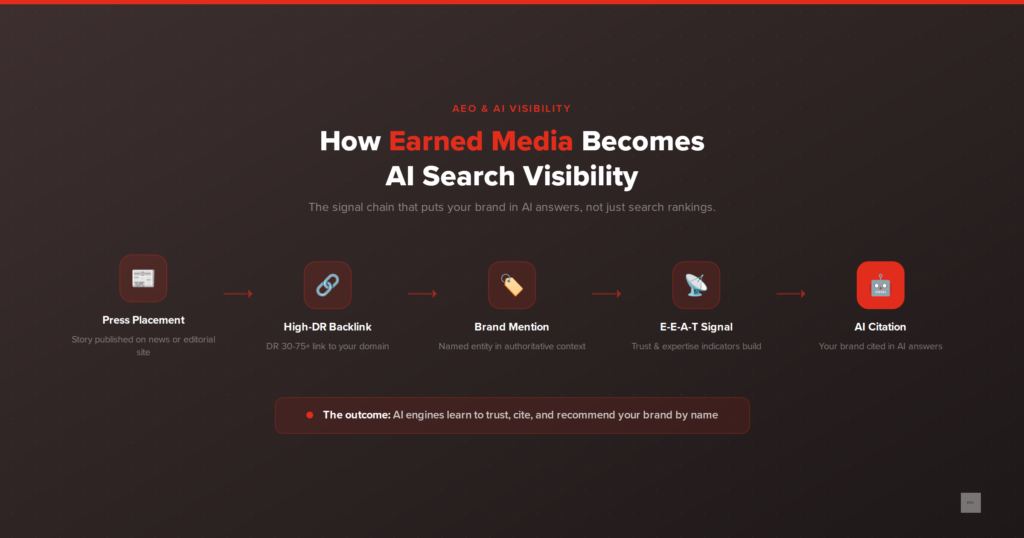
When credible outlets publish stories about your brand, those stories generate backlinks. High-DR backlinks from real editorial publishers are among the strongest ranking signals Google has. An article in Houston Chronicle or SFGATE linking to your site carries far more weight than a hundred directory links.
Beyond the link itself, the brand mention matters. Google uses entity recognition to build a picture of what your brand is, what it is known for, and how trusted it is. Earned media feeds that picture directly.
AI Systems Run on Credibility
This is the shift that most brands have not fully absorbed yet.
AI-powered tools like ChatGPT, Perplexity, Google’s AI Mode, and AI Overviews do not just pull from websites. They pull from sources they have already deemed trustworthy: primarily established media outlets, news publishers, and authoritative editorial sites.
If your brand appears consistently in those sources, AI systems recognize you as a credible entity. If you do not appear in those sources, you do not exist in the AI’s frame of reference.
This is what marketers mean by AEO: Answer Engine Optimization. It is the practice of positioning your brand to be cited by AI systems when they answer queries related to your space. And earned media is one of the most reliable paths to AEO visibility.
Every time a credible outlet covers your brand, you are building the kind of citations that AI systems prefer. Every brand mention is an entity signal. Every publication that picks up your story is training AI models to associate your brand with credibility and relevance.
What Makes Earned Media Different From Link Building?
If you have been doing SEO for a while, you might be wondering: is earned media just another way to say link building?
Not quite.
Traditional link building: guest posts, link insertions, link outreach, is about acquiring backlinks. It is an SEO play, and it works. But earned media is different in a few important ways:
The content is editorially driven.
Earned media stories are written in a journalist-style format and distributed through editorial channels. They are not guest posts. They are not sponsored content with a disclosure tag. They are real coverage.
The distribution is wider.
A single earned media story can be picked up by dozens of outlets simultaneously. When your brand story is distributed to a network of verified publishers, you are not getting one link: you might be getting 50 or more from a single campaign.
The credibility signals are stronger.
Because earned media comes through real editorial channels, it sends both trust signals to Google and entity signals to AI systems that traditional link building does not. Google knows the difference between a link from a manually edited news outlet and a link from a site in a guest posting network.
The brand awareness compounds.
Beyond SEO, earned media is read by actual people. When a story about your brand runs on AOL or MSN, real audiences see it. That drives direct traffic, brand recognition, and top-of-funnel awareness that backlinks alone cannot produce.
In short: link building builds your backlink profile. Earned media builds your brand’s place in the information ecosystem.
How Earned Media Affects Your SEO (With Numbers)
Let’s talk mechanics.
When a publisher with a Domain Rating of 50, 60, or 70 links to your site, they are passing a significant amount of link equity. The higher the DR, the stronger the ranking signal.
When you earn 50+ placements from a single campaign, you are generating 50+ backlinks from 50+ unique domains. Domain diversity: the number of unique referring domains pointing to your site, is one of the strongest indicators of organic authority. A business with 50 links from 50 different credible publishers looks very different to Google than a business with 500 links from 10 sites.
These placements also drive anchor text diversity. Editorial coverage tends to use your brand name, your URL, or natural descriptive language as anchor text: exactly the type of anchor profile that looks organic to search engines.
The result is compounding authority. Each campaign reinforces the last. As your domain rating climbs and your backlink profile diversifies with editorial placements, your rankings improve across your entire site, not just the pages you are actively targeting.
How Earned Media Affects AEO
Here is something worth understanding: AI models like ChatGPT, Claude, and Gemini were trained on the internet. The sources they trust most are the ones that appeared most often and most authoritatively across the web during training.
News publishers, media outlets, and editorial sites are disproportionately represented in that training data. That means brands that appear in those outlets have a higher probability of being cited in AI-generated responses.
But it does not stop at training data. AI systems actively pull from trusted sources when generating real-time answers. Perplexity, for example, is essentially a search engine that surfaces citations from credible content. Google’s AI Mode cites sources directly in responses. Being in those sources is not a nice-to-have. It is a prerequisite for AI visibility.
Every earned media placement builds what you might call an entity footprint: a web of mentions, citations, and signals that AI systems use to understand who your brand is and whether you are worth recommending. The more footprint you have across credible sources, the more likely AI is to surface you in relevant responses.
This is how brands win in an AI-driven search environment. Not by trying to game an algorithm, but by becoming genuinely visible in the places AI systems trust.
To understand where your brand currently stands in AI search, HOTH AI Discover audits your AI visibility and identifies exactly where the gaps are.
Types of Earned Media (and Which Drive the Most SEO Value)
Not all earned media is created equal when it comes to SEO impact.
Editorial news coverage is the gold standard. A story in a regional news outlet, a national publication, or a trade media site carries genuine editorial credibility and typically produces a dofollow link. These are the backlinks that move the needle fastest.
Story syndication is a high-efficiency form of earned media. A single journalist-style story gets distributed across a network of publishers simultaneously. Instead of earning one link from one outlet, you earn placements across dozens from verified, real-traffic sites. This is the model behind HOTH Earned Media.
Organic brand mentions happen when publications reference your brand, product, or statistics without necessarily linking to you. These still carry entity signal value, and many can be converted to links through link reclamation outreach.
Expert quotes and HARO-style placements earn you citations in stories written by journalists who needed expert input. These tend to produce high-authority editorial backlinks from sites where the journalist works.
Podcast appearances and video interviews produce fewer direct backlinks but build entity presence, drive referral traffic, and create content that can be cited and linked to downstream.
For pure SEO value, story syndication and editorial news coverage deliver the highest ROI. For AEO, brand mentions across credible media, regardless of link presence, contribute to the entity signals AI systems rely on.
A Real-World Example: What Earned Media Did for a Career Coaching Company
YES Career Coaching came to The HOTH looking to grow traffic and revenue. They were already investing in content, but needed to build the kind of external authority that would push them up the rankings for competitive keywords.
As part of their campaign, The HOTH distributed high-performing blog content across a network of high-authority publishers via HOTH Syndication. The results were significant: one syndicated piece earned pickups from local FOX and CBS news affiliates across the country, the International Business Times, SFGate, and radio stations.
Those placements were not just backlinks. They were brand credibility signals distributed to audiences that YES had no previous access to. Combined with targeted link building and content strategy, YES went from an 8% growth rate to a 45% revenue increase by the end of the year, by cutting every other marketing channel and going all-in on organic authority.
That is what earned media coverage does at scale. It gets you into rooms you could not buy your way into.
How to Build an Earned Media Strategy
You do not need a PR firm or a massive budget to start earning media coverage. Here is how to think about building it.
1. Make your brand worth covering.
Earned media starts with having something genuinely interesting to say. Original research, a contrarian take, a proprietary dataset, a compelling client story, or a timely take on an industry trend: these are the raw materials. If your brand has nothing to say that a journalist would want to report, start there.
2. Develop journalist-style story angles.
Not every piece of content becomes earned media. What earns coverage is content that reads like news: it has a hook, a data point, a consequence, and a reader who cares. Develop story angles around your expertise, your client results, or your industry perspective that are written for a reader, not for a search engine.
3. Identify the right distribution channels.
Earned media reaches the right audience through the right outlets. Map your target audiences to the publications they trust. A regional small business wants local news coverage. A SaaS brand wants trade media and tech publications. Target accordingly.
4. Pitch consistently.
A single campaign is a start. Sustained earned media comes from consistent outreach, consistent story development, and a long-term presence across relevant publications. Treat it like managed SEO : not a one-time sprint but an ongoing investment in authority.
5. Track performance beyond traffic.
Measure earned media with the metrics that matter: number of placements, publisher DR, referring domain diversity, brand mention volume, and changes to your AI citation presence over time. HOTH AI Discover can give you a baseline and track progress in AI search visibility specifically.
What HOTH Earned Media Delivers
For businesses that want earned media at scale, without building an in-house PR team, HOTH Earned Media handles the full process.
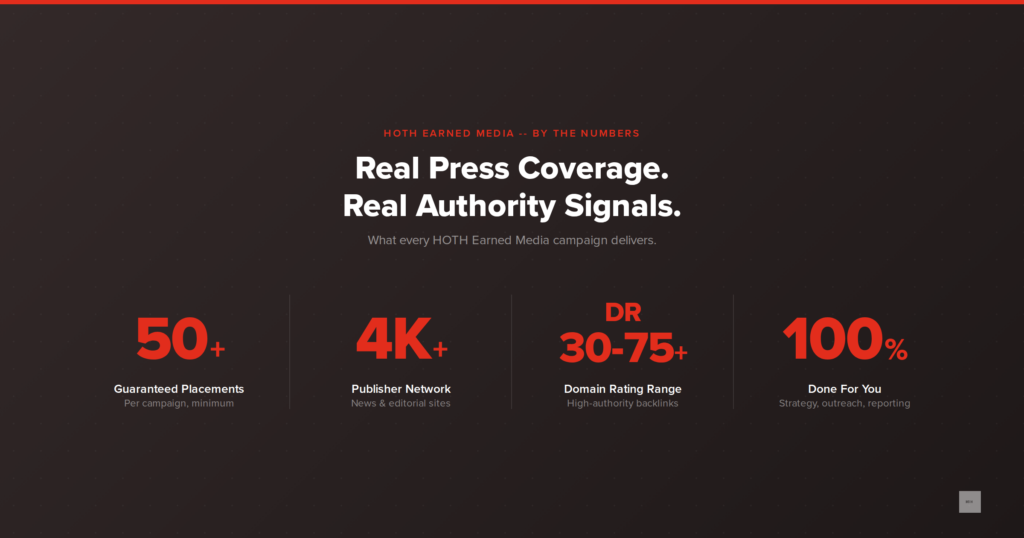
The HOTH team creates original, journalist-style stories about your brand and distributes them through a verified network of 4,000+ publishers. Outlets include Houston Chronicle, SFGATE, AOL, and MSN.
Each campaign delivers:
- 50+ guaranteed placements per campaign
- DR 30-75+ backlinks from real editorial publishers
- AI-ready entity signals that build brand recognition across AI systems
- Transparent reporting dashboards showing every pickup, publisher rating, and audience reach
Unlike traditional PR agencies that charge retainers and promise impressions, HOTH Earned Media delivers measurable results tied to specific SEO and AEO outcomes.
Earned Media Is Not Optional Anymore
The brands winning in search, and in AI-driven search, are not just the ones with the best content. They are the ones that have made themselves part of the information ecosystem that Google and AI systems trust.
Earned media is how you get there. Not a single campaign, not a viral moment, but consistent coverage from credible sources that builds authority over time.
If you are ready to start, book a free strategy call with a HOTH expert. We will help you build an earned media approach that drives real SEO and AEO results, and keeps working long after the stories go live.
Leave a comment