

A few years ago, ranking on Google was the whole game. You picked your keywords, built your content, earned some backlinks, and watched your traffic grow. That formula still works. But something has quietly changed about where your customers are actually searching.
More people are getting answers from AI tools now. ChatGPT, Perplexity, Google’s AI Overviews, and a growing list of AI-powered platforms are answering questions before searchers ever click a link. If your brand isn’t showing up in those answers, you’re invisible to a chunk of your market, no matter how well you rank on page one.
That’s where Answer Engine Optimization (AEO) comes in. And here’s what a lot of people don’t realize yet: you can’t just bolt AEO onto your strategy as an afterthought. The foundation it’s built on is the same one that makes SEO work. Content authority, link equity, technical structure, topical coverage, entity clarity. These things aren’t separate from AEO. They are AEO.
A well-run managed SEO campaign addresses all of them. Here’s how.
What Is AEO, and Why Does It Matter for Your Business?
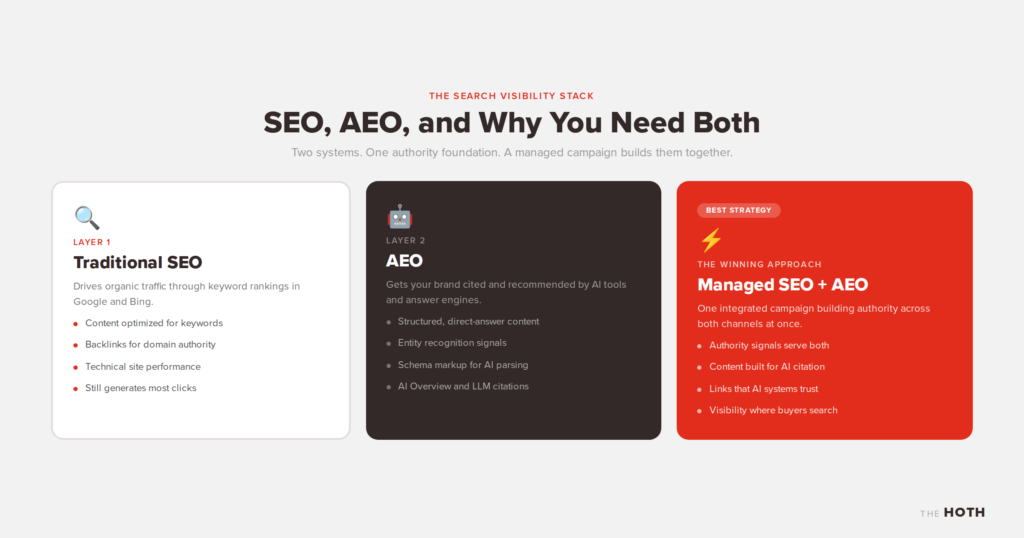
AEO stands for Answer Engine Optimization. It’s the practice of making your content, brand, and website signals strong enough that AI systems cite you, quote you, or recommend you when someone asks a relevant question.
Think about how often you see an AI Overview at the top of Google before any organic results. Or how many people now ask ChatGPT, “What’s the best project management software for small teams?” and get a list with names and explanations instead of blue links. The brands in those answers aren’t there by accident.
AI systems pull from sources they trust. They favor content that’s clearly written, factually grounded, topically comprehensive, and backed by authority signals from across the web. That’s a description of what strong SEO produces. Not a different playbook entirely, but an extension of it.
If you want a deeper look at AEO as a discipline, our guide on what AEO marketing is and how it works is a good starting point. But the short version: if you’re already investing in SEO, you’re building the foundation for AEO. The question is whether your campaign is structured to take advantage of it.
Bottom line: If you’re already investing in SEO, you’re building the foundation for AEO. The question is whether your campaign is structured to take advantage of it.
What Goes Into a Full-Service Managed SEO Campaign
Managed SEO means someone else runs your entire search strategy for you, not just one piece of it. You get a dedicated team handling research, content, link building, technical optimization, and reporting, all coordinated toward the same goal.
Here’s what that typically looks like in practice:
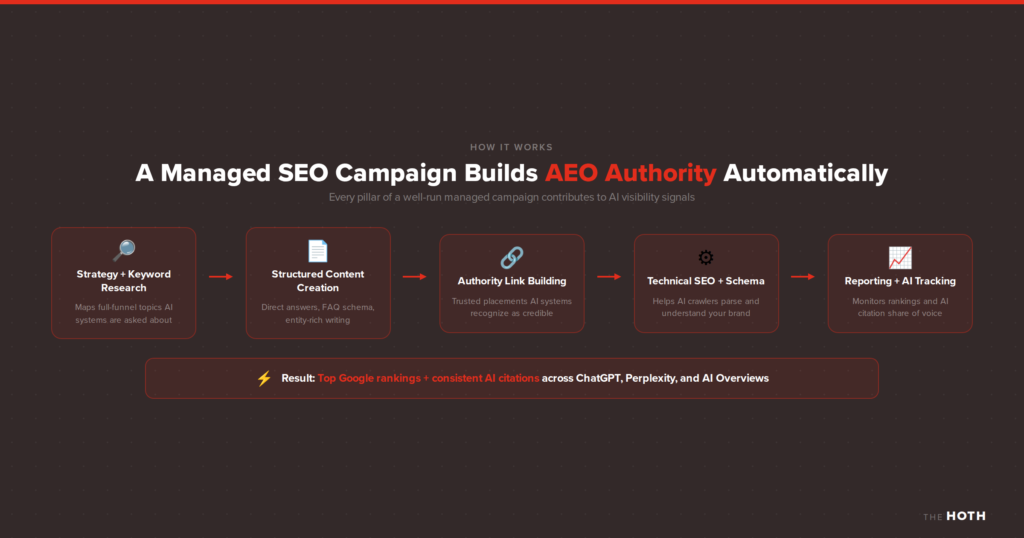
Strategy and Keyword Research
A managed campaign starts with a real audit of where you stand, what your competitors are doing, and what keyword opportunities exist across the full funnel. That means targeting informational queries (top of funnel), commercial comparisons (middle of funnel), and high-intent terms (bottom of funnel).
The same keyword mapping that helps you rank on Google also tells you what questions AI systems are being asked about your category. When you build content that answers those questions definitively, you’re positioning yourself for both.
Content Creation and Optimization
Content is the biggest lever in both SEO and AEO. AI systems are trained on the web and continue to reference it. Clear, structured content with direct answers, organized headings, FAQ sections, and entity-rich language is exactly what both Google and AI tools look for.
A managed campaign builds this content consistently over time, which matters because topical authority, being the site that covers a subject completely, is a major trust signal for AI systems. Our SEO copywriting guide covers how to write content that performs in both traditional and AI-driven search.
Link Building
Backlinks are how search engines and AI systems evaluate credibility. A link from a trusted publication tells AI models that your brand is considered an authoritative source in your space. That’s not an SEO-only signal. It directly affects whether an AI tool is comfortable recommending you.
Our link outreach service pursues high-quality, relevant placements that build both ranking authority and the kind of brand credibility that AI systems reward. For brands that also want press-level coverage, HOTH Earned Media takes that a step further by securing placements in major publications.
Technical SEO
Page speed, crawlability, structured data, schema markup, and clean site architecture all contribute to how easily search engines and AI crawlers can parse your content. Schema markup in particular helps AI systems understand what your content is about, who you are, and how to categorize your brand.
Reporting and Iteration
Managed SEO doesn’t set and forget. Monthly reporting tracks which keywords are moving, which content is performing, and where the gaps are. The best campaigns now also track AI visibility metrics, including brand mentions in AI Overviews, citation frequency across AI tools, and share of voice in AI-generated answers.
That’s exactly what our AI Discover product is built for. It audits where your brand currently shows up (or doesn’t) across AI platforms and tells you what signals need strengthening.
How Managed SEO Directly Fuels AEO Results
This is the connection that gets skipped over in most conversations about AEO. People treat it like a standalone discipline, something you do separately from SEO. But the signals AI systems use to decide what to cite aren’t fundamentally different from ranking signals. They’re built on the same foundation.
Topical Authority Tells AI You’re the Expert
AI tools don’t pull random content. They favor sources that cover a topic deeply and consistently over time. A managed campaign builds that topical depth intentionally, creating content clusters around your core subjects so that your domain becomes a reliable source on those topics.
When an AI model has indexed dozens of well-written, well-linked articles from your site on a given subject, your chances of being cited when someone asks about that subject go up significantly. This is why topical authority has become one of the most important long-term SEO investments a brand can make.
High-Quality Backlinks Build AI Trust
Citation trust is a real factor. An AI system that’s been trained on the web knows which publications are authoritative and which aren’t. A backlink from a respected industry site or major publication carries weight not just for traditional rankings, but for the credibility signals that influence AI recommendations.
Managed link building targets exactly those placements. The brands that show up in AI answers consistently tend to be the ones with strong, diverse backlink profiles from trusted sources. For a deeper look at what makes a link count, our post on how to improve domain authority covers the fundamentals.
Structured Content Gets Pulled Into AI Answers
Google’s AI Overviews often pull from content that’s clearly structured with direct answers at the top. If your content buries the answer in paragraph four after a long preamble, an AI system is more likely to skip it.
Managed content teams optimize for this. They write with clear H2/H3 structure, lead with answers, and use FAQ sections strategically. These aren’t just SEO best practices anymore. They’re AEO requirements. Our full guide on optimizing content for AI search engines goes deeper on the specific formatting signals that matter.
Technical Signals Help AI Systems Understand Your Brand
Schema markup is underused but powerful for AEO. Organization schema, FAQ schema, HowTo schema, and breadcrumb markup all give AI crawlers structured data about what your content contains and what your business does. A managed technical SEO partner makes sure these are implemented correctly and kept up to date.
The key insight: Every component of a well-run managed SEO campaign, content, links, technical work, and strategy, contributes to the signals AI systems use to decide what to recommend. You don’t need a separate AEO campaign. You need a managed SEO campaign that’s built with both goals in mind.
What This Looks Like in Practice: Real Results
One of the clearest ways to understand this is to look at what a comprehensive managed campaign actually produces.
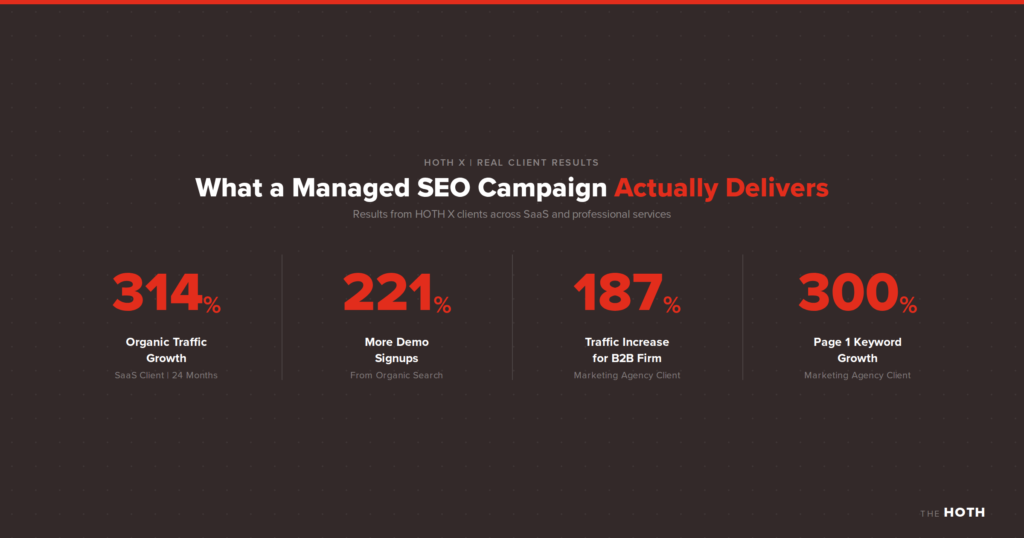
A B2B SaaS company came to HOTH X with a solid product but almost no organic search presence. Their core product pages weren’t ranking, they had minimal backlinks from relevant tech domains, and they weren’t appearing in any industry searches that mattered to their buyers. Over 24 months, HOTH X ran a full managed campaign: keyword mapping across product and use-case pages, high-authority link building in the SaaS space, content optimization targeting both decision-makers and technical users, and ongoing technical improvements.
The results: organic traffic grew by 314%, demo signups from organic search increased by 221%, and the site reached top-3 rankings for multiple high-intent software keywords, including more than 500 new Page 1 placements. That kind of topical coverage and domain authority doesn’t just improve rankings. It’s exactly the profile that AI systems recognize as a credible source.
A B2B marketing firm saw a similar pattern. Low visibility on their own service terms, thin content, few authoritative backlinks. After a managed campaign focused on content optimization, high-authority link building, and keyword research aligned to buyer intent, they saw a 187% increase in organic traffic and a 300% lift in Page 1 keyword rankings. Their sales team went from cold outreach to closing inbound leads.
In both cases, the managed campaign wasn’t just building Google rankings. It was building the authority profile that makes a brand recommendable across channels, including AI-driven ones.
AEO Isn’t a Replacement for SEO. It’s the Next Layer.
There’s a version of this conversation that frames AEO as the death of SEO, or at least its successor. That’s not accurate. Google still drives enormous amounts of traffic. Organic search rankings still matter. Most buying journeys still involve a search, even if they also involve asking an AI.
What’s changed is that the brands showing up in both places have a compounding advantage. Every time your content gets cited in an AI Overview, your brand gets exposure without a click. Every time a user asks ChatGPT about your category and your brand comes up, that’s awareness you didn’t pay for. Over time, that compounds with your organic traffic to create a visibility moat that competitors who are only playing the traditional SEO game can’t easily replicate.
The way to build that moat isn’t to split your attention between two separate strategies. It’s to run one integrated campaign that builds authority comprehensively. For more on how AI search is changing the landscape, our guide on AI search ranking factors breaks down what signals matter most right now.
That’s what managed SEO does when it’s done right.
How to Know If Your Current SEO Is Built for AEO
A few questions worth asking about your current strategy:
- Does your content build topical depth, or does it cover topics in isolation?
- Are your most important pages built with clear, structured answers and FAQ sections?
- Is your link building targeting high-authority, relevant sources, or just volume?
- Do you have schema markup implemented across key page types?
- Is anyone tracking whether your brand shows up in AI Overviews or AI-generated answers?
If the answer to most of those is no or not sure, your SEO foundation needs work before AEO will gain traction. You can’t optimize for AI visibility on top of a weak content and authority base. Our AI Discover audit is a fast way to see exactly where your brand stands across AI platforms today.
What HOTH X Does Differently
HOTH X is The HOTH’s fully managed SEO service, built for exactly this kind of comprehensive, long-term campaign. Every client gets a dedicated campaign manager, a custom strategy, and a coordinated team handling content, links, and technical work.
What sets HOTH X apart in 2026 is that it’s built for both traditional search and AI visibility. The content it produces is structured for AI citation, not just keyword ranking. The links it builds come from authoritative, niche-relevant sources that carry weight with AI systems. And the technical work includes schema markup and structured data that helps AI crawlers understand your brand.
If you want to show up in Google AI Overviews, get cited by ChatGPT and Perplexity, and still dominate traditional organic rankings, the path runs through a comprehensive managed SEO campaign.
You can also pair HOTH X with AI Discover, our AI visibility audit product that shows exactly where your brand is being mentioned across AI tools, where you’re missing, and what’s needed to close the gap. Together, they give you both the execution and the visibility data to know whether it’s working.
The Bottom Line
AEO isn’t a trend to monitor. It’s a shift in how a growing percentage of your customers are finding products, services, and recommendations. The brands that show up in AI answers have built the same thing that shows up in Google rankings: content authority, trusted backlinks, and a technically sound site.
If you’re already investing in managed SEO and your campaigns are well-run, you’re building toward AEO visibility whether you realize it or not. The question is whether your campaign is intentionally structured to capture it.
If you’re not yet running a managed SEO campaign, or if your current approach isn’t producing the kind of compounding authority that both Google and AI systems reward, it’s worth looking at what a more comprehensive approach could do for your brand.
Book a free strategy call with our team at thehoth.com/meet and we’ll show you exactly what a campaign built for both SEO and AEO looks like for your site.
Leave a comment