

White label SEO is SEO work that one company performs and another agency resells under its own brand. Your clients see your name on the strategy, the reports, and the results, while a specialist partner does the fulfillment in the background. It lets an agency offer SEO without hiring an in-house team.
Your clients are asking you for SEO. Maybe they want to rank in Google, maybe they want to show up in ChatGPT, and maybe they just know a competitor is beating them online. You could turn the work away. You could hire an SEO team and hope the billings cover the payroll. Or you could deliver it under your own brand starting next week, without adding a single specialist to your staff.
That last option is white label SEO, and it is how a large share of agencies quietly offer search services they do not fulfill in house. This guide covers what white label SEO is, how it works, what you can resell, how to price it, and how to pick a partner that protects your brand and your margin. The demand is not slowing down, either. As search shifts toward AI answers, more clients are asking their existing agency to handle visibility across Google and tools like ChatGPT, and the agencies that can say yes are the ones keeping those accounts.
What is white label SEO?
White label SEO is a service one company produces and another sells under its own name. The reseller owns the client relationship and the branding, and the provider does the work anonymously behind the scenes.
Think of it like a store brand at the grocery store. The product is made by an established manufacturer, then packaged and sold under the retailer’s label. With white label SEO, the SEO work is the product, your agency is the retailer, and your provider is the manufacturer who never appears on the box.
The term covers the full range of search work, not just one piece of it. White label link building is a common entry point, and we cover that narrower topic in our guide to white label link building, but white label SEO also includes content, technical work, local SEO, and full managed campaigns. If a client can buy it as an SEO service, you can usually resell it.
Who uses white label SEO?
White label SEO is used by digital agencies, freelancers, web design studios, PR firms, and marketing teams, anyone who has clients asking for SEO but does not want to build a search team in house.
Full-service marketing agencies use it to add search to a roster that already includes design, ads, or social. Web design studios use it to keep clients who would otherwise leave for an agency that also does SEO. Freelancers and consultants use it to take on work that is bigger than one person can deliver alone. PR firms use it to fold AI visibility and earned media into their existing pitch. The common thread is a client relationship worth protecting and a service gap worth filling.
How does white label SEO work?
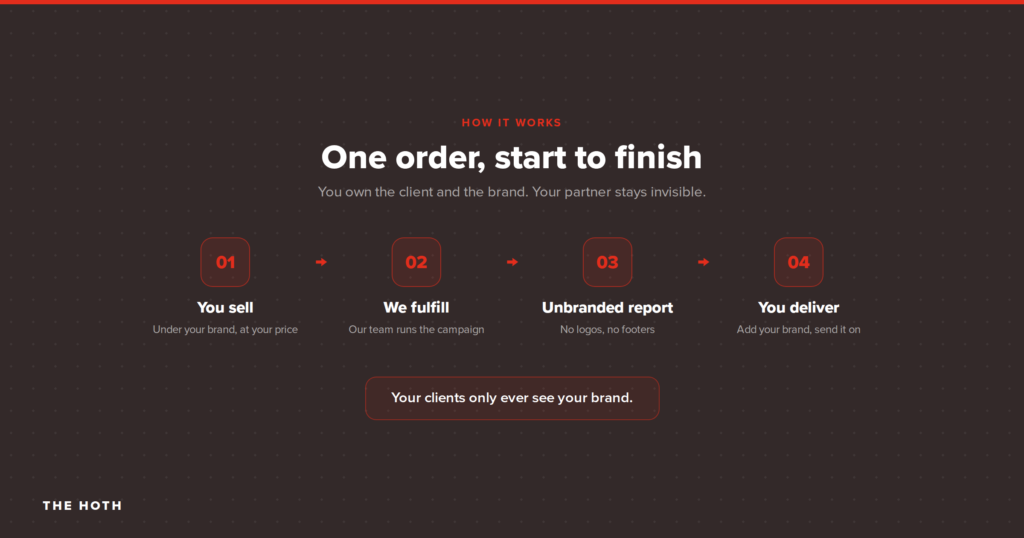
You sell the service under your brand, your partner fulfills it, and every report and deliverable comes back unbranded so you can hand it straight to your client. The client never knows a second company was involved.
There are three parties in a white label arrangement, but your client only ever sees two. There is your agency, there is your client, and there is your provider, who stays invisible. You set the price, manage the relationship, and present the work. The provider runs the strategy and the production.
The piece that makes it work is unbranded delivery. A good provider gives you reports with no logos, no phone numbers, and no powered-by footers, so you can add your own branding and send them on. The best partners back this with a confidentiality agreement, so your client relationship is protected in writing, not just by habit.
Here is what a single order looks like in practice. A client tells you they want to rank for a set of local terms. You scope the work, quote your retail price, and place the order with your provider. The provider runs the campaign, and a few weeks later you receive an unbranded report showing the links built or the content published. You add your logo, write a short note in your own voice, and send it to the client as your agency’s work. The client sees progress from you, and your provider is never mentioned.
At The HOTH, every report and deliverable is private label by default, and resellers manage everything from one white label dashboard. You place orders, track results, and pull client-ready reports in one place, instead of juggling freelancers and vendor logins.
What SEO services can you white label?
The core white label menu covers link building, content, managed SEO, local SEO, technical SEO, and now AI visibility. The wider your provider’s range, the fewer vendors you have to manage.
Most agencies start with one or two services that match what their clients already ask for, then expand. Here is what is typically available to resell:
- Link building. Guest posts, editorial links, and link insertions that build a client’s authority. This is the most common first product for new resellers.
- Content. Blog posts, web copy, and content refreshes written to rank and to be cited by AI tools.
- Managed SEO. A full, done-for-you campaign that bundles strategy, content, and links into one monthly engagement you sell as a retainer.
- Local SEO. Citations, listings, and reviews for clients who need to show up in a specific city or service area.
- Technical SEO. Audits and fixes for crawlability, indexing, and site health that support everything else.
- AI visibility. Earned media, digital PR, and reputation work that gets clients cited in ChatGPT, Google AI Overviews, and Perplexity.
Breadth matters more than it looks. Every service your provider does not offer is a vendor you have to source, vet, and manage yourself. A partner that covers link building, content, managed SEO, and local work under one roof keeps your operation simple as you grow.
White label SEO vs hiring an in-house team
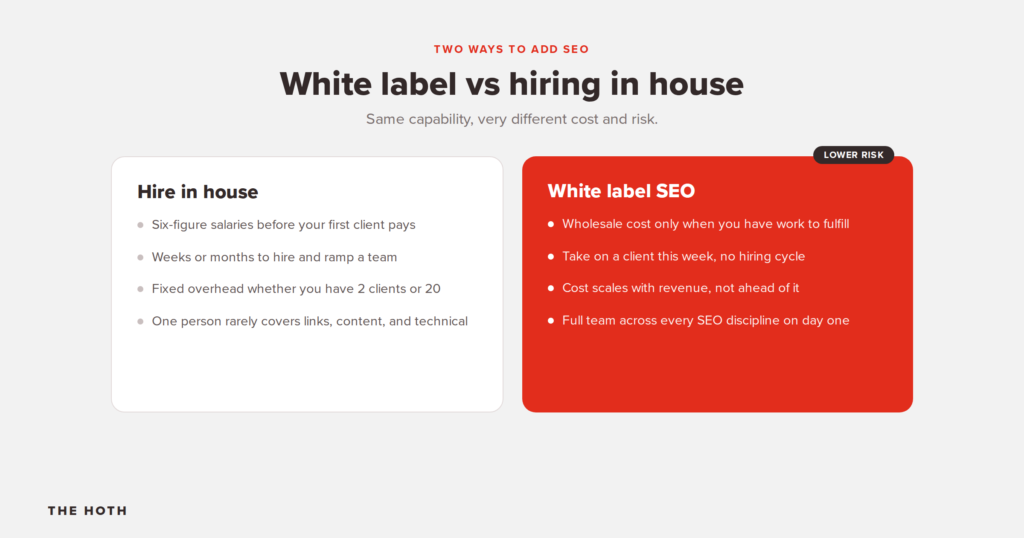
Building an in-house SEO team means salaries, software, and training before you earn a dollar. White label SEO gives you the same capability at a wholesale cost, with no hiring and no fixed overhead.
An in-house hire is a bet. A single experienced SEO specialist can cost six figures a year once you add tools and benefits, and one person rarely covers content, links, technical, and local well. You are paying that salary whether you have two SEO clients or twenty.
White label flips the math. You pay wholesale only when you have work to fulfill, so your cost scales with your revenue instead of running ahead of it. You can take on a client this week without a hiring cycle, and if a client leaves, you have no idle payroll to cover. For most agencies, especially ones adding SEO to an existing service mix, that flexibility is the whole point.
There is also a hidden cost to doing SEO yourself without a specialist: the learning curve. SEO changes constantly, from Google algorithm updates to the rise of AI answers, and staying current is a job on its own. Add the price of tools like Ahrefs or Semrush, and a do-it-yourself approach can cost more than a wholesale partner while producing weaker results. White label lets you skip the ramp and deliver proven work from day one.
How much does white label SEO cost, and how do you price it?
You pay wholesale and set your own retail. Most agencies mark services up 2x to 4x and keep margins in the 40 to 60% range, with managed SEO wholesale starting around 1,000 dollars a month and scaling by scope.
Because you control the retail price, your margin is a decision, not a fixed number. The common pattern is a 2x to 4x markup on wholesale, justified by the strategy, account management, and reporting you provide on top of the fulfillment. Resellers who package their services well tend to land in the 40 to 60% margin range.
A simple example makes the model clear. Say a link package costs you 300 dollars wholesale. At a 3x markup you sell it for 900 dollars, keeping 600 dollars to cover your strategy, management, and reporting. Do that across a handful of retainer clients and the recurring revenue adds up quickly, without a single new hire on your side.
Package based pricing closes more deals than per-deliverable pricing. Bundling a clear set of services into a monthly retainer makes the offer easy to say yes to and easy to renew, which is how you turn one-off projects into recurring revenue. We break down which products to package and how to price them in our guides to reselling SEO and the easiest HOTH products to resell.
How do you choose a white label SEO provider?
Look for fully unbranded reporting backed by an NDA, broad and consistent service coverage, wholesale pricing that protects your margin, a real dashboard, and proven AI visibility capability. Those five factors decide whether reselling protects your brand or exposes it.
Not every provider is built for resellers. Use this checklist before you commit your clients to one:
- Truly white label delivery. Reports, dashboards, and communication carry your brand, not theirs, ideally backed by a confidentiality agreement. If a client could ever tell someone else did the work, the provider fails here.
- Service breadth. Links, content, technical, local, and managed campaigns in one place, so you are not stitching together five vendors.
- Consistent quality at scale. Output that holds up as you add clients, rather than quietly getting passed to the cheapest subcontractor.
- Wholesale pricing with room to mark up. A pricing model that leaves you a healthy margin and matches how you sell, whether that is ala carte, managed, or packaged.
- AI visibility capability. Your clients are already asking why they are not in ChatGPT and AI Overviews. Confirm your partner can deliver that work, not just traditional links.
A track record helps too. A provider that has run tens of thousands of campaigns has seen your client’s situation before, which lowers your risk on every account you hand over.
Watch for a few red flags as well. Providers that lean on private blog networks, that cannot show you a real reporting dashboard, or that outsource content to the lowest bidder put your client relationships at risk. If a partner is vague about how the work gets done, treat that as a warning, because your brand is the one on the deliverable.
Can you white label AI search visibility too?
Yes. The same authority signals that win Google rankings now drive AI citations, so a strong white label partner lets you resell AI visibility alongside traditional SEO.
This is the fastest-growing question in agency sales right now. Clients see competitors named in ChatGPT and Google AI Overviews and want to know why they are not. The good news is that the work overlaps: earned media, digital PR, structured content, and reputation management build the trusted mentions that both Google and AI models reward.
That means you can add AI visibility to your offering without rebuilding your service from scratch. Our own strategies, the same ones available to resellers, drove 354% growth in AI-referred traffic and roughly 9 times higher conversion from those visitors on our properties, along with 502% growth in ChatGPT traffic. You can resell that capability under your brand through AI Discover, our AI-first managed program.
What reselling SEO can do for your agency
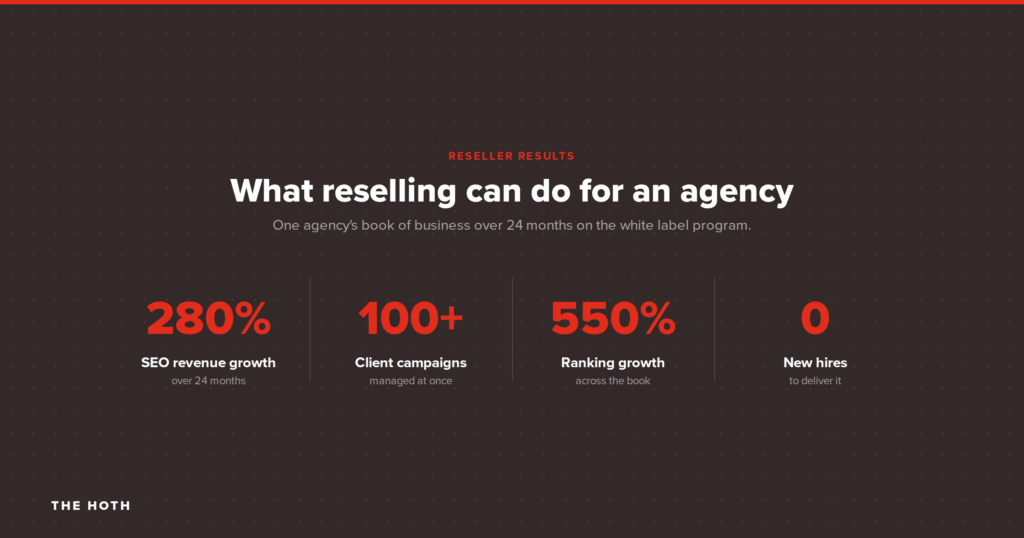
The upside is not theoretical. A fast-growing digital marketing agency that joined our white label program grew its SEO revenue by 280% over 24 months while managing more than 100 client campaigns, with zero new hires. Keyword rankings improved 550% across their book of business. They owned every client relationship. We ran the fulfillment in the background.
That is the pattern white label is built for. You keep the part of the business that compounds, the client relationships and the brand, and you hand off the part that does not scale cleanly with headcount, the production. Your revenue grows without your payroll growing to match.
How to start reselling white label SEO with The HOTH
The HOTH has run a reseller program since 2010, and more than 200,000 businesses use our services to fill gaps in their offering without hiring specialists. A free reseller account gets you wholesale pricing, an unbranded dashboard, and bulk buyer bonuses that raise your margin as your volume grows. Verified resellers also get sales guides, case studies, and pitch decks built to help you close the deals these services support. See how it works on our white label SEO reseller program page, learn the mechanics in our guide to reselling SEO like a champion, or book a call with our team to map out your first reseller package.
Frequently asked questions
Is white label SEO legal and ethical?
Yes. Reselling a service you did not produce is standard practice across marketing, from web design to paid ads. You provide real value through strategy, account management, and client service, and your provider handles fulfillment. As long as you deliver results and stand behind the work, there is nothing untoward about it.
What is the difference between white label SEO and reseller SEO?
They describe the same arrangement from two angles. White label refers to the unbranded work you put your name on, and reseller refers to your role selling it. In practice the terms are used interchangeably.
How much can you mark up white label SEO?
Most agencies charge 2x to 4x their wholesale cost and keep margins in the 40 to 60% range. Your markup is justified by the strategy, management, and reporting you add on top of the fulfillment.
Do clients find out you outsource the work?
Not with a true white label provider. Reports and dashboards carry your branding, communication runs through you, and a good partner backs it with a confidentiality agreement, so your clients only ever see your brand.
Can you white label local SEO and AI visibility?
Yes. Local SEO, technical SEO, and AI visibility work like earned media and digital PR are all resellable, so you can cover a client’s full search presence under one brand.
The bottom line
White label SEO lets your agency offer search services, and win the revenue that comes with them, without building a team to fulfill the work. Sell under your brand, pick a partner that keeps its own brand invisible and its quality consistent, price for a healthy margin, and make sure you can deliver AI visibility alongside traditional SEO. Do that, and SEO becomes a growth line for your agency instead of a request you have to turn away.
Leave a comment