
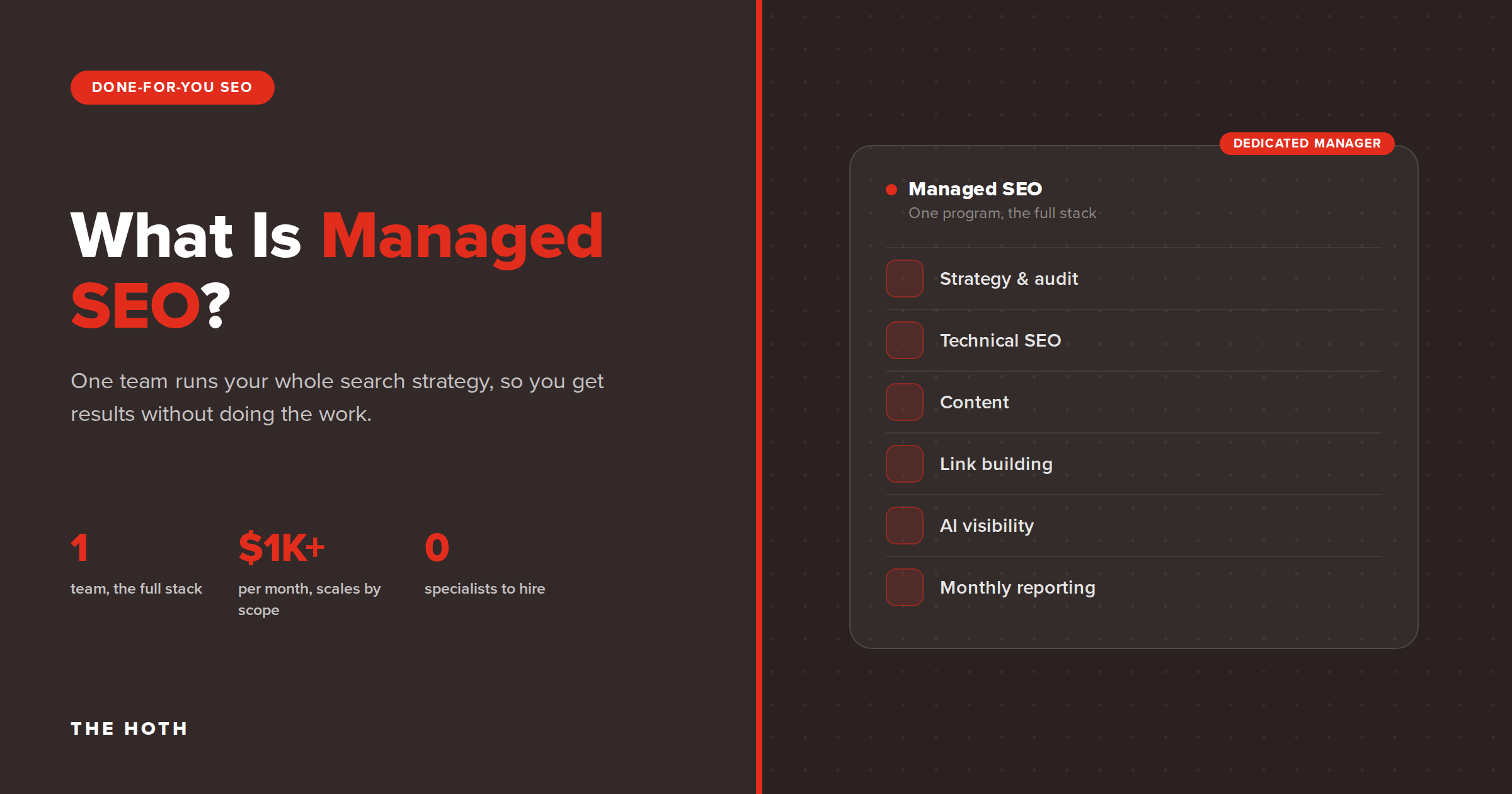

Managed SEO is a done-for-you service where a dedicated team runs your entire SEO strategy, content, links, technical work, and reporting, for a monthly fee. Instead of buying individual SEO tasks or hiring in-house, you hand the whole program to specialists who plan and execute it for you.
Most business owners know they need SEO. What they underestimate is that SEO is not one job. It is content strategy, technical fixes, link building, local optimization, reporting, and now AI visibility, each a specialty of its own. Doing it well means either learning all of it, hiring a team of specialists, or coordinating a stack of freelancers and hoping they pull in the same direction.
Managed SEO is the fourth option: hand the whole thing to a team that does it for a living. This guide explains what managed SEO is, what is included, how it works, who it fits, and what it costs, so you can decide whether handing off your search strategy is the right move.
What is managed SEO?
Managed SEO is a fully handled SEO service. A dedicated strategist and team plan and run your entire campaign, across content, links, technical work, and reporting, for a recurring monthly fee, so you get results without doing the work or managing the pieces yourself.
The key word is managed. With managed SEO, you are not buying a single deliverable like a batch of links or one audit. You are buying an outcome and a team to reach it. Someone owns your strategy, decides what to work on each month, executes across every discipline, and reports on what it produced. Your job shrinks to reviewing results and steering the direction.
That is what separates it from the alternatives. Ala carte SEO means buying individual products and coordinating them yourself. Doing it in house means building and paying for a team. Managed SEO folds the strategy, the execution, and the management into one service you pay for monthly.
What is included in managed SEO?
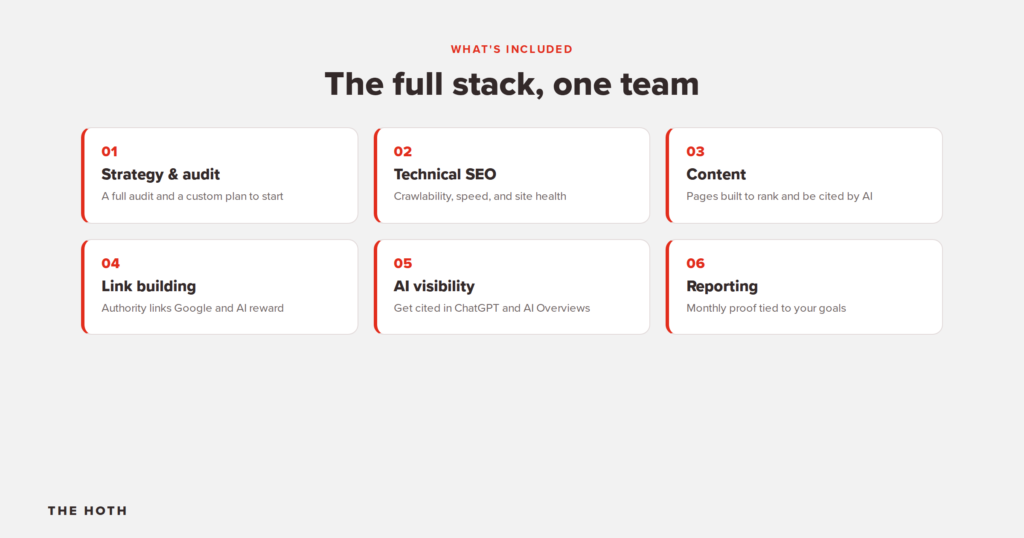
A managed SEO program bundles the full stack: strategy and an audit, technical SEO, content, link building, and reporting, and in 2026 it should include AI visibility too, all run by a dedicated campaign manager.
A complete managed program covers every lever that moves rankings, coordinated so they reinforce each other:
- Strategy and audit. Every campaign should start with a full SEO audit that finds the issues and the easy wins, then a custom strategy built around your goals.
- Technical SEO. Fixes to crawlability, site speed, and structure so the rest of the work can rank. See our technical SEO service.
- Content. New and refreshed pages built to rank and to be cited by AI, through a content program.
- Link building. Authoritative backlinks that build the trust Google and AI systems reward.
- AI visibility. Earned media, news links, and reputation work that get you cited in ChatGPT and AI Overviews, the core of AI Discover.
- Reporting and a campaign manager. Monthly reporting on what was done and what it produced, plus a dedicated strategist who owns the whole plan.
How does managed SEO work?
It starts with an audit, moves into a custom strategy, and then a dedicated team executes across content, links, and technical work while reporting monthly and adjusting as results come in.
A good managed program runs on a clear rhythm. It opens with a detailed audit of your site, your competitors, and your easy-win keywords. From there, your strategist builds a customized plan and the team gets to work, coordinating technical fixes, content, and links so they compound rather than compete. Each month you get a report and a strategy that adapts to what the data shows. With Managed SEO from The HOTH, that team is led by a dedicated campaign manager who is an experienced SEO veteran, so one accountable person owns your results.
In practice, the first month is mostly discovery and setup: the audit, the keyword and competitor research, and the roadmap. From month two on, the team executes the plan on a monthly cadence, shipping content, building links, resolving technical issues, and reporting on the results, then adjusting the next month based on what moved. You are never left guessing what is happening, because the report and the strategist tie every activity back to the goal.
The advantage of one team running everything is coordination. When the same group handles your technical health, your content, and your links, the work reinforces itself. A new page ships with the technical foundation to rank and the links to push it, instead of three vendors each doing their piece in isolation.
Who is managed SEO for?
Managed SEO fits businesses that need results but lack the time or in-house expertise to run SEO themselves, from local service businesses to SaaS and ecommerce brands, along with agencies that resell it under their own brand.
It is the right fit if you recognize any of these. You know SEO matters but cannot make it a full-time job. You do not have an in-house team and do not want the cost of building one. You have tried buying individual services and found that coordinating them is its own headache. Or you are an agency that wants to offer SEO without hiring specialists, in which case managed SEO can be delivered white label under your own brand.
It works across business types, though the emphasis shifts. Local service businesses lean on local SEO and reviews, ecommerce brands need product and category optimization at scale, SaaS companies compete on high-value informational terms, and regulated niches like finance and healthcare need heavy authority and trust signals. A good managed program tailors the mix to your model rather than running the same playbook for everyone.
Managed SEO vs the alternatives
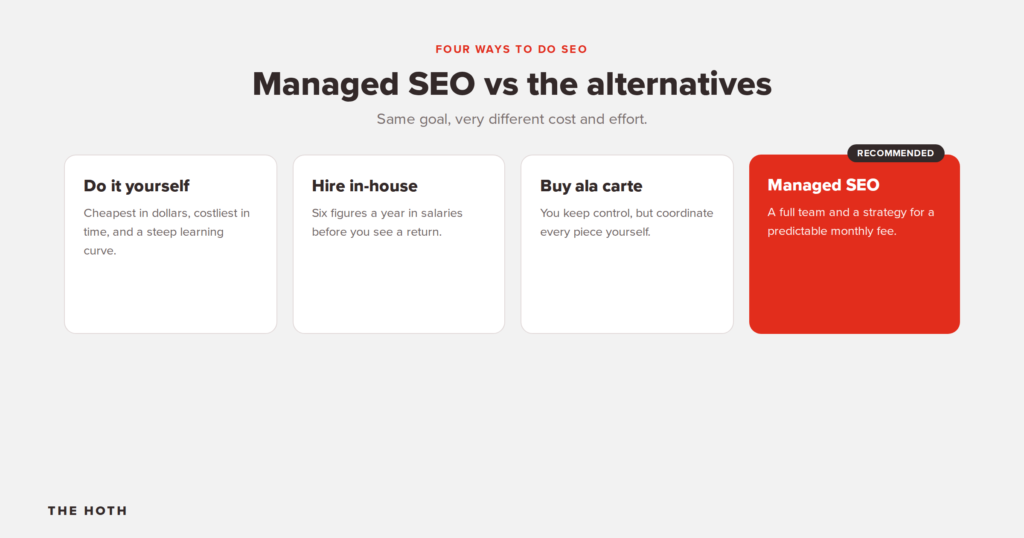
Doing SEO yourself costs your time and a steep learning curve, hiring a team costs six figures a year, and ala carte SEO leaves you coordinating every piece. Managed SEO gives you a full team and a strategy for a predictable monthly fee.
Weigh the four paths. Doing it yourself is the cheapest in dollars and the most expensive in time, and SEO changes fast enough that staying current is a job on its own. Hiring in house means salaries, tools, and management for a team of specialists, easily six figures a year before you see a return, and one generalist hire rarely covers content, links, and technical well. Buying ala carte products keeps you in control but puts the strategy and coordination on your plate. Managed SEO trades a monthly fee for a team that handles all of it, which is why it is the default for businesses that want results without the overhead.
Is managed SEO the same as hiring an SEO agency?
Managed SEO is a service model, and an SEO agency is one type of provider that offers it. Most managed SEO is delivered by agencies or specialized SEO companies, but the term describes the done-for-you structure, not the vendor.
The distinction that matters is not the label but what you get. Some agencies sell you a strategy and hand execution back to you, or bill by the hour for scattered tasks with no one owning the outcome. Managed SEO specifically means the provider owns the plan and does the work, from strategy through execution and reporting, for a set monthly fee. When you evaluate an agency, the question to ask is whether the engagement is truly managed, or whether you will still be coordinating the pieces yourself.
What should you look for in a managed SEO provider?
Look for a dedicated strategist who owns your account, full-stack coverage across content, links, and technical work, transparent monthly reporting, real AI visibility capability, and a track record you can verify.
Not every managed service is built the same, so vet a provider against a few things before you commit. Is there a dedicated campaign manager, or will you be a ticket in a queue? Does the program cover the full stack, or just links and content with the technical work left to you? Is the reporting clear enough to tie activity to results, or is it a monthly data dump? Can they deliver real AI visibility, not just traditional rankings? And do they have documented case studies in situations like yours? A provider that checks those boxes is one you can hand your search strategy to with confidence.
How much does managed SEO cost?
Managed SEO is priced as a monthly retainer that scales with scope and competition. The HOTH’s Managed SEO starts around 1,000 dollars a month and grows with the size of the campaign.
Because managed SEO is ongoing, it is billed monthly rather than per deliverable. Entry-level programs for smaller or local businesses start around 1,000 dollars a month, and campaigns scale up from there based on how competitive your market is and how aggressive your goals are. For a fuller breakdown of what SEO costs and why, see our guide on how much SEO costs.
What managed SEO can deliver
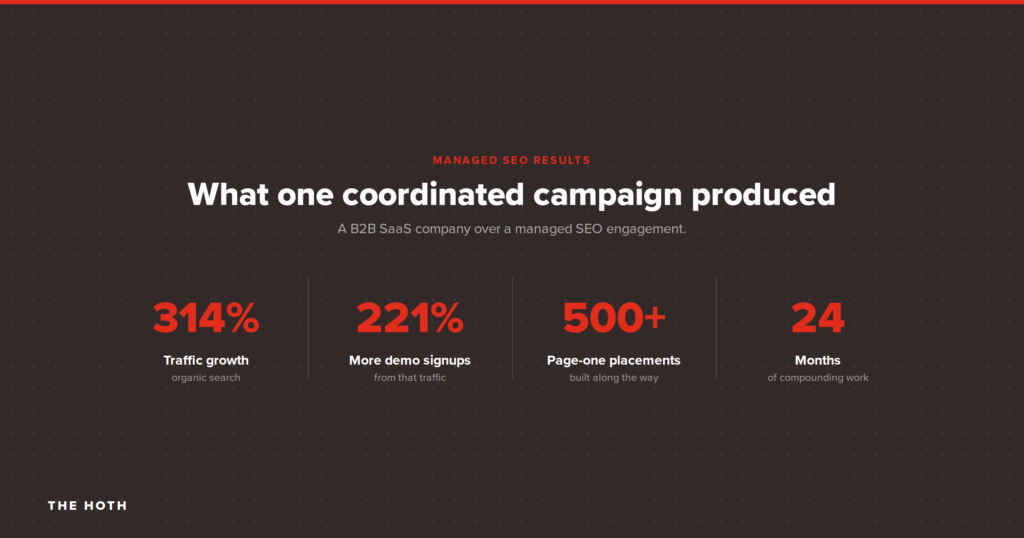
The payoff of a coordinated program shows up in the results. A B2B SaaS company on a managed campaign grew its organic traffic by 314 percent and increased demo signups by 221 percent over the course of the engagement, with hundreds of page-one placements built along the way. That kind of outcome comes from every discipline pulling together under one strategy, month after month, rather than from any single tactic.
Results like that are not instant. Managed SEO compounds, so the early months build the foundation and the later months bank the returns. It helps to watch the right signals along the way: early on, look at leading indicators like new keywords ranking, pages indexed, and links earned, and expect the lagging outcomes like traffic and conversions to follow a few months behind. The businesses that win with managed SEO treat it as an ongoing investment, not a one-time purchase, and judge it on the trend rather than any single month.
Getting started with Managed SEO
If SEO is something you know you need but do not want to run yourself, managed SEO is the shortest path from where you are to results. The HOTH’s Managed SEO program gives you a dedicated campaign manager, the full suite of SEO and AI visibility work, and monthly reporting, all under one roof. You can see how it fits alongside our other done-for-you options on the Managed Services hub, or book a call with our team to map out a plan for your business.
Frequently asked questions
Is managed SEO worth it?
For most businesses without an in-house team, yes. SEO is a multi-discipline job that rewards consistency, and a managed program delivers that consistency without the cost of hiring or the time of doing it yourself. The compounding nature of SEO means the visibility you build keeps paying off long after the work is done.
How is managed SEO different from ala carte SEO?
Ala carte SEO means buying individual products, like a batch of links or a set of blog posts, and coordinating the strategy yourself. Managed SEO includes the strategy and the coordination, so a dedicated team decides what to do each month and executes it for you.
How long until managed SEO shows results?
Most campaigns show early movement within a few months, with the larger gains compounding over six to twelve months and beyond. Competitive markets take longer, which is why managed SEO is structured as an ongoing program rather than a short project.
Does managed SEO include AI and AEO?
A modern managed program should. The same authority signals that rank you in Google, earned media, news links, and reputation work, are what get you cited in ChatGPT and AI Overviews, so strong managed SEO now builds both at once.
Can agencies resell managed SEO?
Yes. Managed SEO can be delivered white label, so an agency can sell it under its own brand while a partner runs the fulfillment. This lets agencies offer full-service SEO without hiring a team of specialists.
The bottom line
Managed SEO exists because SEO is too big and too specialized for most businesses to run well on their own. It hands the strategy, the execution across every discipline, and the reporting to a dedicated team for a predictable monthly fee. If you need SEO results but do not have the time or the team to build them, a managed program is the most reliable way to get there, and the most likely to keep working as search and AI keep changing.
Leave a comment