
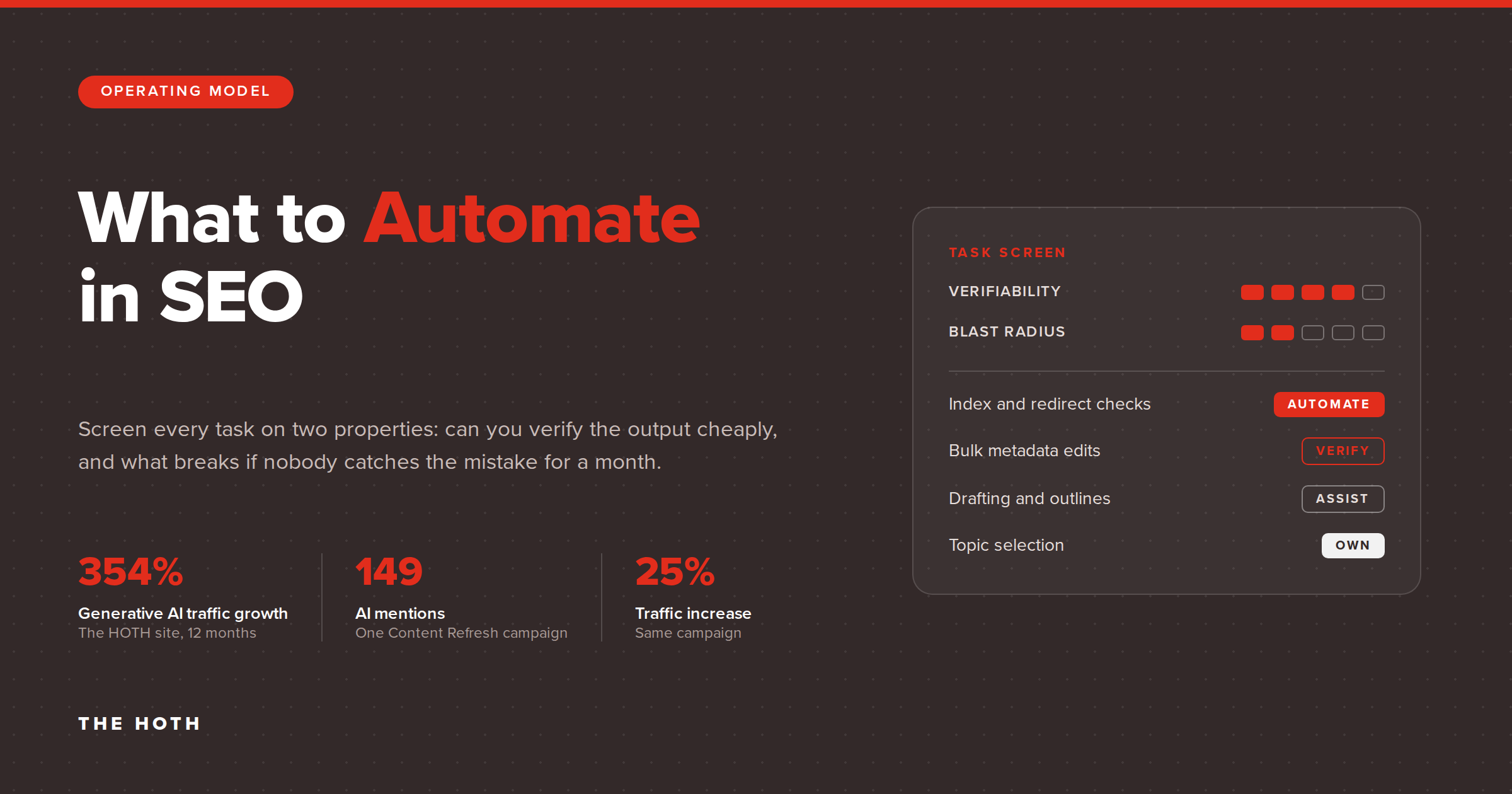

Automate the SEO tasks whose output can be checked against an objective standard and whose mistakes are cheap to reverse: rank and crawl monitoring, report assembly, research gathering, candidate lists, and mechanical QA. Keep people on the work that has no answer key: topic selection, editorial standards, outreach targeting, and client diagnosis. The dividing line is not human versus machine. It is verifiable versus judged.
You have probably already run the tools test. Somebody on your team spent a month with a stack of AI tools, some of it worked, a lot of it was noise, and you kept maybe a third.
That test answered the easy question. The hard question sits underneath it: what does your operation look like now, and where do the people go.
That is a different problem from picking software. When you automate a step in an SEO workflow, you are not just removing labor from that step. You are changing what the person who used to do it knows, what gets caught downstream, and what your team will be capable of noticing six months from now. Some of those changes are fine. Some of them stay invisible until a client asks a question nobody on the account can answer.
This post is about where to draw that line. It is written for agency owners and in-house leads who have to decide this quarter which parts of the operation still need a person, and which do not. If you are rebuilding the content side of that operation, HOTH Content Services is built around the same split described here.
Why is the automation question about your operating model, not your tools?
Tool selection asks whether a task can be performed by software. Operating model design asks what happens to the rest of your system when that task stops being performed by a person. The second question is where the money is, because most automation failures are not tool failures. They are supervision failures.
Human factors researchers have been working on this problem for decades, in settings with far higher stakes than a content calendar, and the findings transfer better than you would expect.
In their 1997 review in the journal Human Factors, Raja Parasuraman and Victor Riley described the misuse of automation as over-reliance that produces failures of monitoring and decision bias. Their setting was aviation and industrial control, not marketing, but the mechanism travels: when a person’s job shifts from doing the work to watching a system that is usually right, they get measurably worse at catching the times it is wrong.
Microsoft Research reached a similar place from the software side. Its literature review on overreliance on AI synthesizes around 60 studies and frames the core problem as users accepting incorrect outputs, at exactly the moment when policy and practice are asking those same users to serve as the last line of defense.
Translate that to a marketing operation and you get a useful screening question. Which of your steps could survive a supervisor who has quietly stopped paying close attention? Those are your automation candidates. Everything else needs a person who is still doing the work, not just approving it.
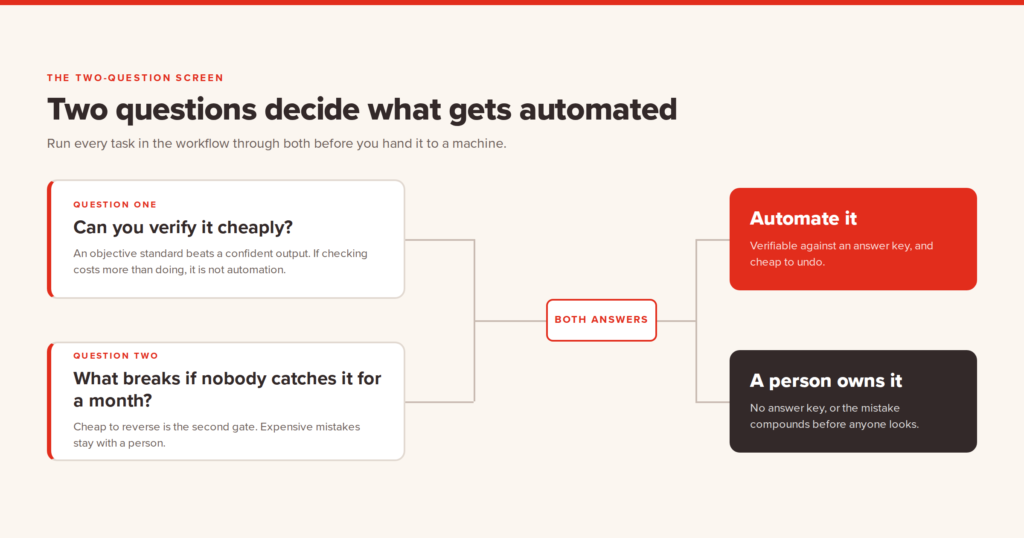
Two properties decide which bucket a task lands in.
- Verifiability. Can the output be checked against an objective standard, quickly, without pulling in your most senior person?
- Blast radius. If it is wrong and nobody catches it for a month, what does that cost in traffic, in rework, or in a client relationship?
Almost everything useful about this decision comes out of those two questions. The rest of this post is what they produce when you apply them to a real SEO operation.
Which SEO tasks are safe to automate?
Automate data collection, monitoring, report assembly, research gathering, candidate generation, and mechanical QA. These share one property: the output has a right answer that a junior team member or a second script can verify in seconds, and errors surface quickly rather than compounding silently.
Here is what belongs on the automated side of the line.
- Rank and visibility monitoring. Position tracking, index coverage, crawl errors, page speed alerts, uptime. There is a correct value for every one of these, and a wrong one shows up as an anomaly rather than as a plausible-looking sentence.
- Report assembly. Pulling numbers into a template on a schedule. Note the word assembly. Putting the chart together is automatable. Explaining what the chart means is not, and we will come back to that.
- Research gathering. Google’s own documentation says generative AI can be useful when researching a topic and when adding structure to original content. Read that sentence carefully, because it is narrower than most people quote it as being. It authorizes research and scaffolding. It does not authorize publishing the output.
- Mechanical QA. Broken internal links, missing alt text, orphan pages, schema validation, title and description length, redirect chains. Every one of these is a pass or fail against a rule you can write down.
- Candidate generation. Internal link candidates, keyword clusters, prospect longlists, refresh queues. The machine produces the longlist. A person makes the cut. That handoff is the whole point.
The pattern underneath all five: automation is safest when it produces the inputs to a decision rather than the decision itself. The moment a step starts producing conclusions that go out the door unread, you have moved it into a different category, whatever the tool vendor calls it.
What breaks when you automate content production?
Automating the writing step rarely breaks compliance first. It breaks differentiation first. Pages produced without an editorial point of view read like every other page on the topic, and interchangeable pages are the ones Google and AI answer engines have the least reason to cite.
Compliance is the part people ask about, so start there and get it out of the way.
Google’s spam policies define scaled content abuse as generating many pages primarily to manipulate rankings rather than to help users, and the policy is explicit that this applies no matter how the content was created. That phrasing matters more than most summaries of it let on. It means “we used AI” is not the violation, and “we used human writers” is not the defense. Volume plus absence of added value is the violation.
If you want the operational version of that standard, Google points site owners at the Search Quality Rater Guidelines, specifically the sections covering scaled content abuse and main content created with little effort, little originality, and little added value. Those sections in the rater guidelines document are the closest thing you will get to a written rubric for the thing your review step is supposed to be catching.
So the compliance line is clear enough to work with. It is also, for most operations, the smaller risk.
The larger risk is commercial and it is quieter. When the writing step is automated end to end, the output converges. Everybody is prompting similar models with similar briefs against the same top ten results, so everybody produces the same argument in the same order. There is a real difference in what that produces, and we have written about the practical gap between AI and human writers in more depth elsewhere.
That convergence is expensive in AI search specifically. Retrieval systems have to choose which sources to ground an answer in, and a page that says exactly what four other pages say gives them no reason to pick it. The related failure mode, where a page keeps ranking in Google while quietly dropping out of the AI citation pool, is worth understanding on its own terms, and we broke it down in our post on content decay in Google versus LLMs.
The judgment-heavy work is where the returns showed up
Our own campaign data points the same direction. One HOTH ecommerce client earned 149 AI mentions from a single Content Refresh campaign, alongside a 25% traffic increase and a 40% gain in traffic value.
Content Refresh is not a volume product. Nothing about it scales by producing more pages. The work is deciding which existing pages are worth saving, identifying what has gone out of date, and restructuring them so they answer the question directly. That is judgment work end to end, and it outperformed the obvious volume alternative.
The HOTH grew its own generative AI traffic 354% in 12 months on that same combination of content investment. More examples of how this plays out across verticals sit in our client case studies.
What breaks when you automate judgment?
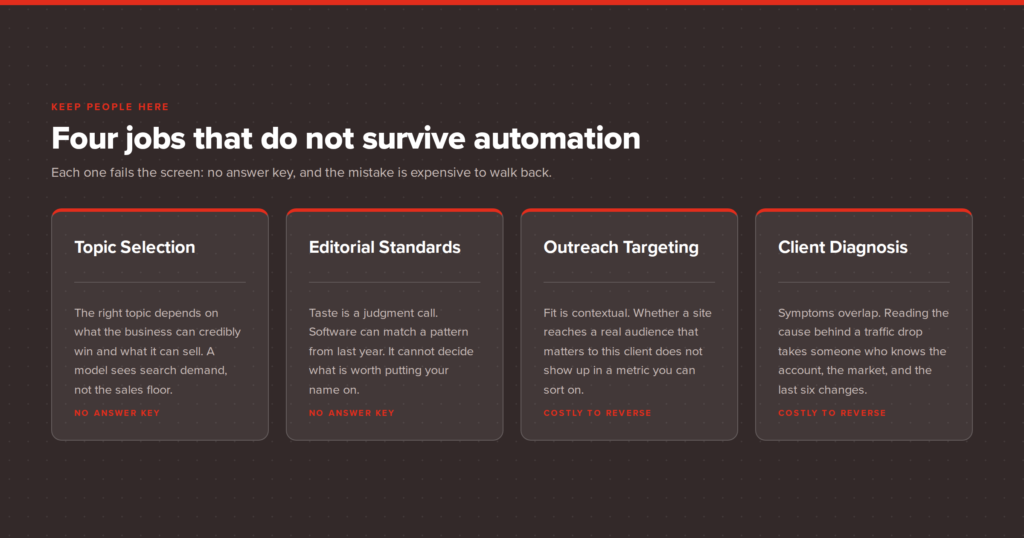
Four jobs degrade quietly when you hand them to a system: topic selection, editorial standards, outreach targeting, and client diagnosis. None of them fail loudly. They fail as a slow drift toward average that looks like nothing is wrong until two or three quarters have gone by.
Topic selection
A model will cheerfully hand you 200 topic ideas. What it cannot tell you is which three matter to this business this quarter, because that requires knowing the sales cycle, the margin on each service line, which deals are stalling and why, and what the founder wants the company to be known for in three years.
The tell that this has been automated is cannibalization. You end up with six posts circling the same query, each one competent, none of them the definitive answer, all of them splitting the same signal. Nobody decided that. It happened because nobody was deciding.
The editorial standard
The review step is where your standard physically lives. It is not in a brand document. It is in the moment a specific editor looks at a specific draft and says this is not good enough yet, and can explain why in a sentence the writer can act on.
Automate that step and the standard does not relax gradually. It gets replaced by whatever the checker measures, which is usually readability score, keyword coverage, and length. Those correlate with quality loosely at best. If nobody on your team can articulate what good means for your brand beyond “it passed,” the standard is already gone.
Outreach targeting
Which sites are worth a placement is a reputation judgment, and it is one that shifts. A domain that was a fine target 18 months ago may now be selling links to anyone with a credit card. Automated prospecting at volume, with no human filter on the list, reliably reproduces the exact patterns Google’s link spam policy describes. Our Link Outreach team runs the filter as a human step for this reason.
Client diagnosis
Traffic drops 18%. Your monitoring will tell you that, fast, and it should. What it will not tell you is whether that was a core update, an annual demand cycle you see every year, a developer deploy that broke canonical tags on a Tuesday, or a competitor that just published something better. Those four have four different responses, and picking the wrong one costs a quarter. Reporting that carries this weight has to be built for it, which is why AI visibility reporting has to sit alongside a person who can read it.
How do you decide what to automate?
Run every step through two questions. Can the output be verified cheaply against an objective standard, and what does it cost if it is wrong and nobody catches it for a month? High verifiability with low cost means automate. Low verifiability with high cost means a person owns it, permanently.
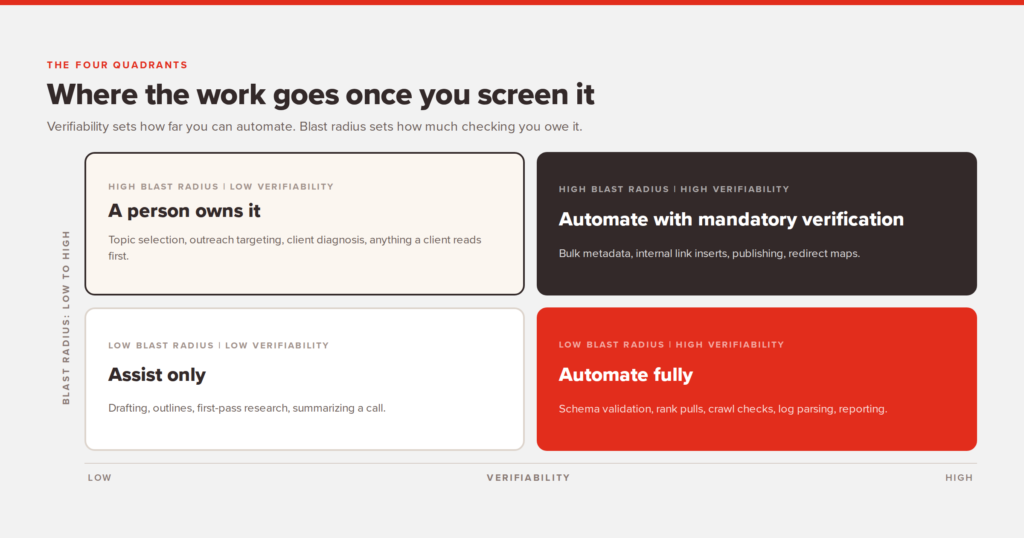
Those two questions produce four quadrants, and each one has a different rule attached.
- Verifiable, low cost. Automate fully. Rank tracking, crawl monitoring, alerting, report assembly. Sample the output occasionally so you find out when something has silently broken, but do not staff a review step here.
- Verifiable, high cost. Automate with mandatory verification. Bulk redirects, schema deployment, sitewide technical fixes, bulk metadata updates. The machine can do it. Somebody signs off before it ships, and the sign-off is a real check against the standard, not a formality.
- Hard to verify, low cost. Assist only. Drafting, first-pass outlines, ideation, subject line variants. Let the machine produce the raw material. A person shapes it into something that goes out with your name on it.
- Hard to verify, high cost. A person owns it. Strategy, editorial standards, outreach targeting, client diagnosis, pricing conversations. No sampling rate makes this safe, because the failures do not look like failures until much later.
One useful nuance: a step can move between quadrants, and moving it is often cheaper than fighting over it. You lower blast radius by staging changes and shipping in smaller batches. You raise verifiability by writing down what good looks like in checkable terms, which is uncomfortable work precisely because it forces you to name a standard you have been carrying around implicitly.
Practical note for the team: run this exercise on your actual workflow, step by step, before buying anything else. Most operations discover they have already automated two or three things from quadrant four without ever deciding to.
What does a healthy automated SEO operation look like?
Every automated step has a named owner, a sampling rate above zero, a rollback that somebody has run at least once, and a separate measure for the judgment layer it feeds. Automation without those four is not an operating model. It is an unmonitored process that happens to be working right now.
- Every automated step has a name on it. “The tool does it” is not an owner. Somebody is accountable for that step producing correct output, and that person should be able to tell you when they last looked at it.
- The sampling rate is above zero. Pick a number, 10% or 20%, and review that share of output on a schedule without exception. A review process that never finds anything is not a review process. It is a habit.
- The rollback has been tested. If your bulk metadata script writes something wrong across 4,000 URLs, how long until it is reverted? An untested rollback is a hope, not a control.
- The judgment layer gets measured separately. Track output volume and outcome quality on different lines. Pages published is a volume metric. Citations earned, rankings on the pages your strategist deliberately chose, and conversions from those pages are outcome metrics. When those two lines separate, you learn something important early.
- People stay fluent in what they no longer do daily. Skill decay is the least discussed cost of automation and the hardest to reverse. Rotate people through the work occasionally. If your only reviewers are people who have never built the thing they are reviewing, the standard erodes and nobody will be able to point to the week it happened.
None of this requires a large team. It requires that somebody has decided, on purpose, which parts of the operation carry judgment. If you would rather hand the whole system to a team that already runs it this way, that is what Managed SEO and AI Discover are for.
Frequently asked questions about automating SEO tasks
Can AI replace an SEO team?
No, but it does replace specific tasks inside one, and that changes what the team should be staffed for. Monitoring, reporting assembly, technical QA, and research gathering compress substantially. Strategy, editorial standards, outreach judgment, and client diagnosis do not. A team that automates the first group and invests the recovered hours in the second usually outperforms one that does neither.
Does Google penalize AI-generated content?
Not for being AI-generated. Google’s spam policies target scaled content abuse, meaning many pages produced primarily to manipulate rankings rather than help users, and the policy applies regardless of whether those pages came from automation, people, or a mix. The question Google’s systems are built around is whether the page adds value, not which tool produced it.
Which SEO tasks should never be fully automated?
Topic selection, the final editorial review, outreach and placement targeting, and client diagnosis. Each one requires context that lives outside the data your tools can see, and each one fails silently rather than loudly, which means the cost accumulates for months before anything in your reporting flags it.
How much of a content workflow can be automated safely?
Research, competitive analysis, outline scaffolding, and mechanical QA sit comfortably at the safe end. Drafting sits in the assist category, useful as raw material and not as finished output. Topic selection at the front and editorial review at the back should stay human, because those two steps are what make the middle worth publishing.
How do I know if automation is quietly hurting my SEO?
Watch the gap between output volume and outcome. If pages published is climbing while citations, rankings on your priority terms, and conversions from content are flat or drifting down, the judgment layer has thinned out. A second signal worth watching: ask a team member to explain why a specific recent page was written. If nobody can answer without opening a tool, the topic was not selected. It was generated.
The line to hold
Automation is not a threat to an SEO operation. Under-supervised automation is, and the distinction is entirely a management decision rather than a technology one.
The teams handling this well are not the ones with the best tool stack. They are the ones that named which parts of their work carry judgment, protected those parts on purpose, and automated aggressively around them. That ordering is the whole trick. Automate the answerable, staff the arguable.
If you want a second set of eyes on where that line sits in your own operation, book a call with our team. Bring your workflow, step by step, and we will run the two questions with you.
Leave a comment