
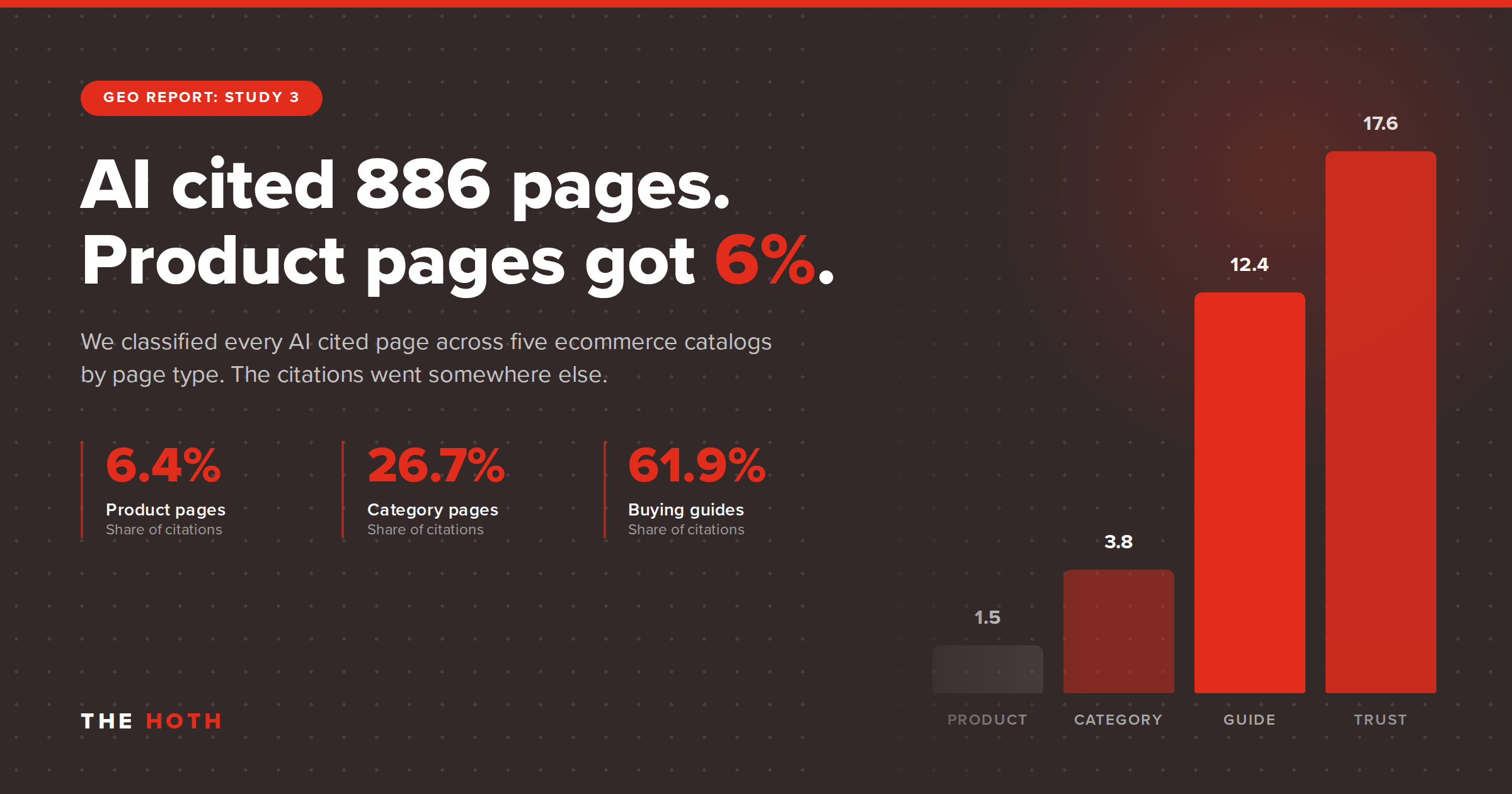

Across five ecommerce catalogs we pulled on September 8, 2026, AI engines cited 886 distinct pages in 5,362 responses. Product pages were 25% of the cited URLs but earned 6.4% of the citations. Buying guides and blog posts were 30% of the cited URLs and earned 61.9%. A guide on these sites was cited eight times more often per page than a product page.
Every ecommerce client asks the same question once AI visibility comes up: which of my pages is AI going to pull from? The catalog has thousands of SKUs, a few hundred collections, and a blog that nobody has looked at in a while. Where does the effort go?
Most answers to that question are opinion. This one is a count. We took five ecommerce sites from AI Discover and HOTH X campaigns, pulled every page on each site that appeared in an AI response across ChatGPT, Google AI Overviews, Google AI Mode, Gemini, Perplexity, Copilot, and Grok, and classified all 886 of them by page type. Then we counted.
The short version: AI does not cite your catalog the way shoppers browse it. Product pages are consumed as data and cited as pages almost never. Category pages get cited at a modest, steady rate, and Google AI Mode likes them more than anyone else does. The guide layer, the buying guides and comparison posts that most stores treat as an afterthought, is where the citations land. This is the third study in our GEO Report series and follows the same data model we used in the campaign findings study.
What did the ecommerce citation data show?
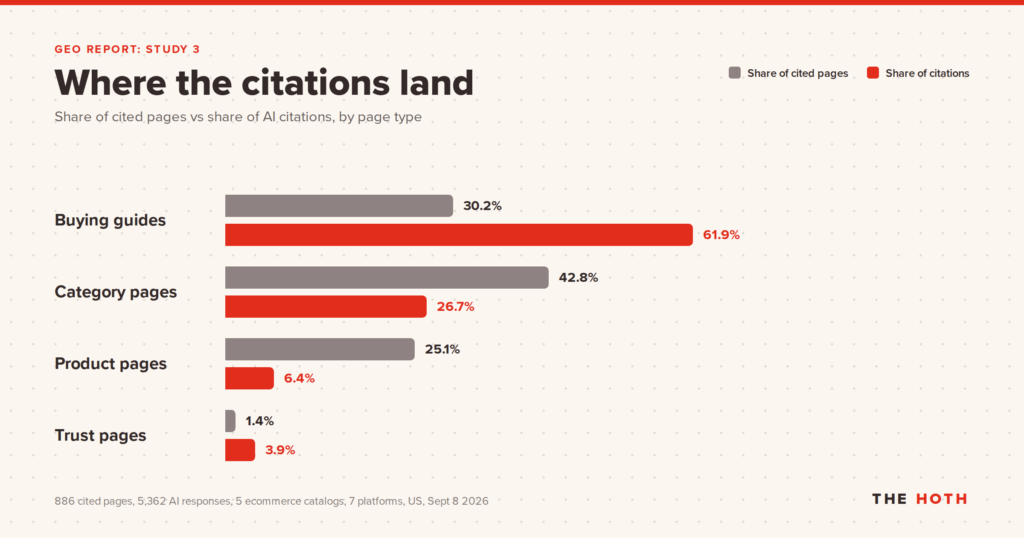
Pooled across five catalogs, guides earned 61.9% of AI citations from 30.2% of the cited pages, category pages earned 26.7% from 42.8%, and product pages earned 6.4% from 25.1%. Per page, guides averaged 12.4 citing responses, category pages 3.8, and product pages 1.6. Trust and policy pages were rare but heavily cited when they appeared, at 17.6 responses per page.
Here is the pooled table. “Cited pages” is the count of distinct URLs on the site that appeared in at least one AI response. “Responses” is the number of AI answers that pulled from those pages. The ratio is the number that matters.
| Page type | Cited pages | Share of pages | Responses | Share of responses | Responses per page |
|---|---|---|---|---|---|
| Guides and blog posts | 268 | 30.2% | 3,318 | 61.9% | 12.4 |
| Category and collection pages | 379 | 42.8% | 1,429 | 26.7% | 3.8 |
| Product pages | 222 | 25.1% | 343 | 6.4% | 1.5 |
| Trust and policy pages | 12 | 1.4% | 211 | 3.9% | 17.6 |
| Homepages | 5 | 0.6% | 61 | 1.1% | 12.2 |
| Total | 886 | 100% | 5,362 | 100% | 6.1 |
Source: Ahrefs Brand Radar via Site Explorer, all seven platforms, US, pulled September 8, 2026. Five catalogs: Bees Lighting, KICKS CREW, BloqUV, Sjolie, and a white-label kitchen appliance brand. Page types classified by URL pattern.
Three things stand out before we get into the per-site detail.
Product pages are the largest category of cited page that nobody reads. One in four cited URLs was a product page, which sounds like product pages matter. But they were cited an average of 1.5 times each. The typical product page in this dataset appeared in one AI answer, once, and was never pulled again. Guides averaged 12.4. That is an eight to one gap in citations per page.
Category pages are the workhorse. They were the most common cited page type on the two large catalogs and they held their own at 3.8 responses per page. When AI needs to point a shopper at a set of products rather than an explanation, the collection page is what it grabs.
Trust pages punch far above their weight. Twelve pages, most of them on one site, earned 211 citing responses. Shipping information, authenticity guarantees, terms, ingredient lists, and certification pages. We will come back to why.
Why do product pages get so few AI citations?
Product pages are cited rarely because AI shopping surfaces read product data from structured feeds, not from the page. ChatGPT ranks products from merchant metadata, Google AI Mode draws on the Shopping Graph, and Adobe found product pages are the least machine-readable page type on US retail sites at 66% visibility. The page is a data source, not a citation source.
This is the finding most people push back on, so it is worth being precise about what it does and does not mean. Product pages are not irrelevant to AI. They are consumed differently.
When ChatGPT shows a product carousel, it is not reading your product page and deciding to cite it. According to OpenAI’s own explanation of shopping results, products are selected from structured metadata supplied by merchants and third-party providers, Shopify stores are ingested automatically through Shopify Catalog, and merchants are ranked on availability, price, quality, and whether they are the maker or primary seller. The product exists in the answer as a data record. Your page might get a link, but the retrieval happened in a feed.
Google is building the same layer. In January 2026 it launched the Universal Commerce Protocol and announced dozens of new Merchant Center attributes for AI Mode and Gemini, including answers to common product questions, compatible accessories, and substitutes. Read that list again. Those are the things a buying guide used to be for, and Google is asking merchants to submit them as feed attributes.
Then there is the readability problem. Adobe’s Q1 2026 AI traffic report ran US retail pages through its AI Content Visibility Checker and found homepages scored 75%, category pages 74%, and individual product pages 66%. A third of the average product page is invisible to a language model. Adobe attributes it to scale: retailers have thousands of SKUs and the templates were never built for machines to read. The same report found AI-referred traffic to US retail sites up 393% year over year in the first quarter and converting 42% better than non-AI traffic by March. The traffic is real. It just is not being earned by product pages.
Put those together and the 6.4% makes sense. Product pages are read by feed ingestion and cited by nobody. That is not a reason to neglect them. It is a reason to stop expecting them to do a job they are not built for.
Which pages did AI cite most in each catalog?
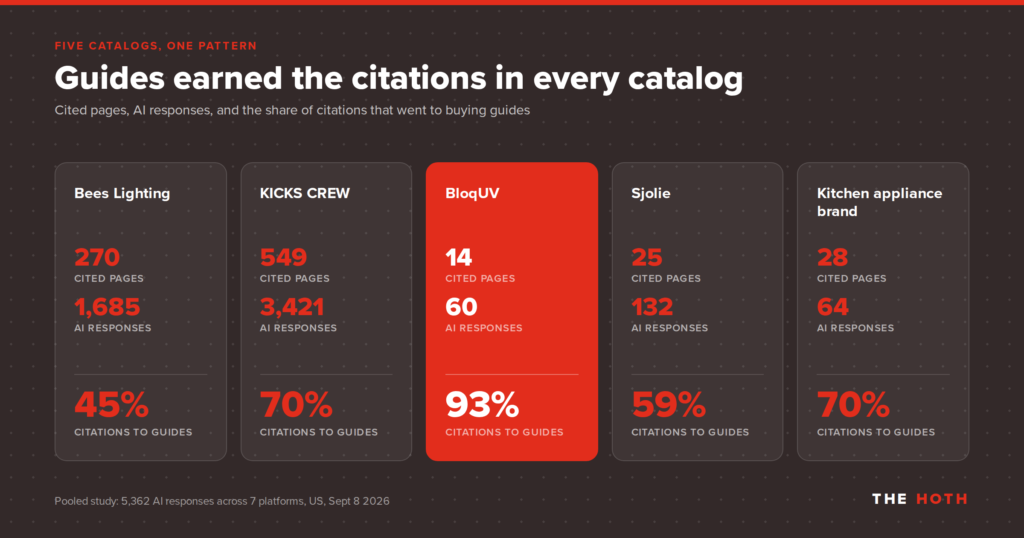
On Bees Lighting, guides were 17% of cited pages and 45% of responses, with a switch wiring guide cited 76 times. On KICKS CREW, guides were 34% of pages and 70% of responses, led by a sneaker buying guide at 188. The three smaller catalogs ran between 59% and 93% of citations to guides. No product page on any site broke 12 responses.
The pooled number hides a lot, because two catalogs supply 92% of the pages. Here is each one.
Bees Lighting: a 30,000 SKU catalog where 45 guides beat 206 collections
Bees Lighting is a residential and commercial lighting retailer with a catalog of over 30,000 products. It had 270 pages cited across 1,685 responses, and 206 of those pages were collection pages. On the surface it is a category story: collections were 76% of cited URLs and 54% of responses.
But the other 45 cited pages were posts on the Ideas and Advice blog, and those 45 pages earned 751 responses, 45% of the site total. That is 16.7 responses per guide against 4.4 per collection. The most-cited page on the entire site is a guide to single pole, 3-way, and 4-way light switches, cited 76 times. Behind it: how many shop lights a garage needs (61), a track lighting compatibility guide (59), can versus canless recessed lights (59), and a wall sconce placement guide (41). The best collection page, A15 light bulbs, was cited 28 times.
Sixteen individual product pages were cited. Together they earned 22 responses.
The Bees Lighting campaign focused on link building and Digital PR to close an authority gap against much larger lighting retailers, and the client picked up 1,065 AI citations over the campaign period along with 843 page one keywords. What this study adds is where on the site those citations concentrated. The authority work lifted the whole domain. The guides are what the engines chose to cite once they trusted it.
KICKS CREW: 191 product pages, 290 citations
KICKS CREW is a global sneaker marketplace. It had the largest footprint in the dataset, 549 cited pages across 3,421 responses, and the most even spread between page types: 184 guides, 167 collection pages, 191 product pages. That balance is what makes the result clean.
The 184 guides earned 2,388 responses, or 70% of the total. The 167 collection pages earned 497. The 191 product pages earned 290, or 8.5%, at 1.5 responses each. Nearly 200 product pages for rare and mainstream sneakers, each with its own SKU and imagery, and combined they were cited fewer times than the top two guides alone.
Those top guides: an ASICS Gel-1130 buyer’s guide at 188 responses, a Sp5der brand guide at 152, a UGG Tasman slipper guide at 133, an Adidas Campus 00s size guide at 108, and a Denim Tears buyer’s guide at 106. Every one is a how-to-choose page for a product the site sells. Every one links down to the collection that sells it.
KICKS CREW is also where the trust pages show up. The authenticity page was cited 74 times, shipping information 54, terms and conditions 40, and a post titled “Is KICKS CREW legit?” 41 times. ChatGPT in particular leaned on them: 87 of its 393 KICKS CREW citations, 22%, went to those pages. When a shopper asks an AI assistant whether a marketplace can be trusted, the assistant goes looking for the page that answers it. Most stores do not have one worth citing.
Three smaller catalogs, same shape
BloqUV, a sun-protective apparel brand, had 14 cited pages. Eleven were blog posts and they earned 93% of the responses. The single cited product page earned one.
Sjolie, a professional spray tan brand, had 25 cited pages and 132 responses. Guides took 59%, category pages 17%, product pages 11%, and the remaining 12% went to an ingredient list and a certification page, the same trust pattern as KICKS CREW at a smaller scale. The most-cited page on the site was a post on how long self-tanner lasts, at 24 responses.
A white-label kitchen appliance brand had 28 cited pages and 64 responses. Guides and recipes took 70%. This was the only site where product pages cleared 20% of citations, and the reason is instructive: the product name is also the category name. When the product is the search, the product page gets cited. That is the exception, and it applies to almost nobody.
Do different AI platforms pull from different page types?
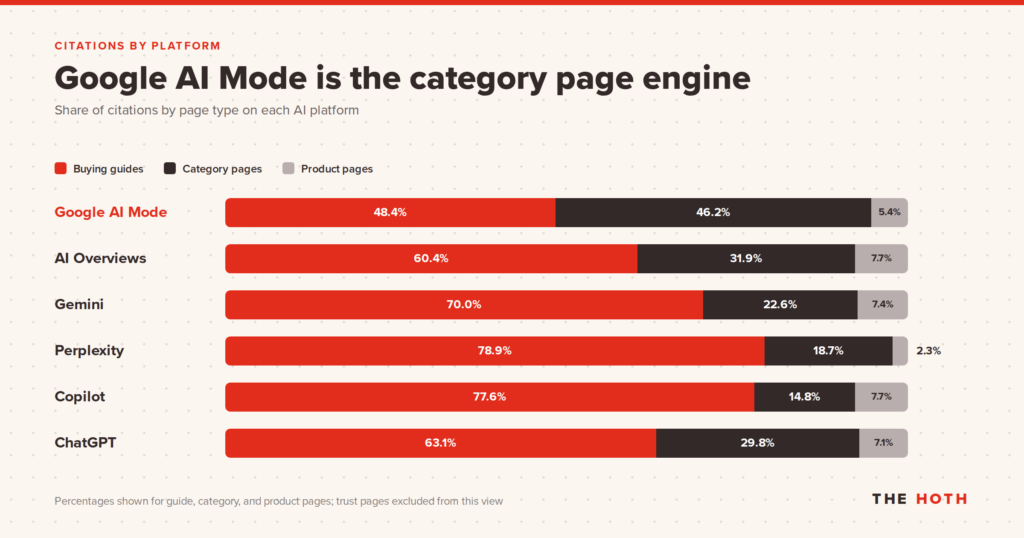
Yes. On the two large catalogs, Google AI Mode sent 46% of its citations to category pages, the highest of any platform. Perplexity and Copilot sent 79% and 78% of theirs to guides. On Bees Lighting, Copilot cited a blog post in 117 of 120 responses. Product pages never exceeded 8% of any major platform’s citations.
Pooling Bees Lighting and KICKS CREW, where the per-platform counts are large enough to mean something, here is how each engine split its citations between guides, category pages, and product pages.
| Platform | Guides | Category pages | Product pages | Citing responses |
|---|---|---|---|---|
| Google AI Mode | 48.4% | 46.2% | 5.4% | 1,145 |
| Google AI Overviews | 60.4% | 31.9% | 7.7% | 960 |
| Gemini | 70.0% | 22.6% | 7.4% | 836 |
| Perplexity | 78.9% | 18.7% | 2.3% | 769 |
| Copilot | 77.6% | 14.8% | 7.7% | 562 |
| ChatGPT | 63.1% | 29.8% | 7.1% | 490 |
| Grok | 73.1% | 7.5% | 19.4% | 93 |
Bees Lighting and KICKS CREW pooled. Trust, policy, and homepage citations excluded from the split. Grok volume is too small to draw conclusions from.
Two patterns are worth acting on.
Google AI Mode is the category page engine. It is the only platform that comes close to splitting evenly between guides and collections, and on Bees Lighting it sent 451 of its 662 citations to collection pages. That tracks with how it is built. AI Mode sits on top of the Shopping Graph and treats a collection page as a set of products it can reason over. If category pages are going to earn citations anywhere, it is here, and this matters because AI Mode was the volume leader for citations in our campaign data across both studies.
Perplexity and Copilot barely look at the catalog. Both are retrieval-first engines that want a page that reads like an answer. On Bees Lighting, Copilot cited a guide in 117 of 120 responses and a collection page in two. If your AI visibility strategy is built around Perplexity and Copilot, the catalog is nearly invisible to it and the guide layer is the entire game.
ChatGPT sits in the middle on page type but is the platform that cares most about trust content, for the reason described above. It is answering “should I buy from these people,” and it wants a page that says yes with specifics.
How concentrated are ecommerce AI citations?
Very. On KICKS CREW, 30 pages produced half of all citing responses, which is 5.5% of the cited pages. On Bees Lighting, 34 pages did it, or 12.6%. The top 10 pages on each site earned 26% to 30% of all responses. AI visibility for a catalog is decided by a few dozen pages, and almost none of them are product pages.
This is the number that should change how ecommerce teams allocate effort. A 30,000 SKU catalog does not need 30,000 pages optimized for AI. It needs the 30 to 40 pages that are going to carry the load to be excellent, and it needs the rest of the catalog to be clean enough that feeds can read it.
On KICKS CREW those 30 pages were 27 guides, the homepage, the authenticity page, and the shipping page. On Bees Lighting they were 25 guides and 9 collection pages. Not one product page made the top 30 on either site.
We saw the same concentration in our campaign findings study, where citation gains clustered on a small set of pages per domain rather than spreading across the site. In ecommerce the effect is sharper because the long tail is so long. Thousands of near-identical product URLs, each cited once or not at all, next to a few dozen guides that get cited constantly.
What should an ecommerce brand do with this?
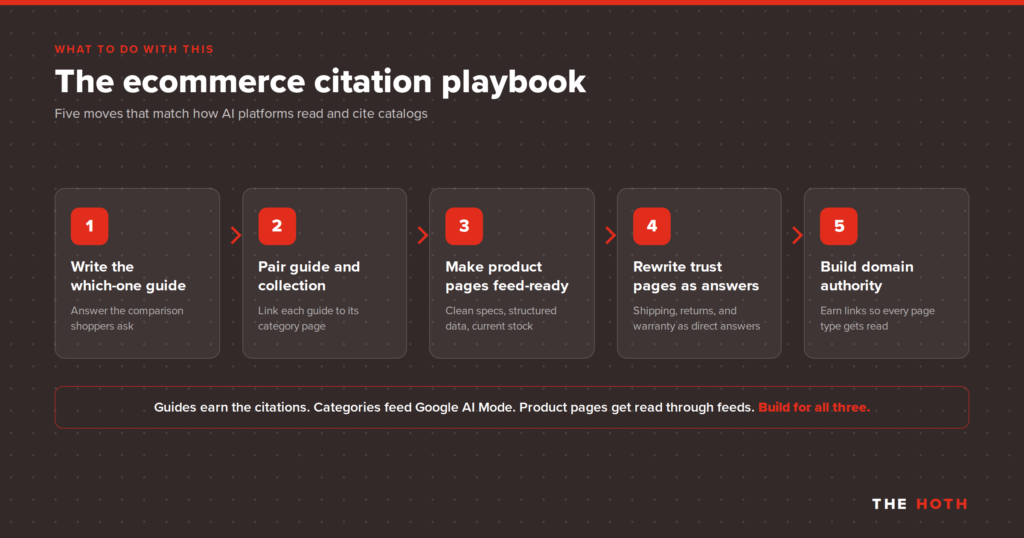
Build a guide for every collection that matters, link each guide to its collection, keep product pages feed-ready rather than citation-ready, write trust pages that answer real questions with specifics, and put off-page authority behind the domain so engines retrieve the guides in the first place. That is the order of operations the data supports.
Five moves, in priority order.
1. Write the “which one” guide for every collection that drives revenue. Every top-cited page on every site in this study is a version of the same document: here is the category, here is how to tell the options apart, here is what to buy for your situation. Single pole versus 3-way. Can versus canless. How the Campus 00s fits. Which DHA percentage for which skin tone. If a collection matters to your business and there is no guide answering the question a shopper asks before they land on it, that guide is the highest-leverage page you can add. Write it to be liftable: a direct two or three sentence answer up top, question-style subheadings, specific numbers.
2. Make the guide and the collection a pair. The guide earns the citation. The collection page earns the AI Mode citation and the click. Link them both ways, with the guide pointing at the collection in the first section, not the footer, and the collection pointing at the guide near the top of the page. Bees Lighting’s soffit lighting collection (26 responses) and its soffit lighting design guide (29) are cited as a pair for exactly this reason.
3. Treat product pages as data, and get the data right. Stop trying to make product pages earn citations and start making sure they can be read. Complete structured data, GTINs, a Merchant Center feed with the new question-and-answer attributes as they roll out, a direct OpenAI feed if you are eligible, and a Shopify Catalog connection if you are on Shopify. Adobe’s 66% readability figure is the benchmark to beat. This is plumbing, and it is what puts you in the carousel.
4. Write trust pages that would survive being quoted. Shipping, returns, authenticity, ingredients, certifications, and a plain “are we legitimate” page if your category invites the question. KICKS CREW’s authenticity page was cited more than any collection page on the site. Most stores have a two-line shipping policy and a returns page written by a lawyer. Rewrite them as answers.
5. Put authority behind the domain. None of this works if the engines do not retrieve your pages, and retrieval follows authority. Every page in this dataset also ranks organically. Bees Lighting’s guides did not get cited because they were well written, although they are. They got cited after a link building and Digital PR campaign gave the domain enough weight for AI engines to trust it as a source. The guide layer is what gets cited. The authority is what gets it read. You need both, and most ecommerce sites have neither.
How does AI Discover fit an ecommerce catalog?
AI Discover is The HOTH’s managed AI visibility service. It builds the off-page authority that gets a catalog retrieved, through Earned Media, Digital PR, and citation building, and tracks where citations land across platforms. For ecommerce brands the combination matters: the guide layer earns the citation, and AI Discover is what makes the engines trust the domain enough to pull from it.
The data in this study came from AI Discover and HOTH X campaigns, and the pattern across all five is the same. The pages that earn AI citations are guides and trust pages on a domain that engines have learned to trust. The trust came from off-page work: editorial placements, Digital PR, and earned links pointed at the right pages.
That is what AI Discover does. A strategist runs Earned Media, Digital PR, Content Refresh, and reputation signals together, and the reporting shows you the page-level citation data we used here, so you can see which guides are being pulled and which collections are getting the AI Mode citations. KICKS CREW grew organic traffic 754% during its campaign. BloqUV grew 258%. Both had AI citation gains that landed almost entirely on the guide layer.
If you sell online and you want to know which of your pages AI is pulling from right now, and which ones it should be, that is the first thing we look at.
How we ran this study
We pulled every page on five ecommerce client domains that appeared in an AI response across seven platforms using Ahrefs Brand Radar data through Site Explorer, US only, on September 8, 2026. Each URL was classified by its path pattern into guide, category, product, trust, or homepage. Responses count AI answers in which the page appeared, including background retrieval.
Details and limits, so you can weigh the findings correctly.
- Sample. Five ecommerce domains from HOTH campaigns: Bees Lighting, KICKS CREW, BloqUV, Sjolie, and a white-label kitchen appliance brand. Bees Lighting and KICKS CREW supply 92% of the cited pages, so the pooled numbers are dominated by two catalogs. The three smaller sites agree in direction but are too small to stand alone.
- Source and scope. Ahrefs Site Explorer top pages with Brand Radar AI response counts per platform, United States, single pull on September 8, 2026. A “response” is an AI answer in which the page appeared, whether as a visible citation or as a page the engine retrieved in the background. Only pages with organic ranking data are included, which is a limitation and also a finding: the cited pages are ranking pages.
- Classification. By URL pattern. Blog, guide, and article paths are guides. Collection, category, and brand paths are category pages. Product paths are product pages. Policy, shipping, authenticity, ingredient, and certification pages are trust pages. This is a heuristic, not a manual review, and a small number of pages will be misfiled.
- What this does not measure. Product carousel appearances in ChatGPT and AI Mode that come from feeds rather than page retrieval are not citations and are not in this data. That is the point of the product page finding, not a gap in it.
- Naming. Four clients are named with their permission through published case studies. One is described by industry.
Frequently asked questions
Do AI engines cite ecommerce product pages?
Rarely. Across 886 cited pages on five ecommerce sites, product pages were 25% of the cited URLs but 6.4% of the citations, at 1.5 citing responses per page. Products reach AI shopping surfaces mainly through structured feeds, not page citations.
Which ecommerce pages get cited most in AI answers?
Buying guides, comparison posts, and how-to-choose content. Guides were 30% of cited pages and 62% of citations in our data, averaging 12.4 citing responses per page. The single most-cited page on every site in the study was a guide.
Are category pages worth optimizing for AI search?
Yes, especially for Google AI Mode, which sent 46% of its citations to category pages on the two largest catalogs. Category pages averaged 3.8 citing responses each and were the most common cited page type on large catalogs. Pair each important collection with a guide that links to it.
Why does ChatGPT cite shipping and authenticity pages?
Because shoppers ask it whether a store can be trusted. On KICKS CREW, 22% of ChatGPT citations went to the authenticity page, shipping information, terms, and a post answering whether the marketplace is legitimate. Trust pages written as real answers earn citations that policy boilerplate does not.
How many pages drive most of a store’s AI citations?
A few dozen. On KICKS CREW, 30 pages produced half of all citing responses. On Bees Lighting, 34 did. The top 10 pages on each site accounted for 26% to 30% of citations, and none were product pages.
The catalog is data. The guide is the citation.
That is the whole study in one line. AI reads your products through feeds and cites your explanations through search. The stores in this dataset that earned the most citations were not the ones with the biggest catalogs. They were the ones with a guide for every question a shopper asks before buying, a collection page to land on, a trust page that answered the question nobody wants to ask out loud, and enough authority behind the domain for engines to pull from it.
Study 2 in this series looks at YMYL categories, where the bar for citation is higher still. If you sell online and want to see your own page-level citation data, AI Discover starts there.
Leave a comment