
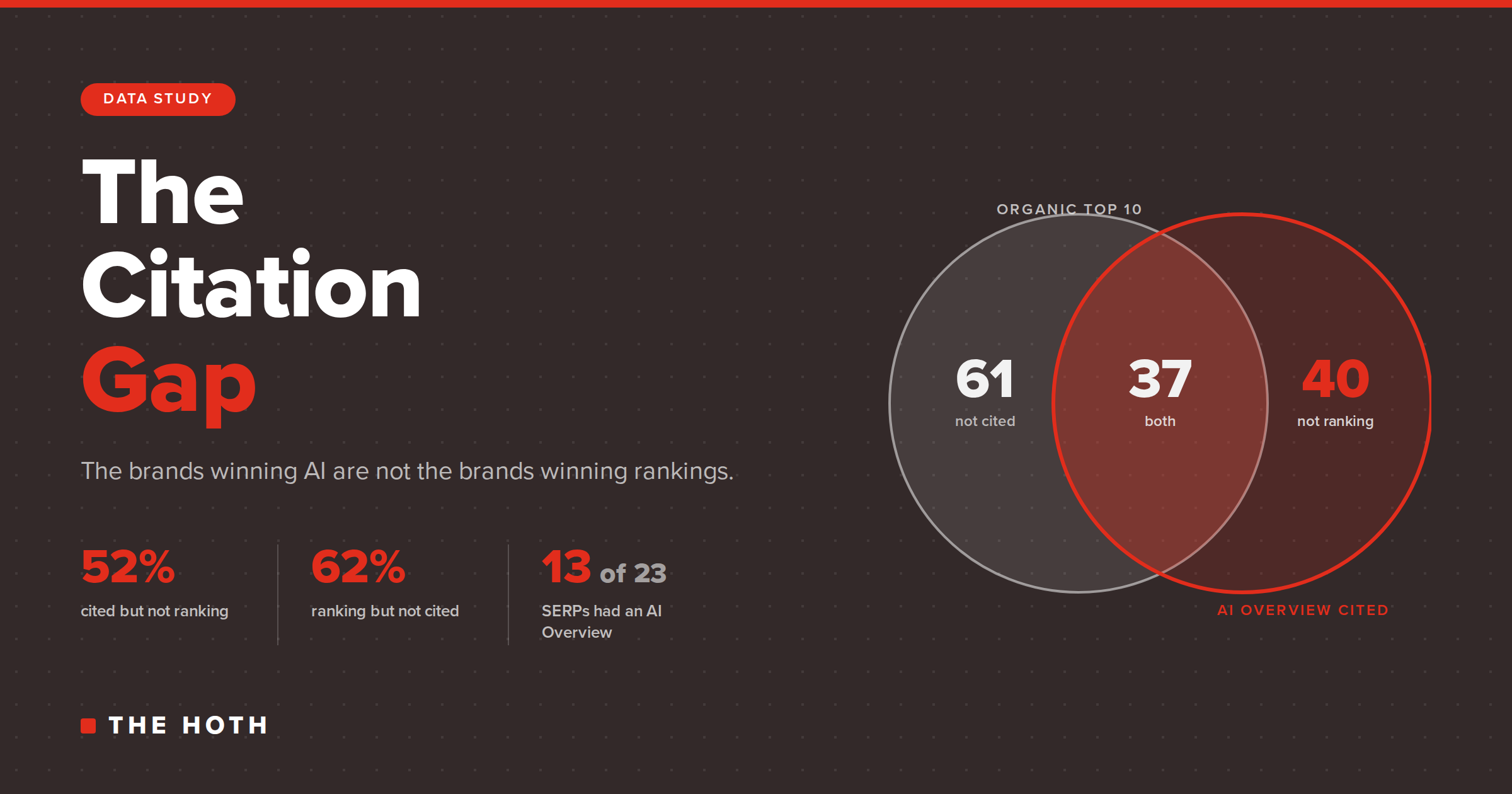

Roughly half of the sites Google’s AI Overviews cite for a buyer query do not rank on page one for it, and roughly six in ten page-one rankers are not cited. That’s what we found when we pulled 23 buyer-intent searches across the industries our clients compete in and compared the AI Overview citations to the organic top 10. The brands winning AI answers and the brands winning rankings overlap far less than most SEO reporting assumes.
If your monthly report says you rank #3 for your best commercial keyword, it’s tempting to assume you’re inside the AI answer sitting above it. On the 13 AI Overview SERPs in this dataset, the #1 organic result was cited on only 4 of them. AI Discover exists because that assumption keeps breaking, and this post is the data behind why.
This piece is a spoke off our 12 month study of AI search campaigns, which found no AI specific hack: the same authority work that ranks you is what gets you cited. That study didn’t compare who ranks against who gets cited on the same query, though, so we built a separate dataset for this one. Here’s what it shows, why Google’s own documentation predicts it, and how to measure the gap on your own keywords in an afternoon.
What is the citation gap?
The citation gap is the difference between the set of sites Google’s AI Overview cites for a query and the set of sites ranking in the organic top 10 for that same query. In this dataset, 52% of cited domains were not on page one and 62% of page-one domains were not cited. The two lists are related, but they’re not the same list.
We pulled Ahrefs SERP overviews for 23 buyer-intent queries on September 8, 2026, US results, spread across legal, medical, home services, SaaS, ecommerce, and marketing. For each query we listed every domain in the organic top 10 and every domain cited in the AI Overview, deduplicated per query, then counted the overlap at the domain level.
13 of the 23 queries carried an AI Overview. 10 didn’t. Across the 13 that did:
- 77 domains were cited. 37 of them (48%) also ranked in the organic top 10. The other 40 (52%) did not rank on page one for the query they were cited on.
- 98 domains ranked in the organic top 10. 37 of them (38%) were cited. The other 61 (62%) were not.
- The #1 organic result was cited on 4 of the 13 queries.
- 10 of the 13 queries cited at least one domain from outside the top 10, and on 4 of them, most of the cited domains came from outside it.
Put plainly: if you picked a random domain out of an AI Overview on these searches, it was a coin flip whether that domain was on page one. If you picked a random page-one domain, the odds it was cited were worse than a coin flip.
What did the data show across 13 AI Overview SERPs?
The gap wasn’t evenly spread. Legal and home services queries produced long citation lists, often 10 or more domains, dominated by individual practitioner sites that don’t rank. SaaS and ecommerce queries produced short lists of two or three domains skewed toward Reddit, YouTube, and brand sites, and those short lists mostly did rank.
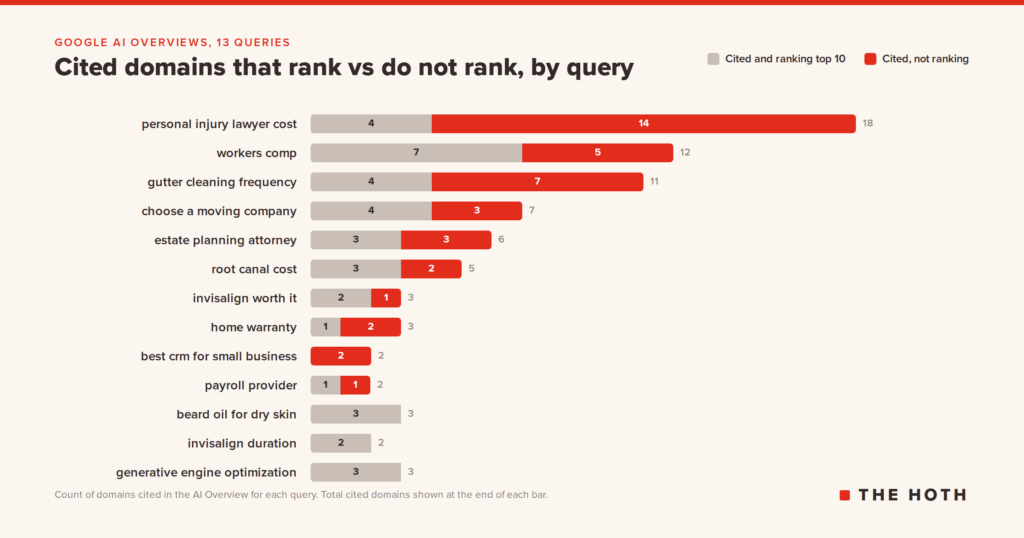
The widest gap was “how much does a personal injury lawyer cost.” The AI Overview cited 18 domains. Only 4 of them ranked in the top 10. The other 14 were mostly small firm sites plus a legal directory or two, none of which a searcher would see without scrolling past page one.
“how does workers compensation work” was next: 12 domains cited, 7 of them ranking. “how often should you clean your gutters” cited 11, and 7 of those weren’t on page one.
At the other end, three queries cited only two or three domains and every one of them ranked: “best beard oil for dry skin,” “how long does invisalign take,” and “what is generative engine optimization.” When the AI Overview keeps its list short, it tends to stay close to the organic results.
Then there’s “best crm for small business.” The AI Overview cited two domains, Reddit and Salesforce. Neither was in the organic top 10. All seven page-one domains, a mix of consultancies, Forbes, LinkedIn, and a payments company, went uncited. That’s the citation gap at its most extreme: a SERP where ranking and being cited had nothing in common.
Across the whole set, YouTube was cited on 4 queries and Reddit on 3. No other domain was cited more than once. On the ranking side, across all 23 SERPs, Reddit appeared in the top 10 sixteen times, YouTube eight times, and Quora five. The platforms show up everywhere. The brands don’t repeat.
Why do AI Overviews cite sites that don’t rank?
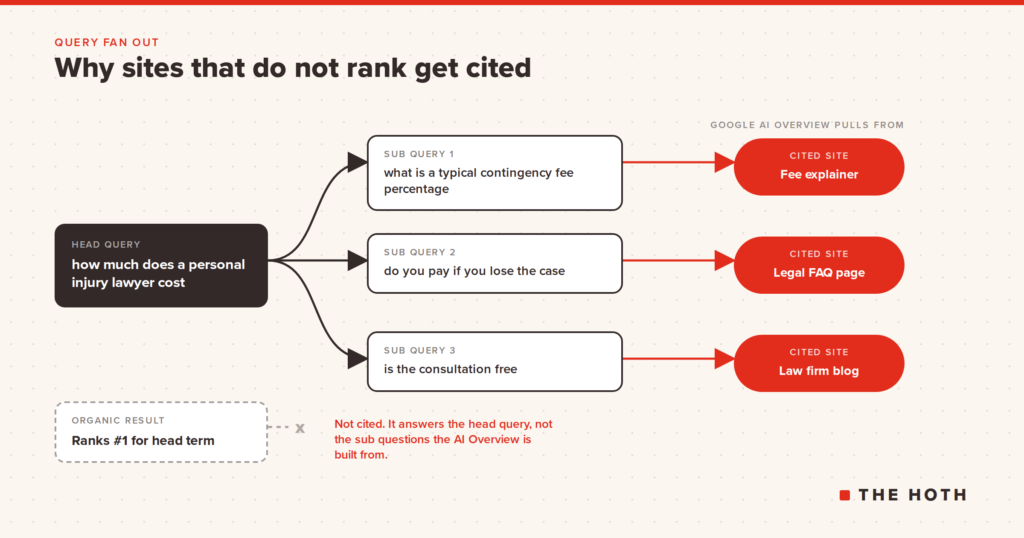
Because Google doesn’t build the AI Overview from the page-one results. Its documentation says AI Overviews and AI Mode may use a “query fan-out,” issuing multiple related searches across subtopics and then pulling supporting links from those results. A site that ranks for one of the sub-questions can be cited without ranking for the original query.
This is the part most SEO reporting misses. Google’s guidance on AI features and your website states that to be eligible as a supporting link, a page only needs to be indexed and eligible to show in Search with a snippet. There’s no extra technical requirement and no special markup. Google also says these features are designed to show a wider and more diverse set of links than a classic search would.
Fan-out is why. When someone searches “how much does a personal injury lawyer cost,” the system doesn’t just read the ten results for that string. It may also search contingency fee percentages, what a lawyer charges if you lose, whether the consultation is free, and so on. A small firm with a clear page on contingency fees ranks for that sub-question, gets pulled into the overview, and now sits above the firm that ranks #1 for the head term. We covered the mechanics in how answer engines decide what to cite; this dataset is what it looks like on real buyer SERPs.
The pattern holds at a much larger scale. Ahrefs published an update in March 2026 covering 863,000 keyword SERPs and about 4 million AI Overview URLs. Their analysis found 37.9% of cited URLs also appeared in the top 10 blocks of the SERP, with the rest split almost evenly between positions 11 to 100 and beyond the top 100. Among cited pages that didn’t rank in the top 100, 18.2% were YouTube URLs. Our smaller, domain-level sample lands in the same territory: 48% overlap here versus their 38% at the URL level, which is about what you’d expect, since a domain can rank with one page and be cited for another.
So when your report shows a #2 ranking and no citation, nothing is broken. The AI Overview was assembled from a different set of searches than the one you’re tracking.
Does this mean rankings don’t matter for AI citations?
No. Rankings still matter in two ways this dataset makes obvious: 10 of the 23 buyer queries had no AI Overview at all, so the organic results were the whole page, and on the queries with short citation lists, the cited domains were the ranking domains. What changes is that ranking is no longer sufficient on its own.
Start with the queries that had no AI Overview. “how much does hvac repair cost,” “how much does seo cost,” “how much do movers cost,” “how much does a divorce lawyer cost,” and six others returned no overview in the Ahrefs snapshot. On those SERPs, whatever ranked won the click. There was no second list to be on.
One of those was “how much is a mini cow.” That’s a query where a HOTH client, a miniature Highland cattle ranch, ranks #1. There’s no AI Overview to compete with there, but the same campaign that took the site from a domain rating of 0 to 6 in under four months also produced 181 brand mentions across Google AI Mode, Gemini, AI Overviews, and Perplexity, and Gemini recommends the ranch by name when people ask what a mini cow costs. The ranking and the AI presence came from the same authority work. That was the core finding of our 12 month study, and it shows up again here.
Now look at the tight SERPs. “best beard oil for dry skin” cited three domains and all three ranked. That’s an ecommerce category where the overview leans on the results in front of it, so ranking is close to the whole game. A beard grooming client picked up more than 70 AI citations across platforms in the first three months of a campaign built on technical fixes, on-page copy, original blog content, and link building. Nothing in that list is an “AI tactic.” It’s ranking work that AI systems reward.
The legal and home services SERPs are where ranking alone comes up short. Long citation lists mean more slots, and most of those slots went to sites that answered a specific sub-question well, not to the sites that ranked for the head term. If you’re a law firm at #1 for a cost query and you’re not cited, the fix isn’t more links to that page. It’s coverage of the questions the fan-out is asking.
We’re not putting vertical-level percentages on any of this. With two to four AI Overview SERPs per vertical, the sample is too small to support a number. The pattern is worth acting on. The percentages are not worth quoting.
How do you check your own citation gap?
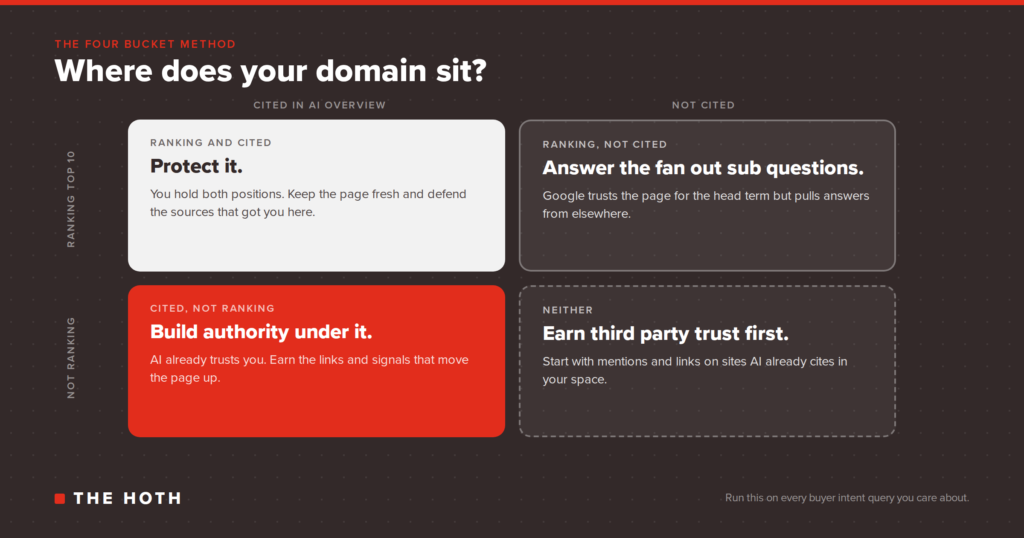
Pull your top 20 commercial queries, record which domains the AI Overview cites for each, record the organic top 10, and sort your own domain into one of four buckets: ranking and cited, ranking but not cited, cited but not ranking, or neither. The bucket tells you what to fix.
You can do this in an afternoon with any SERP tool that captures AI Overview citations, or by hand in an incognito window. Here’s the method we used, simplified so it’s repeatable.
- List your 20 most valuable commercial queries. Cost, comparison, “best,” and “how to choose” queries are the ones most likely to carry an AI Overview and most likely to precede a purchase.
- For each query, record whether an AI Overview appeared and, if so, every domain it cited. Deduplicate per query. Note the date, because overviews change often.
- Record every domain in the organic top 10 for the same query.
- Sort your domain into a bucket for each query: ranking and cited, ranking but not cited, cited but not ranking, or neither.
- Count the buckets. The share of your ranking queries where you’re not cited is your citation gap.
Two tools make this faster. Google rolled out AI appearance insights in Search Console to all websites worldwide as of August 31, 2026, including impressions and which of your pages appear in AI responses. That gives you the citation side from Google’s own data. For the competitor side, and for who else is cited when you aren’t, you’ll need a third-party SERP tool. Our Atlas dashboard does this for AI Discover clients; Ahrefs Brand Radar and similar tools do it for anyone.
Spot-check before you act. Ahrefs snapshots reflect the last crawl date, not a live pull, and AI Overviews change frequently. Re-run three or four of your most important queries by hand before you move budget on the strength of the data.
What should you do about a citation gap?
Treat each bucket differently. Ranking but not cited means your page answers the head term but not the sub-questions the fan-out asks, so add them. Cited but not ranking means your visibility is real but fragile, so build authority under it before it’s replaced. Neither means you need third-party trust signals before anything on your own site will move.
Ranking but not cited. This is the most common bucket for established brands and the most fixable. Your page wins the head term and loses the fan-out. Go back to the query, write down the five to ten follow-up questions a buyer would ask (what’s included, what it costs if something goes wrong, how long it takes, whether it’s worth it), and make sure each one has a clear, direct answer on your page or a linked page. Google’s eligibility bar is just being indexed with a snippet. The selection bar is whether your content answers the sub-question better than the practitioner site that currently does. Our guide to getting cited in AI Overviews covers the on-page side.
Cited but not ranking. Congratulations, and be careful. 14 of the 18 domains cited on the personal injury query were in this bucket, and most of them are small firms one model update away from disappearing. If you’re here, you have proof that AI systems trust a specific page. The move is to build the authority underneath it: earned media, links from relevant sites, and a cluster of supporting content, so the citation survives the next change. Our 12 month study found this is the work that moves both channels at once.
Neither. If you rank nowhere and get cited nowhere for your best queries, on-page changes won’t move you yet. AI systems and Google’s ranking systems both start from the same question: does anyone credible talk about this brand? That’s the work AI Discover is built around: earned placements on the sites AI engines read, content structured to answer the fan-out, and tracking so you can watch the buckets shift month to month.
Ranking and cited. Protect it. Keep the page fresh, keep answering new sub-questions as they appear, and watch the other three buckets for your competitors.
What are the limits of this data?
This is a pattern, not a proof. It covers Google AI Overviews only, 13 AI Overview SERPs, US results, one Ahrefs snapshot pulled September 8, 2026, at the domain level. Treat the direction as reliable and the exact percentages as a starting point for your own check.
- Google AI Overviews only. There’s no ChatGPT, Perplexity, or Gemini data in this set. Citation behavior differs by engine.
- 13 SERPs with an AI Overview. Enough to show a pattern, not enough to prove one. The large-scale Ahrefs study points the same direction, which is why we’re comfortable publishing.
- Ahrefs snapshots, not live pulls. AI Overviews are volatile. Spot-check before quoting.
- Domain-level overlap, not URL-level. A domain can rank with one page and be cited for a different one. URL-level overlap would be lower.
- No vertical percentages. Two to four SERPs per vertical is too few to support one.
- Two citation URLs on the root canal query were Google redirect links that couldn’t be attributed and were excluded. Two other queries returned empty and two returned only redirect URLs; all four were dropped before analysis.
The full query list and every domain counted are at the end of this post. Rerun it on your own keywords and tell us what you find.
Frequently asked questions
Do you need to rank on page one to be cited in an AI Overview?
No. In this dataset, 52% of cited domains didn’t rank on page one for the query they were cited on, and Google’s documentation says the only requirement is to be indexed and eligible for a snippet. Ranking helps. It isn’t required.
Why am I ranking #1 but not cited?
Most likely because the AI Overview was built from fan-out sub-queries you don’t rank for. The #1 organic result was cited on only 4 of 13 queries here. Add direct answers to the follow-up questions a buyer would ask after the head term.
Is the citation gap the same on ChatGPT and Perplexity?
We can’t say from this data. It only covers Google AI Overviews. Our 12 month study found the same authority signals drive citations across engines, but the overlap with Google rankings specifically hasn’t been measured here.
How often should I re-check my citation gap?
Monthly for your top 20 queries. AI Overviews change frequently and Google updates the underlying model, so a snapshot older than a month is a guess.
Does a longer citation list mean more opportunity?
Yes, for sites that don’t rank. Legal and home services queries cited up to 18 domains, and most weren’t on page one. Short lists, common in SaaS and ecommerce, stayed close to the organic results.
The gap is measurable, so measure it
The brands winning AI answers and the brands winning rankings are related sets, not the same set. Half of what gets cited isn’t on page one. Six in ten page-one sites aren’t cited. That’s the gap, and it’s measurable on your own keywords this week.
If you’d rather we run it for you, book a call and we’ll pull your citation map as part of an AI visibility assessment.
Leave a comment