
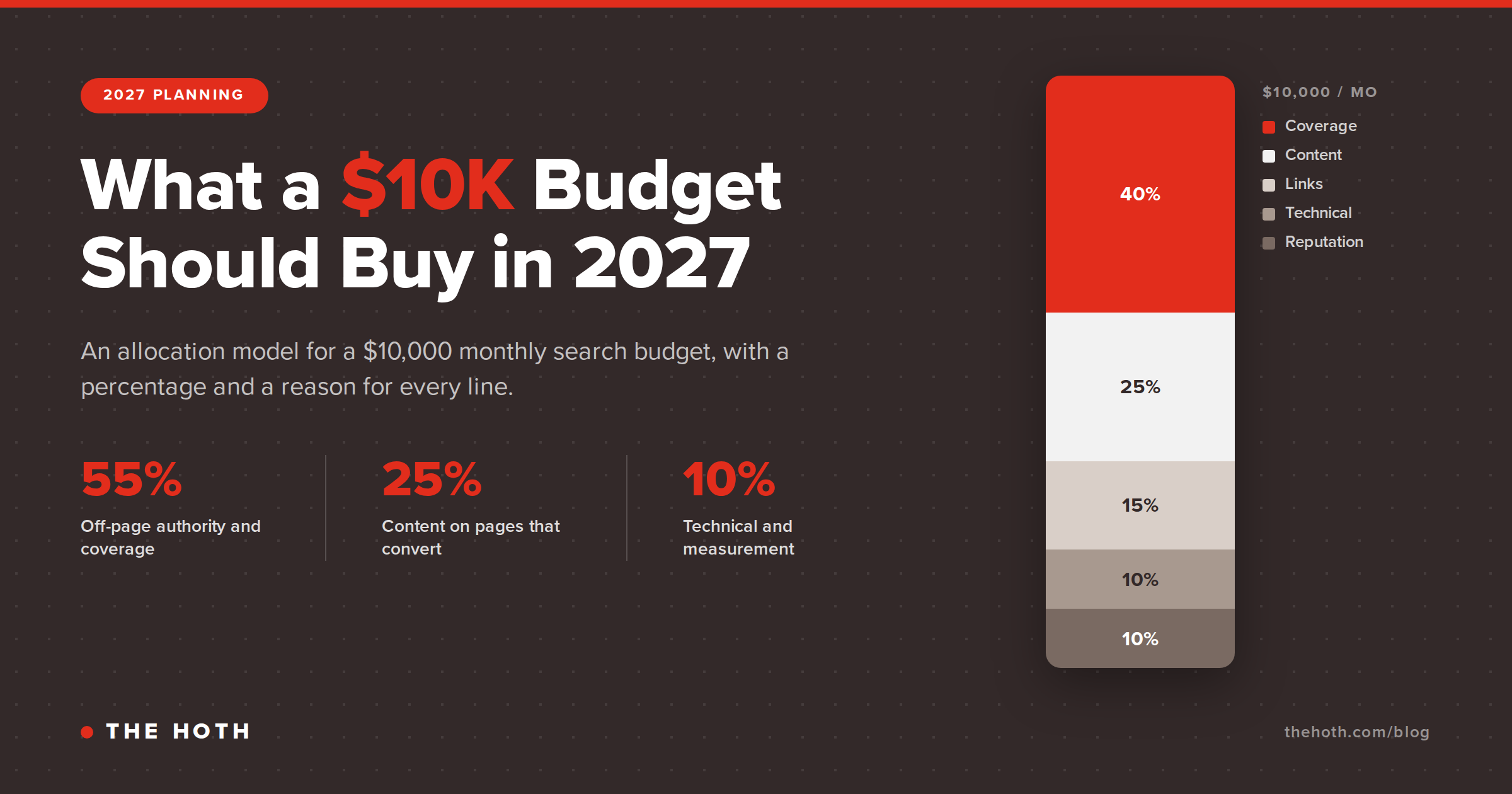

A $10,000 monthly search budget in 2027 should put roughly 55% into off-page authority and earned coverage, 25% into content on the pages that convert, 10% into technical health and measurement, and hold 10% for reputation signals and quarterly reallocation. That split reflects what moved rankings and AI citations across a year of campaign data, and it is different from the content-first split most budgeting guides still recommend.
Ten thousand dollars a month is where SEO stops being a line item and starts being a program. It is also the budget where the most money gets wasted, because at that scale a bad allocation costs more than a bad vendor.
Most guides on the subject answer a different question. They will tell you what SEO costs by company size, or what an agency charges per hour, and they stop there. Our own pricing guide covers that ground. What almost nobody publishes is a real allocation: what percentage goes where, and why.
That is what this post is. It is the model we would run with a $10K budget on a HOTH X managed SEO engagement in 2027, with the reasoning behind each line, the places where the numbers should move, and a 12-month sequence for spending them. The percentages are opinions. The results they are based on are not.
Why is $10K the budget where allocation matters most?
Because at $10,000 a month you can afford every category of work, which means the decision is no longer what to buy but how much of each. Below that figure most businesses are forced to pick one or two levers. At this figure the mix itself is the strategy.
Some context on where this budget sits. In Ahrefs’ survey of 439 SEO providers, the average monthly cost of SEO came out to $2,917, and 63% of businesses spend between $500 and $5,000. Fewer than a third of providers charge more than $2,000 a month. A $10K budget sits at the top of that range, which is why it is also the tier where “we do a bit of everything” quietly turns into “we do everything a little.”
Compare that to the pressure marketing budgets are under overall. Gartner’s 2026 CMO Spend Survey puts the average marketing budget at 7.8% of company revenue, effectively flat for three years, and 56% of CMOs say they lack the budget to deliver their 2026 strategy. The same survey found CMOs carving out 15.3% of their budgets for AI initiatives.
Put those together and you get the 2027 problem in one sentence: budgets are flat, a new AI line is competing for the same dollars, and the businesses that win will be the ones that allocate rather than the ones that spend.
That is the reason to get specific. So here is the model.
What should a $10K monthly SEO budget buy in 2027?
Our base allocation for a $10K monthly budget is: 40% earned coverage and authority ($4,000), 25% content on money pages ($2,500), 15% link equity pointed at those pages ($1,500), 10% technical health and measurement ($1,000), and 10% split between reputation signals and a reallocation reserve ($1,000). The largest single line is coverage, not content.
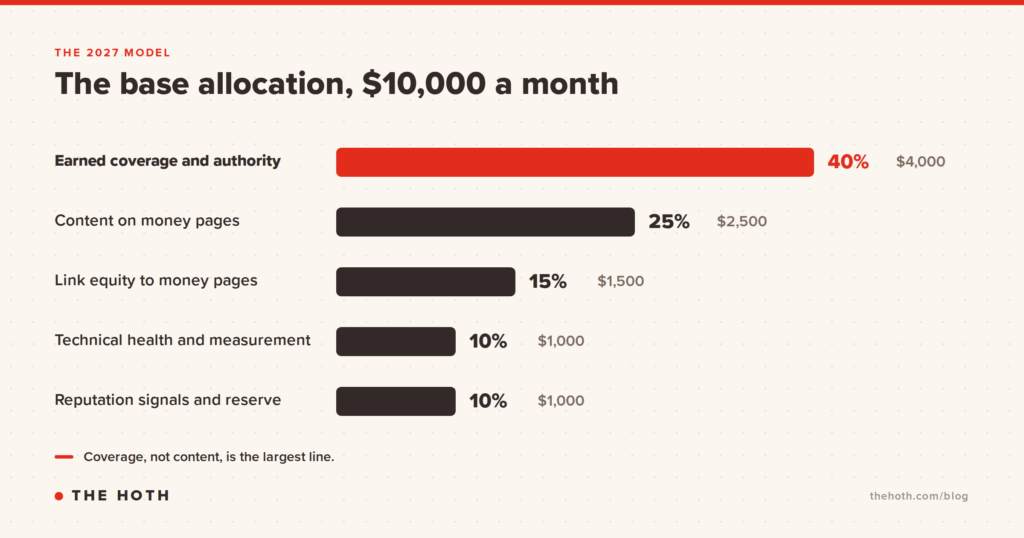
Here is the base model, then the reasoning for each line.
Earned coverage and authority: 40% ($4,000)
This is the line that most budgeting guides underweight, and it is the one our campaign data argues for most strongly.
When we ran AI search campaigns for twelve months, the finding that held across the whole set was that product mix mattered more than product volume, and the ingredient that separated high-citation campaigns from low-citation ones was editorial coverage. Every campaign that produced strong citation counts had digital PR or earned media in the stack. Campaigns that bought link equity alone underperformed on that metric even when they ran twice as long.
At $4,000 a month, the practical shape is one Earned Media campaign most months ($3,500 per campaign, 50+ guaranteed pickups from newsrooms rated DR 30 to 75+), with the remainder going to Digital PR placements or a second story in the months you skip the first. Over a year that is roughly ten editorial stories distributed across thousands of publishers, each one a brand mention and a link from a domain that both Google and AI engines already treat as a trust signal.
Why the largest line? Because coverage compounds in a way links do not. A link passes equity to a page. An editorial story builds the entity: the pattern of mentions across trusted sources that engines use to decide whether your brand is a credible answer at all. You need both. But if the budget forces a choice, the year of data says fund the coverage.
Content on the pages that convert: 25% ($2,500)
Notice that this is content on money pages, not a blog volume target.
The second pattern from our campaign set was where authority got pointed. Every campaign that produced a result worth writing up built to service pages, product pages, or category pages, usually alongside the homepage. No campaign that pointed everything at the homepage made the cut. And the corollary is that those pages have to be able to stand as answers. When an AI engine cites a page in response to a commercial question, the page it cites is the page a buyer lands on. If your service page is three paragraphs of positioning copy, there is nothing to lift.
So the $2,500 goes in this order. First, Web Copy for the commercial pages that carry the business, rewritten to answer the question a buyer is asking, with the depth an engine can quote. Second, a Content Refresh cadence on the pages that already earn rankings or citations, because recency is one of the few signals engines weigh consistently. Third, and only then, new blog content targeting the buyer questions your money pages do not cover. Blogger Pro starts at $80 for a 500-word piece and scales with length, so at this budget the constraint is editorial judgment, not cost per article.
The conventional split puts content at 40 to 50% of an SEO budget. We are putting it at 25% on purpose. Content volume was a rational strategy when every ranking was a click. The click math changed, and the twelve-month findings linked above cover that shift and what it does to the value of a session. The short version: fewer sessions, each worth more, which rewards depth on the pages that convert over breadth across the pages that do not.
Link equity to money pages: 15% ($1,500)
Coverage builds the entity. Links move specific pages. This line is for the second job.
At Link Outreach pricing of $175 to $405 per placement depending on the authority tier, $1,500 buys four to eight editorially placed links a month, every one pointed at a commercial page you have already made worth citing. That is the whole discipline: the content line makes the page an answer, and this line makes sure the page has enough authority to be chosen.
The moving company campaign in our case study library is the clean illustration. A two-metro packing and moving service came to HOTH X for link building specifically, with a solid site and dedicated location pages but no authority to compete against national chains at DR 50+. We built 210+ backlinks from 39 referring domains, started on the Kansas City and Denver location pages, and diversified to service pages as velocity built. The result was 131 top-three rankings, the #1 position for “moving company kansas city,” $18.2K in monthly traffic value, and 69+ AI citations. Same links, two discovery channels.
Technical health and measurement: 10% ($1,000)
This is the smallest line with the biggest veto.
In one campaign from our set, a fine jewelry retailer with more than 4,000 pages stuck in a crawled-but-not-indexed state got a technical audit and remediation. No PR, no links, no content program. The outcome was 54 AI citations and a 19-point domain rating gain. The authority was already there. The pages were not retrievable.
That gives you the one sequencing rule in this model that is not negotiable: audit before you buy authority. If a meaningful share of your site cannot be crawled or indexed, every dollar in the coverage and link lines above is filling a bucket with a hole in it. In month one, this line should be closer to 25% of the budget. By month three it drops to a maintenance level, and the difference goes back into coverage.
The rest of the 10% is measurement, and specifically the discipline of tracking citations and referrals as separate numbers. They will not agree with each other, and reading one as if it were the other is how a lot of 2026 budgets got misallocated. We covered why single-number AI visibility scores mislead in a separate study.
Reputation signals and reserve: 10% ($1,000)
Two smaller lines share this slot.
The first is Review and Reputation Management, which matters far more for local and service businesses than it does for national ecommerce. Reviews are an authority signal engines read directly, and for a business with a physical footprint they belong in the base model at 5%. If you are not local, fold this into the content line.
The second is a 5% reserve you hold for quarterly reallocation. Every quarter, look at which line produced results and move the reserve there. Over a year that is $6,000 of budget that follows evidence instead of a plan written in January.
How should the allocation change for your situation?
The base model assumes an established site with indexable pages and some existing authority. A new domain should front-load technical work and money-page content before buying coverage. A local business should raise reputation to 15%. An ecommerce catalog should shift content spend toward category page depth and hold technical spend higher for longer.
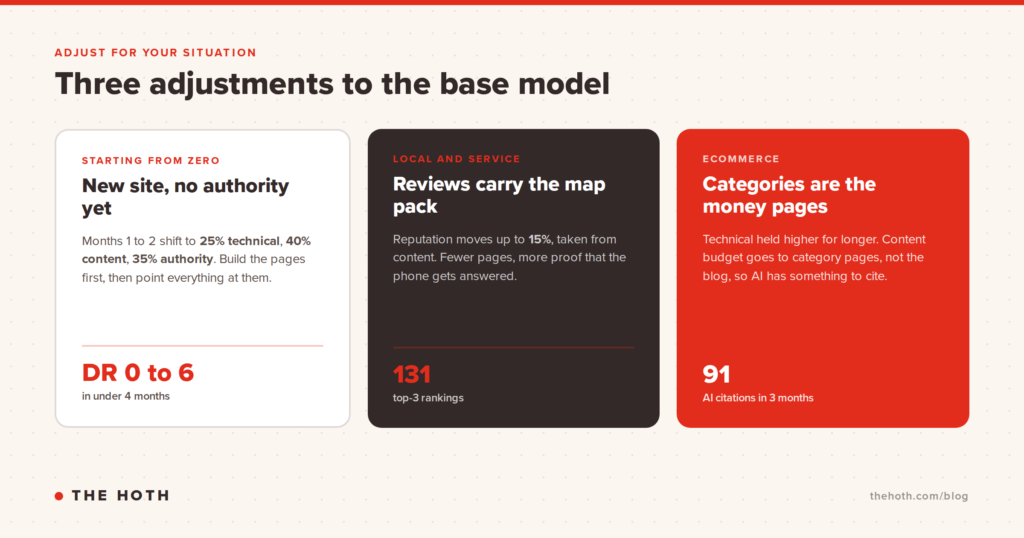
No allocation survives contact with a specific business unchanged. Three adjustments come up constantly.
Starting from zero. A miniature cattle ranch in our campaign set began at domain rating 0 with no backlink profile, in a category where AI tools were already recommending competitors by name. The stack was a technical audit, money-page content, Exclusive Media Links, and outreach, in that order. In under four months: DR 0 to 6, 47 referring domains, organic traffic from 231 to 2,222 monthly visitors, 50 top-three rankings, and 181 AI brand mentions across four platforms. For a new site, spend months one and two at roughly 25% technical, 40% content, 35% authority, then converge on the base model by month four.
Local and service businesses. Raise reputation to 15% and take it from the content line. Location and service pages still get the money-page treatment, but review velocity and Google Business Profile signals do work here that content cannot. The moving company above is the model: location pages first, links pointed at them, service pages once velocity builds.
Ecommerce. Shift the content line toward category page depth and hold the technical line higher for longer, because catalog sites have crawl budget and indexing problems that a service site never sees. A spray tan ecommerce brand in our set ran digital PR, earned media, and platinum links for three months and reported 91 AI citations, 666 additional organic visitors, and a 3-point domain rating gain. Coverage plus links pointed at product pages, on a site that could already be crawled.
Why shouldn’t AI visibility be a separate line in the budget?
Because every tactic that earned AI citations in our campaigns also improved organic performance, and every tactic that improved organic performance also made pages more citable. A separate AI line pays twice for one set of work, and the products sold to fill it are often built around tactics Google has said it ignores.
This is the question we get most in 2027 planning conversations, and the Gartner figure above explains why. When 15.3% of a flat marketing budget gets designated for AI, the natural move is to carve a matching slice out of the search budget and label it AEO or GEO. Resist that.
Go back through the model. Technical audits fix indexing, which improves rankings and makes pages eligible for AI features at the same time. Editorial coverage builds entity signals engines read and passes equity Google reads. Money-page content deep enough to cite is content deep enough to rank. Not one line in the allocation is AI-only, and not one of them is Google-only either.
What a separate AI budget usually buys is packaging: llms.txt files, content chunking, pages rewritten “for AI.” Our twelve-month findings post covers Google’s own position on those items. The version we believe in is one program that funds technical health, coverage, authority, and content depth, and then reports on both channels. That is the shape of AI Discover, and it is the shape of the allocation above.
What does the 12-month sequence look like?
Months one and two are technical-heavy: audit, fix what blocks retrieval, rewrite the money pages. Months three through twelve shift to the base allocation, with coverage as the largest line. Expect first meaningful citations around month three or four, and treat a campaign with nothing to show by month six as a diagnosis problem rather than a patience problem.
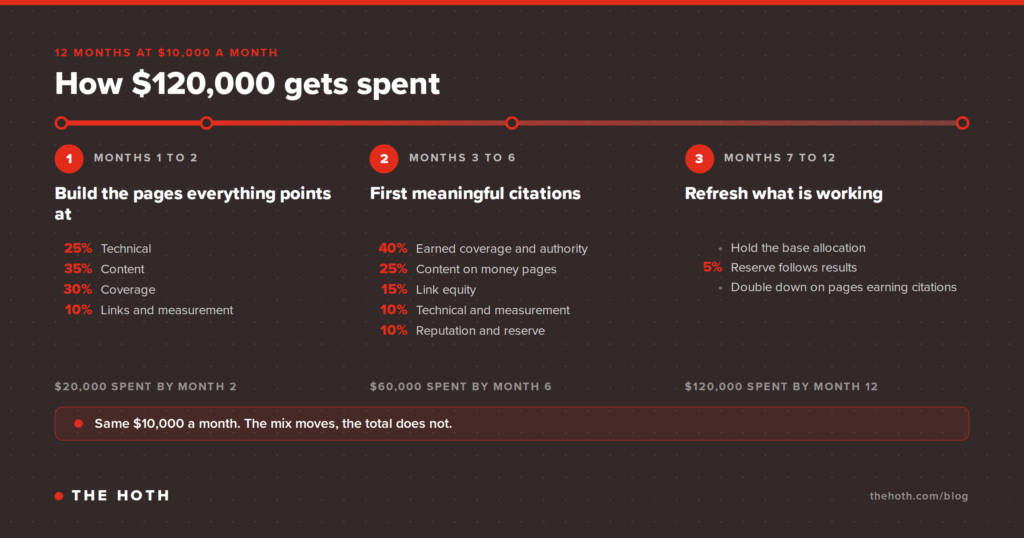
Here is how the $120,000 gets spent across the year.
Months 1 to 2. Roughly 25% technical (audit, remediation, indexing), 35% content (money pages first), 30% coverage (the first Earned Media story goes out in month one regardless, because coverage takes time to compound), and 10% links and measurement. You are building the pages that everything else will point at.
Months 3 to 6. Converge on the base model. Coverage becomes the largest line. Links start pointing at the rewritten money pages. This is the window where first meaningful citations tend to appear, and it is not the window to change the plan.
Months 7 to 12. Hold the base allocation and let the reserve do its work. Each quarter, move the 5% reserve to whichever line produced results. Add a content refresh cadence on the pages that are now ranking or being cited. If month six produced nothing, look for a technical or targeting problem before adding spend.
The reason the sequence matters as much as the percentages is that the same $120,000 spent in a different order produces a different result. Coverage bought before the money pages exist points authority at nothing. Links bought before the audit fill the bucket with the hole in it. Content written before you know which pages convert is volume for its own sake.
Frequently asked questions about SEO budget allocation
How much of an SEO budget should go to link building?
In our model, off-page work is 55% of a $10K budget, split 40% to earned coverage and 15% to links pointed at money pages. That is higher than most guides recommend because a year of campaign data showed coverage and authority doing more of the work in both Google and AI search.
Should I split my budget between SEO and AI visibility?
No. Every tactic in our allocation serves both channels. A separate AI line usually funds tactics Google has said it ignores, and it means paying twice for the same technical, content, and authority work.
What should I spend first?
A technical audit. It is the cheapest line and it gates everything else. If pages cannot be crawled or indexed, no amount of coverage or links will produce rankings or citations.
How long before a $10K budget shows results?
Three to four months to first meaningful citations and ranking movement is the pattern across our campaign set, including for sites starting from a domain rating of 0. Results before month two are unusual.
Is $10K a month a lot for SEO?
It is at the top of the typical range. Ahrefs’ survey of 439 providers found 63% of businesses spend between $500 and $5,000 a month, and fewer than a third of providers charge more than $2,000. At $10K the question is not whether you can afford SEO but whether the mix is right.
What if my budget is $5K or $2,500 instead?
The percentages hold. The difference is that smaller budgets cannot fund every line at once, so sequence harder: technical first, one money-page rewrite, then one coverage campaign every other month. Our pricing guide covers what each tier typically buys.
The bottom line
A $10K monthly budget in 2027 should buy coverage first, depth on the pages that convert second, links pointed at those pages third, and technical health before any of it. Hold a reserve and move it toward what works.
The percentages in this post will be wrong for some businesses, and we have tried to say where. What we are confident about is the order, and the principle underneath it: fund the work that serves both search channels at once, and stop paying for packaging.
If you would rather have that allocation run for you than assembled piece by piece, HOTH X managed SEO is built on exactly this model, at every tier from $1,000 to $10,000 a month. Book a call and we will walk through where your own sequence should start.
Leave a comment