

For many brands online, inconsistency is a blind spot that carries a hidden cost, especially on AI-driven search platforms.
In particular, inconsistent brand mentions quietly erode your authority in the background, which is something most visibility metrics won’t show you.
This presents the need for brand consistency SEO, a practice centered on forging a uniform brand profile across the web, not just on your own website.
Brand mentions shape how AI search systems understand your brand’s entity.
If your mentions appear fragmented, inconsistent, or semantically unstable, you risk confusing AI models, and they may:
- Falsely categorize your niche or value proposition
- Split your brand into multiple entities, diluting your authority in the process
- Never fully identify your brand due to inconsistent noise
As you can see, inconsistency can derail your AI search strategy before it ever gets going, so it’s crucial to know how to form a consistent narrative about your brand online, which is what we’re going to show you today.
Keep reading to learn more about the hidden cost of inconsistency and how to foster a cohesive brand presence that AI systems can’t ignore.
Why Consistent Brand Mentions Matter for All Forms of SEO
Brand mentions are instances of your brand name occurring on other websites, and they’re a cornerstone of modern SEO.
Whether you want to improve your brand’s visibility in the organic search results or on AI platforms (or both), you need to maintain control of your brand’s online narrative.
That’s because SEO is no longer a single system; it’s a layered ecosystem that combines:
- Traditional search algorithms
- Semantic indexing
- Entity recognition
- Large language models
One mechanism remains constant across all of these systems, and that’s pattern recognition.
The strongest pattern any system can learn is coherent repetition, and that’s exactly what consistent brand mentions provide.
In terms of Google’s organic search results, unlinked brand mentions (called citations) have always contributed to a domain’s authority, although they carried less weight than linked mentions.
These are called implied links, and Google actually has a patent for them:
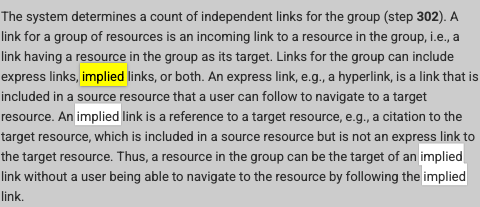
That means unlinked brand mentions can act like ‘implied links,’ contributing to your overall authority and how Google understands your domain as a group of resources in organic search.
The importance of consistent brand mentions in AI search

Regarding AI search systems, brand mentions play an even more significant role.
They rely on entity-based understanding, and not just keywords.
Whenever your brand appears with consistent naming, in similar contexts, and alongside relevant topical associations, it becomes a stable entity inside an AI systems’ internal knowledge graph.
This stability is what drives stronger topical authority, better relevance matching, higher trust weighting, and clearer distinction from competitors.
Also, modern search systems use semantic embeddings to understand the meaning behind words and the relationships between similar concepts. Embeddings are multi-dimensional, numerical representations of meaning positioned in vector space.
Technical lingo aside, consistent brand mentions yield dense, tightly spaced ‘semantic entity clusters’ containing things like:
- Product and service entities. When brand mentions are consistent, entity clusters will naturally form around your flagship products, feature names, service offerings, pricing tiers, use cases, etc.
- Problem and solution relationships. These entity clusters are the most commercially valuable because they position your brand as a potential solution to common customer pain points. Most of the time, users lead with problems instead of products when prompting AI tools. Thus, AI systems look for solutions instead of specific brand names. This makes problem and solution oriented entity clusters crucial conversion levers.
- Conceptual and narrative entities. Clusters will form around your brand’s positioning, philosophy, differentiators, narrative themes, and value proposition.
- Trust and authority signals. If your branding is consistent, all your reviews, backlinks, testimonials, case studies, and third-party mentions will naturally gravitate toward the same semantic space. If your mentions use inconsistent naming, your signals won’t cluster, fragmenting your authority as a result.
- Comparative positioning. Handle your brand’s entity optimization correctly, and you’ll cluster near competitors, alternatives, benchmarks, trade-offs, and category leaders. Instead of diluting your presence, clustering alongside these entities reinforces your brand’s prominence and authority within the industry.
With consistency, you become intrinsically associated with the core topics related to your products and services, and your brand is easier for LLMs to retrieve, recommend, and rank with confidence.
Unpacking the Hidden Cost of Inconsistent Brand SEO
An inconsistent brand profile online causes signal dilution, which isn’t good for AI search or classic SEO.
Remember, you want to broadcast coherent, repetitive signals to ensure that algorithms and LLMs recognize your brand as a single, authoritative entity in your industry.
Examples of inconsistent brand mentions
What does inconsistent brand SEO look like?
It can take on many forms:
- Different versions of your brand name. Examples of brand name inconsistency include swapped or shortened names, typos, and legacy names (before rebranding) hanging around in old directories. This causes search systems to see two brands (or more) instead of a single entity, which splits authority instead of condensing it.
- Unclear or conflicting positioning. Multiple, mismatched value propositions on your site can confuse search systems and send conflicting messages. Inconsistent labeling also poses a problem, like if one mention refers to you as an ‘SaaS’ while another calls you a ‘marketplace.’
- Messy product and service descriptions. You shouldn’t use different names for the same product or service. For example, referring to a single product by two different names (like AI SEO Blueprint on one site and AI Search Playbook on another) is a recipe for signal dilution. Use one name for all your products and services across all your online mentions.
- NAP (name, address, and phone number) and geographic inconsistency. Multiple addresses and regions across different directories, news articles, and bios will fragment brand signals and dilute authority. NAP and geographic consistency are both critical for proper entity understanding and semantic clustering.
- Reputation and sentiment contradictions. Polarizing sentiment can throw off search systems, like if one mention calls you ‘an excellent solution for large enterprises’ while another claims ‘you’re the premier tool for startups and SMBs.’ If you want to capitalize on valuable problem and solution entity clusters, you need consistent reviews that clearly outline your target audience, their pain points, and how you can fix them.
If there’s one thing these issues have in common, it’s that they can happen naturally to any brand over time.
Rebrands, location changes, mergers, and shifts in product focus can all cause inconsistent brand signals to form online.
That’s why modern SEO demands constant brand narrative stewardship.
This involves actively shaping your web-wide story so that AI systems never have to guess who you are.
| Do you want expert control over your brand’s narrative without the hassle? Sign up for our Review and Reputation Management Service! |
Fragmented semantic clusters and weakened narrative authority
If your third-party brand mentions are all over the place, your semantic clusters will fragment instead of gravitating together.
That’s because each inconsistent mention creates its own mini-cluster in semantic space. Without consistency, the ‘vacuum,’ so to speak, all your mentions will remain isolated.
This also provides weaker narrative authority since inconsistent messaging confuses search engines (and audiences) about what you actually do.
As a result, problem and solution associations, comparative positioning, and product-topic links never get to spread their wings, causing reduced visibility and ranking prominence.
How to Build a Consistent Narrative Online

As we’ve established thus far, inconsistency is an AI trust killer.
The good news?
It’s always possible to establish a consistent narrative for your brand, regardless of any old signals and noise floating around online.
Research by Anthropic proved that it only takes 250 consistent documents for a narrative to form inside of an LLM. Once the narrative gets established, it becomes self-reinforcing.
Therefore, it’s possible to overwrite incorrect or outdated narratives.
Fresh, unified signals from authoritative sources drown out old noise every time.
Your secret weapons in this regard are:
- Exclusive Media Links (EMLs) – Exclusive backlinks on relevant media domains are the perfect vehicle for locking in your brand’s preferred narrative. Including your brand’s name, value proposition, and core offerings provides crawlable patterns that AI trusts. LLMs trust these sites because they have editorial oversight from journalists and editors, and they have a legal obligation to report the truth.
- Digital PR – If ENLs set the stage for your brand’s narrative, digital PR tactics put on the rest of the show. Journalist-led story pitching, podcast appearances, and original research campaigns help strengthen brand entity and semantic authority. However, your framing must remain congruent across all your mentions, backlinks, and content for the right narratives to form. Remember to keep things like your NAP, product names, and brand values uniform across all channels.
These two methods are ideal for developing and maintaining consistent brand narratives online.
As a bonus, target co-occurrences with key terms, concepts, and even competitors to reinforce AI entity associations. Examples include industry round-ups, ‘best-of’ articles, and resource pages.
Final Thoughts: The Importance of Brand Consistent SEO
To summarize, consistency is a key SEO ingredient that applies to all brands, regardless of industry or target audience.
In the current noise-heavy landscape, brand stewardship is essential for maintaining consistent entity signals and narratives.
Do you need help maintaining your brand’s consistency online?
Sign up for HOTH X, our fully managed, ‘set it and forget it’ SEO service!
Leave a comment