
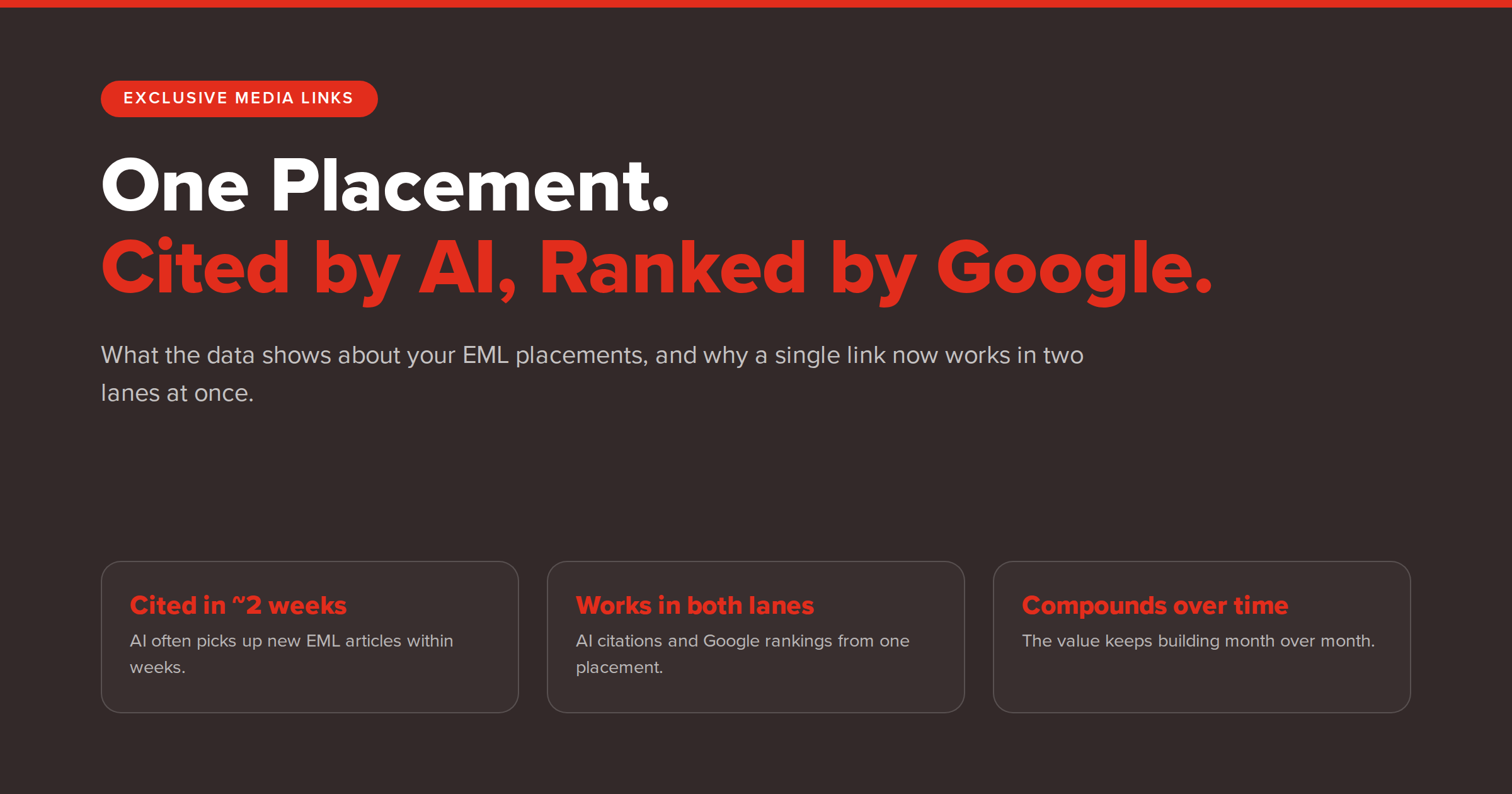

When you order an Exclusive Media Link, you already know you’re getting a dofollow link inside a real article on a high-authority US news site. What you might not realize is how much that placement is now doing for you in a second arena: the AI answers your customers see when they ask ChatGPT, Gemini, or Google a question.
We pulled the data on our own published EML articles to see exactly what happens after they go live. The short answer: these placements are getting cited by AI systems, often within weeks, and the same articles are picking up organic Google rankings at the same time. This post walks through what we found, why it works, and how we measure it, so you can see what your placements are really doing.
The short version
Here’s what the data shows about EML performance in AI and search:
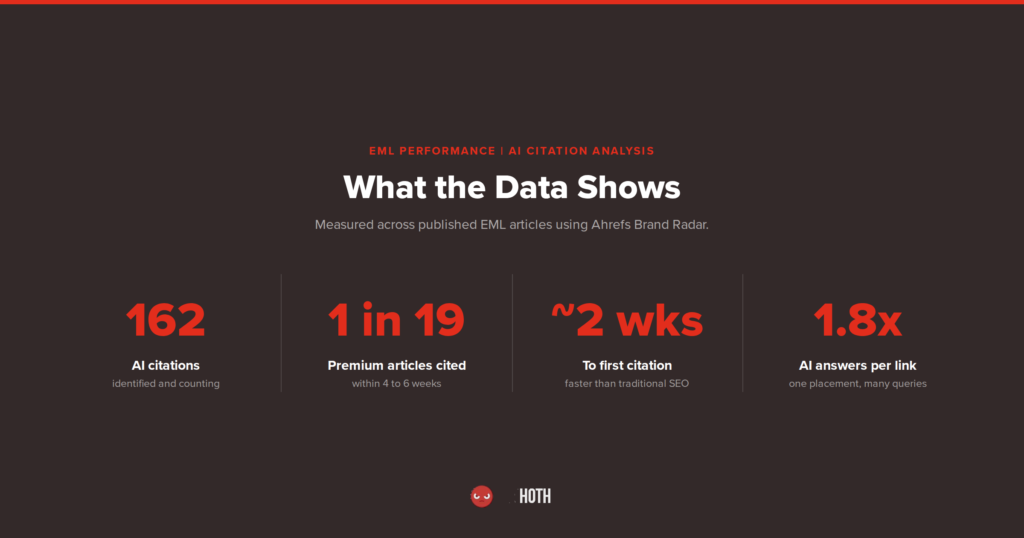
- AI cites them, and fast. On our premium news placements, roughly 1 in 19 articles earned an AI citation within four to six weeks, with the first citations often appearing about two weeks after publishing.
- One link, many answers. Each cited link earns about 1.8 AI appearances on average, and up to 2.4 on our strongest network. One placement answers multiple questions across multiple AI platforms at once.
- Citations compound. One group of articles grew from 46 to 63 AI citations in just four days, and citation counts keep climbing month over month as coverage expands.
- AI and SEO move together. The same articles getting cited by AI also picked up new organic Google rankings in the same weeks. One placement works in both lanes.
- We measure it openly. We track citations across Google AI Overviews, AI Mode, ChatGPT, and Gemini, and we’re upfront that AI citations are dynamic, not permanent guarantees.
A quick refresher: what an Exclusive Media Link is
An Exclusive Media Link is a dofollow link placed naturally inside an original, evergreen article on a vetted US news site. The domains we use have real organic traffic, real editorial standards, and domain ratings from roughly 30 to 60 and up. Placements come in two tiers: Gold (DR 60+ news sites) anchors authority, and Silver (DR 30+) expands reach. You provide a URL and a target keyword, and we handle the article and the placement.
This is different from Earned Media, which distributes one story across thousands of publishers for broad coverage. EML is the targeted option: individual links on specific, high-authority news domains. If you want the full picture on how editorial coverage drives SEO and AI visibility, our earned media guide covers the wider landscape. The reason EML deserves its own look is what these news domains are doing inside AI answers right now.
Why EMLs get cited by AI search
More of your customers now start their research inside an AI assistant instead of a list of blue links. Google’s AI Mode alone passed a billion monthly users within a year of launch. When people search that way, the brands that get named are the ones whose content the AI trusts enough to cite, and an EML is a direct way to become one of those cited sources.
AI answer engines don’t invent their responses from nothing. When someone asks a question, the system pulls from sources it considers trustworthy and relevant, then cites them. High-authority US news domains are exactly the kind of source these systems lean on. That’s the core reason an EML placement shows up in AI answers: you’re publishing on the domains that Google’s AI Overviews, AI Mode, ChatGPT, and Gemini already trust.
It’s worth being specific about why a news domain works where a generic blog doesn’t. AI systems weigh the credibility of a source, not just whether it mentions a keyword. A vetted news site brings editorial standards, real organic traffic, and an established reputation, the same things that build trust with Google. On top of that, EML articles are written as editorial: original, data-rich, and free of promotional language. That combination, a trusted domain plus content that reads like reporting, is what AI systems reach for when they build an answer. A keyword-stuffed post on a low-authority blog offers neither.
The data backs this up. Across our published EML articles, we identified 162 AI citations and counting. On our premium Gold-tier placements, about 1 in 19 articles (a rate near 5.3%) earned a citation within four to six weeks of going live. That’s a consistent, repeatable baseline, not a one-off. And the first citations tend to appear fast, often within about two weeks of publishing, which is quicker than traditional SEO typically moves.
Two patterns stood out. First, Google’s AI Mode and AI Overviews are doing most of the citing, together accounting for nearly 80% of what we found. ChatGPT and Gemini cite EML content too, just at lower volume. Second, citations compound. One group of articles went from 46 citations to 63 in a span of four days, and the numbers keep growing as AI coverage of more topics expands. A placement that looks quiet in week two can be working hard by month two.
One placement in the data shows how far this can reach. A single evergreen article about a consumer product earned 18 AI citations on its own, and it was cited not only in English but in Spanish, French, and German. One article, on one high-authority domain, became a multilingual answer source within weeks of publishing. That is reach you can’t buy with a traditional one-and-done link.
One placement, multiple answers: the AI multiplier
Here’s the part that changes the math on a single link. When an EML article gets cited, it rarely answers just one question. On average, each cited link earns about 1.8 AI appearances, and on our strongest network that climbs to 2.4. One placement ends up answering several different questions, across more than one AI platform, at the same time, with no additional spend.
A real example from our data, with the client kept anonymous: a single plumbing article became an AI reference across 14 distinct queries, everything from “how to tell if a plumber is overcharging you” to technical questions about plumbing specifications. One article, one placement, cited as the answer to fourteen different things people were asking.
This happens because AI maps topics, not just exact keywords. Systems like Google’s AI Mode break one question into many related searches, a technique Google calls query fan-out, then pull the best source for each. A weight-management article in our set was cited for questions about several different medication brand names, because the AI understood they belonged to the same topic. Content that covers a subject thoroughly earns citations across the whole cluster of related questions, not only the one keyword it was built around.
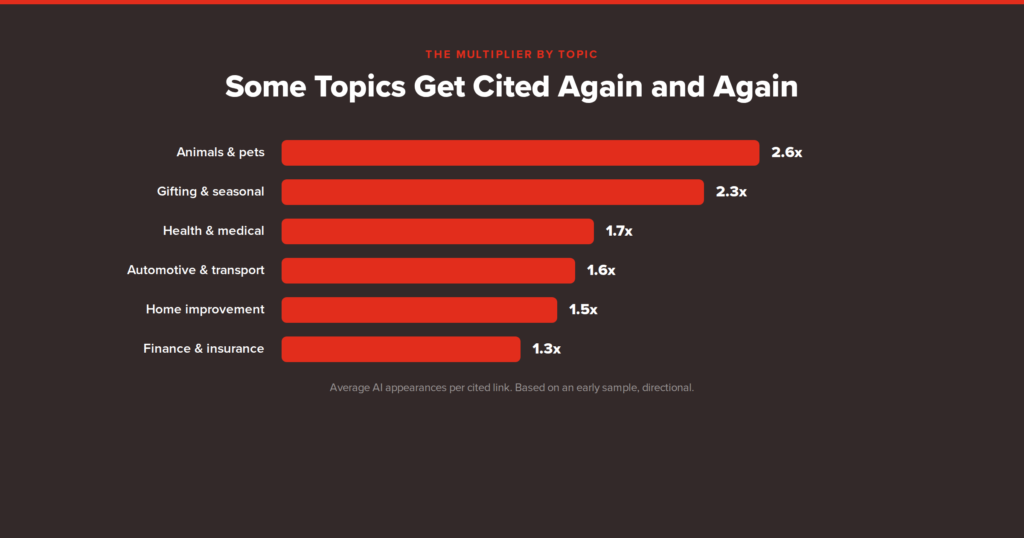
Some topics earn this repeat-citation effect more than others. In an early sample, the strongest performers were animals and pets (about 2.6 appearances per cited link), gifting and seasonal content (2.3), health and medical (1.7), automotive (1.6), home improvement (1.5), and finance and insurance (1.3). These figures come from a limited early dataset, so treat them as directional, but the pattern is clear: useful, evergreen, consumer-friendly content multiplies best.
The keyword side: AI citations and Google rankings rise together
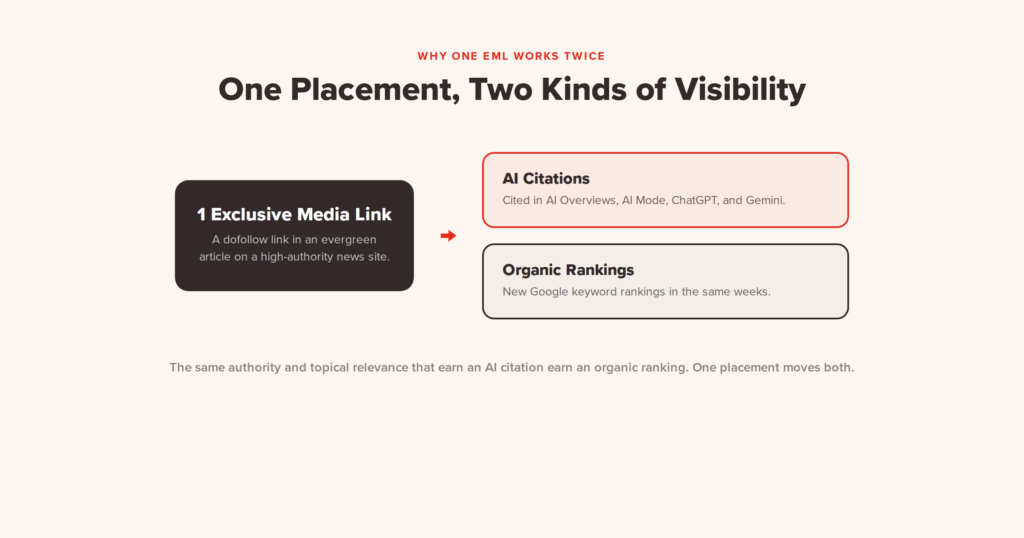
It would be easy to assume AI visibility and traditional SEO are separate games. The data says otherwise. The same EML articles getting cited by AI were also picking up new organic Google rankings in the very same weeks.
A few anonymized examples from the set: a bath-remodeling article landed a new page-one-adjacent ranking for an installation keyword the same month it started getting AI citations. A weight-management article ranked in the top five organically while being cited across AI platforms. A family-travel article picked up three new keyword rankings, and an interior-design article picked up two, all alongside their AI citations. The authority and topical relevance that earn an AI citation are the same signals that earn an organic ranking, so one placement tends to move both at once.
That’s the keyword-perspective takeaway: an EML isn’t an AI play or an SEO play. It’s one placement working in both lanes, which is what makes the per-link economics work in your favor.
There’s a durability angle as well. Because an EML lives inside an evergreen article on an established news domain, it keeps getting found and re-cited long after it goes live. We saw articles from earlier cohorts still picking up fresh citations weeks and months later, including one that kept appearing in snapshots more than six weeks apart. Unlike a placement that spikes and fades, an evergreen news article tends to accumulate value, in both AI citations and organic rankings, the longer it stays up.
How we measure this (and what the numbers don’t promise)
We want you to understand exactly what we’re doing here, with no black boxes. The measurement works like this: we use a tool called Ahrefs Brand Radar, which monitors keyword prompts across AI platforms and records which URLs get cited in the AI-generated answers. We export those results and cross-check them against our list of published EML article URLs to find matches. When one of our articles shows up as a cited source, we log it, along with the platform, the question that triggered it, and how often that question is asked.
Everything in this analysis is filtered to four platforms: Google AI Overviews, Google AI Mode, ChatGPT, and Gemini. We track citations over time by re-checking the same articles in later snapshots, which is how we can see citations compounding rather than just a single moment.
The tier of a placement matters too. Gold-tier domains (DR 60+) drove the large majority of citations, which makes sense, since the highest-authority sites are the ones AI trusts most. What surprised us is that Silver-tier placements (DR 30+) are breaking through as well. We confirmed citations on several Silver domains, and Google’s AI Mode in particular looks more willing to cite mid-authority sources than people assume. The practical read: the citation bar is lower than the conventional wisdom suggests, and a blended Gold-and-Silver approach can earn AI visibility across a wider set of placements.
The honest caveat matters as much as the numbers. AI citations are dynamic. According to Ahrefs research, the sources AI cites change roughly 46% of the time, so any single snapshot is a point-in-time reading, not a permanent guarantee. We read this data as strong, directional evidence that your content is high quality and relevant enough for AI systems to trust, which is the goal. What we don’t do is promise that a specific article will be cited for a specific query forever. Anyone who promises guaranteed, permanent AI placements isn’t being straight with you about how these systems work.
What this means for your campaign
A few practical things to keep in mind as you think about EML performance:
- Give it a few weeks. First AI citations often appear around two weeks in, and the picture gets stronger over the following months. Judge the program on a quarter, not a week.
- Evergreen and useful wins. Data-rich, useful consumer content earns the most repeat citations. Purely promotional angles do not, which is why the articles read like editorial, not advertising.
- Think in placements, not a single link. Because each cited link multiplies across queries and platforms, and because citations compound, the value builds as your set of placements grows.
- It’s working in two places at once. Every EML is building both your AI visibility and your traditional search authority from the same placement.
The bottom line
Exclusive Media Links were always about placing your brand on news domains that carry real authority. What the data now shows is that those same domains are the ones feeding AI answers, so a single placement earns you visibility in AI search and traditional search at the same time, and it compounds over the months that follow.
If you want to see how EML fits your current goals, or you’re curious which placements would work hardest for your topics, your strategist is happy to walk through it. You can also review the Exclusive Media Links details anytime.
Frequently asked questions
How long until an Exclusive Media Link gets cited by AI?
First citations often appear around two weeks after publishing, which is faster than traditional SEO usually moves. Citations then tend to compound over the following weeks and months as AI platforms expand the range of questions they cover.
Do EMLs help with Google rankings, or only AI?
Both. In our data, the same articles being cited by AI were also earning new organic Google rankings in the same timeframe. The authority and topical relevance that earn an AI citation are the same signals that drive organic rankings, so one placement works in both lanes.
Which AI platforms cite EML content?
We track Google AI Overviews, Google AI Mode, ChatGPT, and Gemini. Google’s AI Mode and AI Overviews do most of the citing in our data, together accounting for nearly 80% of citations, with ChatGPT and Gemini contributing at lower volume.
Are AI citations guaranteed or permanent?
No, and anyone who promises that isn’t being straight with you. AI citation sources are dynamic and change often, so a citation is a point-in-time signal that your content is trusted and relevant, not a permanent fixture. The goal is to publish the kind of high-authority, useful content that AI systems consistently reach for.
What kind of content gets cited most?
Evergreen, data-rich, useful consumer content performs best, especially in topics like home improvement, health, automotive, finance, and pets. Comprehensive articles get cited across a whole cluster of related questions, not just one keyword.
Why a news site instead of a niche blog?
High-authority US news domains are exactly the sources AI systems and Google already trust and pull from. A link on one of those domains carries the editorial credibility that drives both AI citations and search authority, which a low-authority niche blog cannot match.
Leave a comment