
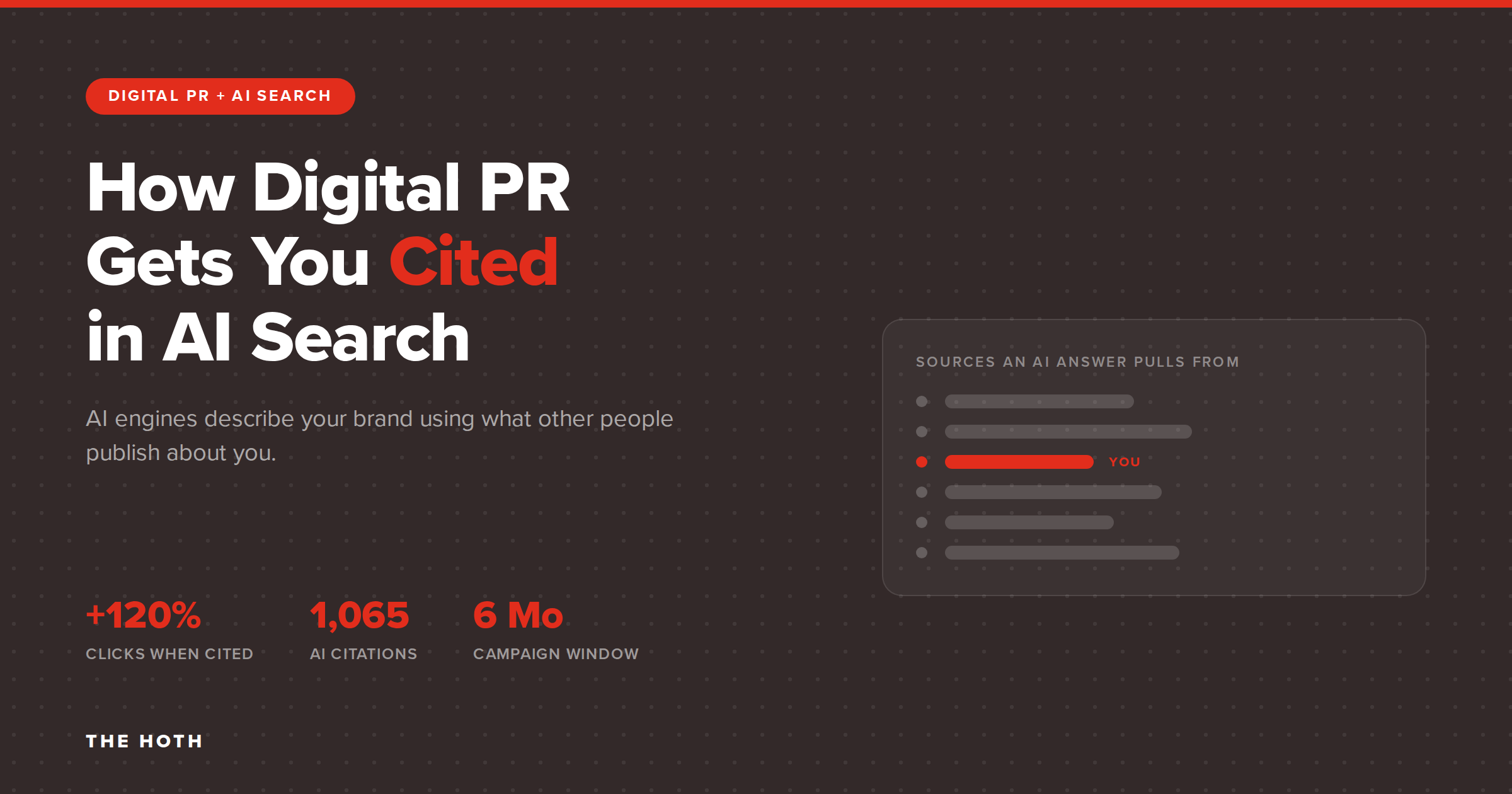

Digital PR earns AI citations by getting your brand described, quoted, and recommended on the third-party sites that AI engines read. ChatGPT, Google’s AI Overviews, Perplexity, and Gemini build answers largely from independent sources rather than your own marketing pages. Coverage you earn elsewhere is what puts you inside the answer.
You can hold the number one organic spot and still be missing from the answer sitting above it.
That is the uncomfortable part of AI search. The engine writes a summary, names three or four brands, and most people never scroll past it. If your brand is not in that summary, the ranking you spent months earning is doing a lot less work than it used to.
The fix is not another round of on-page tweaks. AI engines describe your brand using what other people publish about you, which means the highest-leverage work happens off your website. That is the job Digital PR does: it earns real editorial coverage on the sites AI engines already trust.
This guide covers why citations behave differently from rankings, what a citation is worth, which PR tactics earn them, and how to measure the results.
Why do AI engines cite some brands and ignore others?
AI engines cite brands they can verify through independent sources. When several trusted sites describe your business the same way, the model has enough corroboration to name you in an answer. Your own claims about yourself carry far less weight than what others publish about you.
A search engine ranks documents. An AI engine assembles an answer. Those are different jobs, and they call for different evidence.
When Google ranks a page, it is deciding which document best matches a query. When ChatGPT or an AI Overview writes an answer, it is deciding which claims it can safely make and which brands it can safely name. That second decision leans on corroboration.
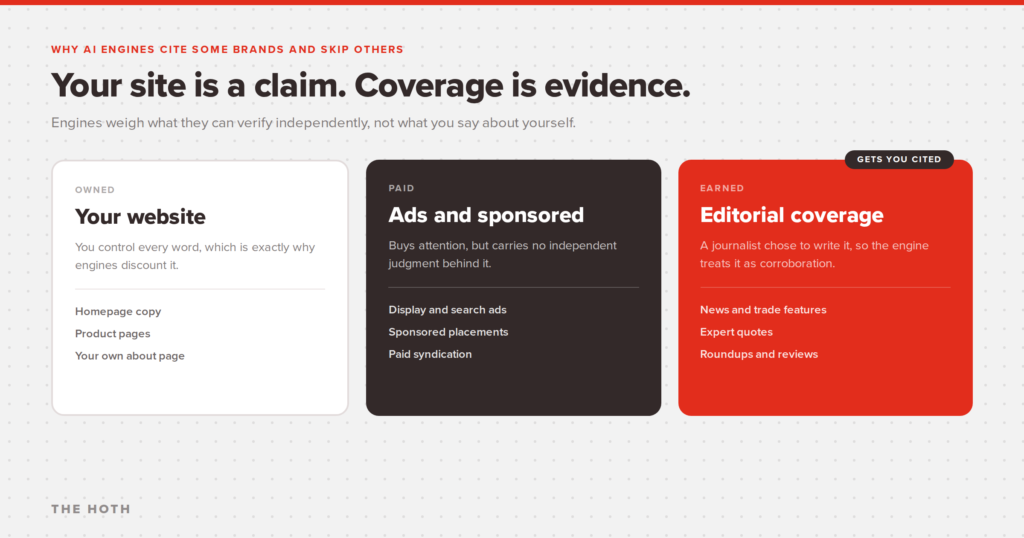
Your website is a claim. A feature in a trade publication, a mention in a roundup, an expert quote in a news story: those are evidence. When the same description of your brand shows up across several independent sources, the model treats it as reliable and repeats it.
This is why two companies with nearly identical rankings can have wildly different AI visibility. One has a footprint across the wider web. The other only has a website.
The on-page side of this still matters, and we cover it separately in our guide to getting cited in AI Overviews. Structure makes your content extractable. Coverage makes your brand credible. You need both, but most teams are heavily over-invested in the first and barely working on the second.
What is an AI citation worth?
Being named inside an AI Overview measurably outperforms being left out of one. Seer Interactive found that brands cited in an AI Overview earned 35% higher organic click-through rates than uncited brands on the same queries, and its 2026 update put that gap considerably wider.
Seer Interactive tracked 3,119 search terms across 42 organizations and 25.1 million organic impressions between June 2024 and September 2025. On queries where an AI Overview appeared, the results split sharply depending on whether the brand was cited inside it.
- Cited in the AI Overview: 0.70% organic click-through rate
- Not cited, same queries: 0.52% organic click-through rate
- Paid results followed the same pattern, at 7.89% versus 4.14%
Seer’s 2026 update widened the gap further, finding that cited pages pull roughly 120% more clicks per impression than uncited pages on the same AI Overview results. Cited pages still trail pages on results with no AI Overview at all, so a citation is not a full recovery. It is the difference between participating in the answer and being invisible next to it.
Worth being straight about the limits of this data: Seer’s own researchers note they cannot prove that citation causes the lift. Brands with stronger authority may simply be more likely to get cited in the first place. The correlation holds consistently across the dataset either way, and the practical takeaway does not change much, because the same work that earns citations is the work that builds authority.
There is also value that never shows up as a click. When an AI engine names your brand as the source of an answer, the user has seen you positioned as the authority on that question. That impression tends to surface later as branded search.
Why can’t you earn AI citations from your website alone?
You control what your site says, but not whether an AI engine believes it. Models weigh independent coverage, reviews, and third-party roundups heavily when deciding which brands to name, so a business with a polished website and no outside footprint usually loses to one that other people write about.
Think about what an AI engine has to work with when someone asks it to recommend a vendor.
It cannot try your product. It cannot call your references. What it can do is read what independent sources have published about you, check whether those sources agree, and weigh how trustworthy each one is. A brand with fifty editorial mentions across credible publications gives it a lot to work with. A brand with a great homepage gives it almost nothing.
Seer’s own recommendation to marketing leaders makes the same point from the other direction: break the silos, and get PR, content, and search teams coordinating, because the citation gap is too big to treat as an SEO-only problem.
This is also where reputation work overlaps. AI engines check review signals before recommending a business, which is why review and reputation management pairs naturally with a PR push. Coverage tells the model you are notable. Reviews tell it you are good.
Which digital PR tactics earn AI citations?
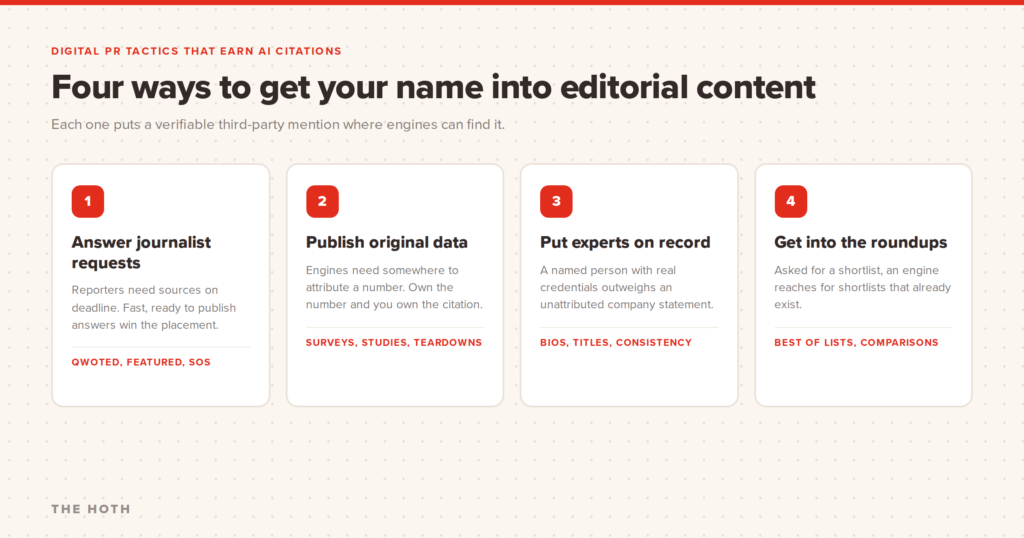
The tactics that earn AI citations are the ones that put your name inside editorial content: responding to journalist requests, publishing original data, offering named expert commentary, and getting into the roundups AI engines pull from when they need a shortlist.
Respond to journalist requests on the platforms that still work
If you have read older advice on this, it almost certainly told you to sign up for HARO. That advice is out of date.
Cision shut down Connectively, the rebranded version of HARO, on December 9, 2024. The brand was later revived under new ownership, but it is now one option among several rather than the default it once was. Anyone still running a media strategy built entirely around it is working from a 2023 playbook.
The current working set looks like this:
- Qwoted, where many former HARO users landed
- Featured, which assembles curated expert roundups for larger publishers
- Source of Sources, built by HARO’s original creator and free to use
- Help a B2B Writer, narrower and higher hit rate if you sell to businesses
- The #JournoRequest feed on X and LinkedIn, monitored in real time
Three things separate responses that get published from ones that get ignored. Speed, because reporters work on deadline and the first usable answer often wins. A ready-to-publish quote, so the journalist can paste it in without editing. And specific expertise, because generic answers that read like they came out of a chatbot get filtered immediately.
Work two or three of these platforms rather than betting on one. HARO’s collapse is a reasonable argument against depending on any single source of coverage.
Publish original data
Original research is the single most citable asset you can produce, because AI engines need somewhere to attribute a number to.
The pattern is easy to see in the wild. The best-performing article on this exact topic is Search Engine Land’s analysis of 8,000 AI citations, which has attracted hundreds of referring domains. It ranks because it contains numbers nobody else has.
You do not need a dataset that large. A survey of 300 customers, an analysis of your own anonymized performance data, or a teardown of 50 competitors in your category all produce something a model can cite and a journalist can cover. The requirement is that the number has to originate with you.
Put named experts on the record
Attribution is a trust signal. A quote from a named person with a real title and a verifiable background is worth more to both journalists and models than an unattributed company statement.
Pick one or two people who will be the public voice of the business, give them proper bio pages, and keep their credentials consistent everywhere they appear. Consistency matters here as much as volume, because inconsistent details make a brand harder for a model to resolve confidently.
Get into the roundups and best-of lists
When someone asks an AI engine for a shortlist, it frequently reaches for existing shortlists. Being absent from the roundups in your category is one of the most common reasons a competent business never gets recommended.
This is the gap Earned Media and Exclusive Media Links are built to close, by placing your brand in editorial content on established publications rather than waiting to be discovered.
How many AI citations can digital PR realistically produce?
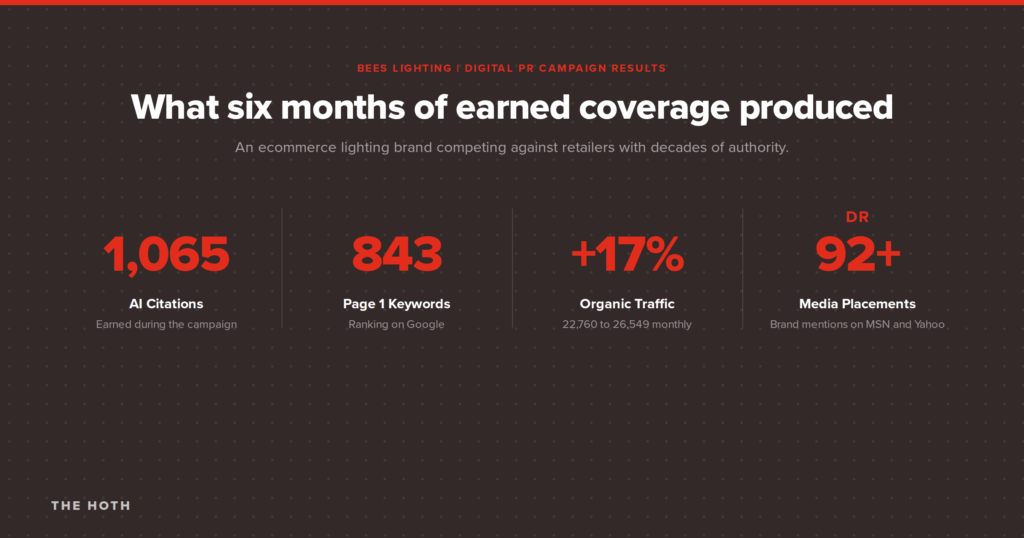
Bees Lighting earned 1,065 AI citations in six months through digital PR combined with targeted link building. The same campaign produced 843 page one keywords and a 17% increase in organic traffic.
Bees Lighting sells lighting online, in a category dominated by Home Depot and Wayfair. Those competitors have domain ratings above 70 built across decades. The client came to us with 20 years of expertise and BBB accreditation, and almost no external signal to match it.
The campaign combined three things: targeted outreach to niche-adjacent sites like interior design blogs and contractor resources, journalist outreach for contextual brand mentions, and deliberate distribution of link equity across product pages, category hubs, and cornerstone content rather than piling everything onto the homepage.
The journalist outreach produced contextual brand mentions on MSN, at a domain rating of 92, and Yahoo, at 94. Those are exactly the kind of editorial placements AI engines lean on when deciding whether a brand is worth naming.
After six months:
- 1,065 AI citations earned during the campaign
- 843 keywords ranking on page one of Google
- Organic traffic up 17%, from 22,760 to 26,549 monthly visitors
The client’s own summary was that the campaign gave them the external authority to match their internal operations. That framing is the right one. The expertise already existed. What was missing was the public evidence of it.
How do you track AI citations?
Track AI citations by monitoring where your brand appears across engines instead of watching rankings alone. Build a fixed set of prompts, run them against the major engines on a schedule, and record which brands get named and which third-party pages get cited.
Rankings will not tell you this. A page can rank third and never be cited, or be cited constantly without ranking at all.
The most durable method is also the simplest. Write down the 20 to 30 questions a real buyer would ask an AI engine before choosing a vendor in your category. Run that same set against ChatGPT, Gemini, Perplexity, and Google’s AI Mode on a fixed schedule, monthly at minimum. Log which brands get named, and which sources the engine cites when it answers.
Two things fall out of that log. You learn your share of voice against named competitors, and you get a target list, because the publications an engine cites for your category are exactly the ones your PR effort should be aiming at.
Pair it with brand mention monitoring so you catch new coverage as it lands, and watch branded search volume as a lagging indicator. Rising branded search after a coverage push is usually the first sign that visibility is converting into recall.
Dedicated AI visibility tooling is improving quickly, and our AI Discover service handles this tracking as part of a managed program. But the recurring prompt set is the practice worth keeping regardless of which tools you use, because it survives every change in the tooling market.
How do you build a digital PR program that compounds?
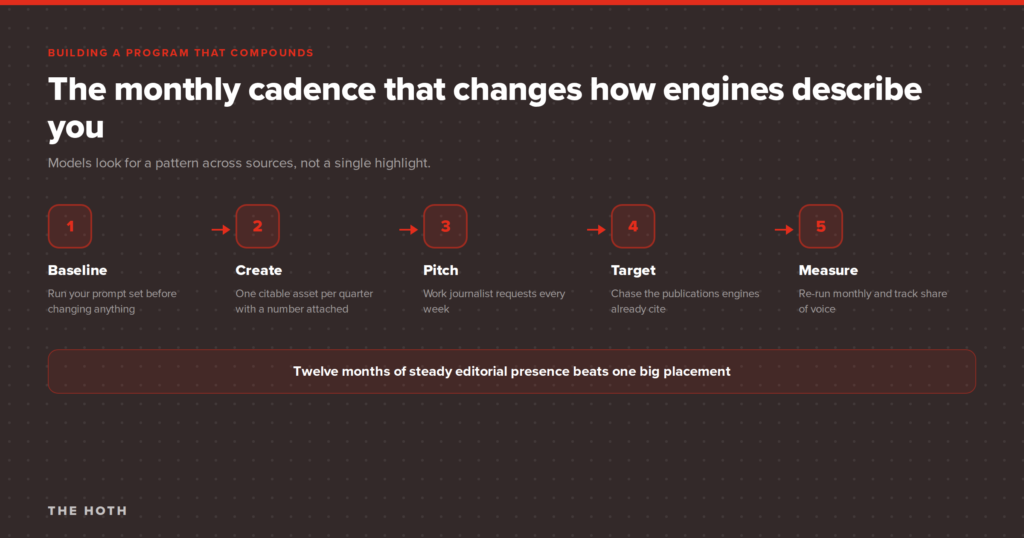
Treat AI citations as a compounding asset rather than a campaign. Publish something worth citing, get it placed in editorial coverage, keep your brand described consistently everywhere it appears, and hold a monthly cadence instead of running occasional bursts.
A workable sequence looks like this:
- Baseline first. Run your prompt set before you change anything, so you know which competitors currently own the answers.
- Build one citable asset per quarter. Original data, a survey, an analysis. Something with a number attached to your name.
- Work journalist requests weekly. This is the steady drumbeat between larger placements, and it compounds faster than most teams expect.
- Target the publications the engines already cite. Your prompt log tells you which ones those are, which beats guessing.
- Keep descriptions consistent. Same company description, same expert credentials, same category language everywhere you appear.
- Re-run the prompt set monthly and track share of voice, not just traffic.
The cadence matters more than the size of any single placement. One feature in a major publication is nice. Twelve months of steady editorial presence is what changes how a model describes your brand, because the model is looking for a pattern rather than a highlight.
If you want the wider strategic picture beyond AI specifically, our ultimate guide to digital PR covers the discipline end to end.
Frequently asked questions about digital PR and AI search
How long does digital PR take to affect AI visibility?
Most campaigns start producing placements within four to six weeks, and meaningful movement in AI citations tends to show up around the three to six month mark. AI engines refresh their view of a brand gradually, so the change follows the coverage rather than arriving with it.
Do AI citations require backlinks?
No. Unlinked brand mentions still contribute, because the model is reading the text rather than following the link. That said, ask for the link anyway. A linked mention does the same work for AI visibility and adds ranking value and referral traffic on top.
Is digital PR the same as sending press releases?
No. A press release is a distributed announcement that you control and pay to syndicate. Digital PR earns placement inside editorial content that a journalist chose to write. Engines weigh the second far more heavily, because independent editorial judgment is the signal being measured.
Can a small brand earn AI citations, or is this only for large companies?
Small brands can and do. Citation depends on being described credibly by outside sources, not on company size. A specialist business with genuine expertise and a handful of strong placements often outperforms a larger competitor with no editorial footprint.
How is this different from optimizing content for AI Overviews?
On-page optimization makes your content easy for an engine to extract and quote. Digital PR makes your brand credible enough to be worth naming. They solve different halves of the same problem, and doing only one of them caps your results.
Earn the coverage that gets you cited
AI engines are describing your brand right now using whatever they can find about you. If that footprint is thin, the description is thin, and your competitors fill the gap. The HOTH’s Digital PR service puts your brand into real editorial coverage through journalist outreach on Qwoted, Featured, Source of Sources, and Help a B2B Writer, with guaranteed placements and reporting tied to Ahrefs domain rating. Plans start at $1,500 per month with a three month minimum.
Ready to build the footprint AI engines read? Book a call with our team.
Leave a comment