

Imagine if AI platforms like ChatGPT and Perplexity began recommending your products and citing your content to your target audience.
It would be like having an omnipresent brand advocate consistently feeding your business leads and sales.
The best part?
Not much effort is required on your behalf. Once AI models trust your brand, they’ll handle most of the heavy lifting.
Well, with GSO (generative search optimization), this idea isn’t a fantasy; it’s entirely achievable with the right optimization strategy.
In a nutshell, GSO is SEO for generative answers.
Instead of trying to achieve high search rankings on engines like Google and Bing, the goal of GSO is to earn more citations and recommendations from generative AI platforms.
While the methodology is relatively new, brands are already reaping the rewards of GSO.
AI traffic converts at higher rates than visitors from traditional search engines, and GSO has the potential to amplify brand awareness like never before.
In this guide, we’ll teach you how to master GSO so that you can thrive in the new search ecosystem.
Why Does GSO Matter for Business Owners? Does Standard SEO Suffice?
At this point, AI models have completely reshaped the online search ecosystem.
Generative AI search platforms are skyrocketing in popularity. Perplexity boasted a 191.9% increase in its user base from 2024 to 2025, and ChatGPT had seized 1% of the overall search market by late 2024.
That may not seem like a lot, but it’s exceptionally difficult to gain just a fraction of a percent in the search engine market since Google has dominated it for decades. The fact that ChatGPT was able to grab 1% of the search engine market share in such a short period of time is a pretty insane feat.
Also, even if your target audience is still hooked on Google and Bing, they’re both dominated by generative AI Overviews (powered by Gemini and Copilot, respectively):
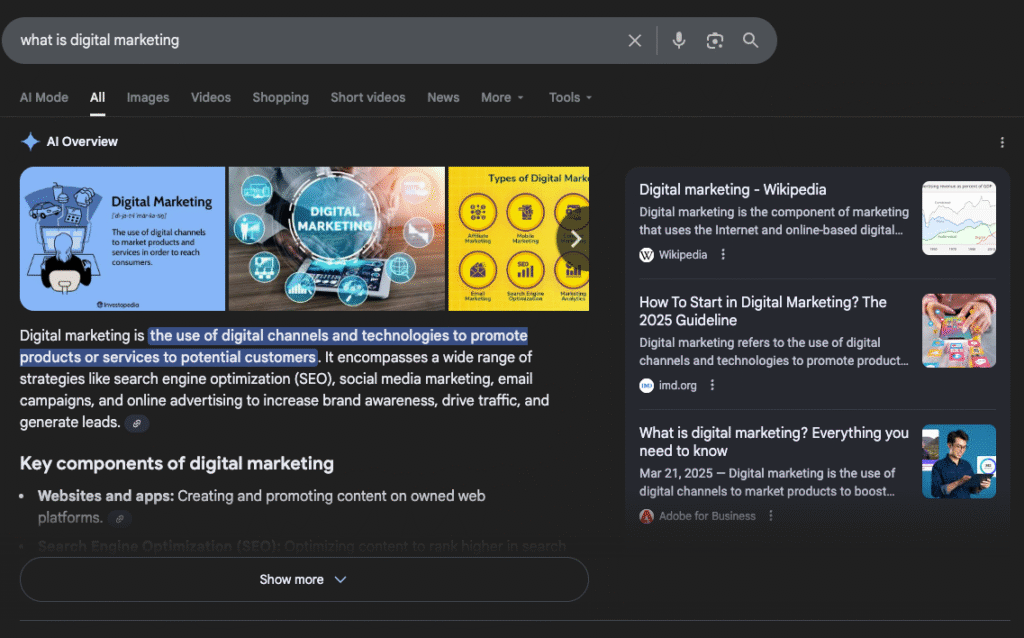
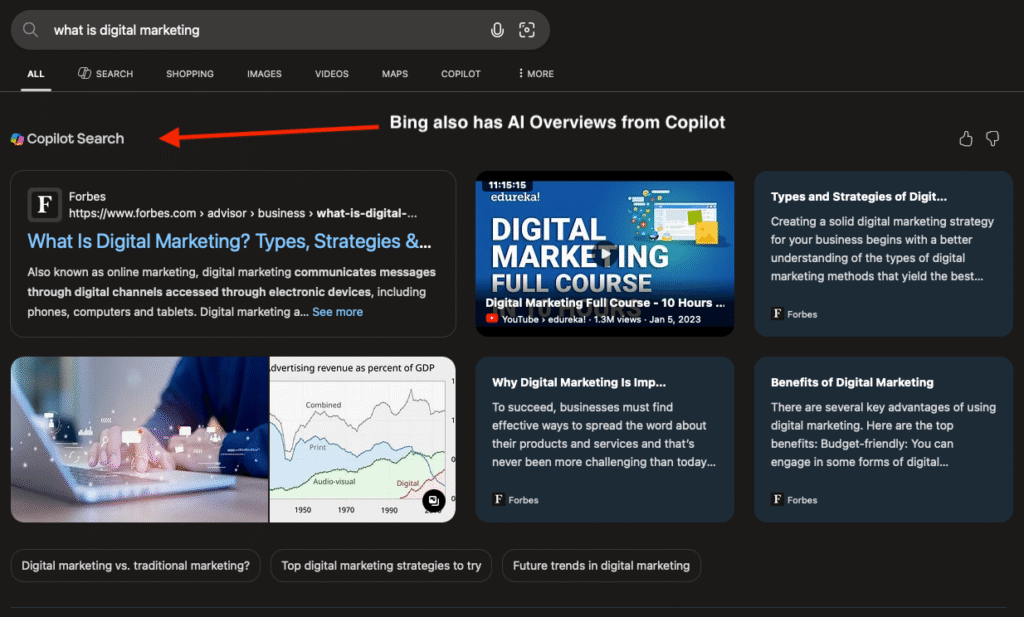
Add all these factors together, and it becomes clear why GSO is a necessity for search marketers.
Generative AI tools are now deeply embedded in the search landscape at all angles.
While standard SEO can still yield great results for some brands, especially local businesses and e-commerce stores, it won’t be long before GSO takes over completely.
The best thing site owners and marketers can do now is adopt GSO as quickly as possible. Acting fast could lead to establishing a breakaway lead between you and the competition.
If you build rock solid trust with large language models (LLMs) now, your competitors will have lots of catching up to do.
Meanwhile, generative AI platforms will consistently cite your content and recommend your products, providing you with a steady pipeline of leads and customers.
If anything, it won’t hurt to learn the basics of GSO and start implementing them into your existing SEO campaigns. As a bonus, GSO techniques will also improve your performance on traditional search engines.
Doing things like adding schema markup and building high-quality brand mentions are optimizations for LLMs and search algorithms, so you won’t hinder your SEO campaign by adding GSO tactics.
Mapping Legacy SEO to GSO: Linking Familiar Concepts to New Ones
Speaking of regular SEO, there are many concepts that parallel GSO best practices. This makes it possible to map traditional search optimizations to generative search optimizations.
Doing so will help you form new habits that will help improve your AI visibility without seeming completely foreign.
Let’s take a closer look.
Entities instead of keywords
Traditionally, SEO revolved around the concept of researching search keywords to discover what your target audience is looking up online.
Uncovering trending keywords related to your business to develop content ideas is SEO 101.
However, visibility on generative AI platforms is less about exact-match keywords and more about entity recognition and understanding.
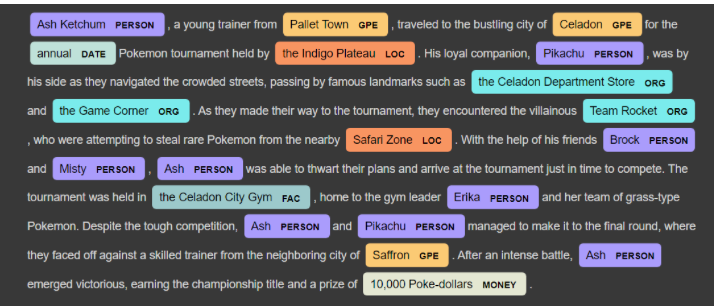
LLMs are able to interpret meaning by identifying entities, which are distinct concepts or things that exist independently of the text they appear in.
Entities can be:
- People (Rachel Hernandez)
- Places (St. Petersburg)
- Organizations (The HOTH)
- Products (HOTH X)
- Concepts (link-building)
Each of these entities gets linked to an entry in a knowledge graph or database (both internal and external, as LLMs use databases like Wikidata and Crunchbase).
Here’s a visual representation of how LLMs identify entities in a piece of text (it’s about Pokemon, but you get the gist):
Optimizing for entities and semantic range
How does this relate to GSO?
Instead of researching keywords related to your business, you want to reinforce your brand’s connection to your industry and topics related to what you do.
Here’s an example.
In legacy SEO, a site selling running shoes may optimize its content for the keyword ‘best running shoes’ on Google.
In GSO, the same company would want to optimize its online presence so that LLMs view it as a trusted entity related to running gear in general.
They can do this by:
- Earning positive brand mentions and backlinks on relevant, credible websites
- Having their content cited by other running gear websites
- Consistently publishing high-quality content related to running gear topics
- Boasting a mostly positive review profile across multiple platforms
- Implementing semantic HTML and schema markup to make content easy to parse for LLMs
Once they’ve solidified trust with AI platforms like ChatGPT, they’ll be in a highly advantageous position.
In fact, this fictitious company would have the potential to get cited for thousands of prompts related to running gear. This is due to the power of semantic range, and it’s something that not a lot of search marketers are talking about yet.
Remember, LLMs aren’t keyword matchers; they understand the meaning behind words and the relationships between concepts.
That means you wouldn’t need to create content for specific running gear and fitness keywords to get cited as a source for them.
Therefore, entity optimization scales infinitely better than legacy keyword optimization.
Trust signals instead of link volume
Link-building is another concept that’s been transformed by generative AI platforms. Backlinks are still trust signals for AI models, but it’s all about contextual relevance.
Google’s algorithm uses the link graph, a visualization of every site linked to one another, to assign authority signals to backlinks.
LLMs do not use a link graph, but connect entities to knowledge graphs as we’ve already discussed. Thus, they want to see backlinks that:
- Reflect your brand in a positive light
- Treat your content and products as credible
- Demonstrate your expertise and experience with a topic
For example, if a fitness enthusiast links to one of your blogs about running techniques, it signals to AI models that your content is credible and respected within the fitness community.
Other crucial trust signals include:
- Brand mentions, even if they don’t contain a backlink
- Community brand sentiment (what are people saying about you on Reddit, Quora, and niche forums?)
- Your review profile on platforms like Google, Yelp, Glassdoor, and niche-relevant platforms
Due to how generative AI systems build trust, key optimization tactics include digital PR, review management, and reputation management.
A digital PR campaign will populate your website with high-level content like original research, expert interviews, and thought leadership articles.
At the same time, the news and media outreach aspect of digital PR will help you generate authoritative brand mentions and backlinks.
On the reputation side, actively managing your review profile and presence in relevant community discussions is the best way to keep your brand sentiment positive (and LLMs like to see audience engagement).
| Need help optimizing for AI trust signals? Try out our Digital PR and Review and Reputation Management services! |
AI visibility instead of organic search rankings

As seasoned SEO professionals, the diminished importance of organic search rankings can be a hard pill to swallow.
Trying to rank #1 for crucial keywords has been the guiding ethos of SEO since the very beginning, so it can be difficult to retrain your brain. Yet, there’s nothing to gain from being stuck in the past, and the writing is on the wall at this point.
Keyword rankings are now in the backseat, and AI Overviews are at the wheel.
If you want your audience to continue to find you online, you need to ensure AI visibility instead of top organic rankings.
As previously mentioned, becoming a trusted entity in your field expands your semantic range, eliminating the need to target specific keywords.
The result?
You’ll scale your visibility much faster and unlock the potential to generate far more leads than you would by optimizing for one keyword at a time.
The Core Pillars of GSO: Authority, Reputation, and Trust
Now that you know how familiar SEO concepts translate to GSO, let’s analyze the primary elements of a GSO campaign.
At first glance, these ‘pillars’ may seem redundant, but they’re actually distinct factors that LLMs use to weigh credibility.
Authority: “Who you are”

Authority refers to your level of expertise in a particular domain or field of interest. In traditional SEO, authority was determined by backlink volume and quality.
On generative AI systems, authority is formed through consistent entity association. In other words, the more LLMs see your brand name connected to a topic in a trustworthy manner, the more authority you build in that area of expertise.
Here’s how you can build authority with generative AI platforms:
- Produce consistent, high-quality, topical content – Delve beyond surface-level pieces and aim to cover your field with in-depth, original pieces. To get your creative juices flowing, some ideas include conducting studies, interviewing prominent industry figures, and finding unique angles other websites haven’t covered. Creating interlinked topical clusters is another great way to build authority.
- Use semantic HTML and schema markup – Structured content that uses schema and semantic HTML is easier for LLMs to parse and disambiguate. Make sure that all your content contains appropriate Organization, Person, Product, and Article schema types.
- Earn citations, brand mentions, and backlinks from relevant domains – When other brands in your field reference you, it strengthens your brand entity’s connection to your industry. Besides brand mentions, it’s also valuable to earn things like resource citations (like another website linking to one of your studies or guides), product recommendations, and appearances in round-up articles (like ‘best of’ lists).
- Verify your data externally – Ensure that your brand is connected to known databases like Crunchbase, Wikidata, and Knowledge Graph panels. These serve as nodes or anchor points for AI models when they connect your brand to your area of expertise, so they’re massively important.
Reputation: “What others say about you”

This pillar has to do with your brand sentiment. For this reason, it’s all about user reviews and community discussion.
It’s the social layer of your online presence, and it encompasses all discussion related to your brand entity. Also, specifics matter since LLMs can fully understand language, meaning, and context.
For example, if journalists consistently mention the reliability of your brand’s products, AI models will pick up on it and reflect that tone in their generated answers.
Trust: “How reliable your information is”

Lastly, trust refers to the accuracy and quality of the information you provide. Obviously, AI systems don’t want to cite brands that publish incorrect or deceitful content.
Thus, LLMs will cross-reference your content with verified data and authoritative external sources. It’s the AI’s equivalent of ‘fact-checking.’ If you’re found to publish untruthful or outdated content, it won’t bode well for your AI visibility, so do your best to update old posts and verify all claims with citations from trusted sources.
How the HOTH Leads in GSO
The transition to GSO is something that we saw a mile away.
We’d been keeping a close eye on Google’s Search Generative Experience ever since it was first announced back in 2023, and we’ve been experimenting with AI since ChatGPT came out in late 2022.
Also, our existing focus on quality, accuracy, and technical proficiency yielded outstanding AI visibility results for our clients.
The kicker?
They were on our managed SEO service, HOTH X. At the time, we were focusing on organic SEO, but since our tactics already aligned with GSO, our clients started earning tons of AI citations.
As you can read in our case studies, our tactics generated dozens of citations on platforms like ChatGPT, Perplexity, and Google’s AI Overviews.
This led us to release a product entirely focused on improving AI visibility.
With AI Discover, we work our GSO magic to strengthen entity connections and build trust with generative AI platforms.
If you’re ready to start thriving with GSO, don’t wait to sign up for AI Discover today!
Final Thoughts: The GSO Playbook for 2025
In summary, the lines between SEO and GSO are getting thinner each day.
As traditional search algorithms continue to incorporate elements of machine learning and language processing, it won’t be long until all search platforms operate under the GSO playbook.
The best thing you can do for your brand is start transitioning to GSO as soon as possible.
If you need help doing so, don’t wait to book a free strategy session with our expert team!
Leave a comment