

Did your website’s rankings change after the most recent Google update?
Whether they did or not, this is a great time for you to learn how to safeguard your website from Google’s Medic update and any other future algorithm updates.
Before I tell you how to hold on to your rankings, here’s what happened with Google’s Medic update and why it’s important for your site.
What Was The August 1st, 2018 Medic Update?
With the Medic update, Google changed the significance of its algorithm’s core ranking factors. This is the overall framework for how your content gets ranked in search results.
If you want to know whether or not you were impacted by the Medic update, you should look at any changes in your rankings and compare them to their positions prior to August 1st.
Finding advice for what to do if you were impacted is made a bit problematic by Google’s initial statement below, which made clear that there was no specific fix for the update:
This week we released a broad core algorithm update, as we do several times per year. Our guidance about such updates remains the same as in March, as we covered here: https://t.co/uPlEdSLHoX
— Google SearchLiaison (@searchliaison) August 1, 2018
It’s important to note that pages were affected across a variety of sites and no specific niches were targeted directly. The “MEDIC” update was not meant to target health sites, but it earned that name due to the number of sites in that category that saw major rankings changes.
Also, the August 1 core algorithm update was’t designed specifically to target health or YMYL websites. It was just a happy coincidence that it also impacted sites in that vertical.
— Pedro Dias (@pedrodias) August 19, 2018
Data-Based Factors to Improve for the Medic Update
There are more than 200 search ranking factors that Google looks at. Your goal should be to improve on them all over the long term to build your brand’s equity.
We looked at data from a variety of sources, including SEO experts, software companies, and publishers to determine what you should do to avoid being negatively impacted by the Medic update.
Certain commonalities between sites that saw rankings changes from the Medic update have been observed by the SEO community.
Below is a checklist of those factors to improve on your site.
1. Optimize Your Content and Link Profile for Expertise-Authority-Trust
Google provides guidelines for how it rates the quality of different web pages. E-A-T is Google’s measure (section 4.1) of overall quality for web pages. It stands for Expertise-Authoritativeness-Trustworthiness.
Rather than read the 164-page document of Google’s Search Quality Rating guidelines, you can check out this article.
According to early reports from Marie Haynes and Search Engine Land, the Medic update was mainly directed at better evaluating website authority in terms of E-A-T.
The Data
Haynes added that she believed that the update was “primarily about Google getting better at assessing Trust, the ‘T’ in E-A-T.” The data revealed that sites affected negatively by the Medic update had issues related to trust mentioned in the Quality Raters’ Guidelines:
- Selling a product that could possibly compromise the safety of people
- Reputation issues
- Lack of positive reputation as compared to competitors
- No authority in the niche
- Large number of negative reviews
This all comes with a big caveat mentioned by Charles Float: The Quality Raters Guidelines are meant to be used by manual, human reviewers. It’s unlikely that Google’s algorithm can reliably tell if a site is meeting the E-A-T guidelines authentically, or if it’s manipulating the algorithm for the appearance of “expertise.”
In other words, content isn’t the only factor. A site with poor content in terms of E-A-T might still rank thanks to a robust link profile, as a UK site tracked by Floate did for the term “Casino.”
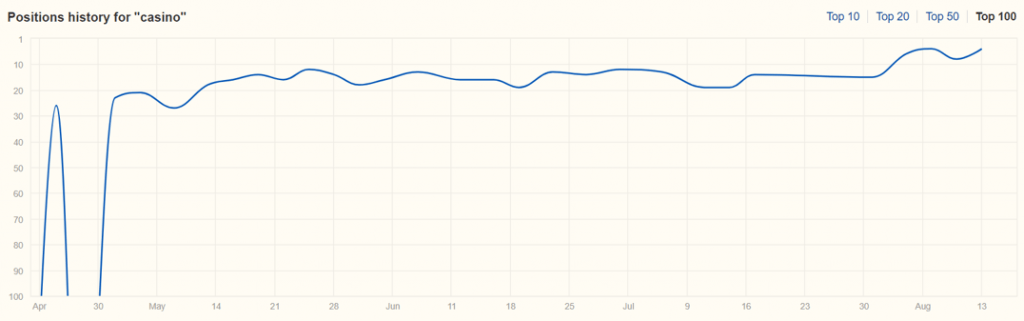
The site had scant content, but plenty of relevant links, and went from #15 to #4 during the update.
The takeaway: Both your content and your link profile should be improved to raise the E-A-T of your site, and its rankings as a result.
Here’s what to do to improve your site for E-A-T:
1. If selling products, make sure there isn’t any question as to their safety.
2. If reputation issues exist, you can attempt to increase the trust of your pages by making sure to have clear contact and customer service information on your “About us,” “Contact,” or “Customer Service” information pages (and make sure they’re prominent in your site’s navigation menu).
3. If your competitors have more/better reputation than you, you can work to improve the number of reviews of your business.
4. If you lack authority in your niche, you can build links back to your website from other sites to increase authority signals.
5. If you have a large number of negative reviews about you, attempt an outreach campaign to have them removed while simultaneously working to outweigh them with more positive reviews.
6. Make sure to maintain and edit your pages regularly and frequently. Google doesn’t want to present outdated content to users.
7. If you aren’t an expert in what your content is about, have experts make that content for you.
8. Include a biography of the writer on the page, and link it to a separate bio on a dedicated page, as well as linking to any other URLs that help to identify the writer as an expert. Avoid having anonymously posted content or anonymous owners for your site, make it clear who made the content.
9. You’ll also want to add any appropriate disclaimers.
2. Optimize & Improve Important Consumer Pages
“Your Money or Your Life” is a Google quality rating (section 2.3) of pages that dispense life-affecting advice, and those pages are held to the highest standard.
As Google explains it,
“Some types of pages could potentially impact the future happiness, health, financial stability, or safety of users. We call such pages ‘Your Money or Your Life’ pages, or YMYL.”
The Data
While YMYL sites and pages were certainly impacted heavily by this update, many non-YMYL sites were impacted as well since E-A-T affects all pages.
Of the impacted sites that were submitted to us, most were in the health niche.
There were also sites that don’t fall under YMYL:
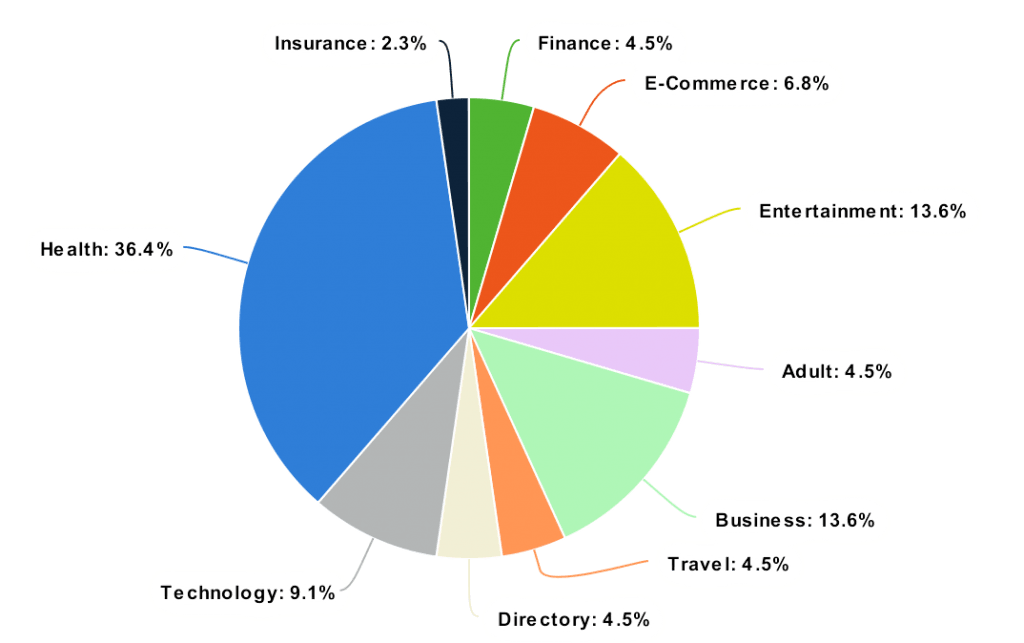
Barry Schwartz’s analysis of 300 sites found plenty of non-YMYL categories impacted as well:
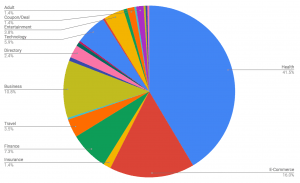
Glenn Gabe’s analysis of 210 impacted sites similarly found a variety of non-YMYL categories impacted such as lyrics sites, e-commerce sites, gaming sites, and more.
Of course, the same steps to optimize for E-A-T apply to YMYL pages, but with some additional steps.
Here’s what to do for your YMYL pages:
1. Have experts make your content
The E-A-T and YMYL standards make it clear that Google wants to show users content written by qualified experts when that content’s topic is about:
- Medical information
- Financial advice
- Advice or information pages on any topic that can have a potential negative impact on a person’s health, happiness or wealth
- High-quality hobby pages
The scope of YMYL also includes legal content, such as blog posts by lawyers and law firms, as that can also have a great potential impact on someone’s life.
Expert writing might sound like a high standard, but you want to protect your site from algorithm updates over the long-term. Following Google’s standards is one of the safest ways to do so.
2. Follow YMYL standards for the following page types:
- Shopping or financial transaction pages: Make sure they’re secure.
- Pages that offer financial information, such as investment or tax information: Make sure they’re expertly written and contain any appropriate disclaimers.
- Pages that offer medical information about specific diseases or conditions or mental health: Should be expertly-written, backed up with research, and updated regularly.
- Pages that offer legal information about topics like child support, divorce, creating a will, becoming a citizen: Should also be written by an expert, provide reference for the laws they refer to, as well as any disclaimers.
- Any page that has the potential to be dangerous or detrimental if it possessed low levels of E-A-T (parenting advice, for example): Again, try to make sure an expert is writing these pages and if possible, that they have the credentials to back it up.
3. Additional Factors to Improve for the Medic Update
While the E-A-T and YMYL guidelines are helpful for meeting Google’s standards, they’re affected by a lot of sub-factors.
Since Google’s long-term focus for its algorithm is to provide a great user experience, you might not be surprised to find that the factors associated with ranking changes are ones that affect UX directly.
Here are those additional factors to check on and optimize if needed:
Content Length: The Data
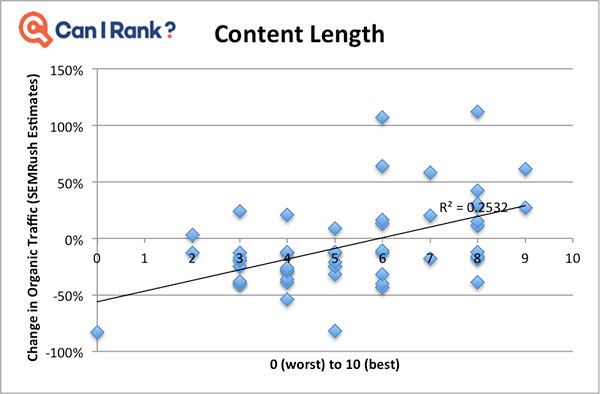
Content-length relative to other related ranking content showed a strong correlation in CanIRank’s study of 100 Medic-impacted sites:
Content Length: What to Do
If the ranking content provides a short and simple answer, such as an answer to “When is the next eclipse?” then make your content short and simple as well. If the content that’s ranking is in-depth, make your content in-depth.
In other words: match the intent of the search query in terms of WHAT and HOW MUCH information users are looking for.
Content Quality:
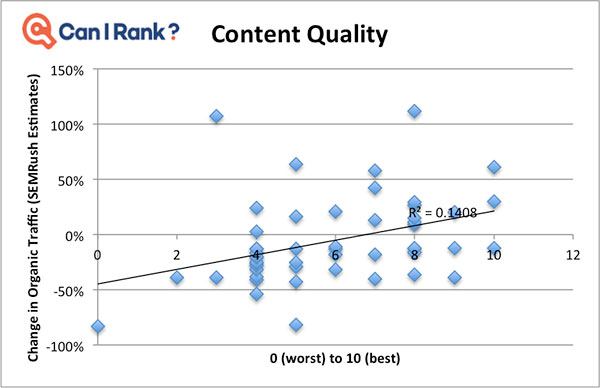
Content quality as a factor can be somewhat subjective, and it contains its own sub-factors like relevance, quality of writing, meeting search intent, and presenting the content well visually.
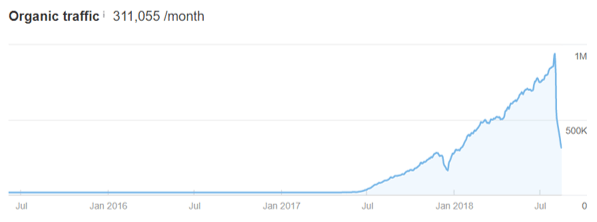
Charles Floate observed that poor content quality on a site such as “small” or low-quality pieces was a big factor tied to overall site quality (and thus UX).
FabAtHome.org was the example site Floate provided that tanked due to its poor overall quality:
CanIRank similarly found that gainers in rankings had the typical hallmarks of quality content:
Content Quality: What to Do
Make sure you have the following:
- Expertly-written content
- Plentiful visual elements of images, videos, and/or illustrations
- Structured content in the form of: tables of contents, headers, bullet points, pull quotes, and metadata
- A good number of dofollow outbound links (external links) to high quality, relevant sources for reference
- Author Bio or Author Markup to link a real person to the page
About Page: The Data
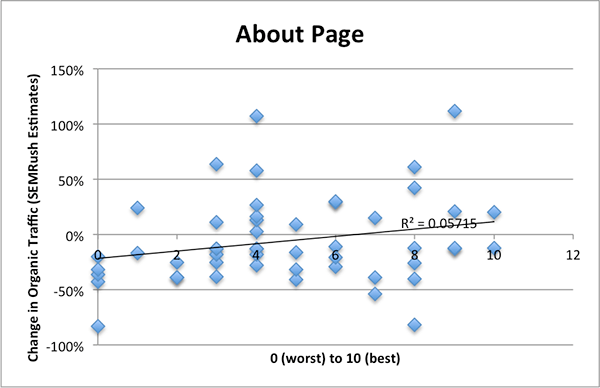
Sites lacking an about page or having a low-quality about page were found to be negatively impacted by Charles Floate and Dale Davies, while sites with a high quality about page were found to gain by CanIRank:
About Page: What to Do
Making your about page really thorough and providing value with the content on it or the content it links to can help. You can emphasize credentials, authority, history, and expertise more greatly in order to improve the quality of about pages in terms of E-A-T.
Mobile Experience: The Data
Well-designed mobile sites saw a rankings increase, which is really not that surprising. A large part of user experience is making your site and its content easily accessible on mobile:
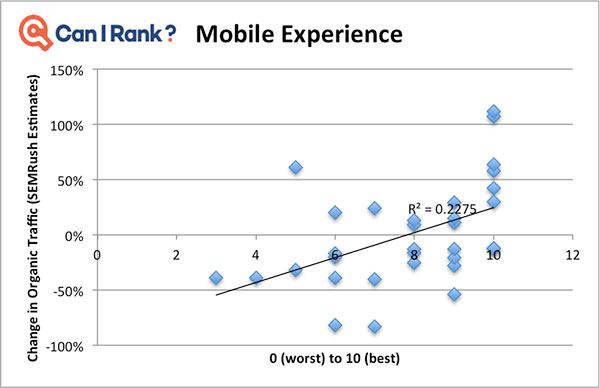
Mobile Experience: What to Do
Check that your site can pass Google’s mobile friendliness test. Make sure your content has a user-friendly design in terms of font, contrast, content visibility, and touch target size, regardless of the device it’s being viewed on.
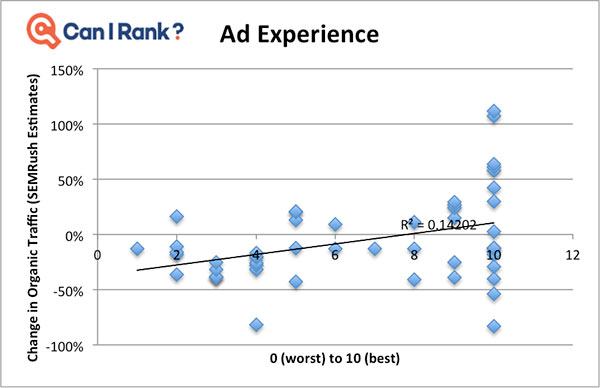
Ad Experience: The Data
Deceptive ads that were easy to confuse with content, excessive ads on the site, and the presence of autoplay video ads were shown to be a strong factor associated with rankings drops:
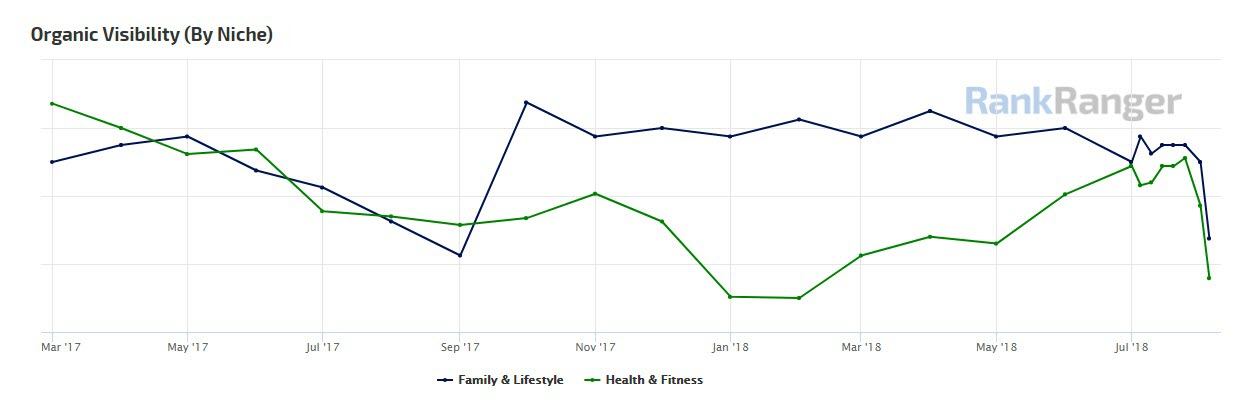
On the flip side, sites that provided a good ad experience by cutting down on their ad placement and making it clear what content was advertorial saw gains:
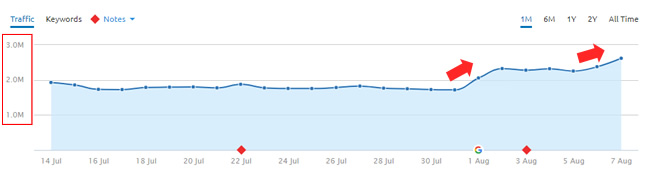
Here is another site that was advised by Glenn Gabe to cut down heavily on its ads prior to the update, and gained once the update hit:
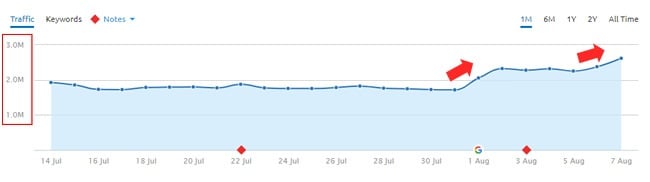
Ad Experience: What to Do
Make sure ads on your site are easy to identify without them being confused for regular content, and that your site’s content is more prominent than the ads.
If your site earns revenue through ad placement, consider cutting down on the real estate given to ads so that you can get more traffic to fewer ads as opposed to less traffic to many ads!
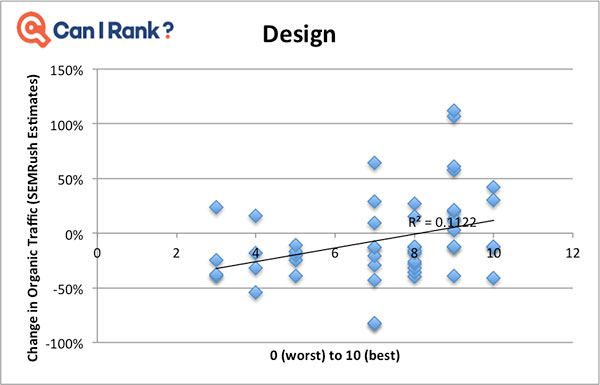
Design: The Data
The design of a site affects a lot of other factors that determine its user-friendliness. Such as accessibility, bounce rate, links, engagement, and brand metrics.
A well-designed site brings a lot of advantages with it, both directly and indirectly. A brand that cares enough to design its site well might also be more likely to invest in quality content, SEO work, outreach and other things that help a site to rank.
According to CanIrank, some of the gaining sites had “incredibly usable, elegant, and modern user interfaces:”
Google crawls pages according to its Page layout algorithm, which is what detects things such as excessive or above-the-fold ads, how a site looks on different screen resolutions, or if content is difficult to find for another design reason.
Design: What to Do
Make sure your site has a user-friendly design, meaning visitors enjoy interacting with it and can get as much information from it as possible in the shortest amount of time. This includes design elements such as:
- Plenty of white space
- Use of structured data, such as headlines, bullets, tables, blockquotes, and numbered lists
- Other non-text visual elements: images, videos, color blocks
- An eye-friendly color scheme
- Easily clickable targets, such as buttons
4. Technical SEO Factors Affected by the Medic Update
There are a lot of technical SEO factors that come into play for Google’s algorithm.
Sites with better on-page and off-page SEO generally gained, while sites with poorer stats declined.
Here are the factors that were reported in the wake of the Medic update:
Keyword Use: The Data
In an attempt to quantify what technical factors are most important, Barry Schwartz ran a comparison of sites through Cora, a technical SEO data tool.
Here is Schwartz’s Cora-plotted data:
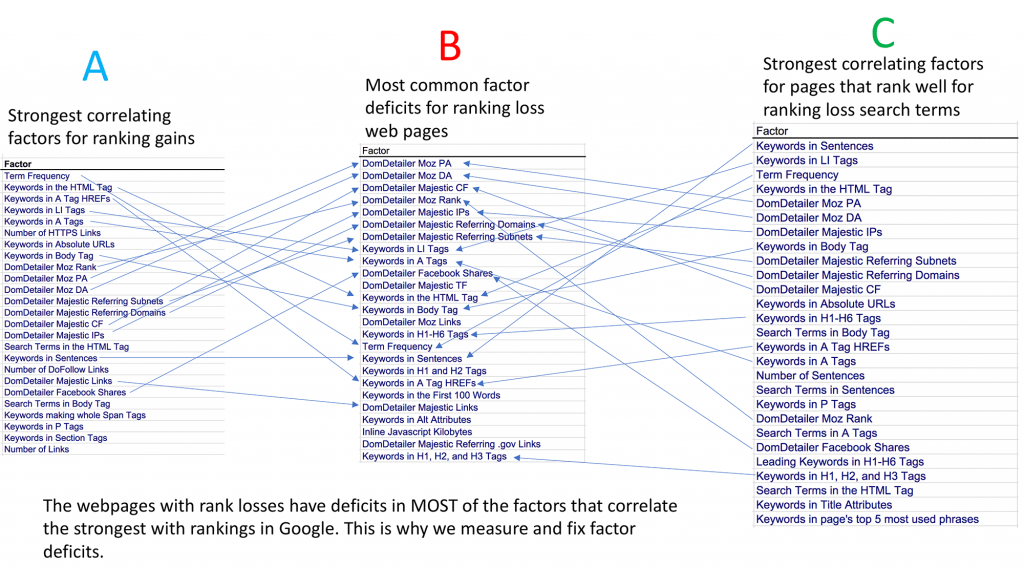
He found that:
- Keywords weren’t found frequently enough in the different areas of content and HTML of sites that were negatively impacted
- Keywords were found more frequently in those areas for sites that gained
Keyword Use: What to Do
- Perform good keyword research, and intentionally incorporate main keywords and LSI keywords within content, title tags, and meta descriptions
- Generally optimize your site’s on-page SEO
Inbound Link Trust: The Data
Schwartz’s analysis also found that sites with a poor backlink profile declined, while sites with a good backlink profile gained.
CanIRank similarly found that sites in the heavily-hit health niche that gained had earned a decent number of links from mainstream, high TrustRank websites:
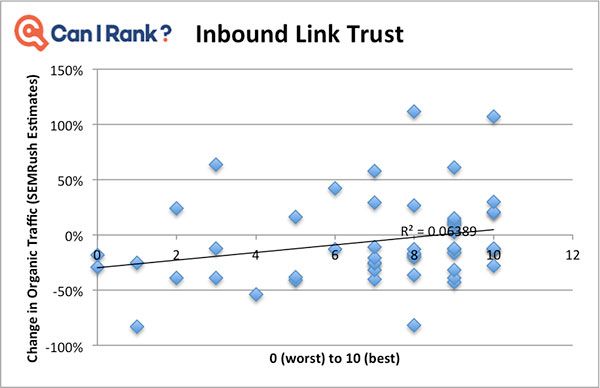
Sites that went down in their rankings tended to be part of a network that had a good number of links from each other, but fewer links from those mainstream, high TrustRank websites.
Inbound Link Trust: What to Do
- Improve the quantity and quality of links pointing to you through content marketing, link building, and brand development for a healthier backlink profile
- Set up social profiles associated with your website and brand to increase link trust
Site Speed: The Data
This factor showed less significant correlation, but it is an important technical factor. Site speed helps the user experience on your site, and in the past speed has been discussed as a ranking factor by Google.
Site Speed: What to Do
Check on your site’s speed and improve it if necessary.
You can boost your site speed in a few ways:
- Find a faster hosting service for your site
- Compress images and larger files before uploading them to your site
- Use a mobile-friendly theme
- Removing spaces or unnecessary characters in your backend code
- Create caches of your site on Content Distribution Networks (CDN’s)
How Can You Optimize Your Content to Avoid Being Hit by Future Google Updates?
The temptation to reduce a Google update to a set of targeted factors or niche categories is best avoided. As mentioned above, there are over 200 factors that Google looks at, and a broad core update is aimed at improving the overall quality of search results by definition.
The signs point to websites needing better content in order to improve their rankings:
Why? Because from everything that’s been observed about it, “Medic” addressed the things Google has been telling us to do for years. There really is nothing new to see here. If you hadn’t switched before to improving the quality and EAT of your content, this is your wakeup call. https://t.co/bgXiuPQaKP
— Mark Traphagen (@marktraphagen) August 22, 2018
“Better” has a loose meaning that can apply to everything from better matching query intent, lengthening or shortening the article, and including further topical keywords, among other factors.
When Google released the Panda update in 2011, it targeted sites with low-quality content. The widespread advice to avoid being hit by the Panda update was to improve content quality and clean up low quality or duplicate content. Not much has changed: Google still values “quality content” that meets their guidelines.
Hopefully, this article has given you a more nuanced view beyond simply “better content” and “less low-quality content” that you can take action on in order to ensure that your content lines up with what Google wants to see.
Conclusion
Clarity on why rankings change when Google performs an algorithm update (and what to do to make sure yours increase) is beneficial to anyone who wants their site to rank.
If you have any questions or comments about the Medic update, or maintaining your rankings in general, leave them in the comments below!
Leave a comment