

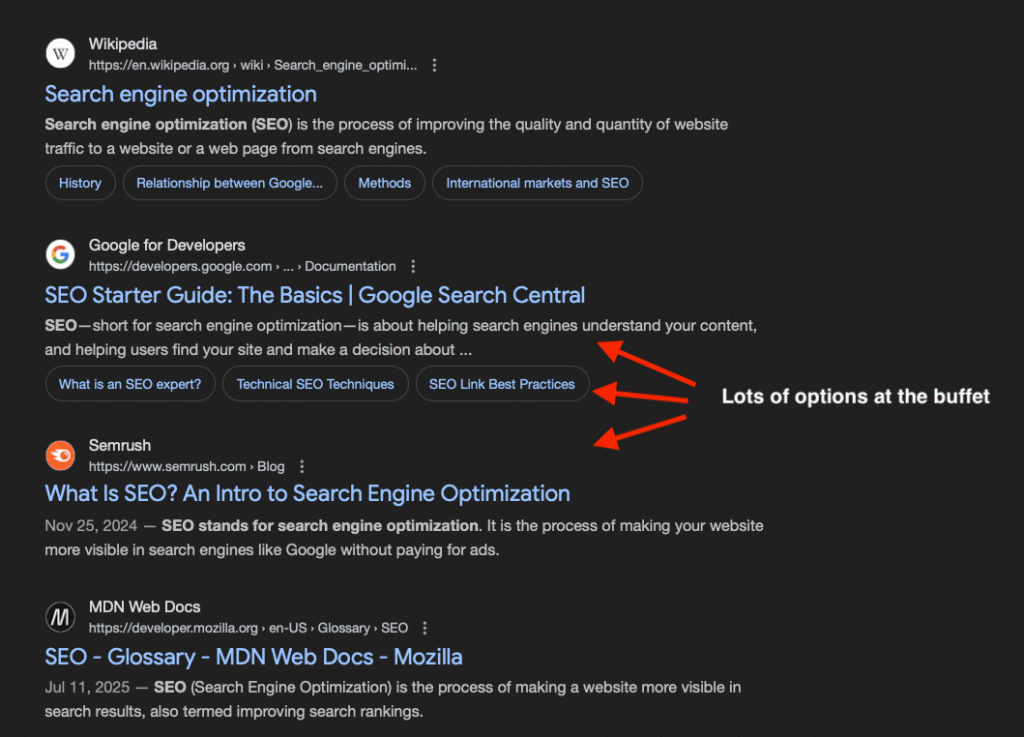
If Google is a buffet, AI search is a curated menu.
By that, we mean Google’s organic results function like a content buffet. There are 10 results per page, and a wide variety of brands get to compete for their audience’s attention:
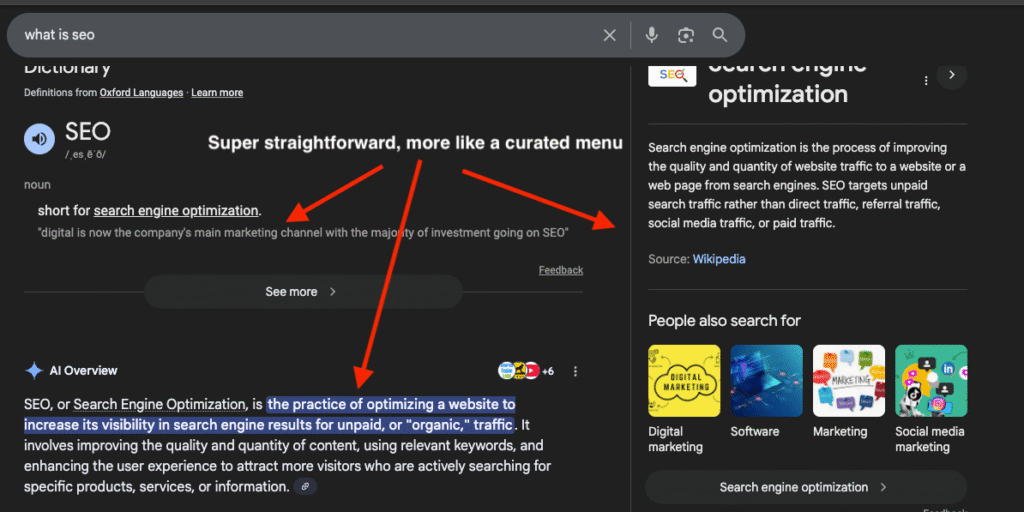
AI search tools work the opposite way.
Rather than presenting a diverse array of sources, LLMs (large language models) tend to only cite and recommend a handful of trusted brands.
So, instead of choosing what you want from a buffet, you’re served a catered dinner instead. The LLM decides what goes on your plate, and you have no say in the matter:
This isn’t necessarily a bad thing from a UX (user experience) perspective, especially considering that most people trust AIs’ recommendations more than their families.
From a marketing perspective, though, it means there’s less room to work with. The playing field has shrunk from 10 blue links to a few citations.
If you want to generate leads and sales through AI search tools, you must ensure your brand gets cited in generative AI responses.
That means earning LLMs trust and optimizing your website based on their preferences, like using structured data and clear formatting.
In this guide, we’ll teach you why LLMs are the internet’s new gatekeeper and provide several methods for unlocking the gate.
How LLMs Process Information
Let’s kick things off by learning how LLMs process information and pull online content. This will help you understand the difference between large language models and traditional search algorithms.
Here’s an overview of the basics:
- Entity recognition and understanding
- Natural language processing (NLP)
- Knowledge graphs and ‘memory’
- Brand mentions and other trust signals
Let’s take a quick look at each one.
Entity recognition and understanding
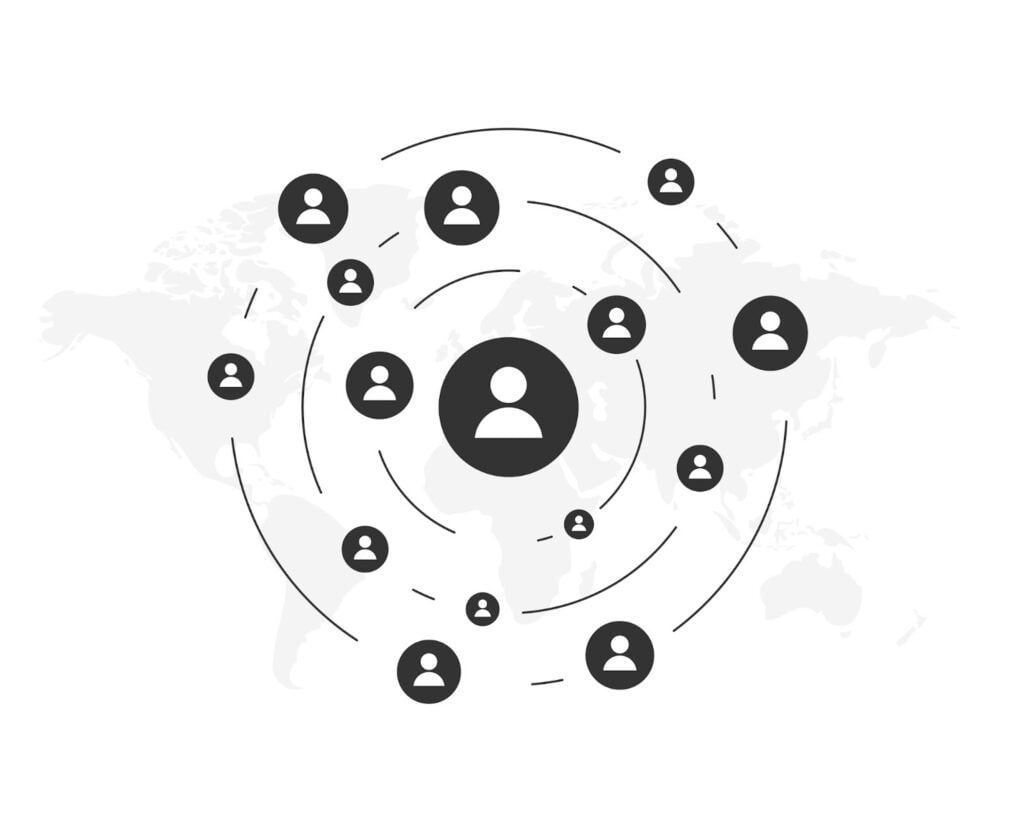
Where search engines index content based on keywords, LLMs take things a step further by understanding entities, like people, places, brands, and organizations.
This gives LLMs the ability to understand context and remove ambiguity from user prompts.
Did the user mean this or that? Is the entity already recognized in popular knowledge databases?
These are the central questions that entity recognition and linking answer.
For example, imagine an AI platform like ChatGPT encounters a prompt like this:
“Where can I find parts for my Jaguar?”
At face value, the word ‘jaguar’ can refer to the animal or the car manufacturer.
However, LLMs are privy to context clues. In this case, the word ‘parts’ is a dead giveaway that the user is referring to the car brand and not the big cat. If no context clues were present (like the prompt, “Tell me about Jaguar”), the AI model would either:
- Make a probabilistic best guess
- Consult a knowledge database like Wikidata to confirm the entity
Knowledge graphs and ‘memory’
Entity recognition isn’t just about clearing up ambiguity, though. Instead, it’s a far deeper process that lets AI models detect and link nouns to knowledge graph entries so that LLMs can reason about them.
Here’s an example. A user types a prompt like, “Tell me about Nike. Are they a sustainable brand?”
In this scenario, nothing is ambiguous. Yet, the LLM will still perform entity recognition to link Nike to an existing entry in its own or an external knowledge graph.
Why?
Because doing so lets it retrieve facts about the company, like sustainability reports and ESG scores. On traditional search engines, brand names were just static words. On AI-powered search tools, your brand name gets connected with who you are and what you do.
Natural language processing (NLP)
Thanks to NLP, AI models are able to read text pretty much the same way humans do. Instead of looking for keywords in static strings of text, LLMs can detect things like tone, relationships, and intent.
This, along with entity recognition, is how AI models can interpret extremely long, conversational-style queries.
Where search engine algorithms demand ‘search engine speak,’ which is stringing together exact-match keywords, you can talk to LLMs just as you would another person.
Brand mentions and other trust signals

AI platforms don’t want to cite low-quality, untrustworthy content. To ensure they don’t, they weigh a series of trust signals.
Ahrefs has uncovered that the top three AI visibility factors are:
- Branded web mentions
- Branded anchor text
- Branded search volume
As you can see, LLMs use your brand’s online presence to determine if you’re trustworthy or not. That’s why digital PR campaigns are so popular for AI search optimization, because they’re all about building a strong buzz for your brand online.
Bear in mind, LLMs will pay attention to the surrounding context of your brand mentions, including how your content relates to the domain mentioning you.
Raw authority scores like Domain Rating don’t matter to AI models, so you need to ensure that your brand mentions are relevant and positive.
Besides brand mentions, LLMs also analyze community discussion (Reddit, Quora, and niche forums) and user reviews when evaluating trustworthiness. As a result, managing your brand’s reviews and reputation is extremely important.
| Want to get the internet buzzing about your brand for better AI search visibility? Try out our Digital PR service! |
What Influences LLM Outputs? What are Their Preferences?

Next, let’s examine the primary factors that influence AI-generated responses on platforms like ChatGPT (and Google’s AI Overviews).
Just like search algorithms, there are certain things that LLMs prefer when citing online content.
Here’s a look at what influences LLMs to recommend brands.
Training data (entity association)

AI models are trained on massive sets of text, including everything from news articles to niche blog posts and academic papers. This dataset forms the LLM’s foundation for responding to prompts, and before they had live access to the web or retrieval-augmentation systems, it was all they had.
Granted, AI models could reason and infer, but they could only reference information present in their training datasets.
When ChatGPT was in its infancy in late 2022, its training dataset only went up to mid-2021. At the time, it didn’t have access to the internet, meaning it couldn’t provide up-to-date information.
That all changed with the addition of RAG (retrieval-augmented generation) and real-time web access.
RAG is the process that enables an LLM to integrate outside information into its reasoning process.
However, it’s not the mechanism that enables internet access (this is a common misconception), as that’s done through a combination of plugins, APIs, and web scrapers.
Why does this matter for marketers?
It does because the inclusion of RAG and internet access means LLMs never stop learning.
Every time an LLM reads the web to answer a prompt, it connects new pieces of information to entities it already knows.
That means if you create relevant, high-quality content and get cited by trusted websites, you’ll train LLMs to associate your brand with your niche.
Brand mentions
We’ve already mentioned how important brand mentions are for building trust with LLMs, but it can’t be overstated.
From an SEO perspective, you can think of brand mentions as the new backlinks. While backlinks are still a powerful trust signal, brand mentions, both linked AND unlinked, are extremely impactful.
When an LLM determines if it should trust a brand, it will check all the instances where its name is mentioned online. If other trusted websites recommend its products and cite its content as helpful resources, it’s an extremely strong trust signal.
The two most important factors for your brand mentions are:
- Context – Your brand mentions have to make logical sense for them to count towards your authority. Random links won’t count, nor will irrelevant mentions. Examples of strong contextual mentions include linking to helpful resources (blogs, free tools, etc.), recommending your brand, and positively reviewing one of your products.
- Relevance – Your branded mentions should be relevant to the topic at hand AND to the domain linking to you. The more relevant your online appearances are, the stronger your entity association will be with related topics.
Remember, focus on contextual relevance above static authority scores like DA (Domain Authority) and DR (Domain Rating).
Structured context
AI models prefer to pull content from structured data, namely pages that have semantic HTML and schema markup in place.
These two elements make it effortless for LLMs to parse and cite content, so they’re essential for AI search optimization.
Concise formatting is also a big deal.
You should use bulleted lists, short paragraphs, clear Q&A sections, and proper headings (H1, H2, H3, etc.).
How Brands Can Manage Perception: LLM Optimization Techniques

Now that you know what makes LLMs tick, it’s time to learn how to optimize your content so that you can earn more AI citations.
Remember, your goals are to:
- Train LLMs to closely associate your brand with your niche
- Get LLMs to trust and cite your content
- Earn enough trust and social proof so that LLMs actively recommend your products and services
Here are the most effective methods for achieving these goals:
Earn relevant brand mentions – Platforms like HARO and Qwoted are excellent for networking with online journalists. Play your cards right, and you can get your brand mentioned in relevant, trending news stories. You can also guest post on trusted blogs, publish original research, and interview industry experts.
Build editorial backlinks – LLMs value backlinks coming from trusted news sites, media outlets, and niche blogs. Bulk link-building won’t work, so stick with quality over quantity.
Implement sitewide structured data – Since structured data improves your chances of getting noticed by LLMs, you should include it on every page that matters for your business. Semantic HTML and schema markup are the most important. You can find a full list of schemas at Schema.org.
Manage your reviews and community reputation – LLMs will check your reviews across multiple platforms, not just Google Reviews. That means you need to keep a close eye on all your reviews, as well as what your target audience members are saying on platforms like Reddit.
Check these boxes, and you’ll be well on your way to becoming a go-to brand whenever LLMs encounter a prompt related to your niche.
The HOTH’s LLM Strategy: Refining What’s Already Been Working
When it comes to SEO, we’ve always focused on top-of-the-line tactics that focus on quality and yield the best results.
Because of this, our clients were finding success in AI search even before we began specifically optimizing for it.
It makes perfect sense if you think about it, because our optimization techniques were already aligned with the preferences of LLMs.
Top-tier brand mentions and backlinks?
We’ve been doing that for years!
Structured data and technical SEO proficiency?
Those have long been two of our specialties.
Over the past year or so, we’ve noticed numerous clients picking up AI citations across multiple platforms, including ChatGPT and Google’s AI Overviews.
This prompted us (pun intended) to take things a step further and launch a product exclusively focused on improving AI search visibility.
If you want to earn more valuable citations and brand exposure across all AI platforms, don’t wait to sign up for AI Discover!
Also, feel free to book a free strategy call with our team to develop a winning AI search campaign for your brand.
Leave a comment