

Google just dropped its first broad core update of 2026, and the timing is hard to ignore. The March 2026 core update began rolling out on March 27, 2026, hot on the heels of a quick spam update that wrapped up just days earlier and a first-of-its-kind Discover-only update back in February.
That’s three significant algorithm events inside of one month.
If your rankings or traffic have been acting strange lately, you’re not imagining things. This is a legitimate shakeup, and understanding what Google is trying to do here is the fastest path to protecting your visibility or capitalizing on the opportunities left by sites that aren’t keeping up.
Here’s everything you need to know about the March 2026 core update: what Google said, what the data shows, and exactly what to do if you’re seeing the effects.
What Is a Google Core Update?
Core updates aren’t targeted patches. They don’t go after specific websites, penalty-style. Instead, they’re broad recalibrations of how Google’s algorithm evaluates and ranks content across the entire web.
Google releases these several times a year. Each one reassesses the quality signals Google uses to decide which content belongs at the top of search results: things like expertise, content depth, user intent alignment, and overall page experience. When a core update rolls out, some sites that were previously over-rewarded drop. Others that were undervalued rise.
Google also releases smaller, unannounced core updates on a rolling basis. But when an update gets a formal announcement, like this one, it means the changes are broad enough to cause real, noticeable ranking movement. You can read Google’s official guidance on core updates here.
What Google Said About the March 2026 Core Update
Google’s own statement on this update was characteristically brief. On its Search Status Dashboard, Google posted:
On LinkedIn, the company added a bit more context:
That phrase, ‘all types of sites,’ is worth paying attention to. Previous core updates have drawn a lot of attention for how they affected large, established publishers. This framing signals that Google is continuing to focus on surfacing quality content regardless of site size or domain age, which opens the door for smaller, more focused sites to gain ground if their content genuinely earns it.
The Context: Three Algorithm Events in One Month
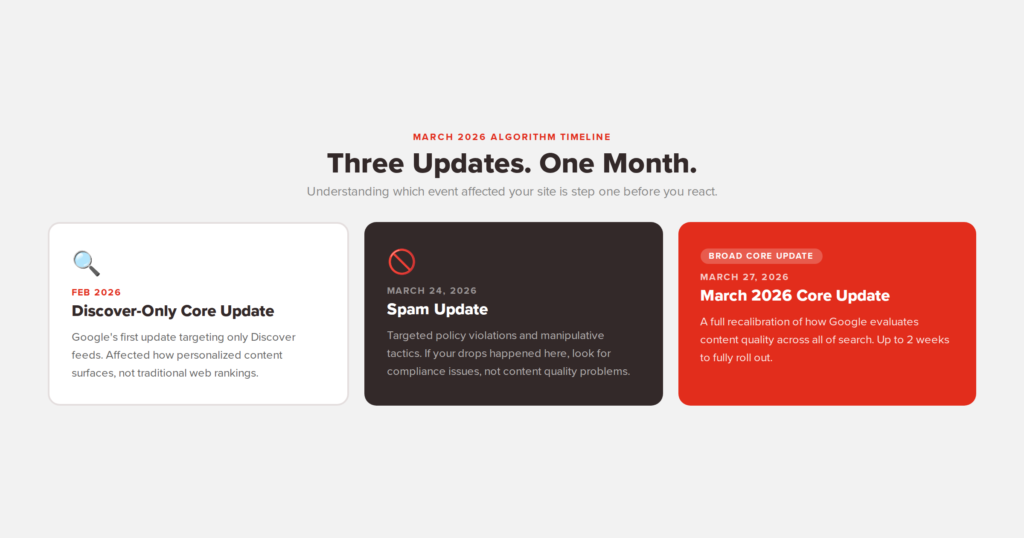
The March 2026 core update didn’t arrive in isolation. Before it rolled out, Google wrapped up a spam update on March 24 and had already completed a Discover-focused core update in February. That’s a notable cluster of activity.
Here’s why that matters for how you interpret your data. If your traffic or rankings shifted in the past few weeks, you need to figure out which event caused it before you react. A spam update penalizes specific tactics. A Discover update affects how content surfaces in personalized feeds. A broad core update changes how Google values content quality across all of search.
The fix for each is different, so diagnosing correctly is step one.
What to Do If Your Rankings Dropped
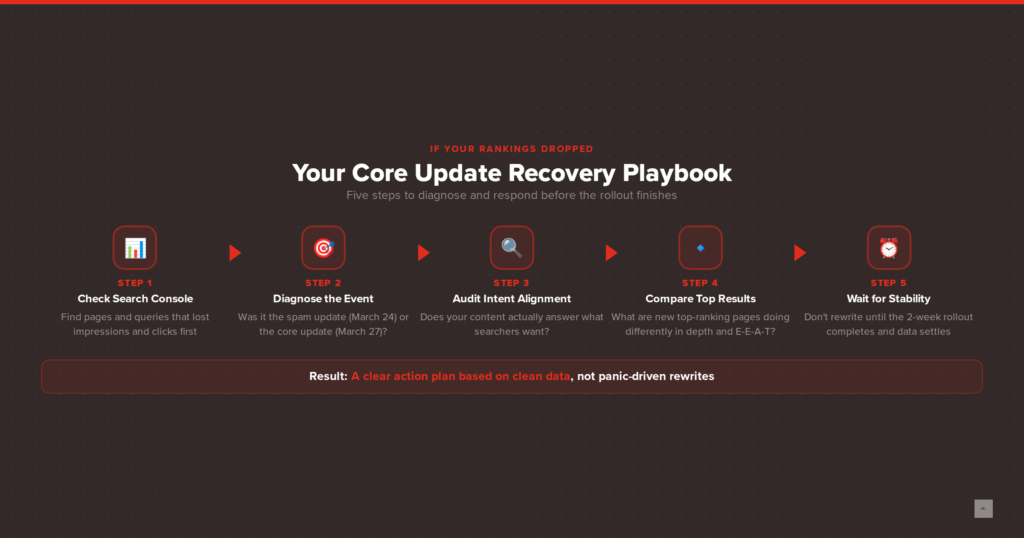
The first thing to understand about a core update drop is that it probably isn’t a penalty. Google is clear that core updates don’t penalize sites; they re-evaluate them. That means you likely aren’t in violation of anything. Instead, Google is saying: other content is now a better answer for these queries.
Here’s how to approach it:
- Check Google Search Console for the pages and queries that lost the most impressions and clicks. This tells you exactly where the update affected you.
- Review the pages that dropped for intent alignment. Does the content actually answer what someone searching for that keyword wants? Mismatched intent is the most common culprit.
- Compare your affected pages to the new top-ranking results. What are they doing differently in terms of depth, format, E-E-A-T signals, and comprehensiveness?
- Don’t start rewriting everything while the rollout is still in progress. Rankings will continue to shift for up to two weeks. Wait for things to stabilize before drawing conclusions.
- If your drops coincide with the March 24 spam update instead, look for potential policy issues rather than content quality problems.
What Google Is Rewarding in 2026
Core updates consistently reward the same things, and the March 2026 update is no different. What’s changed is how clearly the signals align across both traditional search and AI-powered results.
The sites holding steady through this update tend to share a few characteristics. Their content is specific and takes a clear point of view. Their authors have demonstrated expertise in the subject matter. Their link profiles are earned from genuinely relevant sources. And their pages are built for the reader first, not for a keyword formula.
On the flip side, the sites taking the biggest hits right now are typically those relying on high-volume AI-generated content without editorial oversight, thin pages built around keyword stuffing, and link profiles assembled from directories and purchased placements.
None of that is new. What is new is how fast Google’s systems can now identify it.
What Strong SEO Looks Like When Core Updates Roll Through
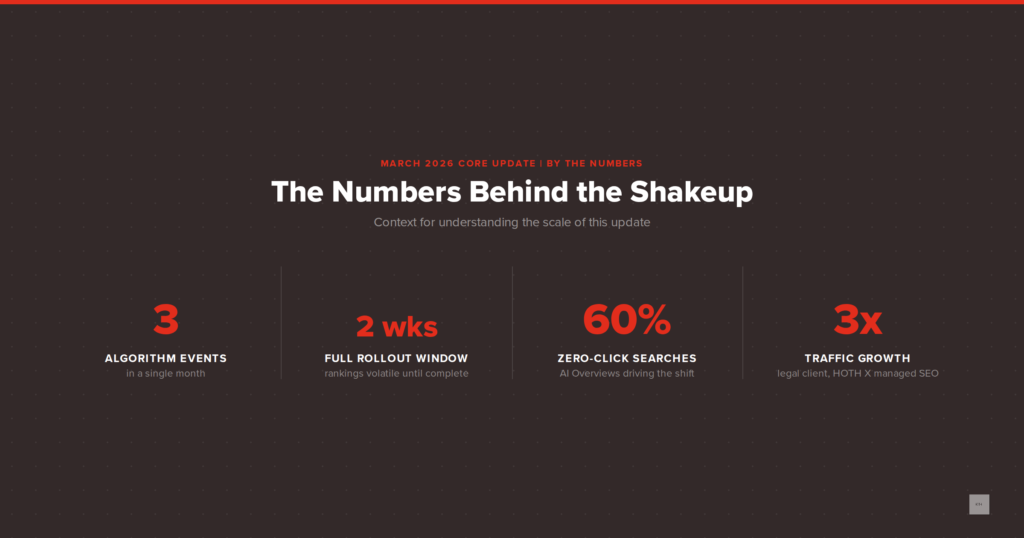
Clients who hold steady through algorithm turbulence like this share a common foundation: consistent content strategy and a clean, earned link profile. Core updates tend to reward exactly that combination.
We’ve seen this play out across verticals. One legal client using HOTH X managed SEO tripled their organic traffic within 12 months, driven by structured content and targeted link building. When updates like this one roll through, that kind of foundation holds.
You can see what that looks like in practice across different industries at The HOTH case studies page.
Core Updates and AI Search Visibility
It’s worth zooming out for a moment. In 2026, Google’s core updates don’t just affect your traditional blue-link rankings. The same content signals that Google evaluates for web search are increasingly what determines whether your content gets surfaced in AI Overviews, cited by ChatGPT, or referenced in Perplexity.
Original, authoritative, well-structured content performs across all of these surfaces. That alignment between classic SEO quality signals and AI visibility is actually good news: you don’t need two separate strategies.
If you’re thinking about how to build visibility in AI-driven search alongside traditional rankings, our AI Discover service is built specifically around the signals that influence how AI models discover and surface your brand.
What to Watch for as This Rollout Completes
The March 2026 core update will take up to two weeks to fully roll out. During that window, you’ll likely see continued ranking volatility as sites move up and down before things stabilize. Here’s what to do in the meantime:
- Watch Google Search Console for impression and click changes, not just rankings. Those give you a clearer signal.
- Don’t make major content changes while the update is still rolling out. You won’t be able to isolate cause and effect until things settle.
- If you see drops, audit your most affected pages for intent alignment and content depth before anything else.
- Check your spam update exposure separately. If your drops coincided with the March 24 spam update, the issue may be a policy violation rather than a quality issue.
- Keep an eye on your competitors in the SERPs. If the same domains are consistently outranking you now, understand what they’re doing differently.
Once the dust settles, you’ll have much cleaner data to work with.
The Bottom Line
The March 2026 core update is Google doing what it always does: raising the bar for what counts as high-quality, relevant content. The sites built on a foundation of genuine expertise, original content, and clean technical performance don’t need to panic. The sites relying on volume, shortcuts, or thin AI output have more work ahead of them.
If you’re not sure where your site stands, the best time to get clarity is right now, before another update rolls through and makes recovery more complicated.
The HOTH’s team can take a look at your current SEO health, identify what this update likely affected, and build a plan that puts you in a stronger position for whatever comes next. Schedule a consultation here.
Leave a comment