

Parasite SEO is the practice of publishing your content on someone else’s high-authority domain so it ranks on their signals instead of yours. Google’s site reputation policy targets exactly this, and the August 2026 spam update plus an August 28 policy rewrite have made the rules more specific, not looser. Outside the European Economic Area, manual actions still demote the offending section of a site. The durable alternative is earning editorial placements that send authority to your own domain.
Two things happened in the last week of August that put parasite SEO back at the top of every SEO group chat. First, Google finished rolling out a spam update that moved rankings harder than a typical one. Second, Google announced it would stop applying site reputation abuse penalties for searchers in the European Economic Area, and rewrote the policy in the process.
Some people read that second announcement as a green light. It isn’t. If you sell to customers in the United States, or anywhere else outside the EEA, nothing about the enforcement you face has softened. What did change is that Google published, for the first time, the specific criteria its reviewers use to decide whether hosted content is legitimate or parasitic.
This post walks through what the update did, what the rewritten policy says, why the EEA change doesn’t help most businesses, and how to get the upside of high-authority placements without renting a spot on someone else’s domain.
What is parasite SEO, and why is it back in the conversation?
Parasite SEO means publishing pages on an established third-party site (a news publisher, a university, a big brand) specifically so those pages inherit the host’s ranking strength. Google calls the abusive version site reputation abuse. It’s back in the conversation because Google shipped a spam update in mid-August 2026 and then split its enforcement by searcher location on August 30.
The name is blunt for a reason. A parasite page feeds on the host. A coupon subdirectory on a metro newspaper, a “best casino sites” article on a medical site, a CBD roundup tucked into a business publication with no author and no path from the homepage: these pages don’t rank because they’re good. They rank because Google presumes a new page on a strong domain is about as trustworthy as the rest of the domain.
Google introduced the site reputation policy alongside the March 2024 core update and started enforcing it that May. We covered the launch at the time. Since then it has been enforced mostly through manual actions: a human reviewer confirms the violation, and the affected section of the site drops out of results while the rest of the site is left alone.
For two years the policy text was short, and the examples list did most of the explaining. That changed on August 28, 2026. The new version is roughly ten times longer, adds a formal review framework, and, for the EEA only, swaps demotion for a quieter technical remedy. All of that landed a week after a spam update finished rolling out, so the two events got tangled together in coverage. They’re related in topic but separate in mechanism, and it’s worth keeping them apart.
What happened in the August 2026 spam update?
Google’s August 2026 spam update ran from August 18 at 9:27 a.m. Pacific to August 21 at 1:49 a.m. Pacific, a little under three days, and applied globally in all languages. Google called it a normal spam update and did not name a target tactic. Third-party ranking data showed the volatility was well above baseline.
The official record is on the Google Search Status Dashboard, which logs the rollout window and describes it as a spam update that applies globally and to all languages. That’s the whole statement. Google didn’t say it was going after links, hosted content, or AI-generated pages, and it didn’t publish a share of affected queries.
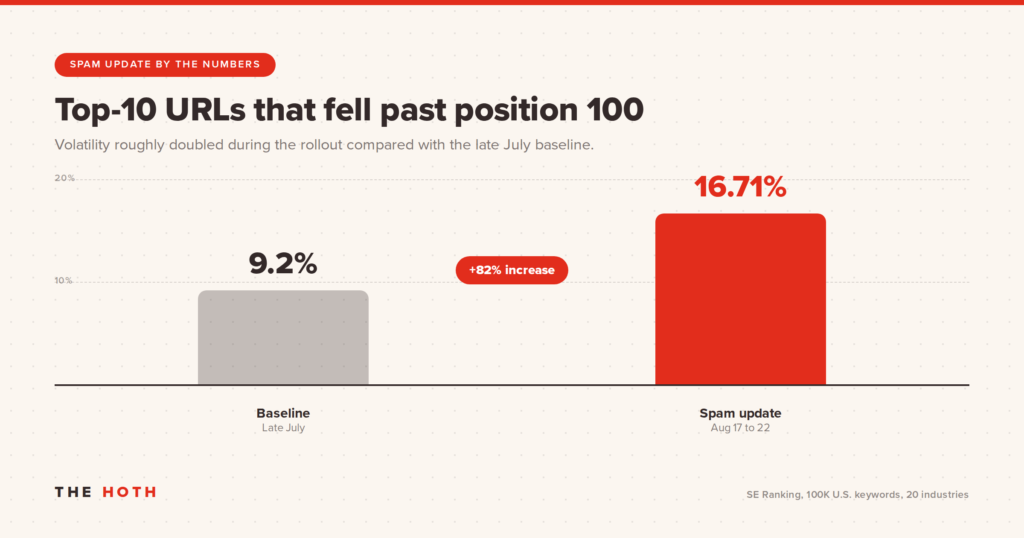
What we do have is ranking data. SE Ranking tracked 100,000 U.S. keywords across 20 industries and compared August 17 to August 22 against a quiet five-day window in late July. Search Engine Land reported the findings: 16.71% of URLs that had been in the top 10 fell past position 100 during the update, versus 9.2% in the baseline period. That’s an 82% jump in the rate at which top-10 pages vanished from the top 100. Every one of the 20 industries saw top-10 volatility above 74%, with fashion and beauty at the high end and real estate and healthcare among the steadiest.
Here is the honest caveat. SE Ranking did not analyze which kinds of pages lost, so nobody can say from that data that parasite pages were the ones wiped out. What the data does show is that this was a larger-than-usual cleanup, and Google’s spam policies (site reputation included) are the list of things a cleanup enforces. If your traffic dropped in that window and you have a hosted-content arrangement anywhere in your strategy, that’s the first place to look.
What does Google’s site reputation policy cover now?
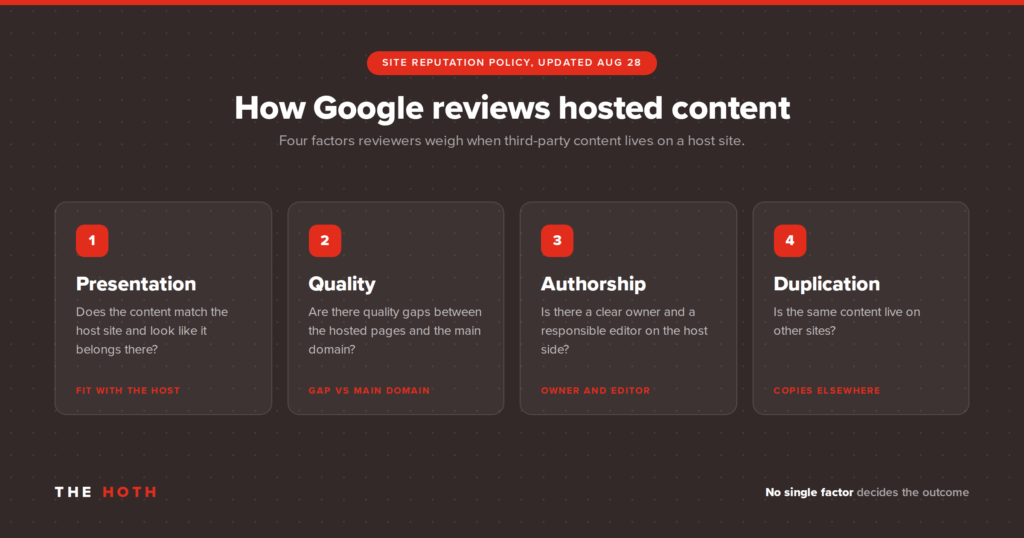
The rewritten policy applies when third-party content is published on a host site mainly because of the host’s established ranking signals. Third-party content on its own is fine. Google now lists four objective factors its reviewers weigh: presentation, quality, authorship, and whether the content is duplicated across other sites. No single factor decides the outcome.
The full text lives in Google’s spam policies documentation, which was last updated August 28, 2026. A few things stand out compared with the older version.
First, Google defines third-party content broadly. It includes content from users of the site, freelancers, white-label services, and anyone not directly employed by the host. That definition catches a lot of normal publishing, which is why the next sentence matters: having third-party content is not a violation by itself. It only becomes one when the content is on the site mainly to borrow ranking signals.
Second, Google trimmed the examples and added a disclaimer that the list isn’t exhaustive and that there are other instances where it won’t act. The two remaining “inconsistent” examples are an educational site hosting a syndicated sponsored review of payday loans, and a medical site hosting a low-quality third-party casino page that isn’t integrated with the rest of the site.
Third, and this is the part that will age well, Google spelled out how a human review works.
The four factors Google reviewers look at
When Google flags a portion of a site, its stated goal is to figure out whether the content has enough input, editorial oversight, or contribution from the host to be considered fully integrated with the main site. The review considers four factors:
- Presentation. Do the design, formatting, typography, and UX of the content match the host domain, or does it look like it was dropped in from somewhere else?
- Quality. Are there quality problems on these pages that don’t show up on the rest of the domain?
- Authorship. Is there a clear statement of who owns or is responsible for the content, and is there anything that contradicts it?
- Duplication. Does identical or near-identical content appear on multiple other sites?
Google is explicit that none of these is necessary or sufficient on its own. Reviewers can also consider outside evidence, such as the pages being sold as part of a third-party ranking package. That last clause is aimed squarely at the sponsored-post marketplaces that built a business on parasite placements.
Google also published three worked examples. A publisher’s coupon section run with a specialist partner is unlikely to draw action if it’s disclosed, curated, cross-referenced in the publisher’s own editorial, navigable from the homepage, and has a working contact for problems. A CBD affiliate article on a business publication with no author, no editor, no disclosure, no navigation path, and content copied from a marketplace is likely to draw action outside the EEA. And a news site’s new cooking section written by a freelancer who also writes elsewhere is unlikely to draw action, as long as the host brands it, takes editorial responsibility, names the author, and the selection of content is specific to that site.
What Google says is not a violation
The policy keeps a list of things that are fine: wire services and press release sites, syndicated news between publications, forums and comment sections, columns and opinion pieces and other editorial work, native advertising meant to reach that publication’s readers rather than to rank, and affiliate links or ad units used throughout a page with the links qualified correctly.
Read that list against the four factors and a pattern emerges. Google is not against paid or third-party content. It’s against content that exists on a domain only to inherit that domain’s trust, and it now judges that by whether the host acts like an owner.
Why is the EEA carve-out not a loophole?
As of August 30, 2026, a site reputation manual action no longer demotes content in results shown to searchers inside the EEA. Instead, Google may categorize the affected section as separate from the main domain so it has to rank on its own merits. Outside the EEA, the manual action works exactly as before. For a business selling in the U.S., nothing has changed.
Google explained the change in an August 28 Search Central blog post and framed it as the result of discussions with the European Commission. The company said its European users are just as frustrated by parasite SEO and that it stands by the policy. The wording is not that of a company backing away from enforcement.
Here’s what the split looks like in practice, according to the policy page:
- Outside the EEA: if a portion of a site is found out of line with the policy, the relevant pages may receive a manual action that affects results shown to users outside the EEA.
- Inside the EEA: the same pages may be categorized as separate from the main domain, but won’t be subject to the impact of a manual action. The different parts of the site then rank independently of each other, so casino content competes with other casino content rather than borrowing a newspaper’s authority.
- Everywhere: Search Console still notifies the site owner, reconsideration requests still work, and eligible EEA sites can take disputes to mediation after a reconsideration request.
Notice what the EEA remedy does. Separation removes the presumption that new pages on a domain match the quality of the rest of the domain. That presumption is the entire mechanism parasite SEO runs on. Even in the one region where demotion is off the table, the thing that made the tactic work is what Google takes away.
And for a U.S. business, or any business whose customers search from outside the EEA, the carve-out simply doesn’t apply. Google’s FAQ on the policy page says a manual action outside the EEA isn’t used as a signal inside it, and vice versa. The two regions are now walled off from each other. If your revenue comes from American searchers, you are in the region where the penalty still lands.
How do you tell parasite SEO from a legitimate editorial placement?
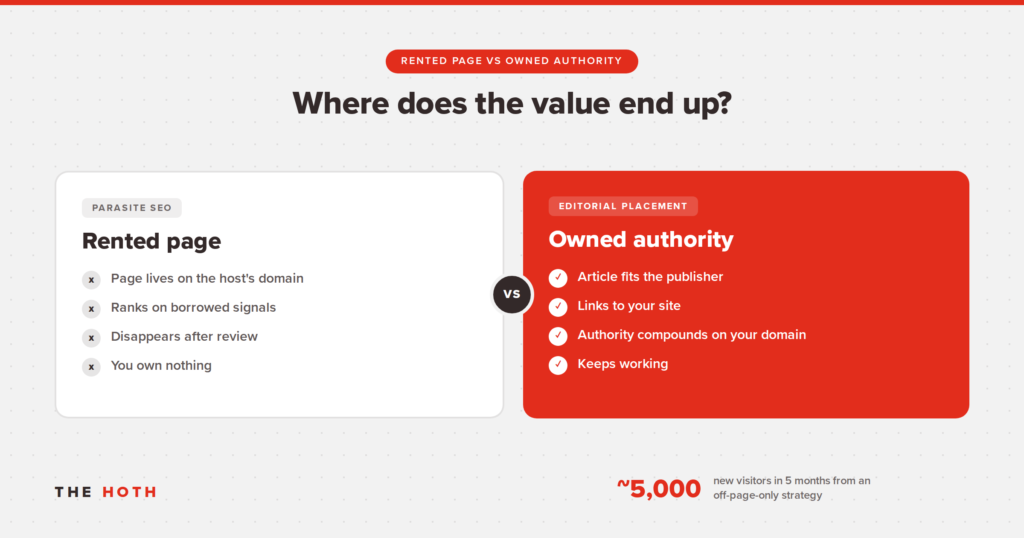
The difference is where the authority ends up. Parasite SEO rents a page on someone else’s domain and tries to rank that page. A legitimate editorial placement earns coverage on a high-authority site that points back to your own domain, so your site is the asset that gets stronger. The first approach depends on Google not noticing. The second gets better the more Google notices.
It helps to be concrete, because “publishing on high-DR sites” describes both tactics and the outcomes couldn’t be more different.
A parasite play works like this. You buy a page on a DR 70 publisher. The page targets a money keyword, the copy is thin, the byline is missing, nothing on the publisher’s site links to it, and the same article is quietly live on three other sites. It ranks for a while on the host’s signals. When the host gets reviewed, the section is demoted (outside the EEA) or split off to rank on its own (inside it). Either way the page dies, and you own nothing. You didn’t build authority. You borrowed it, and the loan got called.
An editorial placement works differently. A real article runs on a real news site, written to fit that publication, with a byline and a place in the site’s structure, and it references your business with a link. The article isn’t trying to rank for your keyword. Your site is. The link, the mention, and the association with a trusted publisher are signals that accumulate on your domain, and they keep working after the article ages off the publisher’s front page.
We see this compound in client data. A stationery and paper goods brand came to us with an established site and stalled traffic. There was no on-page rebuild and no content overhaul. The work was entirely off-page: Earned Media placements for brand mentions at scale, Exclusive Media Links on high-DR editorial sites, Link Outreach to real publishers, and link insertions into already-indexed content. Over five months, the site added nearly 5,000 new organic visitors, and the growth was steady month over month rather than a spike tied to a single placement. None of that authority lives on someone else’s domain. It lives on the client’s.
That’s the distinction the four factors are built to detect. Integrated, authored, non-duplicated editorial content that serves the publisher’s readers passes review. A rented page that only exists to rank fails it. If you want the upside of a strong domain, the sustainable way to get it is to have the strong domain vouch for yours.
What should you do if you’ve been relying on hosted content?
Audit every place your content lives on a domain you don’t control, score each one against Google’s four factors, check Search Console for a site reputation manual action, and shift budget from rented pages toward placements that send links and mentions to your own site. Do this now, while the August update’s before-and-after data is still fresh in your analytics.
Here is a practical sequence you can run this month.
- Inventory your off-domain pages. List every article, subfolder, or profile you’ve paid for or arranged on a third-party site that targets a keyword you care about. Include sponsored posts, guest posts on marketplaces, and any white-label or partner sections.
- Score each one against the four factors. Does it look like the host site? Is the quality on par with the host? Is there a named author and a responsible editor? Is the same content live anywhere else? Two or more red flags means you should assume Google will see it the way you do.
- Check Search Console on the host side if you can. If you have access to the publisher’s property, look at the Manual actions report. If you don’t, ask the publisher directly. A site reputation action on their end tells you your page is already in trouble outside the EEA.
- Compare traffic across August 17 and August 22. That window brackets the spam update. If a hosted page lost rankings there, note it, because you now have a dated, defensible reason to stop paying for it.
- Bring the useful content home. If a hosted article is good, republish an expanded version on your own site with a canonical tag pointing to your version, and ask the host to link to it. You keep the content and convert a liability into a link.
- Reallocate the budget. Money that was buying rented rankings should buy editorial placements, digital PR, and outreach that point authority at your domain. The spend is comparable. The asset you end up owning is not.
One more note for publishers rather than advertisers: if you host partner content, the worked examples in the policy are a checklist. Disclose the commercial relationship, name who is editorially responsible, integrate the section into your navigation, curate the content for your audience, and give readers a way to report problems. Those steps are what separate the coupon section Google says it won’t act on from the CBD article it says it will.
How The HOTH builds authority on high-DR sites without the parasite risk
The HOTH’s Exclusive Media Links place editorial articles about your business on vetted U.S. news sites, with the link and the authority flowing back to your own domain. Paired with Digital PR and Earned Media, that builds the citation density Google and AI search engines use to decide who to trust, without relying on a rented page that a manual action can remove.
Exclusive Media Links are the direct answer to the question this whole post has been circling: how do you get the benefit of a DR 60+ news domain without publishing a page that exists only to rank there? Our team writes an evergreen editorial piece, 500 to 750+ words depending on tier, and places it on a vetted U.S. news site with real organic traffic. The article fits the publication. The contextual dofollow link points to your site. The authority compounds on your domain, month after month, and it’s the same kind of trusted-source signal that AI Overviews and language models weigh when they decide which brands to cite.
For broader coverage, Digital PR earns journalist-driven mentions in mid- to high-authority outlets, with a natural mix of followed and unfollowed links that looks like what it is: press. And Earned Media automates brand mentions across editorial media at a scale that a single placement can’t match. Together, those three are the stack that drove the stationery brand’s five-month climb, and they’re the same stack we’d recommend to anyone unwinding a hosted-content strategy after August.
Frequently asked questions
Is parasite SEO illegal or just against Google’s policies?
It’s a policy matter, not a legal one. Publishing on someone else’s site is legal. Publishing there mainly to inherit the host’s ranking signals is what Google’s site reputation policy targets, and the consequence is a manual action or, in the EEA, separation from the main domain.
Did the August 2026 spam update specifically target parasite SEO?
Google didn’t say so. The Status Dashboard describes it as a spam update that applies globally and to all languages, with no named tactic. SE Ranking’s data shows unusually high volatility but didn’t classify which page types lost. The safe assumption is that any spam policy, including site reputation, is fair game in a spam update.
If the EEA no longer applies manual actions, can I run parasite pages aimed at European searchers?
Google may still categorize the section as separate from the host domain, which removes the borrowed authority the tactic depends on. And the same pages remain subject to manual actions for every searcher outside the EEA. You’d be building on a foundation Google has said it will pull out from under you.
Are guest posts and sponsored articles now banned?
No. Google’s policy lists editorial work, native advertising aimed at the publication’s readers, and properly qualified affiliate links as things it doesn’t act on. The test is integration and intent: content written for the host’s audience, with clear authorship and editorial oversight, is on the right side of the line. Content placed only to rank is not.
How is an Exclusive Media Link different from a parasite placement?
The article is written to fit the publisher, has a byline, lives in the publisher’s editorial structure, and isn’t trying to rank for your keyword. Its job is to send a link and a trusted mention to your site. Your domain gains the authority, which is the opposite of a parasite page, where the authority stays with the host and disappears the moment the host is reviewed.
The takeaway
Parasite SEO was always a bet that Google wouldn’t look closely. As of August 28, Google has published exactly what it looks for when it does. Outside the EEA, the penalty is unchanged. Inside it, the mechanism that made the tactic work is what gets removed. Either way, the page you rented is not an asset.
The alternative isn’t to avoid high-authority sites. It’s to show up on them the way a real business does: in editorial content, with a byline, pointing back to a domain you own. If you want to see how Exclusive Media Links would fit your site and your market, our team can walk you through the tiers and the placements available in your region.
Leave a comment