
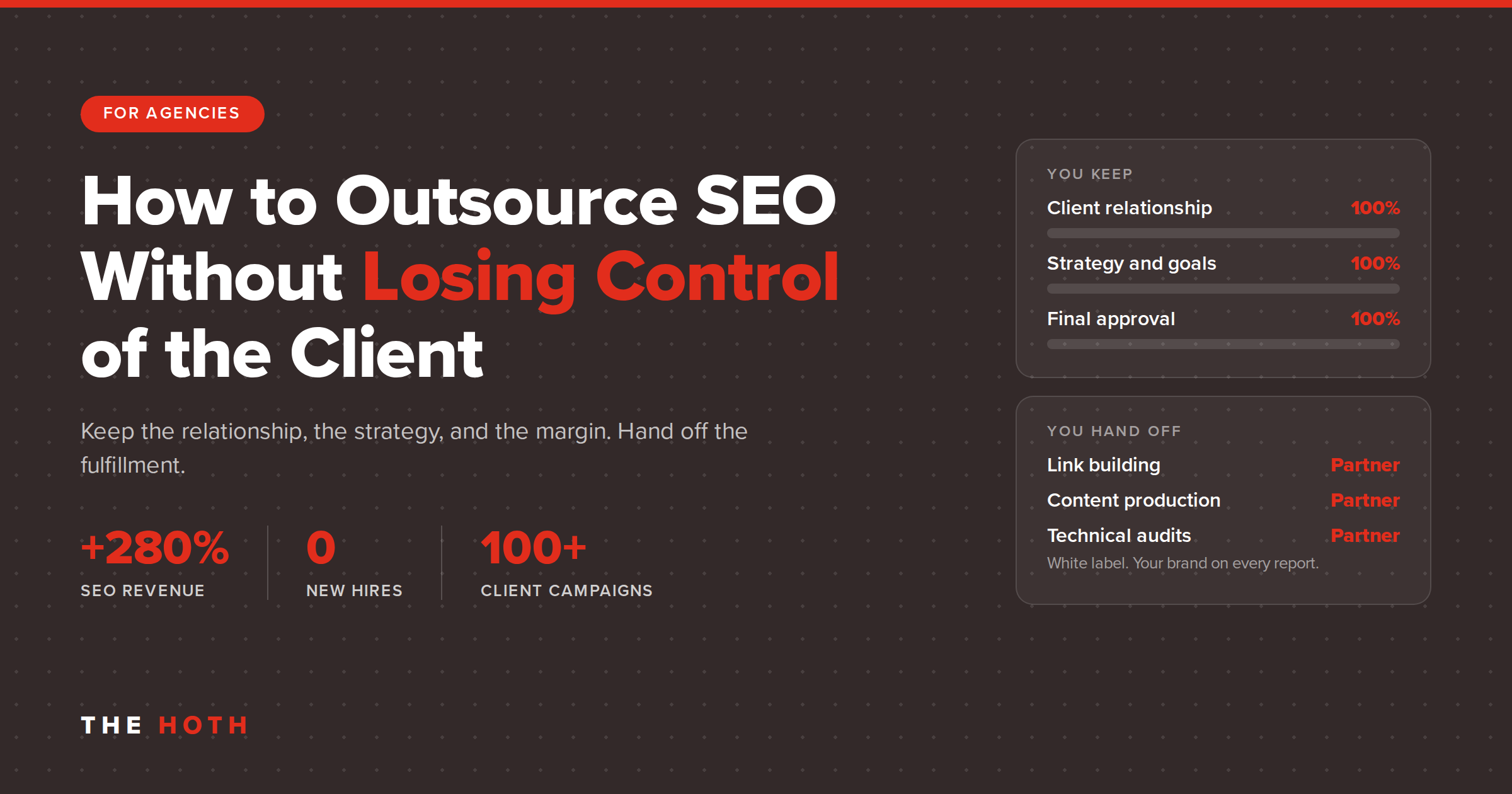

Outsourcing SEO means paying a specialist partner to handle fulfillment (link building, content, technical work, campaign management) while your agency keeps the client relationship, the strategy, and the reporting under its own name. You stay in control by deciding up front what never leaves your building, vetting the partner against the same criteria Google publishes for hiring an SEO, putting turnaround and quality terms in writing, and owning the reporting layer the client sees.
A client emails on a Tuesday afternoon. They want SEO added to the retainer, and they want it from you, because they trust you and do not want to manage another vendor.
You have three options. Hire an SEO team, which means salaries, tools, and six months before anyone is productive. Turn the work away, and watch the client find an agency that says yes. Or outsource the fulfillment and keep the account.
Most agencies land on the third option and then worry about the same thing: what happens to the relationship when someone else is doing the work? That worry is reasonable. It is also solvable, and this guide is about the solving. It covers whether you should outsource at all, what to keep in house no matter what, how to vet a white label partner, what the agreement needs to say, how the margin math works, and how to add AI visibility to the stack without rebuilding your service. If you want the product-level detail on what a reseller program includes, our complete guide to white label SEO for agencies covers that. This post is about the decision.
Should your agency outsource SEO at all?
Outsource SEO fulfillment when clients are asking for it, when SEO is not the thing that wins you business on its own, and when you do not have the people or the link infrastructure to deliver it well. Keep it in house only if SEO is your core product and you already have a team that can build links, produce content, and run campaigns at the volume your clients need.
The honest test is not “could we do this ourselves.” Most agencies could, given enough time and money. The test is whether building fulfillment is a better use of your capital than buying it.
Start with the cost of the alternative. The U.S. Bureau of Labor Statistics puts the median pay for market research analysts and marketing specialists (the occupational category that includes search marketing strategists) at $78,760 a year as of May 2025. That is one mid-level person, before benefits, before the tool stack, and before the year it takes to build relationships with the publishers who supply links. A functioning SEO department is two or three of those people plus a manager, and the link infrastructure does not come with them.
Now look at what happens when an agency skips that build. One digital marketing agency in our white label program grew its SEO revenue by 280% over 24 months while running more than 100 client campaigns. Total new hires to support that growth: zero. Keyword rankings across those campaigns improved by 550% in the same window. The agency sold the work, managed the relationships, and let a fulfillment partner carry the production load.
When does it not make sense? If SEO is the product your agency is known for, if you already employ people who can build links and produce content at quality, and if fulfillment quality is what differentiates you from the agency down the street, keep it. Outsourcing your core competency rarely ends well. For everyone else, the question is not whether to outsource but how to do it without giving up the account.
What should you outsource, and what should you keep in house?
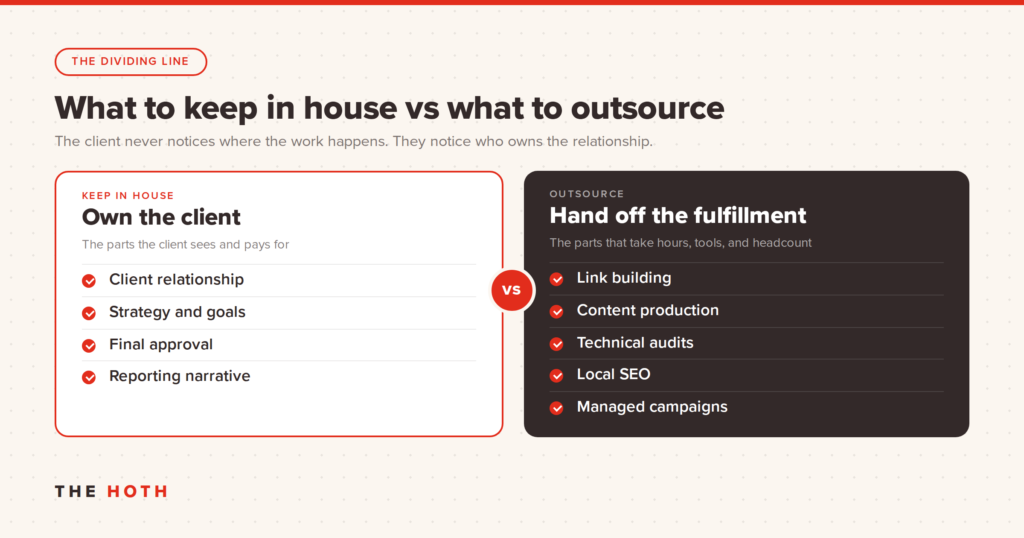
Keep the client relationship, the strategy, goal setting, account management, and final approval in house. Outsource link building, content production, technical audits and fixes, local citation work, and full campaign management. The dividing line is simple: anything the client experiences as “you” stays with you, and anything the client experiences as “results” can come from a partner.
Losing control of the client rarely happens because a partner does bad work. It happens because the agency handed over the parts of the engagement that made the client feel looked after, and had nothing left to offer but a markup.
Keep these in house
- The relationship. Every call, every check-in, every “how are things going” belongs to your account manager. The partner should never have a reason to speak to your client.
- Strategy and goals. You decide what the campaign is for: leads, revenue, a product launch, a market the client wants to enter. The partner executes against that, not the other way around.
- Final approval. Content and link targets go past your eyes before they go live under your name. This takes minutes per month and it is the single most important control you have.
Outsource these
- Link building. This is the hardest thing to build in house because it depends on publisher relationships that take years to develop. It is also the most common thing agencies outsource first. Our guide to outsourcing link building walks through the specifics.
- Content production. Blog posts, service pages, and refreshes at the volume a real campaign needs. You set the brief and the voice; the partner writes.
- Technical audits and fixes. Crawl issues, Core Web Vitals, structured data, and site architecture. Specialists do this faster and catch more.
- Local SEO fulfillment. Citation building, Google Business Profile management, review response. Repetitive, process-heavy, and a poor use of senior time.
- Full campaign management. If you want one invoice and one dashboard rather than a stack of individual orders, a managed program with a dedicated campaign manager handles the whole thing behind the scenes.
If you are not sure where to begin, start with the products your existing clients are already asking for. Our breakdown of the easiest HOTH products for agencies to resell ranks them by how quickly resellers see results.
How do you vet a white label SEO partner?
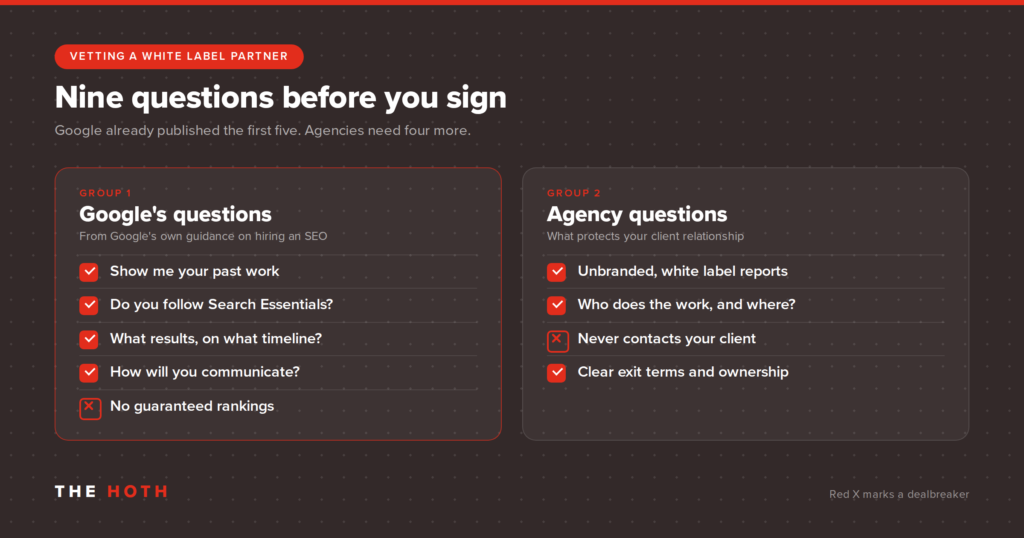
Vet an SEO partner the way Google tells site owners to vet an SEO: ask for examples of past work, confirm they follow Google Search Essentials, ask what results to expect and on what timeline, and walk away from anyone who guarantees rankings. Then add the agency-specific questions: is the reporting unbranded, who does the work, will they ever contact your client, and what happens to the links and content if you leave.
Google publishes its own advice on hiring an SEO, and it is a better vetting checklist than most agencies use. Its questions are the ones you should ask any fulfillment partner: can you show previous work and success stories, do you follow Search Essentials, what results do you expect and in what timeframe, how do you measure success, and how will you communicate changes you make. Google also warns that an SEO who guarantees a number one ranking should be shown the door, and that if a provider asks for Search Console access during an audit, you should grant read access only.
The line from that document that matters most to an agency is this one: you are responsible for the actions of any company you hire. If a partner builds spammy links under your client’s domain, the penalty lands on the client, and the blame lands on you. Vetting is not paperwork. It is the difference between a scalable revenue line and a churned account.
The agency-specific questions
- Is every deliverable unbranded? Reports, dashboards, content files, and email notifications should carry no trace of the partner. Ask to see a sample report before you sign.
- Who does the work? Ask where the writers are, how links are sourced, and whether any of it is subcontracted again. A partner who is vague here is a partner you will have to explain to a client later.
- How are links sourced? You want real sites with real traffic, relevance to the client’s niche, and no private blog networks. Ask for a sample of recent placements and check them yourself.
- Will you ever contact my client? The answer should be no, in writing.
- What happens when I leave? Links should stay live. Content should be owned by you or your client. Client accounts and properties should be in your name from day one.
One more thing Google is explicit about, in its guidance on third-party SEO tools and services: no tool or service is “approved” by Google, none has access to internal ranking data, and predictions from any of them are the provider’s own. If a partner leans on a proprietary score or a “Google-certified” badge to sell you, treat that as a reason to ask harder questions, not fewer.
What should the outsourcing agreement cover?
Put turnaround times, revision rounds, link quality floors, content standards, communication response times, confidentiality, a non-solicit clause, ownership of accounts and deliverables, and exit terms in writing before the first order. The agreement is what turns a vendor into a partner you can put behind a client-facing SLA of your own.
Most agency-partner friction comes from things that were never written down. The client expected a post by the first of the month, the partner’s standard turnaround was ten business days, and nobody had told either party. Write it down.
Service levels
- Turnaround. Days to first draft, days to revised draft, days from link order to placement. Get numbers, and build your client-facing promise with a buffer on top.
- Revisions. How many rounds are included, and what counts as a revision versus a new brief.
- Quality floors. Minimum domain rating or organic traffic for link placements, relevance requirements, word counts and sourcing standards for content, and what happens when a deliverable misses the floor.
- Response time. How fast the partner answers your questions. If your client SLA says 24 hours, your partner SLA needs to say something shorter.
Ownership and protection
- Accounts in your name. Search Console, Analytics, Google Business Profile, and the domain registrar all belong to the client or to you. The partner gets access; the partner never gets ownership.
- Confidentiality and non-solicit. The partner does not disclose the relationship and does not pitch your clients, during the engagement or after it.
- Deliverable ownership. Content is yours on delivery. Links stay live after you leave.
- Tactics. List what is off limits: private blog networks, scaled AI content with no human review, anything that conflicts with Google’s spam policies. Google’s advice to site owners is that a good SEO will explain every change; hold your partner to the same.
Reporting
This is where control is won or lost. The partner should give you a white label dashboard and monthly reports that carry your logo and nobody else’s. You decide what the client sees, when, and with what commentary. Rankings, traffic, links built, content published, and AI citations should all be visible to you on demand, so that when a client asks a question on a Friday afternoon you can answer it without opening a support ticket.
A good habit: never forward a partner report unedited. Add three sentences at the top that connect the numbers to the client’s goals. That is the part the client is paying you for.
How does the margin math work?
You buy fulfillment at wholesale and sell it inside a retainer at retail. Most agencies reselling white label SEO run 40% to 60% gross margins on the fulfillment itself, and the account management time on top is small because the partner is doing the production. Compared to hiring, the math favors outsourcing until you have enough recurring SEO revenue to keep a full team busy.
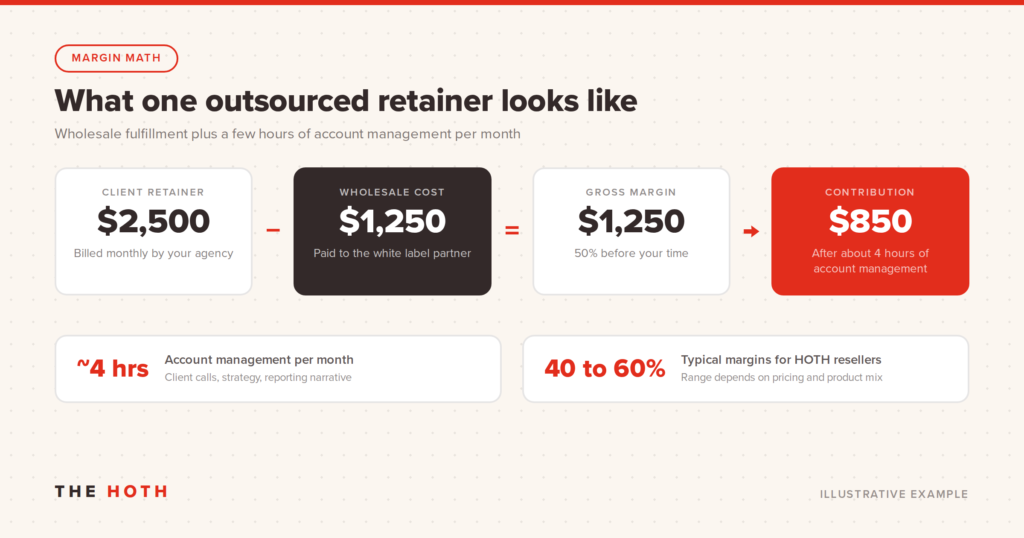
Here is a simple worked example. Treat the numbers as illustrative and plug in your own.
A client signs a $2,500 a month SEO retainer. You order a managed campaign from a white label partner at $1,250 wholesale. Gross margin on fulfillment is $1,250, or 50%. Your account manager spends roughly four hours a month on the account: reviewing deliverables, framing the report, and one call. Even at a fully loaded $100 an hour, that is $400, leaving $850 in contribution from one client who did not require you to hire anyone.
Compare that to the in-house version. Using the BLS median of $78,760 for a single marketing specialist, a two-person SEO team with a manager is a $250,000 to $300,000 annual commitment once benefits and tools are included, and you carry it whether you have five SEO clients or fifty. The HOTH white label SEO program exists for exactly this gap: wholesale pricing, bulk buyer bonuses, and unbranded reporting, so the margin lives with you and the fixed cost does not.
The place agencies get the math wrong is pricing fulfillment as a pass-through. If you sell SEO at wholesale plus 15%, you are not building a service line, you are running a procurement desk. Price the outcome and the expertise, not the deliverable.
How do you add AI visibility to the outsourced stack?
Add AI visibility by reselling the work that earns trusted mentions: earned media, digital PR, and helpful, well-structured content. Google says optimizing for its generative AI features is still SEO, that tactics like llms.txt files and content “chunking” are unnecessary, and that any AEO or GEO service should be checked against its official guidance. The same partner that does your SEO fulfillment should be able to do this without you rebuilding the offer.
Clients are now asking a second question alongside “why aren’t we ranking”: why does ChatGPT recommend our competitor and not us? If your outsourced stack cannot answer that, the client will find someone who can.
The good news is that the work overlaps almost entirely with what you are already buying. Google’s guide to optimizing for generative AI features says its AI Overviews and AI Mode are grounded in the same core ranking systems as regular Search, that unique non-commodity content matters more than any other factor, and that a list of popular “hacks” (special AI text files, breaking content into fragments, rewriting for machines, chasing inauthentic mentions) can be ignored. In Google’s framing, optimizing for generative AI search is still SEO.
That gives you a clean vetting rule for the AI side of the partnership. Any partner selling an AEO or GEO product should be able to explain what they do in terms of content quality, authoritative mentions, and technical accessibility. If they cannot, Google’s own advice is to check their claims against its published guidance and make your own decision. On the fulfillment side, our AI Discover managed program and Earned Media placements are the products resellers add most often, because they produce the trusted third-party mentions that both Google and the AI models reward.
Practically, this means adding one line to your reporting: where the client is being cited in AI answers, and how that is changing month over month. It is the newest question clients ask, and being the agency that already has the answer is a retention tool on its own.
A 30-day plan to outsource SEO without losing the client
In the first month: audit which clients already want SEO, pick one partner and run a single pilot campaign, set your internal approval workflow, build a client-facing SLA with buffer, price the retainer on value rather than cost-plus, and add AI citations to the first report you send.
- Week 1: find the demand. List every client who has asked about SEO, rankings, or AI visibility in the past six months. That is your pilot pool. Pick the one with the clearest goal and the most patience.
- Week 1: shortlist two partners. Run both through Google’s hiring questions and the agency questions above. Ask each for a sample unbranded report and three recent link placements. Choose one.
- Week 2: sign the agreement. Turnaround, revisions, quality floors, response time, non-solicit, ownership, exit terms. Do not skip this because the pilot is small.
- Week 2: set up the accounts. Search Console, Analytics, and Business Profile in the client’s or your name, with the partner added as a user. Read-only during any audit phase.
- Week 3: launch the pilot. One managed campaign or a small bundle of links and content. Route every deliverable through your approval step before it goes live.
- Week 3: write the client SLA. Take the partner’s turnaround numbers, add buffer, and put them in the client’s statement of work.
- Week 4: send the first report. Partner data, your logo, your three sentences at the top, and one line on AI citations. Book the next review call before you hang up.
- Week 4: price the next one. With the pilot running, you know your real hours. Set retainer pricing on value delivered, not wholesale plus a markup, and take the offer to the rest of the pilot pool.
Where The HOTH fits
Everything in this post is the way our white label program is built to work. Resellers get wholesale pricing on link building, content, local SEO, technical work, and Managed SEO, a dashboard with unbranded reporting, a campaign manager the client never meets, and the ability to add AI visibility from the same account. The agency that grew SEO revenue 280% without a single hire did it inside that program, and they are not unusual.
You keep the client, the strategy, and the story. We do the part that is expensive to build.
Frequently asked questions about outsourcing SEO
Will the client know I am outsourcing?
Not if the partner is a true white label provider. Reports, dashboards, and deliverables are unbranded, and the partner never contacts your client. Whether you disclose the arrangement is a business decision; many agencies describe it as “our fulfillment team” and leave it there.
How much should I mark up outsourced SEO?
Most HOTH resellers run 40% to 60% gross margins on fulfillment. The better question is what the outcome is worth to the client. Price the retainer on results and expertise, then check that the margin clears your account management time with room to spare.
What if the partner does something that hurts the client’s site?
Google is clear that the site owner is responsible for the actions of any SEO they hire, which in practice means you are. That is why the agreement lists banned tactics, why every deliverable goes through your approval, and why you should check a partner’s recent link placements before signing. Prevention is cheaper than recovery.
Does outsourcing SEO still make sense now that AI search is growing?
More than before. Clients now expect an answer on AI visibility as well as rankings, and the work that earns AI citations (earned media, digital PR, helpful content) is fulfillment-heavy. A partner who already does that work lets you offer it without adding a second vendor.
The short version
Outsourcing SEO does not cost you the client. Outsourcing the relationship does. Keep strategy, communication, approval, and the reporting narrative in house. Rent link building, content, technical work, and campaign management from a partner you have vetted against Google’s own criteria and bound with a written agreement. Price on value, report with your own voice, and add AI visibility before your clients ask for it twice.
If you want to map out what an SEO service line would look like for your agency, with your client list and your margin targets, book a call with our team and we will walk through it together.
Leave a comment