

Most content doesn’t fail because it’s badly written. It fails because it’s written for the wrong thing.
A page that’s beautifully crafted but organized for the writer’s logic instead of the reader’s questions won’t rank. A page stuffed with keywords but devoid of real answers won’t get cited by AI tools. A page that does one or the other, but not both, is leaving half its potential on the table.
SEO copywriting in 2026 is about threading all three needles at once: writing that earns Google rankings, satisfies readers, and gets extracted by AI systems as a credible source. The good news is that these goals aren’t as far apart as they seem. The same structural choices that help Google understand your content also help AI tools cite it. The same directness that makes readers trust you makes algorithms trust you.
This guide covers exactly what those choices look like in practice, from how you open a section to how you structure your FAQs to what signals actually build the authority that both search engines and AI platforms are looking for.
What SEO Copywriting Actually Means
SEO copywriting is the practice of producing content that serves both search engine algorithms and real human readers simultaneously. Not one or the other. Both.
That sounds obvious, but the failure mode on each side is common. Write only for algorithms and you get keyword-dense, unreadable content that might have ranked in 2015. Write only for humans without any structural or keyword discipline and you get content that’s pleasant to read but invisible in search.
The craft sits in between: content with a clear keyword focus, an answer-first structure, and the kind of genuine usefulness that earns trust from both people and search algorithms.
In practical terms, that means every piece of SEO copy needs to do four things well: signal its topic clearly to crawlers, answer the searcher’s actual question, demonstrate authority through specificity and depth, and be structured so the most important information is findable in seconds.
The Two-Audience Problem: Google and AI Systems
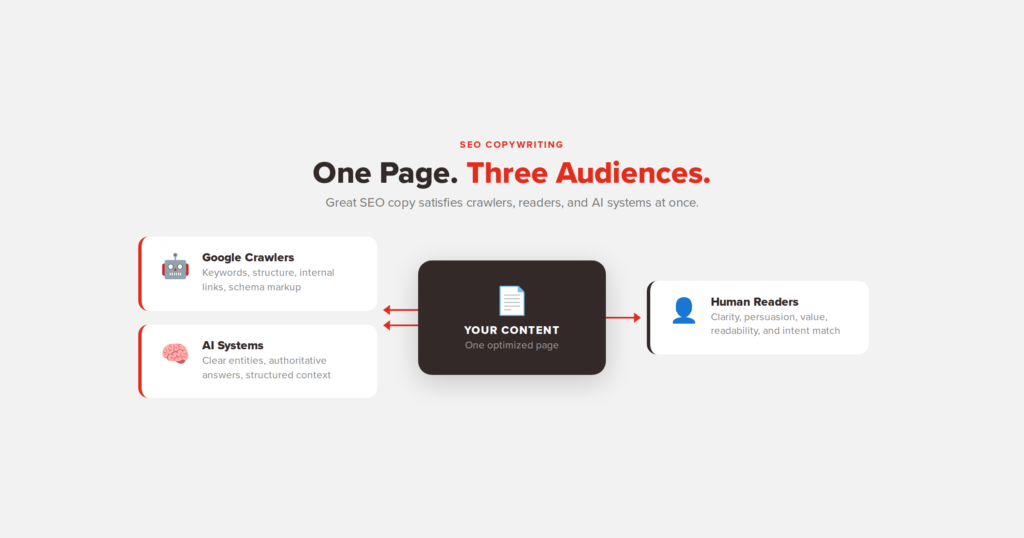
Here’s the structural challenge that makes SEO copywriting harder than it used to be: your content now has two machine readers alongside the human one.
Google’s crawlers have always evaluated your pages. But now AI Overview systems, large language model indexes, and tools like Perplexity and ChatGPT are also reading and evaluating your content to decide whether to surface it in responses. These systems have different mechanics than traditional search crawlers, but they share a lot of the same preferences.
Both reward pages that:
- Lead with the answer rather than burying it
- Use clear heading hierarchies that signal topic structure
- Include named entities and specific data rather than vague generalities
- Demonstrate genuine expertise through depth and detail
- Are organized around questions, not just topics
The practical implication is that optimizing for AI citation isn’t a separate workstream from SEO. It’s a higher standard of the same craft. If your copy already does these things well, you’re already positioned for both. If it doesn’t, neither channel will reward you the way it should.
For the strategy layer on why these signals matter, our post on how managed SEO builds AEO authority covers the full picture. What we’re focusing on here is the writing itself.
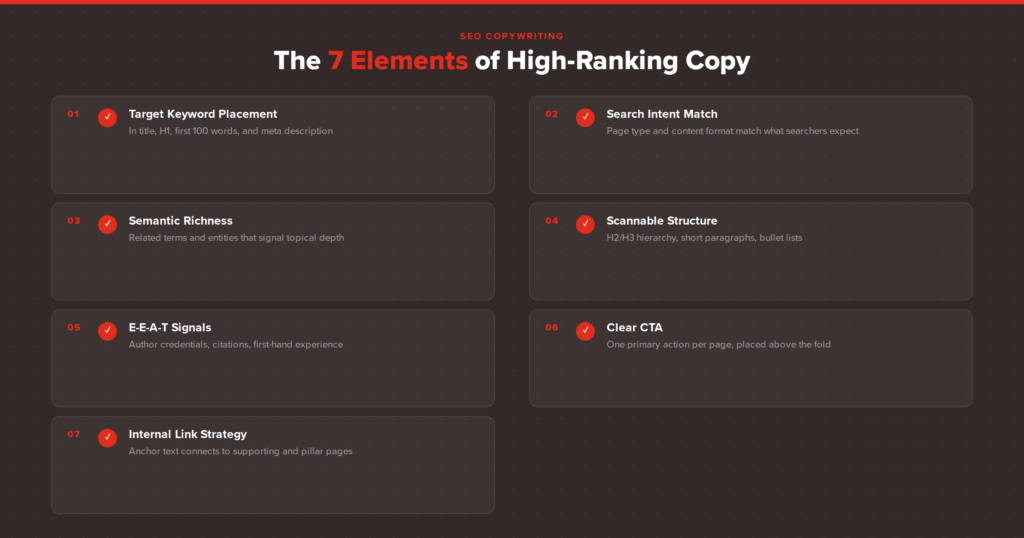
The 7 Elements of SEO Copy That Ranks and Gets Cited
1. Keyword Intent Before Keyword Placement
Every piece of SEO copy starts with a keyword. But the keyword tells you what people are searching. The intent tells you what they actually need when they search it.
Informational intent means someone wants to learn. Commercial intent means they’re comparing options. Transactional intent means they’re ready to act. Your content format, depth, and CTA all need to match the intent, not just contain the keyword.
If someone searches “what is SEO copywriting” they want an explanation. If they search “SEO copywriting service” they want to evaluate providers. Same topic category, completely different pages. Getting intent wrong is the fastest way to rank for something that never converts.
Alongside traditional keyword intent, now map question intent too. What are people asking AI assistants about your topic? Those phrasing patterns, starting with “how,” “what,” “why,” “when,” become your H2 candidates.
2. Heading Structure That Works as a Skeleton
Your headings are the most valuable real estate on your page for both SEO and AI citation. H1 declares the page topic. H2s define the major subtopics. H3s break those into specific questions or details.
A well-structured heading hierarchy lets a crawler, or an AI, understand your entire page without reading the body copy. That’s what enables featured snippets, AI Overview extractions, and the kind of structured citations that show up in conversational AI responses.
The test: cover your body copy and read only your headings. Do they tell a coherent story about the topic? Do they answer the questions your target searcher is asking? If not, your structure needs work before your word choice does.
- One H1 per page containing your primary keyword
- H2s framed as questions or clear subtopics your audience cares about
- H3s for specific details within each H2
- No skipped levels — H1 to H3 without an H2 creates structural gaps crawlers notice
3. The Direct Answer Opener
This is the single most impactful change you can make to existing content. Every section should open with its answer in the first one or two sentences, before any context, history, or caveats.
AI systems pull content that leads with the answer. If your first paragraph after an H2 is background information, the AI moves on. Google’s featured snippet algorithm does the same thing.
Here’s the pattern that works: state the answer directly, then expand with evidence, nuance, and detail. Every H2 section should be able to stand alone as a useful answer to the question its heading poses. If it can’t, the section opener needs a rewrite.
Before: “There are many factors that influence your ability to rank in search engines, and SEO copywriting plays an important role in all of them…”
After: “SEO copywriting improves rankings by signaling topic relevance to crawlers, matching search intent, and building the kind of topical authority that earns links. The key elements are keyword intent, heading structure, direct answers, entity specificity, E-E-A-T signals, FAQs, and internal linking.”
Same topic. One of these gets extracted. The other doesn’t.
4. Entity Specificity
Vague language is the enemy of both rankings and AI citations. AI systems build their understanding of topics from named entities: specific organizations, people, products, data points, and concepts. Content that uses placeholder language gives them nothing to anchor to.
Compare “many companies struggle with SEO” to “most small B2B firms we work with have fewer than 10 referring domains from authoritative sources in their niche.” The second version has entities, specificity, and a claimed point of view. It reads as authoritative because it is.
In practice this means: name your sources, cite real numbers, reference specific tools and products by name, and state your company’s position clearly. Generic hedging doesn’t build trust with readers or algorithms.
This is also how you build topical authority at the domain level. Consistent, specific coverage of a topic over time trains AI systems to associate your site with that subject matter.
5. E-E-A-T Signals Written Into the Copy
E-E-A-T stands for Experience, Expertise, Authoritativeness, and Trustworthiness. These are Google’s quality signals, and they map closely to what AI systems use to evaluate credibility. The difference from old-school SEO is that E-E-A-T now needs to be demonstrated in the copy itself, not just in author bios.
Signals you can write into every piece:
- First-person or first-company experience references: “in our campaigns,” “clients in this vertical typically see”
- Specific data and sources rather than general claims
- Named authors with relevant credentials on bylined content
- Clear statements of what qualifies your perspective on the topic
- Links to credible external sources when citing research
None of this requires turning every paragraph into a credentials statement. It means your content should not read as if it was written by nobody, about nothing specific, for no particular reason. The moment a reader, or an algorithm, can’t tell who wrote something or why they’re qualified, the trust signal disappears.
6. FAQ Sections with Schema Markup
FAQ sections are one of the most reliable paths to featured snippet and AI Overview placement, and they’re consistently underused.
The reason they work is structural. AI tools are query-driven. A well-written FAQ is essentially a pre-formatted set of Q&A pairs ready to be extracted directly. Questions written in natural language, the way people actually ask them, match the phrasing patterns of both voice search and AI prompts.
Keep answers in FAQ sections tight: two to four sentences is usually right. Long FAQ answers dilute the direct-answer signal. And implement FAQ schema markup so search engines can parse the structure, not just the text. Your developer can add this in the page template or via a plugin if you’re on WordPress.
FAQ sections also extend your topical coverage without bloating the main body. Use them to address the long-tail and conversational variants your H2 structure doesn’t cover directly.
7. Internal Links That Build Topical Coverage
Internal linking is the infrastructure that turns individual pieces of content into a topical authority signal at the domain level. Each link you place between related pages tells search engines that your site covers a subject comprehensively, not just partially.
From a copywriting standpoint, this means actively looking for natural link placements as you write, not adding them in a cleanup pass afterward. Reference related guides where they’re genuinely useful to the reader. Link product pages when a service is mentioned. Connect case studies to the topic they illustrate.
Aim for three to five internal links per post, placed where they add genuine value rather than just for the sake of linking. For a deeper look at how internal links contribute to your broader SEO structure, our guide on how to improve domain authority covers the authority-passing mechanics.
A Before and After: What the Difference Looks Like
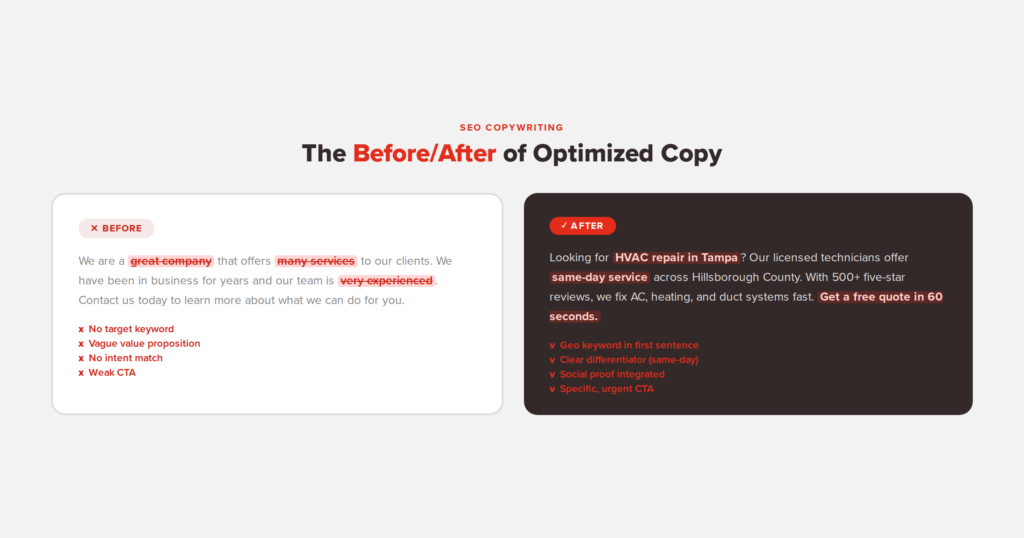
The gap between average SEO copy and copy that performs in 2026 is usually less about word count and more about structure. Here’s a common pattern on service pages:
Before
“At [Company], we offer a wide range of SEO services designed to help your business grow online. Our team of experts has years of experience helping clients achieve their goals. We take a comprehensive approach to search engine optimization that includes keyword research, content creation, link building, and more. Contact us today to learn how we can help.”
This tells a search engine nothing specific. There are no entities, no claims with evidence, no direct answer to any question a potential customer is asking. It could describe any SEO company on the internet.
After
“HOTH X is a fully managed SEO campaign service that handles keyword strategy, content production, link building, and technical optimization as one coordinated effort. Most clients see meaningful ranking movement within 90 days. The service is built for businesses that want SEO handled end-to-end, without managing individual vendors or tools.”
This version names the product, makes a specific claim, and describes who it’s for. A search engine can categorize it. A reader can immediately tell if it’s relevant to them. An AI system has entities and facts to anchor to.
The same principle applies to blog posts, landing pages, and product descriptions. Specific is always better than general. Direct is always better than hedged.
SEO Copywriting Mistakes That Are Still Costing You Rankings
Writing for keyword density
Repeating a keyword 12 times in 800 words doesn’t signal relevance. It signals spam. Write to answer the question. The keyword will appear naturally when you’re covering the topic well. Use semantic variants and related terms rather than forcing exact matches.
Preamble instead of answers
Starting every section with context, history, or definitions before getting to the point is the most common reason content doesn’t get pulled into AI answers or featured snippets. Write the answer first. Expand second.
Ignoring the meta title
Your meta title is the first piece of copy a searcher sees. It should contain your primary keyword, communicate a clear benefit, and stay under 60 characters. A weak title tanks click-through rate regardless of where you rank.
Vague calls to action
“Learn more” and “contact us” are not calls to action. They’re placeholders. Every page should have one primary CTA that tells the reader exactly what to do and what they’ll get. “Book a free strategy call and get a custom SEO roadmap” is a call to action.
Skipping the FAQ
Look at which pages consistently show up in AI Overviews and featured snippets. Almost all of them have structured Q&A content. The FAQ section is not optional anymore. Add it, write it in natural question language, implement the schema, and give yourself a structural advantage over the pages that don’t.
Need SEO Copy That Actually Performs?
Writing copy that earns rankings, satisfies readers, and gets cited by AI tools takes more than a good brief. It takes structural discipline, keyword expertise, and consistent execution across every page on your site.
The HOTH’s web copy service produces SEO-optimized landing pages and service pages built around these principles from the first draft. Our HOTH Blogger service handles long-form blog content with the same standards applied throughout.
For businesses that want content, links, and technical SEO working together as one integrated strategy, HOTH X is our fully managed option. Your campaign manager handles everything, coordinated toward the same ranking and visibility goals.
Want to see what a content strategy built around these principles looks like for your site? Book a free strategy call and we’ll walk you through it.
The Bottom Line
The pages that win in search in 2026 are the ones that take the job seriously on every dimension at once. Keyword intent matched. Heading structure built for crawlers. Sections that lead with answers. Entities named. E-E-A-T demonstrated in the copy. FAQ sections with schema. Internal links placed with intention.
None of these are new ideas. But the standard for execution is higher than it’s ever been, because you’re no longer just competing for a search engine’s attention. You’re competing for a place in the answers that AI systems serve to people who may never click through to your site at all.
Getting the copy right is how you compete in both channels. Start there.
Leave a comment