

Most businesses know they should be showing up in AI search. Almost none of them know whether they actually are, or why they aren’t.
That’s not a strategy problem. It’s a visibility problem. And you can’t fix what you can’t measure.
AI Discover is The HOTH’s managed AI visibility service. It’s built around one core question: when someone asks ChatGPT, Perplexity, or Google’s AI Overviews for a recommendation in your category, is your brand in the answer? And if it’s not, what specifically needs to change?
This guide breaks down what AI Discover is, how the three-part methodology works, what you can actually see and track through it, and whether it’s the right fit for where your business is right now.
The Problem: You Have No Idea Where You Stand
Here’s something most marketing teams can’t answer: name one specific AI tool that cited your brand in the last 30 days.
Not your traffic numbers. Not your keyword rankings. Not even your domain authority. Which AI tool (ChatGPT, Perplexity, Google AI Overviews) actually recommended you to a real user this month?
For most businesses, the honest answer is: we don’t know.
That’s the gap AI Discover was built to close. Not to relitigate why AI search is growing (you already know that), but to give you an actual view into how AI systems perceive your brand right now, and a concrete plan for improving that position.
The measurement piece alone is significant. Without it, you’re making decisions blind. With it, you can track AI citation frequency, compare your position against competitors, and tie your authority-building activities directly to changes in how AI tools are responding to prompts in your category. It’s the kind of reporting framework we outline in our post on
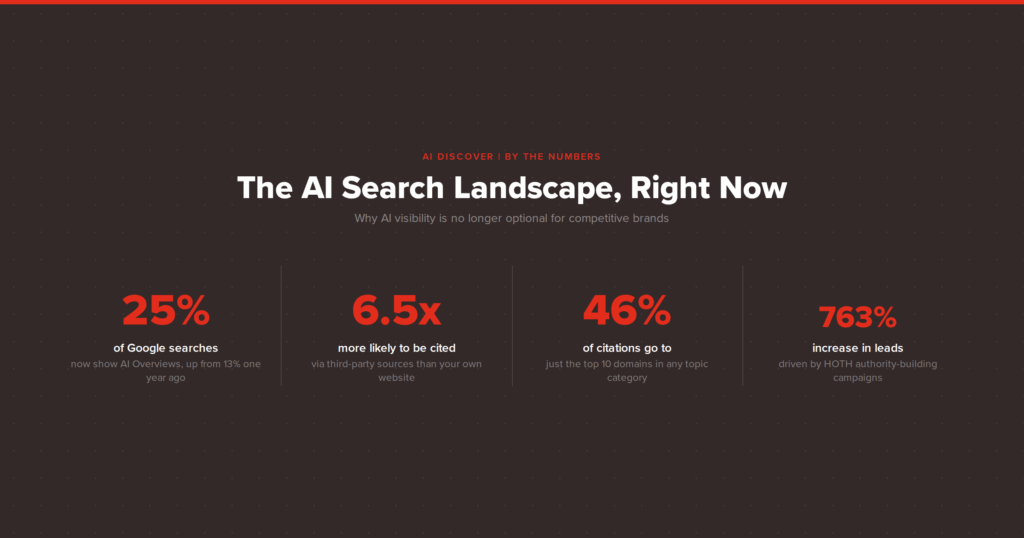
Consider the scale of what’s already happening: AI Overviews now appear on roughly 25% of all Google searches, up from 13% a year ago, according to Conductor’s benchmark study of 21.9 million queries. And that’s before accounting for ChatGPT, Perplexity, and Gemini, which operate entirely outside of Google’s index. If you’re only tracking traditional rankings, you have no visibility into any of it.
The measurement piece alone is significant. Without it, you’re making decisions blind. With it, you can track AI citation frequency, compare your position against competitors, and tie your authority-building activities directly to changes in how AI tools are responding to prompts in your category. It’s the kind of reporting framework we outline in our post on measuring SEO and AEO success, applied specifically to AI visibility.
What AI Discover Is (and What It Isn’t)
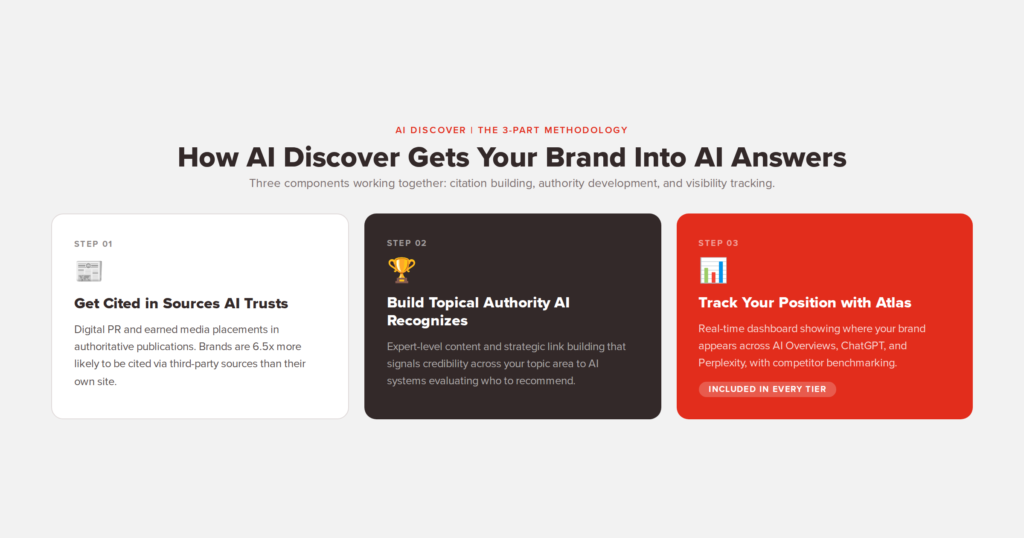
AI Discover is not an audit report you receive once and file away. It’s a fully managed ongoing service with three components working together: citation building, authority development, and visibility tracking.
Here’s how each piece works:
1. Getting Your Brand Into the Sources AI Trusts
AI systems don’t rank pages: they cite sources. And the sources they trust most are authoritative publications, high-credibility platforms, and consistent brand mentions across the web. That’s a different kind of authority than what a backlink profile measures.
AI Discover builds this through Digital PR and Earned Media placements: real editorial mentions in the publications that AI models draw from when they generate answers. This matters more than most brands realize. According to Superlines’ AI search research, brands are currently 6.5 times more likely to be cited in AI responses through third-party sources (publications, reviews, forums) than through their own website. Paired with reputation management to strengthen brand sentiment, this is how you get your name into the information ecosystem AI tools are pulling from.
2. Building Topical Authority That AI Systems Recognize
When an AI model recommends a brand, it’s because that brand has demonstrated consistent, credible depth on a specific topic. A single strong article doesn’t do it. A fragmented backlink profile doesn’t do it. What does it is a coherent body of expert-level content, supported by authoritative links from niche-relevant sources, that collectively signals: this brand knows this subject.
AI Discover builds that signal through structured content creation and strategic link outreach, the same authority methodology The HOTH has applied to traditional SEO for 15 years, calibrated specifically to the trust signals AI systems evaluate.
3. Tracking Your Position with Atlas
Atlas is the dashboard included with AI Discover. It tracks where your brand appears across AI Overviews, search results, and LLM responses so you can see whether the work is moving the needle.
This matters because most businesses have zero visibility into how AI perceives them. Atlas gives you that view: how often you’re cited, for which topics, and how that compares to competitors. You can walk into any strategy meeting with actual data instead of assumptions.
Who AI Discover Is Built For
Marketing Leaders Facing Board-Level Questions About AI
You’re getting asked whether your brand is showing up in AI search. You don’t have a good answer yet. AI Discover gives you both the answer and the roadmap to improve it, without requiring you to rebuild your existing SEO strategy from scratch.
Agency Owners Who Need a White-Label AI Visibility Solution
Your clients are already asking about AI search. Before they find a competitor who offers it, AI Discover gives you something concrete to bring to that conversation: a managed service you can offer under your own brand.
Brands in Verticals Where AI Recommendations Drive Buying Decisions
Legal, financial services, healthcare, SaaS, ecommerce: these are the categories where someone asking ChatGPT “who should I hire” or “what software should I use” is a real buying signal. If your brand isn’t in those answers, the deal is essentially over before the prospect ever visits your site.
AI Discover is also explicitly limited by capacity. Because it’s a fully managed service with dedicated strategy sessions and real human attention on each account, The HOTH caps the number of AI Discover clients each quarter. It’s not a self-serve tool.
The Authority Engine Behind It
AI Discover runs on the same methodology that’s driven measurable results for HOTH clients across competitive verticals for over a decade. The underlying work (authoritative link building, topical content depth, and brand reputation management) is what the service has always been built on. The difference is that it’s now instrumented specifically for AI visibility, with Atlas tracking the outputs.
The authority signals that move rankings in traditional search are the same ones AI systems use to decide who to cite. Building them produces results across both channels:
- 763% increase in leads through authority link building campaigns
- Growth from 400 to 45,000 monthly visitors through sustained content and authority work
- Double the review count in 90 days, directly improving Map Pack and AI Overview visibility
A good example of this methodology applied in a high-stakes vertical is our law firm SEO case study, where a client in a highly competitive category achieved 334% traffic growth through structured authority building. The same type of campaign, when calibrated for AI citation signals, is what AI Discover delivers.
Why the Timing Matters
There’s a compounding dynamic in AI visibility that’s worth understanding clearly.
AI systems develop source preferences based on what they’ve seen consistently cited and validated. A brand that gets mentioned in authoritative publications repeatedly, over time, becomes a trusted source for that system. That trust compounds: the more you’re cited, the more likely you are to be cited again.
The data backs this up. Research analyzing ChatGPT citation patterns found that the top 10 domains in any topic capture 46% of all citations, and the top 30 take 67%. In other words, AI visibility is already becoming a winner-takes-most dynamic, and the brands establishing themselves now are the ones setting those positions.
The inverse is also true. Competitors who are building AI authority right now are reinforcing their position in the model’s outputs. Every month of delay makes it incrementally harder to displace them.
This is the same compounding logic that applies to traditional SEO domain authority, which is why early investment in managed SEO has always produced outsized long-term returns. AI visibility works the same way, just in a newer channel where the positions aren’t yet locked in for most categories.
That window of relative openness won’t last indefinitely.
How AI Discover Works in Practice
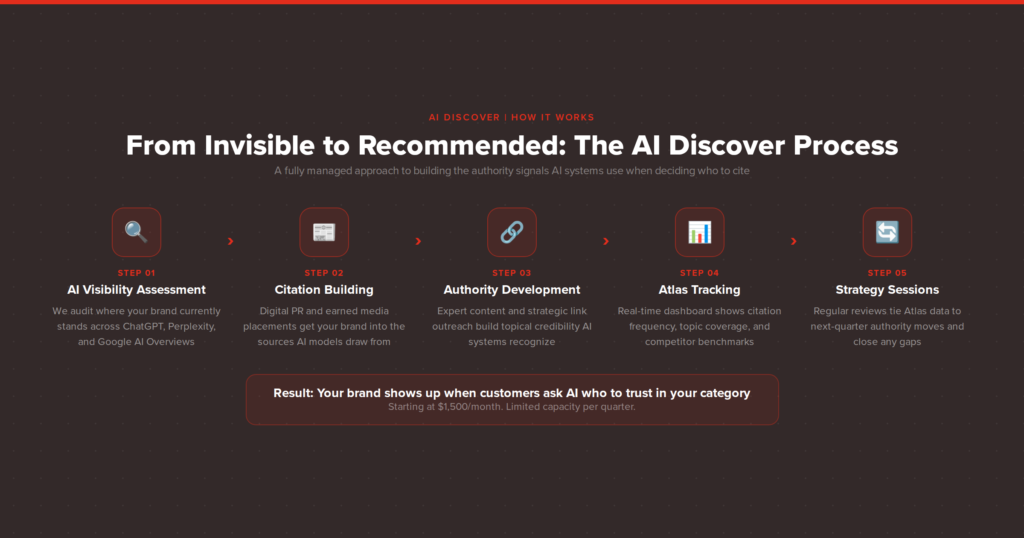
AI Discover is available at three tiers, starting at $1,500/month, depending on the scope of the market and how aggressively you need to build authority in your category. Each tier includes the Atlas dashboard, regular strategy sessions, and the active citation-building and authority work.
The starting point for every new client is a free AI Visibility Assessment: a conversation where we look at where your brand currently stands in AI search, which competitors are already being cited in your category, and what a realistic improvement path looks like.
You can book your free AI Visibility Assessment here. If you’re not ready for that yet, our AI search visibility content is a good place to start building your understanding of how these systems evaluate brands.
The Bottom Line
Most businesses are flying blind in AI search. They don’t know whether they’re being cited, who’s ahead of them in their category, or what specifically is holding them back. AI Discover fixes that.
It’s a fully managed service (not a one-time report, not a DIY dashboard) built on the authority-building methodology The HOTH has refined over 15 years. It tells you where you stand, builds the signals that move you forward, and tracks progress so you can show real results.
If you’re ready to find out exactly where your brand stands in AI search today, get your free AI Visibility Assessment.
Leave a comment