
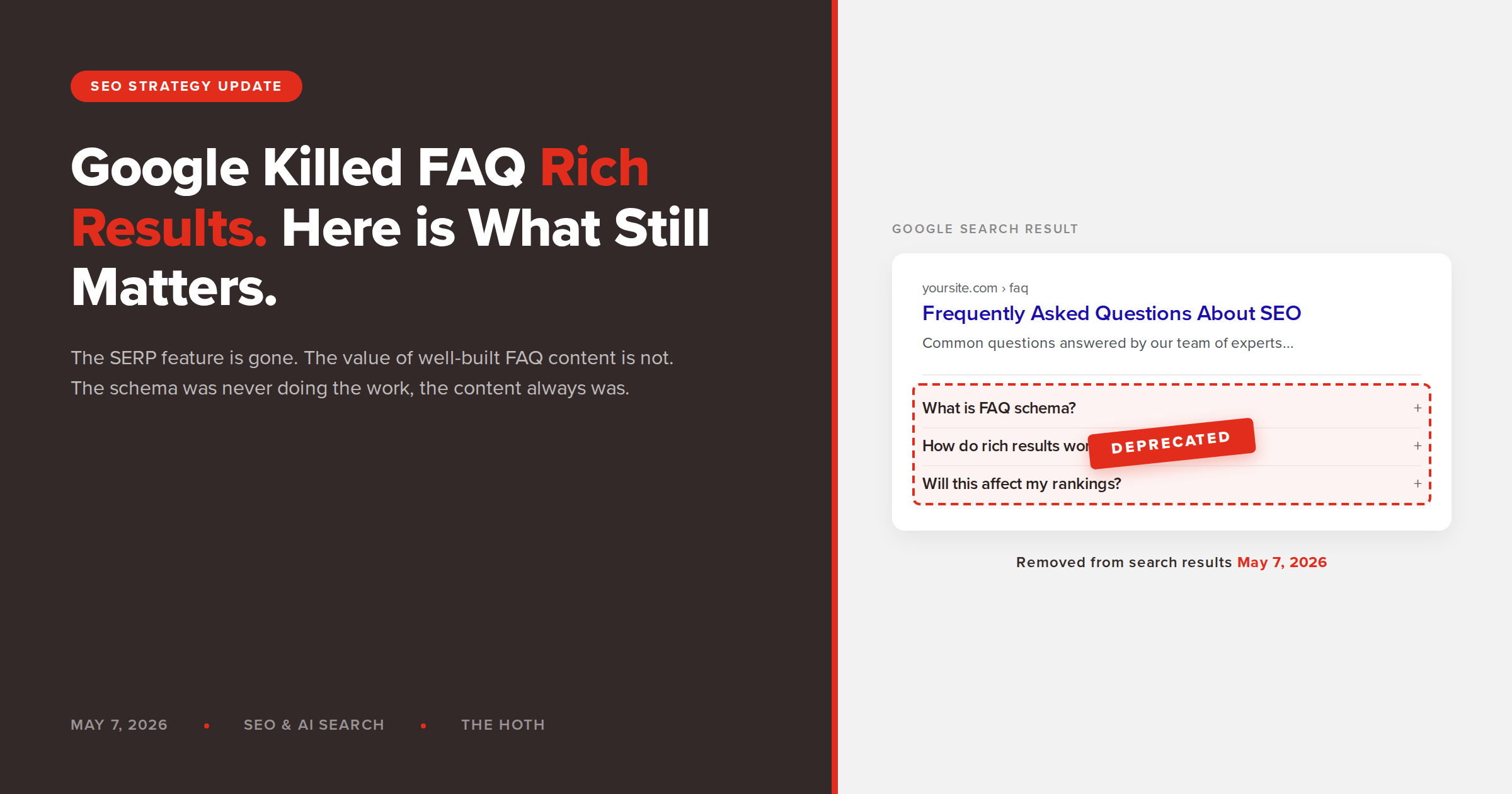

On May 7, 2026, Google quietly added a note to the top of its FAQ structured data documentation: FAQ rich results were no longer appearing in search. No blog post. No webmaster announcement. Just a small label at the top of a developer doc.
If you spent the last few years adding FAQ schema to your pages to win those expandable Q&A dropdowns under your search listings, that feature is gone. The Search Console FAQ report and the Rich Results Test will follow in June 2026. The Search Console API support disappears in August.
Here is what the change actually means: the SERP feature is gone, the value of well-built FAQ content is not. In fact, the deprecation just made one thing much more obvious. The schema was never doing the work. The content always was.
This post walks through exactly what changed, what the change means for your SEO strategy, and where the real opportunity sits now that Google has closed the SERP-display side of the FAQ playbook.
What Google Actually Changed
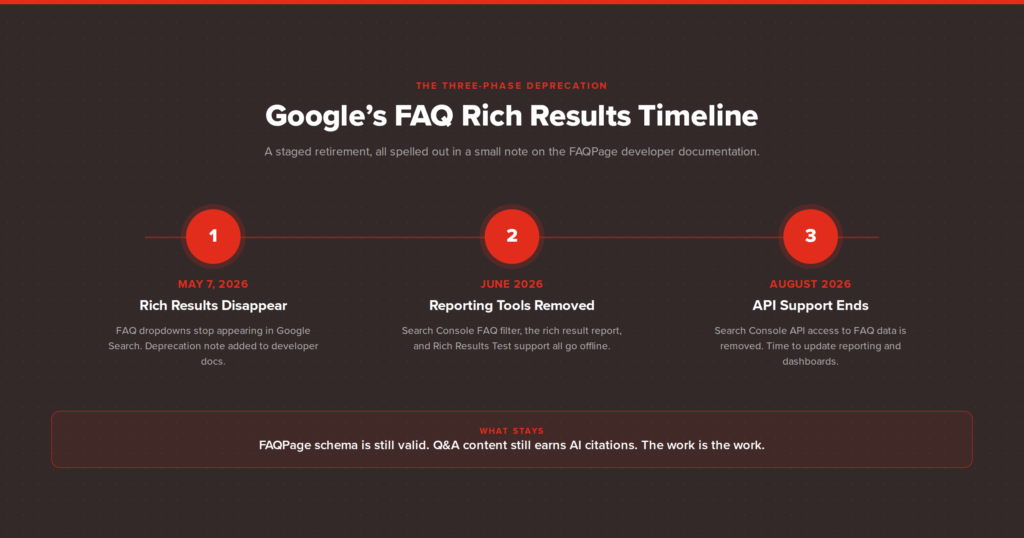
Google deprecated FAQ rich results in three phases, all spelled out in a small note at the top of the FAQPage developer documentation:
- May 7, 2026: FAQ rich results stopped appearing in Google Search.
- June 2026: Search Console FAQ search appearance filter, the rich result report, and FAQ support in the Rich Results Test will be removed.
- August 2026: Search Console API support for FAQ rich result data will be removed.
For the SEO industry, this is not exactly a shock. Google had already restricted FAQ rich results in August 2023, limiting them to well-known authoritative government and health websites. For the vast majority of businesses, FAQ rich results had been functionally invisible for nearly three years.
The May 2026 update closes that loop. The narrow remaining eligibility for government and health sites is gone too. FAQPage is still a valid Schema.org type, and Google has confirmed it will continue to parse FAQ markup to understand pages. But the visible SERP feature, the part marketers cared about, is over.
If you want a comparison point: Google did the same thing to HowTo rich results on desktop in 2023, and pulled seven more structured data types out of search appearance in June 2025. This is a pattern, not a one-off.
The Reframe: FAQ Content Was Never the Schema
The cleanest way to think about this update is to separate two things that have been blurred together for years.
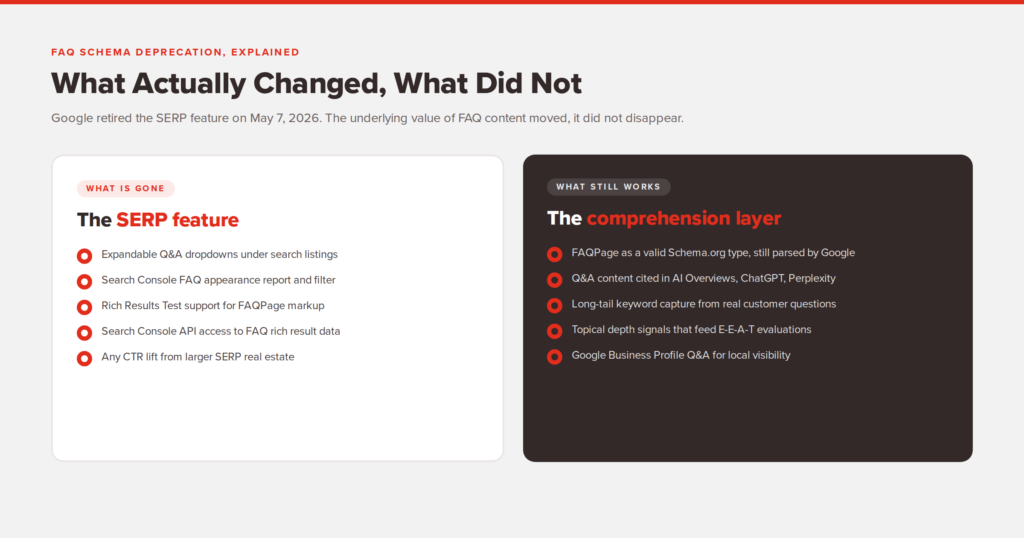
FAQ schema is a piece of markup. It tells search engines that a chunk of content on a page is structured as questions and answers. FAQ rich results were a SERP display feature that used that markup to render an expandable Q&A panel under your search listing.
Those are not the same thing. The first is comprehension. The second is presentation.
Google has ended the presentation. The comprehension layer is still there. And every piece of evidence we have about AI search points to comprehension being where the real value is now.
Where the Value of FAQ Content Actually Moved
FAQ content earns its keep in 2026 for completely different reasons than it did in 2019. Here are the four that matter.
1. AI Overviews and chat-based search love Q&A structure
Google AI Overviews, ChatGPT, Perplexity, and Gemini all generate answers by pulling from clearly structured content. Question-and-answer formatting is one of the easiest patterns for these systems to extract because it mirrors the structure of the queries they are trying to answer.
An Ahrefs study from February 2026 found that only 38% of pages cited in Google AI Overviews rank in the top 10 of traditional search results. The signals that earn AI citations are not always the same signals that earn traditional rankings. Clear, direct, question-led content is one of the strongest of those signals.
And here is the part that gets missed: AI systems do not privilege FAQPage schema when deciding what to cite. They pull from clean Q&A content whether the markup is there or not. The active ingredient is the content.
2. FAQ content captures real long-tail intent
A solid FAQ section is one of the most efficient ways to cover the long tail of search intent for a topic. Each question is its own micro-keyword cluster. People Also Ask boxes, autocomplete suggestions, and Reddit threads are all goldmines for finding the questions your customers actually type. That is true whether or not Google ever displays your FAQ as a rich result. For a deeper dive into structuring this for AI surfaces, see our guide to schema markup for AI.
3. FAQ content reinforces topical depth
Google and AI systems both reward pages that demonstrate coverage. A page that introduces a topic, explains it, and then anticipates and answers the questions a real user would ask shows depth. Depth shows expertise. Expertise feeds the E-E-A-T signals that Google has been weighting more heavily across the past several core updates.
4. FAQ content improves user experience
The least technical reason, and maybe the most important: FAQ sections help users get what they came for. Lower bounce rates, longer sessions, and clearer paths to conversion all flow from a page that anticipates objections and answers them in the user’s own language.
What to Actually Do With This Update
Most of the practical advice floating around the SEO industry right now is either too dramatic (rip out all your FAQ schema today) or too dismissive (do nothing, this changes nothing). Here is the more useful framing.
Leave existing FAQ schema in place
There is no upside to removing FAQPage markup from your existing pages. Google has confirmed unused structured data does not cause problems. Other search engines and AI retrieval systems may still parse it. The only reason to remove FAQ schema is if it describes a section that no longer exists on the page, or if the FAQ section itself was thin, keyword-stuffed filler that should be cleaned up regardless.
Do not add FAQ schema as a new optimization lever
Going forward, FAQ schema is not a tactic. It is a description. If you have real Q&A content on a page, marking it up is fine. If you are adding FAQ schema to chase a SERP feature, that feature no longer exists. Build the content instead.
Audit your existing FAQ sections for quality
This is the part most teams will skip and most teams should not. Now that schema is not doing any cosmetic work for you, the content has to stand on its own. Ask:
- Are these the questions your customers actually ask, or generic placeholders someone wrote to fill the section?
- Does the answer get to the point in the first sentence, or bury the response in setup?
- Are the questions phrased in customer language, or marketing language?
- Are you covering the questions surfacing in People Also Ask, autocomplete, and the broader retrieval ecosystem for your topic?
If the answer to those questions is shaky, your FAQ section was probably underperforming even when rich results were live. The deprecation just removes any cosmetic cover it had.
Update your reporting before August
If your team pulls FAQ rich result data from the Search Console API into dashboards or BigQuery exports, those calls will return null after August 2026. Pull the historical data you want to keep, update your reporting flows, and move on.
Pay attention to Google Business Profile Q&A
This is a different surface from website FAQ rich results, and it is not affected by this update. Google Business Profile Q&A is often overlooked, frequently filled with incorrect user-submitted answers, and one of the easier wins in local search visibility. Seed the questions your customers actually ask. Provide owner-verified answers. Audit the existing user-submitted answers for accuracy. This is genuine low-hanging fruit, especially for local and service businesses.
The Bigger Pattern: Google Is Reclaiming the SERP
Zooming out for a moment: HowTo rich results in 2023. Seven more structured data types in 2025. FAQ in 2026. Each time, Google retires a SERP feature that gave third-party content extra display real estate. Each time, the surface that gains ground is Google’s own AI Overview.
The direction is consistent. Google is reclaiming the SERP for its own answer experiences and reducing the visual real estate available to third-party rich results. This is not hostile to publishers. It is just where the product is going.
The teams that will do well in this environment are the ones that stop chasing individual SERP features and start optimizing for the underlying signals that earn citations across all surfaces: clear entity authority, genuinely useful content, strong topical coverage, and the trust signals that come from links, mentions, and structured presence across the web.
Those are also the strategies that win for traditional search. The good news is the work has not really changed. The bad news is the work has never been about a single tactic.
What We Are Actually Seeing in AI Search
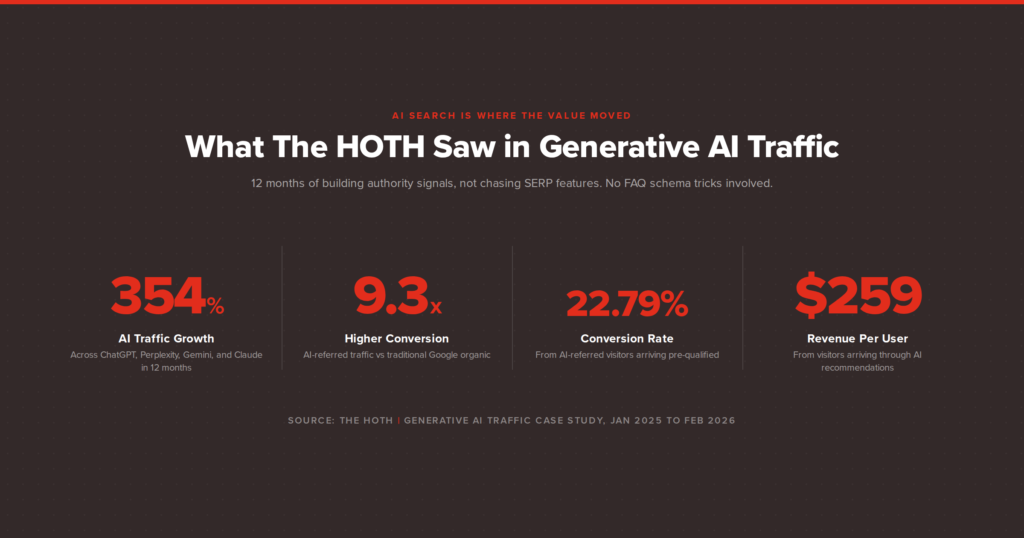
To make this concrete: across the past year, The HOTH grew its own generative AI traffic 354% across ChatGPT, Perplexity, Gemini, and Claude. None of that growth came from chasing FAQ rich results. It came from the same fundamentals we recommend to clients: consistent link building from authoritative sites, comprehensive content built around the questions our audience actually asks, and a strong multi-channel brand presence that AI systems can use as context.
The conversion side of that traffic is the part worth pausing on. AI-referred visitors converted at 22.79%, compared to 2.45% for traditional Google organic. That is 9.3 times the conversion rate. The visitors arrive pre-qualified, because the AI system has already endorsed us as a relevant solution before they click.
We did not get there by adding more schema. We got there by building the kind of content and authority signals that AI retrieval systems use to choose what to recommend. That is the same playbook that wins now that FAQ rich results are gone.
Where to Go From Here
If your team has a few hours this quarter for FAQ work, spend them auditing the actual content of your FAQ sections rather than the markup. Cut the weak questions. Tighten the answers. Pull in real customer language from support tickets, sales calls, and People Also Ask. Pay attention to your Google Business Profile Q&A if you serve local customers. Leave your existing schema where it is. HOTH Web Copy includes an FAQ section in every page over 1,000 words for exactly this reason: it is one of the most efficient ways to capture long-tail intent and earn AI citations.
If you want to know how your current content is performing across AI surfaces, HOTH AI Discover measures your visibility across ChatGPT, Perplexity, Google AI Overviews, and Gemini, and gives you a clear picture of where you are being cited and where the gaps are. The FAQ deprecation is a fine reason to take that look. The bigger reason is that AI search is where a growing share of high-intent traffic comes from, and most brands have no clear view of how visible they are there.
If you want help building the kind of multi-channel presence that earns those citations consistently, book a call with our team. The FAQ update is a small moment in a larger shift, and the brands that get ahead of the shift are the ones that stop chasing features and start building the fundamentals.
Leave a comment