

There is a version of the local SEO conversation that treats business listings as a solved problem from a decade ago. Get listed on a few directories, make sure your phone number matches, move on. The thinking goes that citations were a 2014 ranking factor and the industry has moved past them.
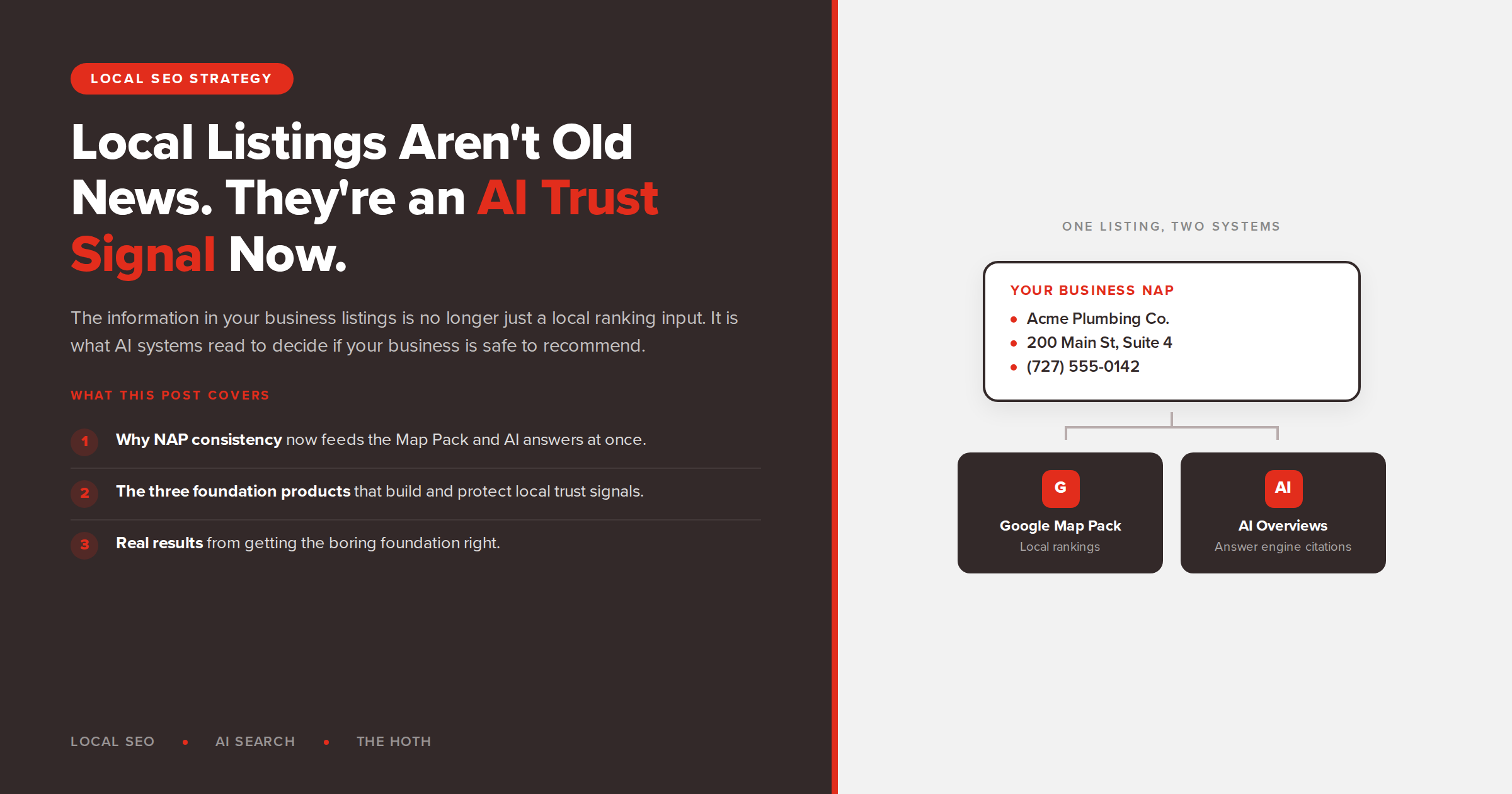
That thinking is wrong, and it is getting more wrong every quarter. The information that lives in your business listings (your name, address, phone number, hours, and the consistency of all of it across the web) is no longer just a local ranking input. It has quietly become one of the signals AI systems use to decide whether your business is real, trustworthy, and safe to recommend when someone asks ChatGPT or Google’s AI Overview for a business like yours.
The work has not changed much. The stakes have. This post explains why listing consistency now feeds two systems at once, the local pack and AI answers, and walks through the three foundation products that build and protect those signals.
Why Listings Quietly Became an AI Trust Signal
Start with how an AI system answers a local question. When someone asks an AI assistant for a good plumber near them, the model is not running a live crawl of the web in that moment. It is drawing on what it already understands about businesses in that category and location, and it is increasingly pulling from the same structured local data that powers Google’s Map Pack: business profiles, directory listings, and the consistency of the information across all of them.
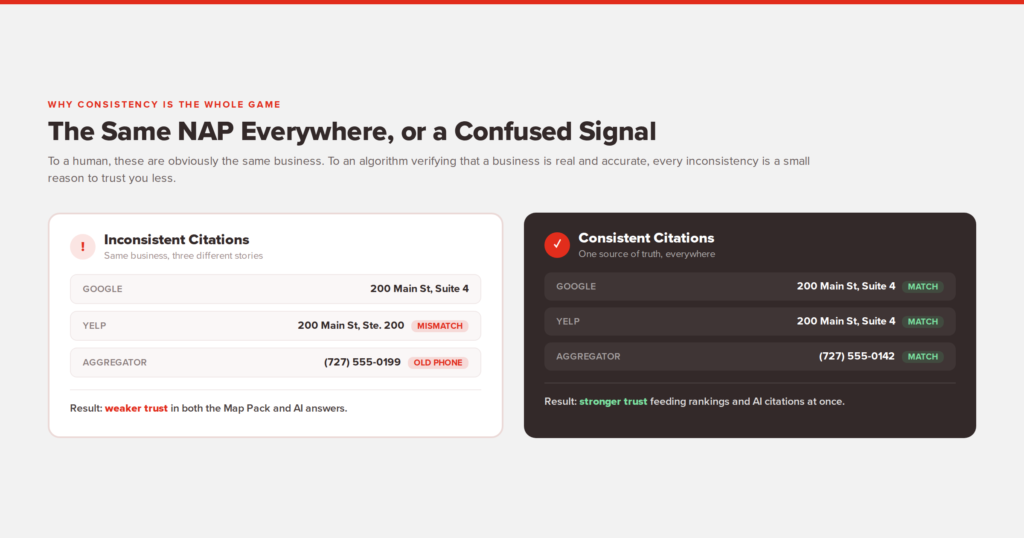
Consistency is the part that matters most, and it is the part most businesses get wrong. If your name, address, and phone number (your NAP) appear three different ways across the directories Google and AI systems consult, you are sending a confused signal. One listing says Suite 200, another says Ste. 200, a third has your old phone number from two offices ago. To a human, these are obviously the same business. To an algorithm trying to verify that a business is legitimate and that its data is accurate, every inconsistency is a small reason to trust you less.
The HOTH’s local SEO services page puts it plainly: the same trust signals that drive Map Pack rankings (consistent NAP data, an active profile, accurate information across business directories) are the signals AI Overviews and AI-powered local search rely on too. Strong local data improves both at once. Weak or inconsistent data undermines both at once.
This is the reframe. Listings were never really about the directories themselves. They were always about giving search engines enough consistent evidence to trust your business. That job used to be done for the benefit of the local pack alone. Now it is done for the local pack and the answer engines, and the businesses that treat listings as old news are the ones quietly disappearing from both.
The Data Backs This Up
Local search is not a shrinking channel. According to BrightLocal’s Local Consumer Review Survey, a majority of consumers regularly read online reviews when researching local businesses, and Google remains the dominant place they look. Google Business Profile is the primary lead-generation tool for a large share of local businesses, and roughly half of all Google searches carry local intent. Add the rise of AI-driven discovery on top of that, and the picture is clear: more surfaces are pulling from your local data than ever before.
The mistake is assuming that because listings are old, they are finished. The opposite is true. The number of systems reading your business data has gone up, not down. Every new AI search surface is one more place where consistent, accurate listings help you and inconsistent ones hurt you.
The Three Products That Build Local Trust Signals
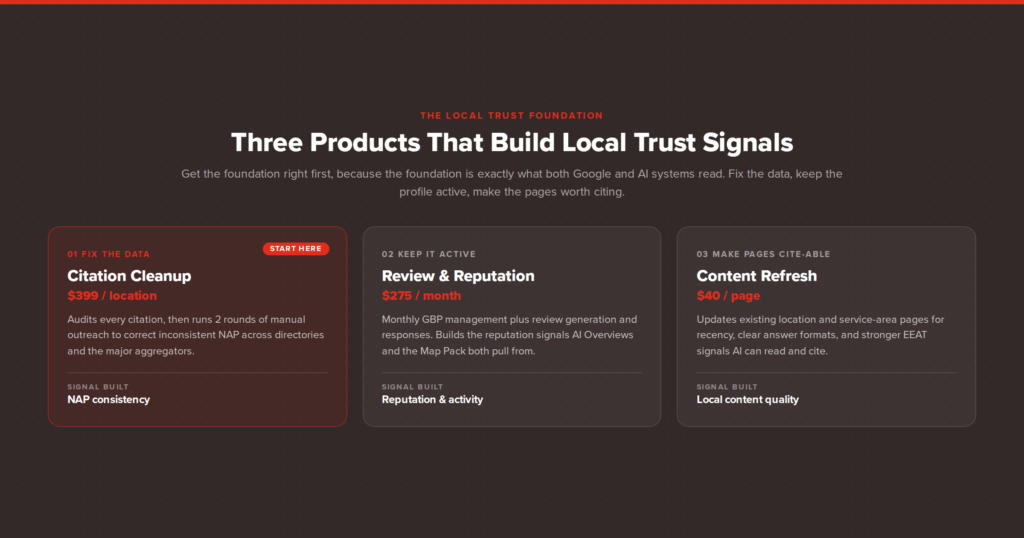
The HOTH’s local SEO lineup is built around a simple idea: get the foundation right first, because the foundation is what both Google and AI systems read. Three foundation products do that work, and they map cleanly to the three things that actually move local visibility: fixing your data, keeping your profile active, and making your local pages worth citing.
1. Citation Cleanup: fix the data first
Inconsistent NAP data is the single biggest blocker to Map Pack rankings, and it is the first thing to fix. HOTH Citation Cleanup runs a complete audit of your existing citations, finds every place your information is wrong or inconsistent, and then does two rounds of manual outreach to correct them. That includes the major data aggregators (Acxiom, Neustar Localeze, Infogroup, Factual, and Foursquare) that feed citation data into hundreds of smaller downstream directories. Fixing the aggregators matters because they are the source of truth that most other directories copy from. Citation Cleanup is priced at $399 per location.
If you only do one thing for local visibility this quarter, this is it. There is no point building reviews or publishing location pages on top of a foundation of contradictory business data. Clean the data first, then build.
2. Review and Reputation Management: keep the profile alive
A clean profile that nobody touches goes stale. Search engines and AI tools both favor businesses that look active and well-reviewed, which is exactly what HOTH Review and Reputation Management maintains. It is a monthly service that manages your Google Business Profile activity (weekly photo uploads, geotagged images, keyword-rich metadata) and runs review generation and responses to build the reputation signals AI Overviews and the Map Pack both pull from. It runs at $275 per month.
The reason this matters more than it used to: reviews and profile activity are not just persuasion tools aimed at customers anymore. They are part of the trust calculation an AI system makes before it will name your business in an answer. An active profile with a steady stream of recent, well-handled reviews tells both Google and the answer engines that this is a real, engaged business worth surfacing.
3. Content Refresh: make your local pages worth citing
The third foundation piece is the content on your location and service-area pages. Pages that were written years ago and never touched tend to quietly stop performing, both in rankings and in AI summarization. HOTH Content Refresh updates existing location pages and local content for recency, clear answer formats, and stronger EEAT signals, which is what helps AI systems read and cite them correctly. It is the lowest-cost entry point of the three at $40 per page.
What This Looks Like in Practice
The theory is fine, but local SEO lives or dies on whether it actually drives calls, direction requests, and foot traffic. Two examples show what the foundation produces when it is built correctly.
A specialty retailer turned its profile into a foot-traffic engine
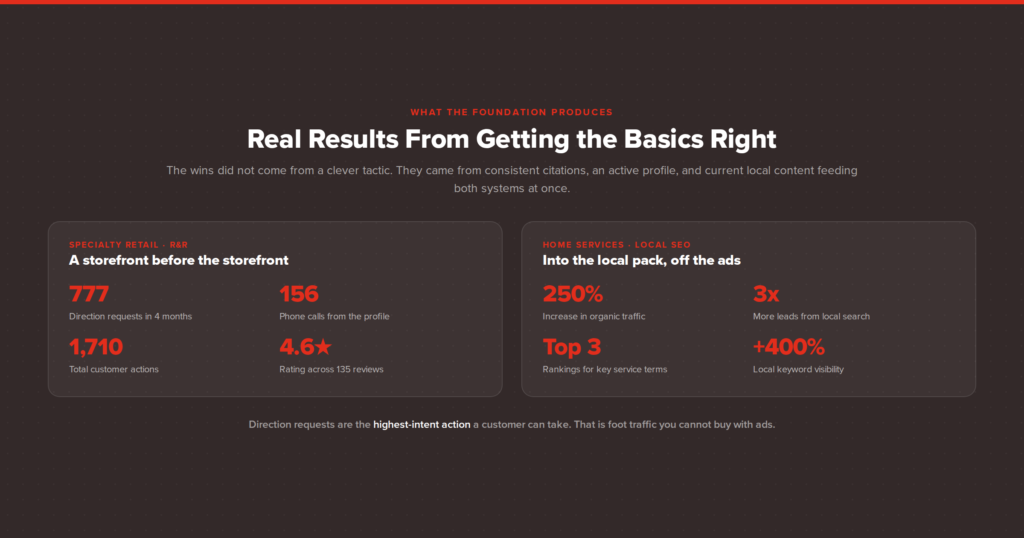
A specialty retail shop selling curated gifts and metaphysical products had real community goodwill offline, but its online presence was not keeping pace. The Google Business Profile needed active management and the review profile needed growth. Over a four-month managed reputation engagement, the shop grew to 135 Google reviews at a 4.6-star rating, synced its business information across more than 70 listing platforms for consistent NAP data, and kept the profile active with regular photos and posts.
The result was a profile that functioned as a storefront before the storefront. It generated 1,710 total customer actions, including 777 direction requests and 156 phone calls, with profile views near 12,750 over the period. For a brick-and-mortar business, direction requests are the highest-intent action a customer can take. They have already decided to visit. That is foot traffic you cannot buy with ads, and it came directly from getting the listings and reputation foundation right.
This is not a fluke of one business. Birdeye’s State of Google Business Profiles report found that each additional Google review a business earns is associated with roughly 80 additional website visits, 63 additional direction requests, and 16 additional phone calls, though the report is careful to note these are averages that vary by industry and competitiveness. Reviews and profile activity are direct inputs to the actions that actually fill a calendar.
An HVAC company climbed into the local pack
A home services company serving a competitive metro area was effectively invisible in local search, even for services it was well known for offline. The campaign centered on the local foundation: optimizing the Google Business Profile, building accurate local citations, creating location-specific service pages, and running ongoing on-page and technical improvements.
The company saw a 250 percent increase in organic traffic and tripled the number of leads coming from local search. It now ranks in the top three for high-intent service terms across multiple nearby cities and earned a 400 percent increase in local keyword visibility. The throughline with the retail example is the same: the wins came from getting the foundational local signals consistent and active, not from any single clever tactic.
When to Use What
If you are deciding where to start, here is the order that works for most local businesses.
- Start with Citation Cleanup if your business information is inconsistent across the web, if you have moved or changed your phone number, or if you have simply never audited your citations. Fix the data before you build anything on top of it.
- Add Review and Reputation Management if your profile is accurate but inactive, or if your review count and recency are thin compared to local competitors. This is the ongoing work that keeps your trust signals strong.
- Layer in Content Refresh if your location pages or service-area pages were written years ago and have quietly stopped performing in search and AI summaries.
And if you would rather not coordinate these yourself, Managed SEO combines citation cleanup, GBP optimization, review management, and local content into one program run by a dedicated strategist, starting at $1,000 per month. It tends to be the better path for multi-location businesses or anyone who wants every local signal handled together rather than ordered piecemeal.
The Bottom Line
Listings are not old news. They are the foundation that two systems now read at once: the local pack that has always rewarded consistent business data, and the AI answer engines that increasingly decide which local businesses to recommend. The businesses winning local search in 2026 are not doing anything exotic. They are getting the boring foundation right (clean citations, an active and well-reviewed profile, current local content) and letting that foundation feed both Google and AI at the same time.
If you are not sure where your local data stands today, the fastest way to find out is to start with a citation audit and cleanup. See how HOTH Citation Cleanup works and get started, or talk to a strategist if you want help mapping the full local plan to your goals and budget.
Leave a comment