

You asked us for a backlink on a site that looks exactly like yours. Same industry, same city, same kind of audience. We came back with a placement on a site that’s close but not a mirror image, and your first reaction was that something went wrong.
That reaction makes sense. When you’re paying for links, you want every one to feel like a perfect fit. But the way search engines and AI systems actually read backlinks is different from how most people picture it, and the “perfect match” you have in mind is rarely the version that moves rankings.
This post walks through what backlink relevance really means to Google, why backlink diversity is the goal rather than a compromise, and why a placement on an adjacent site can do more for you than ten near-identical ones. By the end, you’ll have the same mental model our Link Outreach team uses when they decide a placement is worth pursuing.
The short version
A backlink doesn’t have to come from a site identical to yours to help you rank. Here’s the quick version:
- Relevance is layered. Google reads it at the domain, article, and paragraph level. An adjacent site with on-topic content around your link can be worth more than an exact-niche site where the link sits in an unrelated paragraph.
- Diversity is the goal, not a compromise. Natural profiles earn links from many kinds of sources. A profile where every link is exact-match looks engineered and carries more algorithmic risk.
- Adjacent placements drive real results. One moving company earned 131 top-3 rankings and the #1 spot for its main keyword using links from real estate, home service, and lifestyle sites, not from other movers.
- The same signals feed AI search. A diverse, credible backlink profile is part of what gets your business cited by ChatGPT, Perplexity, and Google’s AI Mode.
What does “relevance” actually mean to a search engine?
Most people picture relevance as a simple yes-or-no test: is this site in my industry or not? Search engines don’t work that way. They read relevance in layers, and the website’s overall category is only one of them.
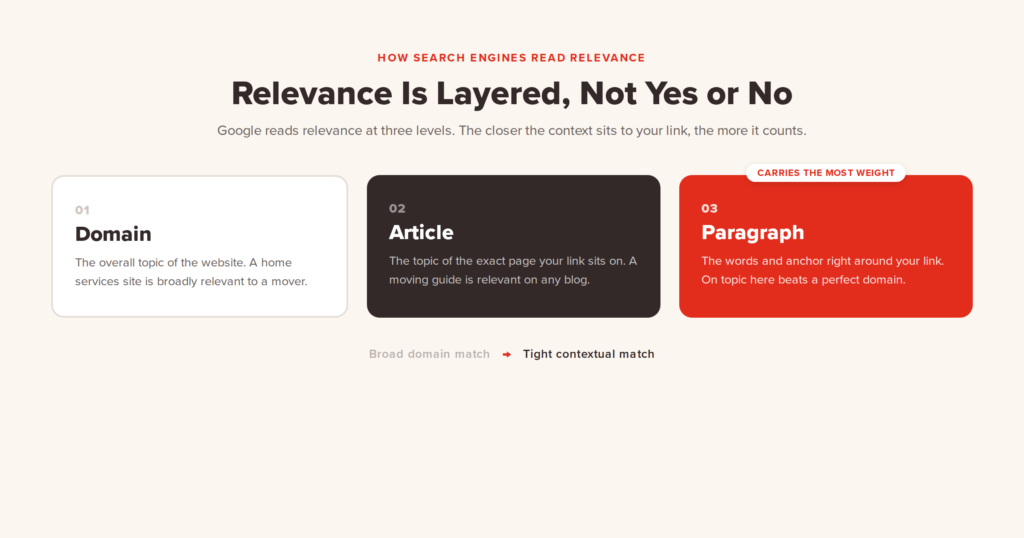
There are three levels worth understanding:
Domain level. This is the one everybody thinks of: the overall topic of the website. A site about home services has domain-level relevance to a moving company.
Article level. This is the topic of the specific page your link sits on. An article titled “how to prep your house for a long-distance move” is highly relevant to a moving company even if it lives on a general lifestyle blog that covers dozens of unrelated subjects.
Paragraph level. This is the context right around your link: the sentences near it, the surrounding words, and the anchor text itself. A link wrapped in a paragraph about relocation, packing, and storage sends a strong relevance signal no matter what the rest of the site covers.
Here’s the part that surprises people. The closer the context gets to the link itself, the more weight it tends to carry. A perfectly on-niche domain with your link buried in an unrelated paragraph is weaker than a broader site where the article and the paragraph around your link are tightly on topic.
There’s a real line here, and it’s worth naming. An adjacent placement is relevant at the article or paragraph level even when the domain is broad. An irrelevant placement has no thematic thread at any level. A payment-security company linked from a paragraph about protecting online transactions on a general business blog is adjacent and useful. That same company linked from a paragraph about backyard landscaping is not, and Google treats it accordingly. When a link has no context to follow, it confuses readers and gets devalued. Our team’s job is to stay firmly on the adjacent side of that line, never to drift across it.
That’s why our team can place you on a site that isn’t an exact copy of yours and still hand you a relevant, useful link. They’re building relevance at the article and paragraph level, where it counts most. If you want to go deeper, our guide on link relevancy breaks the concept down further.
What is backlink diversity, and why is it the goal?
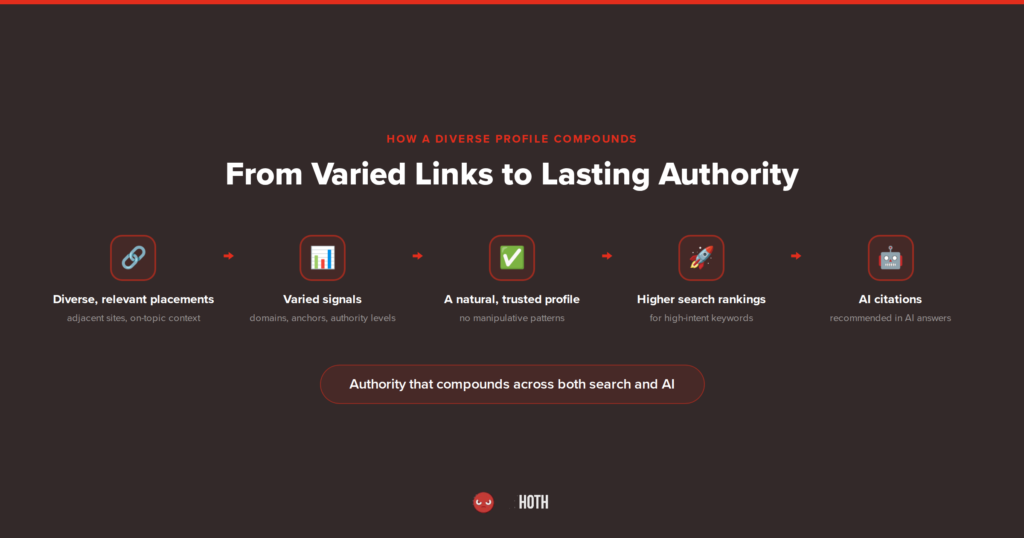
Backlink diversity is the variety in your link profile: links from different types of sites, with different anchor text, at different authority levels, arriving at a natural pace. It’s the goal because search engines compare your profile against the messy, varied patterns that real businesses produce.
Now flip the question around. Imagine we did exactly what the “perfect match” instinct asks for: every link from a site in your precise niche, every anchor using your main keyword, every placement following the same pattern.
To a search engine, that profile would look engineered. And it would be.
Natural backlink profiles are messy. A real business earns links from a spread of sources over time: an industry publication here, a local news mention there, a roundup post, a partner’s blog, a directory, a resource page. They come from different kinds of sites, with different anchor text, at an uneven pace. When you chart the profiles of sites that rank well, they cluster around that varied, organic pattern. Profiles built on repetition are the statistical outliers, and outliers are exactly what algorithms like Google’s Penguin update were built to catch.
Diversity tends to show up in three ways:
- Source types. Editorial articles, contextual mentions, niche blogs, news sites, directories, and resource pages all play different roles. No single type should dominate the profile.
- Anchor text. A healthy profile leans on branded anchors, naked URLs, and natural phrases, with exact-match keywords used sparingly. Over-relying on exact-match anchors is one of the fastest ways to make an otherwise healthy profile look manipulative.
- Authority levels. A mix of high-authority and solid mid-tier sites reads as more natural than a profile stacked entirely with one or the other.
It’s worth sitting with the counterintuitive part of this. The profile that feels safest to a client, with every link tightly on-niche and using the exact keyword you want to rank for, is the one that looks riskiest to an algorithm. Search engines have decades of data on what manufactured link patterns look like, and uniformity is the clearest tell. The varied profile that feels less controlled is the one that reads as earned.
So when you see a placement that isn’t a carbon copy of your business, that’s not a miss. It’s part of building the varied footprint Google trusts. Our breakdown of a healthy backlink profile walks through what that balance looks like in practice.
Do adjacent-industry backlinks still work?
Yes, and often better than the exact-niche links clients ask for. Adjacent placements can be relevant at the article and paragraph level, and they reach authoritative publishers that won’t accept a direct pitch from your niche. The case below shows what that looks like in numbers.
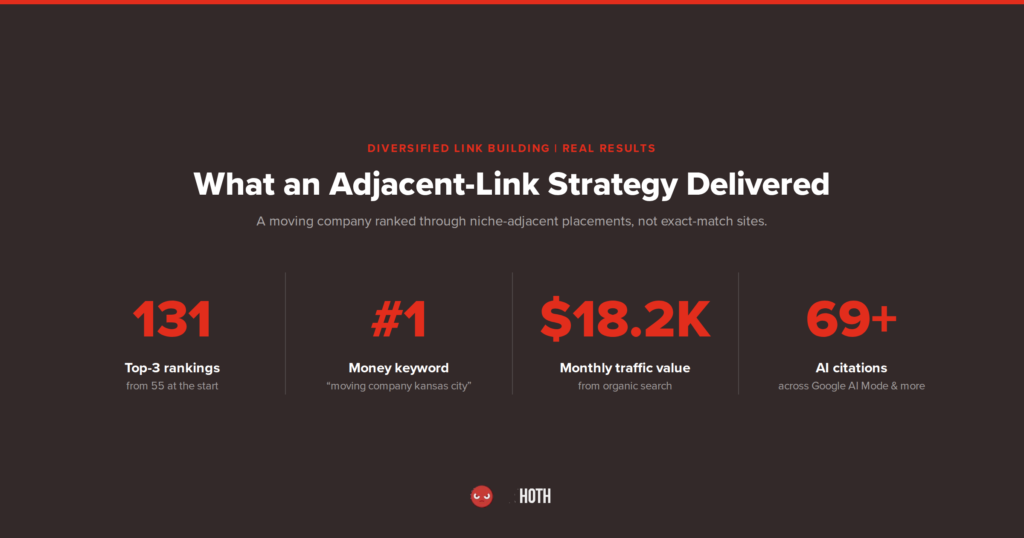
A moving company came to us competing in two brutal metros, Kansas City and Denver, up against national chains with far larger backlink profiles. Through our managed link building, we built more than 210 backlinks from 39 unique referring domains, using a mix of earned natural links, premium placements, and link insertions on credible, relevant sites.
Almost none of those came from other moving companies.
They came from real estate blogs, home service publications, local lifestyle sites, and other industry-adjacent platforms. On paper, none of those is a “moving company website.” In practice, every one of them shares an audience or a topic with the business: people buying homes, relocating across town, or hiring local services.
The results: 131 top-3 rankings, including the #1 spot for “moving company kansas city,” one of the highest-intent terms in that market. The site grew to 581 organic keywords and roughly $18,200 in monthly traffic value. That happened because the placements were relevant at the article and paragraph level, even when the domains weren’t exact category matches.
This holds across industries. A fintech tool earns a strong, relevant link from a paragraph about payment security on a broad small-business blog. A software product earns one from an article about team productivity on a general technology site. In each case the domain isn’t a perfect category match, but the article and the paragraph put the link exactly where it belongs.
There’s also a strategic reason adjacent placements matter, beyond the mechanics. The most authoritative publishers in any space are usually the hardest to pitch directly. A high-authority home and lifestyle publication might never run a piece that’s explicitly about your moving company, but it will happily cover a relocation or home-prep angle where your link fits naturally. Adjacent context is often the only door into the sites that carry the most weight. Our piece on high-authority backlinks digs into how this audience-adjacent relevance works.
What a natural profile looks like as it grows
A diverse, relevant profile isn’t something you assemble in a single month. It develops, and the shape of that development matters as much as the links themselves. Two things our team watches closely.
Link velocity. Links should arrive at a believable pace. A sudden burst of dozens of links followed by silence looks unnatural. A steady, sustained flow looks like a business earning real attention. This is one reason Link Outreach compounds over time rather than dumping everything at once, and why pausing a campaign after a month or two rarely shows you what it can actually do.
Geographic spread. Where your links come from is one signal among many, not the whole picture. Local links from regional papers, community blogs, and area directories help Google connect your business to a physical place, which supports “near me” searches. Links from further afield broaden your overall footprint. Both have a role. A client who insists every link come from their exact city is optimizing for one signal at the expense of the diversity that makes the entire profile credible.
Early in a campaign, some foundational placements exist mainly to establish that baseline of variety. As the profile matures, the higher-powered, more competitive placements have a stable base to build on. For the longer view, our guide to natural backlinks covers how trustworthy profiles develop.
What our team screens before a link goes live
It helps to know that adjacent doesn’t mean random. Every placement runs through the same checks before we pursue it.
- Authority that’s real. We look at a site’s domain strength alongside its actual organic traffic, because authority scores on their own can be inflated. A site should have a real audience, not just a high number.
- Topical or contextual fit. The page and the content around your link need a thread that connects back to your business, even when the domain covers a wider range of subjects.
- Editorial placement. Your link should sit inside the main body of a real article, not in a footer, sidebar, or comment section where it carries almost no weight.
- A natural anchor. The anchor text has to read naturally in context. Forcing an exact-match keyword into a sentence where it doesn’t belong is a pattern we actively avoid, not one we chase.
This is why our outreach is manual instead of automated. Reaching the kind of sites that clear these checks takes real relationships and human judgment, which is also why quality placements take time to land rather than appearing in bulk overnight. If you want the full walkthrough, we covered the process in our overview of how Link Outreach works.
How does Google evaluate backlinks today?
The biggest shift in how this works is that search engines stopped evaluating links one by one a long time ago.
Google now reads your backlinks as part of a larger web of signals: brand mentions, unlinked citations, reviews, press coverage, and the relationships between all the entities involved. Its language models map how topics and brands connect, and they read the meaning around a link rather than just its existence. A single placement is one data point in that network. Pulling it out and judging it in isolation, the way the “perfect match” instinct does, isn’t how the system actually sees it.
Those entity relationships are why a brand mention with no link at all still carries value, and why a placement that surrounds your link with related topics and terminology pulls more weight than the bare link would on its own. The signal isn’t only “a site linked to you.” It’s “a site discussed your area of expertise and pointed to you as part of that discussion.” Diversity across many of those contexts is what builds a durable picture of authority.
This matters more than ever because the same signals now feed AI search. When someone asks ChatGPT, Perplexity, or Google’s AI Mode for a recommendation, those systems lean on the same authority and relevance signals that drive traditional rankings. In that same moving company campaign, the link foundation produced more than 69 brand citations across AI platforms, including 60 in Google’s AI Mode. Nobody built those citations directly. They came out of a diverse, credible profile that taught these systems the business was a trusted name in its market.
So the question worth asking about any single placement isn’t “is this the perfect site?” It’s “does this strengthen the overall picture of authority and relevance my profile is building?” Most of the time, a solid adjacent placement does exactly that.
How to think about your placements going forward
A few things to keep in mind when you open a report and see a placement you didn’t expect:
- Judge the profile, not the single link. One placement is a data point. The strength is in the spread.
- Relevance lives in the content, not just the domain. Check the article and the paragraph around your link before deciding a site is off-target.
- Variety is protection. A profile that’s too uniform is the one that carries algorithmic risk, not the one with a healthy mix.
- Give it time. Authority compounds. The value of a campaign at month six is far greater than at month two.
If a placement ever looks clearly off-topic to you, that’s worth raising with your strategist. There’s a real difference between an adjacent placement that’s relevant at the article and paragraph level and a link with no thematic connection at all. We’re aiming for the former on every campaign, and we’re glad to walk you through the reasoning on any specific link.
The bottom line
The instinct to want the most relevant link possible is a good one. It just needs to be pointed at the right definition of relevance. Relevance isn’t whether a site is a mirror image of yours. It’s whether the content and context around your link tell search engines and AI systems that your business belongs in the conversation. Diversity isn’t the price you pay for that. It’s the proof of it.
Our Link Outreach and Managed SEO teams build profiles with this balance in mind on every campaign. If you ever want to understand the strategy behind a specific set of placements, your strategist is happy to talk it through.
Frequently asked questions
Does backlink diversity really matter for SEO?
Yes. Search engines compare your link profile against the natural patterns real businesses produce, and a varied mix of source types, anchor text, and authority levels signals that your links were earned rather than manufactured. A profile that’s too uniform is more likely to look manipulative and carry algorithmic risk.
Are adjacent-industry backlinks as valuable as exact-niche links?
Often, yes. Relevance is judged at the article and paragraph level, not just the domain, so a link surrounded by on-topic content on an adjacent site can carry as much weight as one from an exact-match domain. Adjacent placements also unlock high-authority publishers that won’t accept direct pitches from your niche.
Will an irrelevant backlink hurt my rankings?
A link with no topical or contextual connection at any level adds little value and can confuse readers, so Google tends to devalue it rather than count it. That’s different from an adjacent link, which keeps a clear thematic thread back to your business and still helps.
Why are some of my backlinks from websites outside my industry?
Because relevance lives in the content around the link, not only in the website’s overall category. Placing you on credible adjacent sites builds the diverse, natural-looking profile that search engines and AI systems trust, and it reaches authoritative publishers that don’t cover your exact niche directly.
Do backlinks affect whether AI tools recommend my business?
Yes. AI search platforms like ChatGPT, Perplexity, and Google’s AI Mode lean on the same authority and relevance signals as traditional search. A diverse, credible backlink profile is part of what earns your brand citations in AI-generated answers.
Leave a comment