

Ads have arrived inside the AI tools your customers use every day. ChatGPT now shows sponsored results. Google is moving the same direction with AI Mode. And the analysts who track ad budgets are calling this the start of a brand new spending category, not a passing experiment.
That raises an uncomfortable question for anyone responsible for growth: do you now have to pay to show up in AI answers, the same way you pay for Google and Meta? The short version is no, not yet, and not entirely. The brands already getting recommended by AI tools mostly got there by earning it, and that head start is something a credit card can’t buy overnight.
This guide breaks down what advertising in AI search means, where it stands in 2026, and why the smartest move right now is to earn your spot in AI answers first, then layer paid placements on top where they make sense.
What is AI advertising?
AI advertising, also called advertising in AI search, is paid placement inside AI-powered search and chat experiences, such as sponsored results in ChatGPT, ads in Google AI Mode, and promoted content alongside AI Overviews.
It is a different animal from the search and social ads you already run. Traditional search ads sit above a list of links. Social ads sit inside a feed. AI advertising sits inside a conversation, next to an answer the user already trusts, which makes the placement valuable and also delicate. Push too hard and you break the experience people came for.
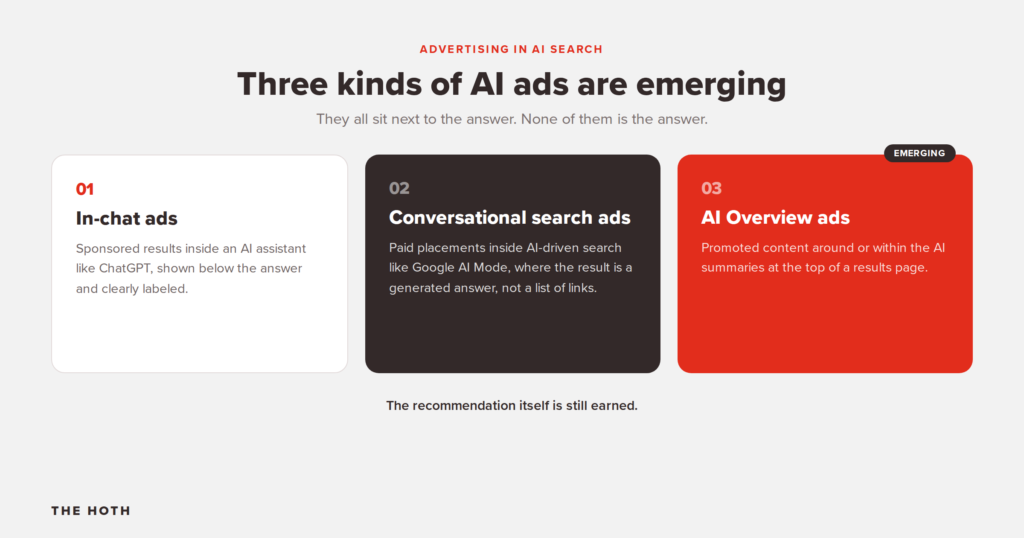
EMARKETER has framed this as the fourth wave of digital advertising, following search, display, and social. Their forecast points to AI ad formats becoming a major slice of US digital ad spend over the next several years. Those formats are taking shape in three broad buckets:
- In-chat ads: sponsored results shown inside an AI assistant like ChatGPT, usually below the answer and clearly labeled.
- Conversational search ads: paid placements inside AI-driven search experiences such as Google AI Mode, where the result is a generated answer rather than a list of links.
- Search-adjacent and AI Overview ads: promoted content that appears around or within AI summaries at the top of a results page.
All three share one trait that should shape your strategy: the paid unit sits next to the answer, but it is not the answer. The recommendation itself, the part where the AI says this brand is a good fit, is still earned.
How AI advertising is different from search, display, and social
Each earlier wave of digital advertising rewarded a different skill, and AI advertising rewards trust: the brands AI already treats as credible are the ones whose ads land in context.
Search advertising rewarded intent. You bid on a keyword and met someone who was already looking. Display rewarded reach and targeting. Social rewarded creative and audience data. None of these waves replaced the one before it. They stacked, and the marketers who won learned to run them together.
AI advertising stacks on top too, but it adds a new requirement. Because the ad shows up next to a generated answer, the surrounding context is a recommendation, not a list of links. If the answer already speaks well of your category and your brand, your ad reads like part of the conversation. If the answer recommends a competitor, your ad is an interruption. The lesson from the first three waves still holds: you do not get to skip the foundation and win on spend alone.
AI advertising is here, and it is moving fast
ChatGPT began testing ads in early 2026 and opened a self-serve ad platform to US businesses within months, so this is a live channel, not a future one.
OpenAI started testing ads in ChatGPT in early 2026 for logged-in adult users on its Free and lower-cost Go tiers in the US. The ads appear below the response, are labeled as sponsored, and, per OpenAI, do not change the answer itself. You can read OpenAI’s own explanation in its post on testing ads in ChatGPT.
What happened next is the part worth paying attention to. In a matter of months, OpenAI moved from an invite-only pilot with a steep minimum commitment to a self-serve ad manager open to any US business, with cost-per-click bidding and no minimum spend. When a platform removes the spend floor that fast, it is signaling that the auction is open for business.
To make this concrete: opening bids land in the low single digits per click, the auction is relevance-weighted so a sharp ad on a modest budget can beat a lazy one with a bigger budget, and there is a conversions tool so you can tie a click back to a sale. Your actual chat prompts stay private. Paid Plus, Pro, and Enterprise tiers remain ad-free for now, which matters if your buyers skew toward power users, because your real reach can be narrower than the headline user counts suggest.
Google is on a parallel track. AI Overviews already appear on a large share of searches and reach a massive monthly audience, and AI Mode is Google’s fully conversational search surface. Monetization of those surfaces is the obvious next step, which is exactly why EMARKETER and others are modeling AI advertising as a wave rather than a niche.
So the channel is real. The harder question is what it is worth to you, and what it quietly assumes about your brand before you ever place a bid.
Why earning your spot still beats buying it
Paid AI placements sit beside the answer, but AI tools decide which brands to recommend inside the answer based on earned trust signals, so earning your way in shapes the outcome that matters most.
Think about how an AI tool answers a buying question like which company should I use for X. It does not pull that recommendation from an ad auction. It assembles it from what the wider web says about you: the publishers that mention your brand, the reviews customers leave, the content on your site, and how consistently all of that lines up. An ad can sit next to that answer. It cannot put your brand inside it.
That distinction has real consequences for budget. Paid placements stop the moment you stop paying. Earned visibility compounds. A citation in a trusted publication keeps working months after it goes live, and the authority it builds makes the next citation easier to earn. One is rented. The other is owned.
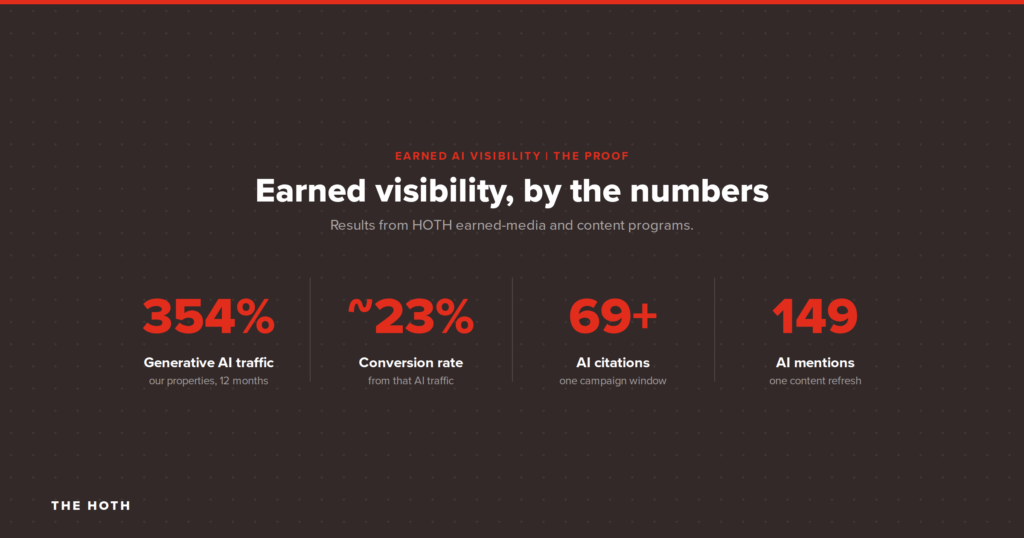
There is also a quality angle. Because AI recommendations are built on trust signals, the brands that earn them tend to convert well. On our own properties, consistent off-page authority work drove a 354% increase in generative AI traffic over twelve months, and that traffic converted at nearly 23%. That is the kind of return that comes from being the answer, not from buying space near it.
None of this means paid AI ads are a bad idea. It means they work best on a foundation of earned visibility, not as a substitute for it. If an AI tool already trusts your brand enough to recommend it, your paid placement reinforces a message users are also hearing from the answer itself. If it does not, you are paying to sit next to a recommendation for someone else.
How brands earn their way into AI answers
You earn AI visibility the same way you earn trust: authoritative mentions on sites AI tools already read, a strong review profile, and content structured so AI can extract and cite it.
There are three levers that move AI visibility, and the good news is they overlap heavily with the SEO work you may already be doing.
1. Earn authoritative mentions and citations
AI tools lean on the same trusted publishers and news sites over and over. Getting your brand featured on those sites, with or without a link, is the single biggest driver of AI citations. This is where earned media and editorial placements earn their keep. Our Earned Media and Exclusive Media Links services exist for exactly this: getting your brand onto vetted US publications that AI systems and Google already treat as sources. A moving company we worked with earned more than 69 AI citations through that kind of editorial coverage, in a single campaign window.
2. Build a review profile AI tools trust
AI tools check reviews across multiple platforms before recommending a business, and they read the meaning of those reviews, not just the star count. A steady stream of genuine, well-managed reviews tells an AI model that real customers vouch for you. For local and service businesses especially, reputation is now a ranking signal in AI answers, not just a trust badge on your site.
3. Structure content so AI can cite it
AI tools cite content they can extract cleanly: clear headings, direct answers near the top of a section, and structured data. Refreshing existing pages into that format is often the fastest win, because the page already has history and authority. One ecommerce brand earned 149 AI mentions from a single content refresh campaign. If you want a managed program that runs all three levers together, that is what our AI Discover service is built to do.
Underneath all three levers sits one more signal: consistency. AI tools build a picture of your brand from everywhere they find you, so your name, your category, and your claims need to line up across your site, your business listings, and the publications that mention you. Mixed signals make a model less sure about recommending you, and less sure usually means left out. The brands that win are the ones an AI tool can describe in a single confident sentence.
What AI advertising will cost, and why waiting is risky
Early AI ad inventory is priced at a premium, and costs climb as more advertisers pile in, so an earned-visibility moat is the most reliable hedge against rising prices.
Early reporting puts premium AI ad placements well above typical display rates, with some rates landing far higher than what you would pay for a standard banner. Cost-per-click bidding has brought the entry point within reach of smaller budgets, but the direction of travel is clear. As more brands enter the auction, the price of being seen goes up, the same way it did on search and social once everyone showed up.
That is the real argument for moving on earned visibility now. The brands that build authority before the auction gets crowded pay less for the same presence later, because they are already part of the answer and their paid placements reinforce a recommendation instead of fighting for attention. Waiting does not keep your costs flat. It just means you start building the moat after your competitors do.
It also pays to know your starting line. Before you put money into AI ads, find out which tools already mention you, for which questions, and where the gaps are. That baseline tells you whether a paid placement would reinforce a recommendation you already earn, or paper over a weakness you should fix first. Spending without that picture is how budgets quietly leak, and it is one of the easier mistakes to avoid, because the fix is simply to measure before you bid.
The smart sequence: earn first, then pay
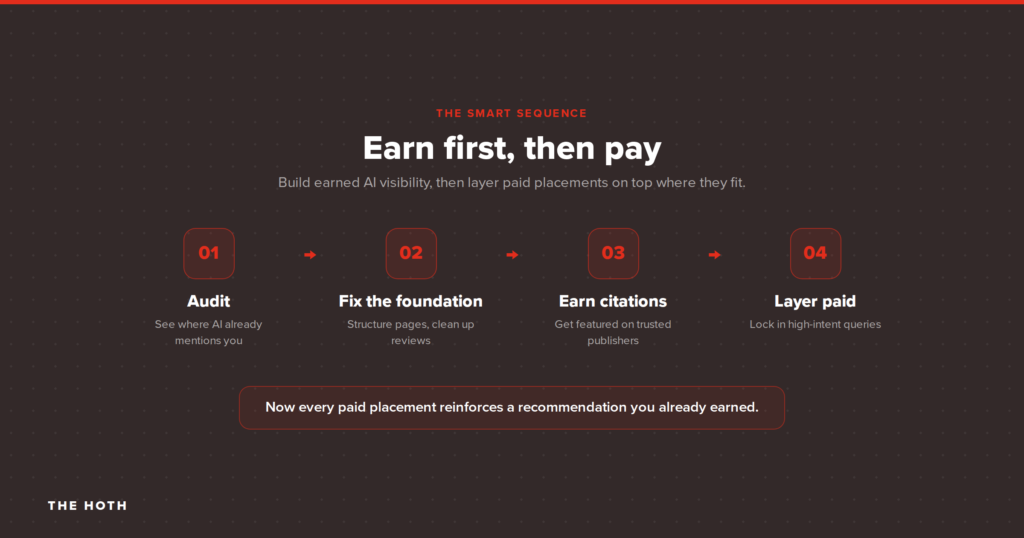
Build earned AI visibility now, measure where you already get cited, then layer paid AI ads on top for the high-intent queries where you want guaranteed presence.
Here is a practical order of operations that does not require you to bet the budget on a brand new auction.
- Audit where you stand. Find out which AI tools already mention you, for which queries, and where competitors are beating you. You cannot manage what you cannot see, and most brands have no visibility into this today.
- Fix the foundation. Get your highest-value pages structured for AI extraction, clean up your review profile, and make sure your brand information is consistent everywhere AI tools look.
- Earn citations on trusted sources. Invest in editorial coverage and authoritative mentions on the publishers AI systems already read. This is the work that compounds.
- Layer paid placements where they fit. Once you are already part of the answer, use AI ads to lock in presence for your most valuable, highest-intent queries. Now the ad reinforces a recommendation instead of replacing one.
Brands that run that sequence in order get two wins. They show up in the earned recommendation, which is what most users trust, and they own the paid placement next to it. Brands that skip straight to ads pay full freight for half the result.
Getting ahead of the fourth wave
AI advertising is going to keep growing, and paid placement will become a normal line item the way search and social did. But the brands that win the next few years will be the ones that earned their place in AI answers before the auction got crowded and expensive. If you want help getting there, AI Discover runs the full earned-visibility program for you, and you can see how we approach the whole shift on our AI visibility services page. When you are ready to talk strategy, book a call with our team.
Frequently asked questions
Does ChatGPT have ads now?
Yes. OpenAI began testing ads in ChatGPT in early 2026 for logged-in adult users on its Free and Go tiers in the US, and later opened a self-serve ad platform to US businesses. Ads appear below the response and are labeled as sponsored. Paid Plus, Pro, and Enterprise users stay ad-free for now.
What is AI advertising?
AI advertising is paid placement inside AI-powered search and chat tools, including sponsored results in ChatGPT, ads in Google AI Mode, and promoted content around AI Overviews. It is widely described as the fourth major wave of digital advertising, after search, display, and social.
Should I pay for AI ads or focus on earning citations?
Both, in order. Earned citations shape the recommendation an AI tool makes inside its answer, which is the part users trust most, and that authority compounds over time. Paid AI ads are best layered on top once you already show up, to lock in presence for high-intent queries.
How do I show up in AI answers without paying?
Earn authoritative mentions on trusted publishers, build and manage a strong review profile, and structure your content so AI tools can extract and cite it. Those are the signals AI systems use to decide which brands to recommend.
The bottom line
AI advertising is real, it is here, and it is growing fast. But paying to sit next to an AI answer is not the same as being the answer. The recommendation itself is still earned, through trusted mentions, real reviews, and content built to be cited. Earn that first, and every paid placement you add later works harder. Skip it, and you are renting space next to a competitor’s win.
Leave a comment