

An SEO reseller package is a bundle of white label services you buy at wholesale and sell to your client under your own brand at your own price. The packaging matters more than the individual products, because how you bundle the work determines whether you’re defending a per-unit price every month or billing a retainer the client stops questioning.
Most agencies start reselling SEO the same way. A client asks for something. You find a vendor, mark it up, send an invoice. It works once.
Then you land the second client. And the fifth. Now you’re quoting per link, per post, per audit, and every renewal conversation starts from zero because the client can see exactly what they’re paying for each piece.
That’s the trap. Selling SEO by the unit caps your margin at whatever the client is willing to pay for that unit, and it makes you replaceable by anyone with a cheaper unit.
Packaging solves it. When you sell a program at a monthly price, the client is buying an outcome, not a line item they can price-shop. Your margin stops being a markup and starts being a business model.
This guide covers what the wholesale numbers look like, which products carry real margin, and four package structures you can lift and adapt to your own client mix.
What is an SEO reseller package?
An SEO reseller package is a fixed monthly bundle of white label SEO services sold to a client under your agency’s brand, priced as a single retainer rather than itemized per deliverable. You pay wholesale to the fulfillment partner and keep the difference.
The mechanics are simple. You sign up as a reseller, you get wholesale pricing and an unbranded dashboard, and every report and deliverable comes back with no logos, no phone numbers, and no “powered by” footer. Your client sees your name on the work.
What separates a package from a pile of orders is that a package has a shape. It has a monthly price, a defined set of deliverables, and a reason those particular deliverables belong together for that particular client.
That last part carries more weight than it sounds like. A package that’s obviously three unrelated services stapled together invites the client to unbundle it. A package where the pieces reinforce each other, links feeding the pages your content work just improved, reviews supporting the local rankings your citations just fixed, reads as a strategy. Strategies renew. Bundles get trimmed.
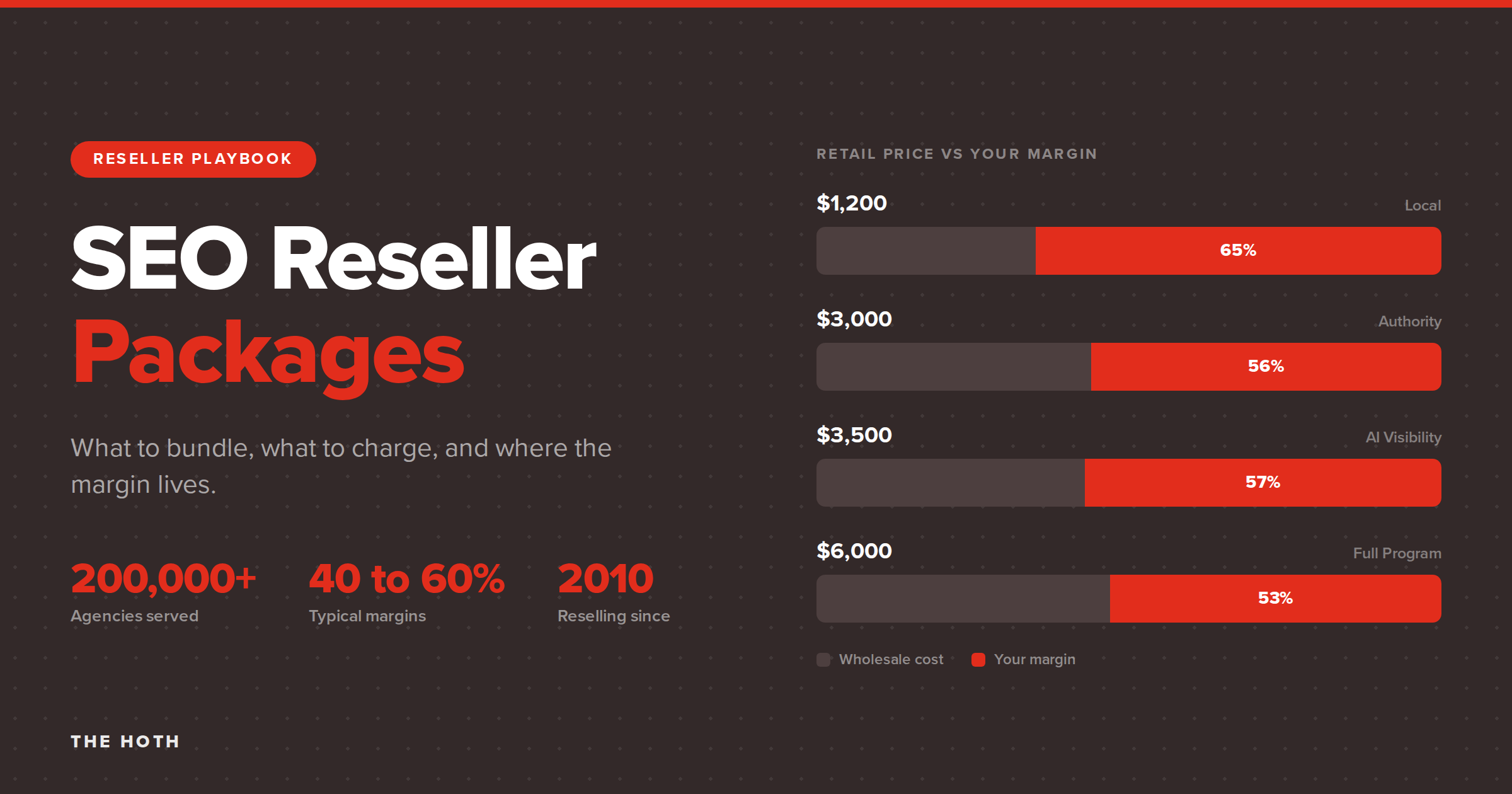
The HOTH has run its reseller program since 2010 and serves more than 200,000 agencies and businesses. Most resellers land in the 40 to 60 percent margin range once they’re pricing packages rather than individual orders.
What do the products cost you at wholesale?
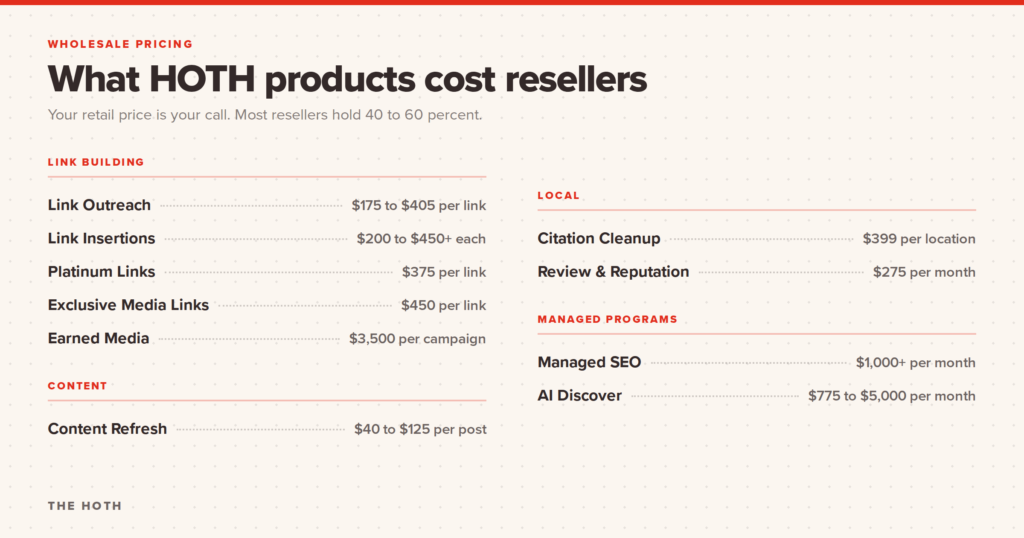
HOTH wholesale reseller pricing ranges from $40 per content refresh to $5,000 per month for the top AI Discover tier. Link products are priced per unit, and managed services are priced per month.
Here’s the full wholesale reference. What you charge on top is your call.
Link building
- Link Outreach: $175 at DA/DR 20+, $225 at 30+, $345 at 40+, $405 at 50+ per link
- Link Insertions: $200 to $450+ per insertion, tiered by DR
- Platinum Links: $375 per link, DR 50+ editorial placements
- Exclusive Media Links: $450 per link, vetted U.S. news sites at DR 30 to 60+
- Earned Media: $3,500 per campaign, 4,000+ publishers with 50+ guaranteed pickups at DR 30 to 75+
Content
- Content Refresh: $40 to $125 per post depending on length
Local
- Citation Cleanup: $399 per location
- Review and Reputation Management: $275 per month
Managed programs
- Managed SEO (HOTH X): $1,000 per month and up, scoped to the client
- AI Discover: $775 Launch, $1,500 Accelerate, $2,500 Advance, $5,000 Dominate, per month with a three-month minimum
The bulk buyer program lowers your effective wholesale cost as volume grows by earning bonus credits you can apply to any service.
Which products carry the best margin?
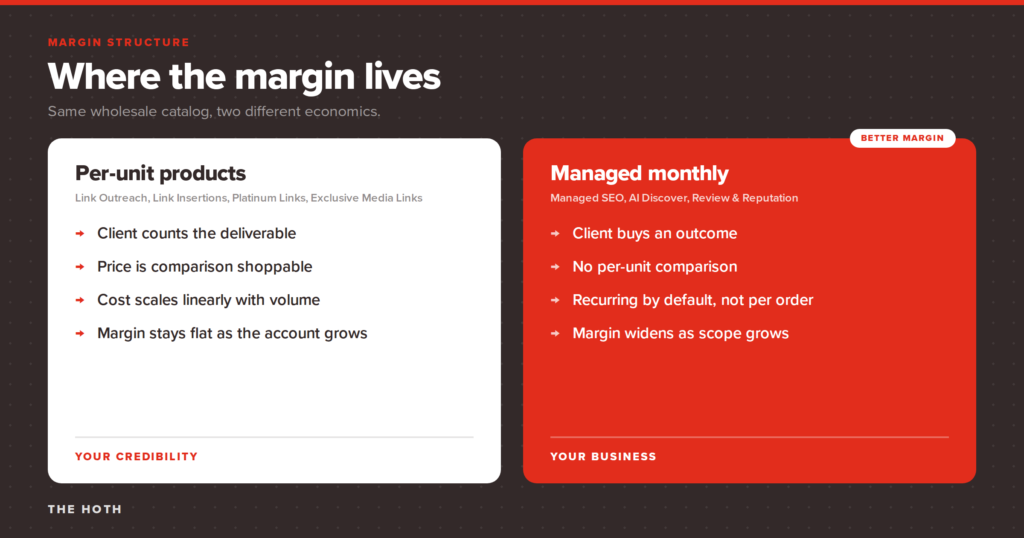
Managed monthly services carry better margin than per-unit link products, because the client is buying a program outcome rather than a countable deliverable they can price against a competitor.
This is the part most reseller guides skip, and it’s the thing that decides whether your book of business is profitable at scale.
Per-unit products have a hard floor. A DR 40+ Link Outreach placement costs you $345. If you sell it at $700, you’ve made $355. Sell four a month and you’ve made $1,420. The math is clean, but it’s also linear and exposed. Your client knows they bought four links. They can go get a quote for four links somewhere else.
Managed products behave differently. Review and Reputation Management costs you $275 a month and includes review monitoring across Google, Facebook, Yelp and dozens of other platforms, up to 200 AI-assisted responses, citation sync across 70+ directories, and weekly Google Business Profile updates. Your client isn’t counting responses. They’re looking at a rising star rating.
That’s the difference. Nobody comparison shops a reputation program the way they comparison shop a backlink.
There’s a second effect that shows up as accounts age. Per-unit margin is flat. Whatever percentage you hold on one link, you hold on forty. Scaling the account scales your revenue but never improves your economics.
Managed lines behave the opposite way. As you scope a Managed SEO engagement up from $1,000 to $2,500 in wholesale, the operational load on your team barely moves. You’re already running one monthly report and one check-in call. The additional revenue lands closer to the bottom line than the first dollar did.
So the practical rule is this: lead with link products to prove you can deliver, then move margin into managed lines as fast as the relationship allows. The link work is your credibility. The managed work is your business.
What do reseller packages look like at each price point?
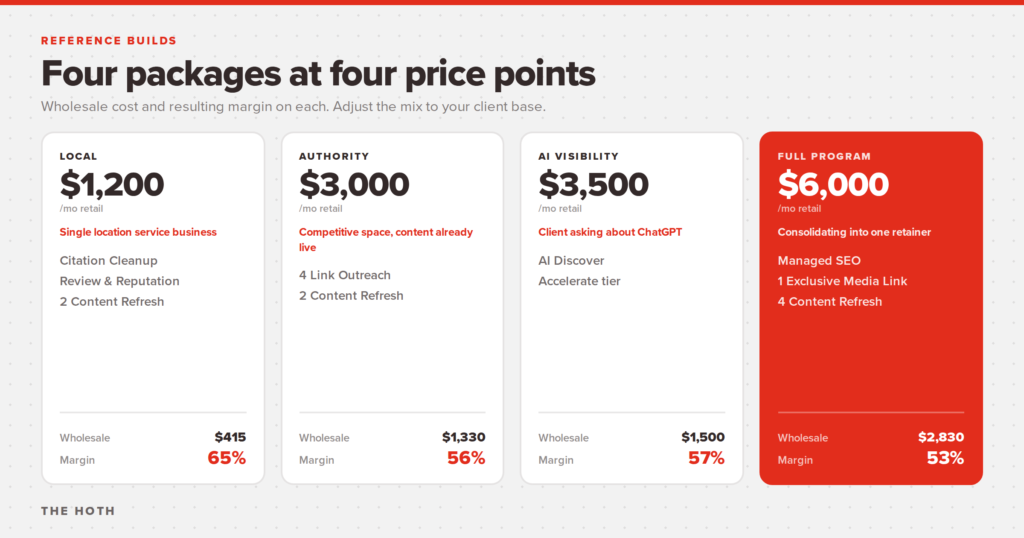
A workable reseller package pairs one anchor product with two or three supporting deliverables, priced as a single monthly number. Below are four structures at common client budgets, with wholesale cost and resulting margin.
These are reference builds, not rules. Adjust the mix to your client base.
The $1,200 local package
Built for a single-location service business that wants to show up in the Map Pack and stop worrying about reviews.
- Citation Cleanup at $399, month one only
- Review and Reputation Management at $275 per month
- Two Content Refresh posts at roughly $70 each
Your recurring wholesale cost is about $415 per month. At $1,200 retail you’re holding roughly 65 percent margin, and the first month absorbs the one-time cleanup.
This is the easiest package to sell because the audit sells it for you. Run the citation report, show the client every directory with their old phone number, and the case makes itself.
The $3,000 authority package
Built for a client in a competitive space who needs link velocity and has content already live.
- Four Link Outreach placements mixing tiers, two at DA/DR 30+ and two at 40+, for $1,140
- Two Content Refresh posts at roughly $95 each
Wholesale lands near $1,330 per month. At $3,000 retail that’s about 56 percent margin.
Note that the margin percentage here is thinner than the local package even though the revenue is higher. That’s the per-unit economics at work. It’s still a strong package, but it’s a stepping stone rather than a destination.
The $3,500 AI visibility package
Built for a client who’s asked why they don’t show up in ChatGPT or AI Overviews.
- AI Discover Accelerate at $1,500 per month, which includes three Digital PR links, one Review and Reputation line, two Content Refresh pieces, one Premium Link Insertion, and Atlas reporting with LLM visibility tracking
Wholesale is a flat $1,500. At $3,500 retail you’re near 57 percent margin with a single SKU and no assembly required.
The tier structure doubles as an upgrade path. Start a client at Launch for $775, prove the citations, and move them to Accelerate or Advance as results compound. That’s a built-in reason to revisit pricing twice a year.
The $6,000 full program package
Built for an established client consolidating everything into one retainer.
- Managed SEO scoped at roughly $2,000 per month
- One Exclusive Media Link at $450
- Four Content Refresh posts at roughly $95 each
Wholesale runs about $2,830. At $6,000 retail that’s roughly 53 percent margin, on a single invoice, with a dedicated campaign manager running the program in the background who never identifies themselves to your client.
How do you price a package without giving away your margin?
Price the package against the client’s expected return, not against your wholesale cost. Cost-plus pricing caps you at whatever multiple feels defensible, while outcome pricing lets the client’s revenue set the ceiling.
Three things protect margin in practice.
Quote one number. The moment you itemize, you invite negotiation on every line. A single monthly figure with a deliverables list underneath keeps the conversation on outcomes.
Anchor to the client’s economics. A personal injury firm where one case is worth $30,000 has a different ceiling than a local bakery. Same wholesale cost, different right answer.
Build in a floor. Decide the minimum monthly figure you’ll take on before you walk into the room. Agencies bleed margin by discounting into packages that were never going to be profitable at that scope.
One more thing worth saying plainly: your margin isn’t only the spread. It’s the spread minus the hours your team spends managing the account. Managed products win on that measure too, because the fulfillment and reporting happen without your people touching them.
What collateral do you need to sell these packages?
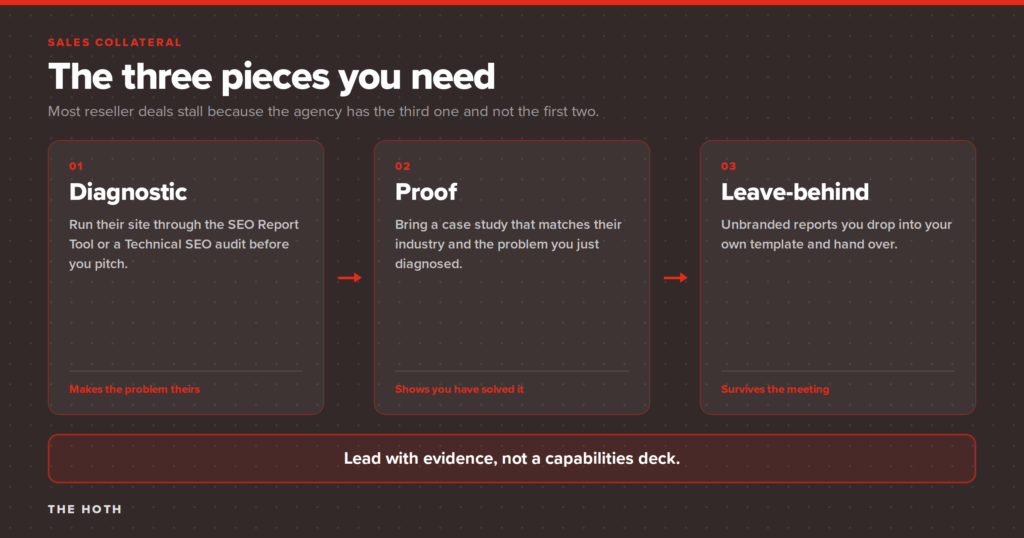
You need three things: a diagnostic that proves the client has a problem, proof that you’ve solved it before, and a leave-behind that survives the meeting. Most reseller deals stall because the agency has the third one and not the first two.
A package priced correctly still loses if the client can’t see why they need it. The pitch isn’t the package. The pitch is the gap between where they are and where the package takes them, and that gap has to be visible on a screen.
Lead with a diagnostic, not a deck. The most effective opener in reseller sales is a report about the prospect, not a document about you. Run their site through the free SEO Report Tool for an on-demand white label audit, or order a Technical SEO audit when the account justifies a deeper look. Either way you walk in holding evidence.
This matters more than it sounds like. When you present findings, the problem belongs to the client and you’re the person who found it. When you present a capabilities deck, the problem is hypothetical and you’re the person selling something. Same meeting, completely different posture.
Local prospects are the clearest case. Pull the citation report, show them eleven directories carrying a phone number they stopped using in 2021, and the Citation Cleanup line sells itself before you’ve quoted a price.
Bring proof that matches their situation. A prospect in home services doesn’t want to hear about a SaaS campaign. The HOTH case study library is organized by industry and outcome, so you can pull one that mirrors the vertical and the problem you just diagnosed. Verified resellers also get access to sales guides, pitch decks, and positioning materials built for exactly these conversations.
Leave behind something with your name on it. Every HOTH report and deliverable arrives unbranded, with no logos, no phone numbers, and no “powered by” footer. Export it, drop it into your own template, and the artifact the client keeps on their desk is yours.
That last point compounds after the sale. Monthly white label reporting is retention collateral as much as it’s a deliverable. The client who receives a branded report every month showing links landed, rankings moved, and reviews accumulated is a client who doesn’t go shopping at renewal. Your dashboard tracks the orders. Their inbox tracks the value.
When should you move a client to a bigger package?
Move a client up when the current package has produced visible results and they’ve started asking what comes next. That question is the buying signal, and answering it with more of the same is how accounts stay transactional.
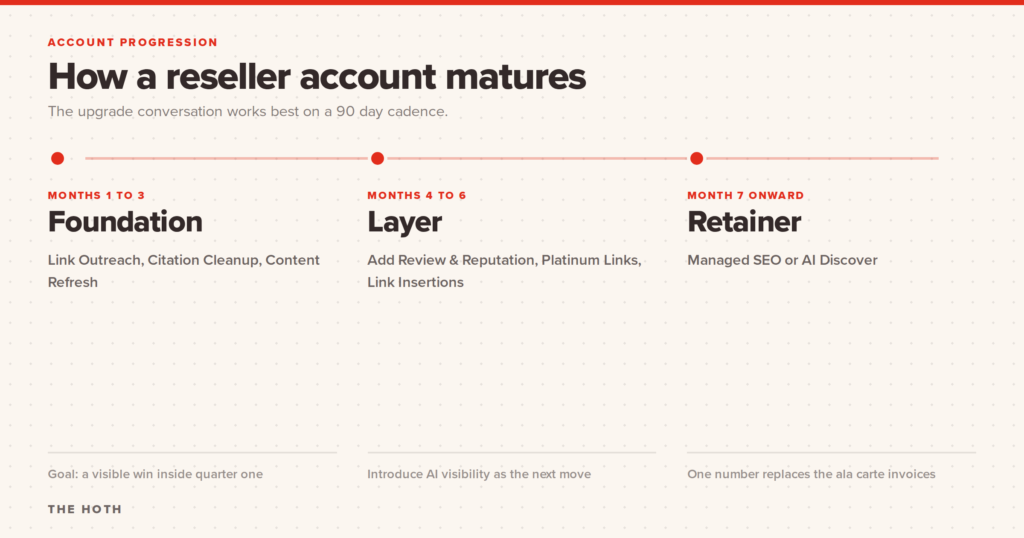
The pattern that works for most agencies runs on a rough 90-day cadence.
Months one through three are foundation. Link Outreach for clients running an active SEO program, Citation Cleanup for local clients, Content Refresh wherever there’s a content backlog. The goal is a visible win inside the first quarter.
Months four through six are where you layer. Add Review and Reputation for local accounts. Introduce Platinum Links or Link Insertions for clients pushing specific money pages. If they’ve raised AI search, start framing Earned Media or AI Discover as the next-quarter move.
Month seven onward is the retainer conversation. The client has two quarters of results and trusts the program. This is when Managed SEO or AI Discover replaces the ala carte invoices with one number.
A regional ad agency that joined The HOTH’s white label program in 2018 followed exactly that path. They started with a single Link Outreach order for one domain. Five years later they had 28+ client domains on the program and a 2x year-over-year increase in net income. Their clients saw a 150% increase in online visibility, a 2x increase in leads, and a 135% increase in sales.
One foundation product, compounded.
What are the most common reseller packaging mistakes?
The most expensive packaging mistakes are quoting per deliverable, building packages around what you can buy instead of what the client needs, and letting one-time products carry a recurring price.
Four patterns cost agencies real money.
Selling the catalog instead of a package. Handing a client a menu of nine products puts the scoping burden on them. They’ll pick the cheapest two. Bring two options at two price points and let them choose between packages, not between line items.
Pricing the one-time work as recurring. Citation Cleanup is a $399 per location fix, not a monthly service. If you bake it into a recurring price without saying so, month four gets awkward when the client asks what they’re still paying for. Break out setup work in month one and keep the recurring number clean.
Underscoping to win the deal. A $600 monthly package with $415 of wholesale cost in it leaves you $185 to cover account management, reporting, and the client’s inevitable extra requests. That account will lose money and consume attention that belonged to a profitable one.
Never revisiting the price. Packages set in month one tend to survive for years while the client’s business grows around them. Build a scheduled review into the engagement, ideally tied to a results milestone, so the upgrade conversation has a natural opening.
What about AI search?
Clients are asking about ChatGPT and AI Overviews whether or not your agency has an answer, and the products that build AI visibility are the same ones that build editorial authority.
The short version of the client conversation: AI systems cite sources they already trust. Editorial coverage, review signals, and structurally clean content are what put you in that set.
Earned Media and Exclusive Media Links build the publisher footprint. Review and Reputation Management feeds the local recommendation signals. Content Refresh handles AI Overview eligibility on posts you already own. AI Discover wraps all of it into a managed program with citation tracking across ChatGPT, Perplexity, and AI Overviews.
The HOTH runs these strategies on its own properties, which drove 354% AI traffic growth and 9x higher conversion rates from AI-referred visitors. That’s the pitch you get to make under your own brand.
Frequently asked questions
What is the minimum I need to start reselling SEO?
A free reseller account gets you wholesale pricing, the unbranded dashboard, and access to sales materials. There’s no minimum spend to open the account. The three-month minimum applies only to AI Discover tiers.
How much margin do SEO resellers typically make?
Most HOTH resellers land between 40 and 60 percent. Managed monthly products tend to sit at the higher end of that range, and per-unit link products at the lower end.
Can my client tell the work is outsourced?
No. Every report and deliverable is unbranded, with no logos, phone numbers, or “powered by” footers. Campaign managers don’t identify themselves to your client or appear on calls unless you want them to.
Should I package or sell ala carte?
Sell ala carte to prove the work, then package to hold the account. Ala carte wins the first sale. Packages win the lifetime value.
What sales collateral do I get as a reseller?
Verified resellers get sales guides, case studies, pitch decks, and positioning materials, plus the free SEO Report Tool for on-demand white label audits. Every report and deliverable is unbranded so you can put your own template around it.
Which package should I start with?
Match the anchor product to the client’s problem. Local businesses start with Citation Cleanup and reviews. Competitive B2B starts with Link Outreach. Clients asking about AI search start with AI Discover.
Build your first package
For a product-by-product breakdown of what each service includes, see our guide to the easiest HOTH products to resell. For the wider picture on how white label fulfillment works, start with our complete guide to white label SEO.
You don’t need to resell the whole catalog. The agencies that do well with white label SEO pick two or three products that fit the clients they already have, prove the work, and expand from there.
If you’re already a reseller, look at your three largest accounts and ask which ones are still buying units instead of a program. Those are the margin conversations worth having this quarter.
If you’re not yet a reseller, the white label program gives you wholesale pricing, the unbranded dashboard, and a library of case studies and pitch decks built to help you close these deals.
Want help mapping products to a specific client mix? Book a call and we’ll work through your current offering and where the packaging opportunities are.
Leave a comment