

Review management services are done-for-you programs that monitor, respond to, and generate online reviews while keeping your business listings consistent across the web. They turn the scattered work of managing your reputation into a single managed channel that builds trust with customers, search engines, and AI tools.
Your reviews are spread across Google, Yelp, Facebook, and dozens of niche platforms. New ones show up at random. Some need a thoughtful reply within hours. Your listings have to stay accurate everywhere a customer or an algorithm looks. Doing all of that by hand, every week, is a job in itself, and it’s the first thing that slips when you’re busy running the business.
That’s the gap review management services fill. The trouble is that the term covers two very different things: software you operate yourself, and a managed service where a team handles it for you. This guide breaks down what these services include, what they cost, how to tell a good provider from a risky one, and how to decide which option fits your business.
What are review management services?
Review management services help businesses collect, monitor, and respond to customer reviews while keeping listings accurate across platforms. They come in two forms: self-serve software you run yourself, and fully managed services where a team does the work for you.
At the core, every review management offering is trying to solve the same problem: your online reputation is one of the strongest signals customers and search engines use to decide whether you’re worth choosing, and keeping it strong takes consistent work across a lot of places at once.
Software tools give you a dashboard. You log in, see your reviews in one place, send review requests, and write your own replies. A managed service takes the logins off your plate entirely. A team monitors your reviews, writes and posts professional responses, runs your review requests, and keeps your listings clean, then reports on what’s happening. Same goal, very different amount of work on your end.
This guide focuses mostly on the managed side, because that’s where the buying decisions get more involved and where the cost questions matter most.
What does a review management service include?
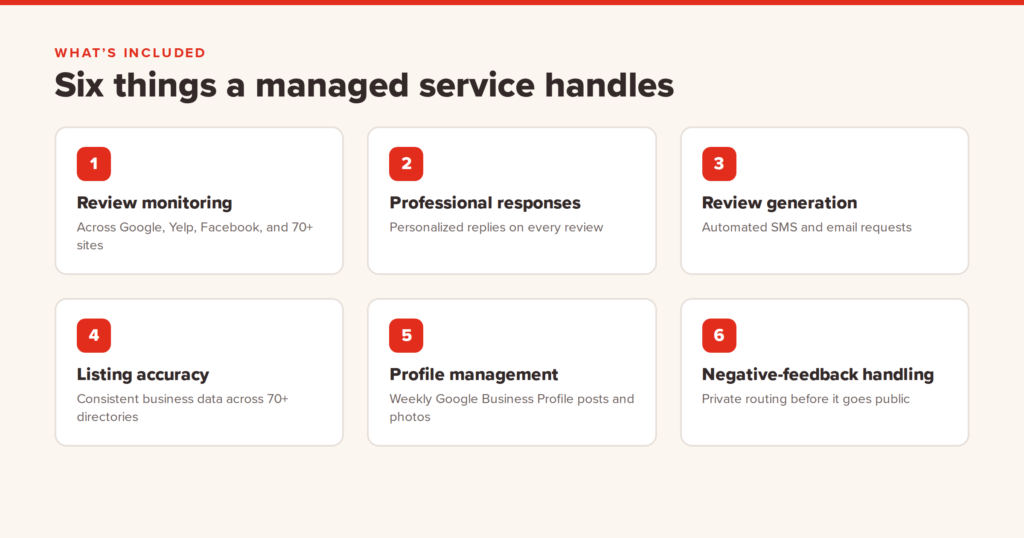
A complete managed service covers six core areas. If a provider is missing several of these, you’re really buying a tool, not a service.
Review monitoring across every platform
Reviews don’t only land on Google. Customers leave them on Yelp, Facebook, and industry-specific sites, and you can’t respond to what you don’t see. A managed service tracks reviews across Google, Facebook, Yelp, and dozens of other directories from one place, so nothing slips through.
Professional, timely review responses
Responding to reviews is where most businesses fall behind, and it’s also where reputation is won or lost. A good service writes personalized replies that acknowledge the customer and reinforce trust, on every review, not just the glowing ones. Slow or generic responses are increasingly read as a red flag by customers comparing their options.
Review generation
The best way to get more reviews is to ask, consistently. Managed services run automated review requests by SMS and email after a customer’s experience, turning happy customers into a steady stream of fresh five-star reviews instead of a one-time push.
Listing accuracy across the web
Your name, address, and phone number need to match everywhere they appear. Inconsistent listings confuse customers and the algorithms that rank you. A service syncs your business data across 70 or more directories so every platform tells the same story.
Google Business Profile management
Your Google Business Profile is often the first thing a local customer sees. Weekly posts, fresh photos, and regular updates signal to Google that you’re active, and active profiles get prioritized in the Map Pack, local search, and increasingly in AI Overviews.
Negative feedback handling
A strong service gives unhappy customers a private path to your team before frustration becomes a public one-star review. When someone signals dissatisfaction through an outreach message, the service routes them to a private channel so you can fix the issue directly. It also monitors for spam and policy-violating reviews you can flag for removal.
Software or managed service: which do you need?
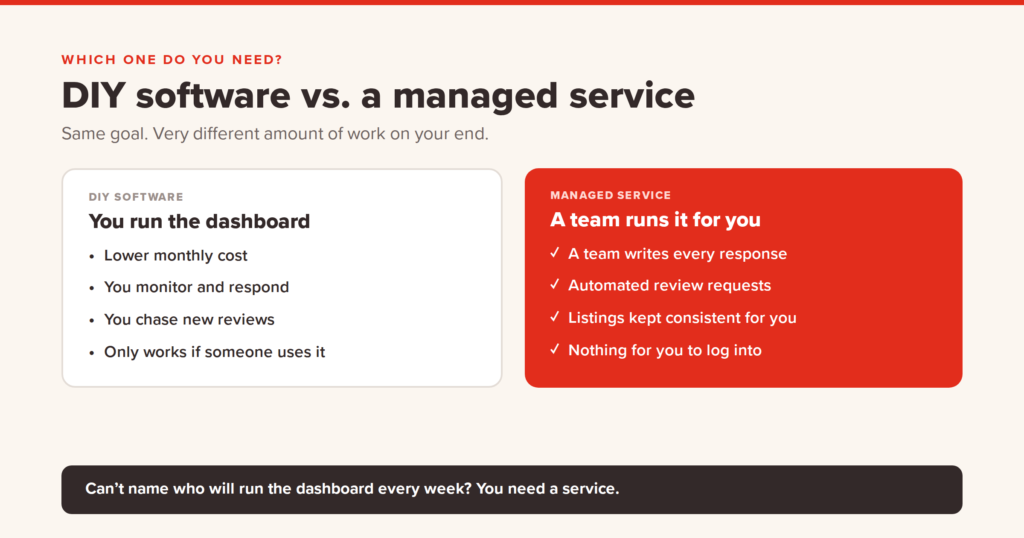
Choose software if you have the time and a team member to run it; choose a managed service if you’d rather hand off the monitoring, responding, and posting entirely. Software is cheaper on paper, but it only works if someone uses it consistently.
Here’s the honest trade-off. Software has a lower sticker price, but it adds a recurring task to someone’s week. If that person gets busy, which they will, the reviews pile up unanswered and the value evaporates. The tool is only as good as the consistency behind it.
A managed service costs more because a team is doing the work, but it removes the task completely. For owners who are stretched thin, businesses with more than one location, or anyone who has tried the software route and watched it gather dust, done-for-you is usually the better value, even at a higher price.
A quick way to decide: if you can name the specific person who will log in every week and reliably respond to reviews, software can work. If you can’t, you need a service.
How much do review management services cost?
Review management pricing depends on whether you buy software or a managed service, how many locations you have, and how much review volume you generate. HOTH Review & Reputation Management starts at $275 a month for a single location, with custom pricing for multi-location brands.
Standalone software usually sits at the lower end, a flat monthly tool fee, because you supply the labor. Managed services cost more because the labor is included: a team writes your responses, runs your requests, and keeps your listings clean. Pricing then scales with the number of locations and how active your review profile is.
For a real anchor, HOTH Review & Reputation Management starts at $275 a month for a single location and includes managed responses, review generation, listing syndication, and weekly Google Business Profile updates. Multi-location brands get custom pricing built around their footprint.
The better question than “what does it cost” is “what does it return.” For a local business, each phone call or direction request from your profile is a potential booking worth anywhere from a hundred to several hundred dollars. When a managed program turns your profile into a steady source of those actions, it tends to pay for itself many times over, which the results below show plainly.
Do review management services deliver results?
Yes. Managed review and reputation work consistently turns a strong offline reputation into measurable online growth, more profile views, more calls, more direction requests, and stronger local rankings, often within a few months.
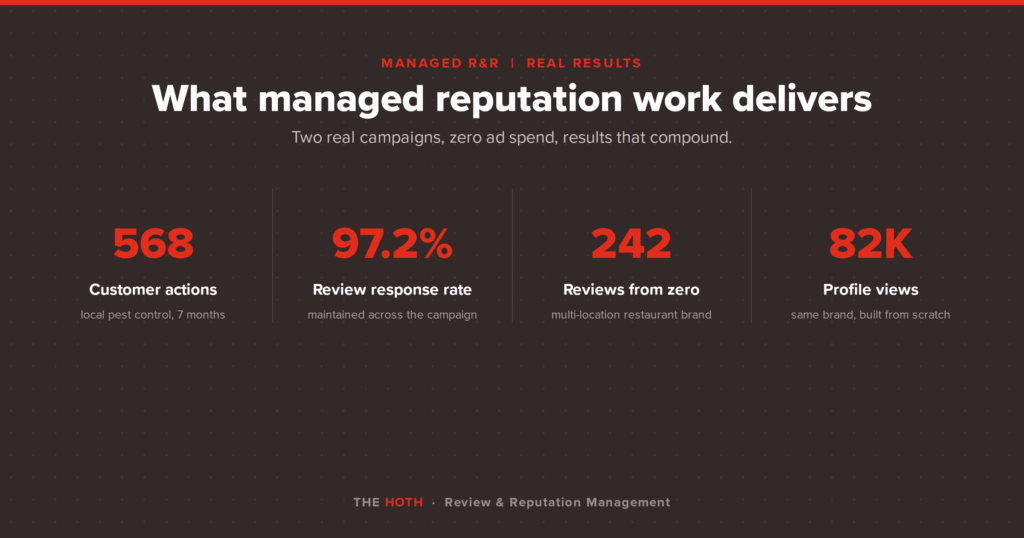
Take a Phoenix-area pest control company that already had a 4.9-star rating but a Google Business Profile that wasn’t pulling its weight. Over a seven-month managed campaign, the profile generated 568 customer actions: 116 phone calls, 248 direction requests, and 204 website visits. Monthly profile views climbed from around 200 to roughly 1,000, a 5x increase, while the team maintained a 97.2% review response rate and held the 4.9-star rating. The reputation work even lifted organic search, with traffic up 280% and page-one keywords tripling over the same window. All of it ran with effectively zero effort from the owner, who kept doing pest control work while the profile did the selling.
Now take the opposite starting point: a UK restaurant group with no Google reviews, no optimized profile, and no organic visibility. Built from zero through a managed program, the brand reached 242 Google reviews at a 4.8-star average, 82,000 profile views, and 6,910 total customer actions, including 1,760 direction requests and 4,870 website visits. It now ranks on page one for local terms diners are searching for, all without spending a penny on ads. Whether you’re protecting an established reputation or building one from scratch, consistent management is what moves the numbers.
How to choose a review management service
Once you’ve decided you want a managed service, use this checklist to separate a real provider from a risky one.
- Fully managed, not just a dashboard. Confirm a team writes and posts your responses and runs your requests, so the work gets done.
- Multi-platform coverage. Look for monitoring across Google, Yelp, Facebook, and listing syndication to 70 or more directories, since consumers now use an average of around six review sites before choosing a business.
- Both generation and response. You want a service that earns new reviews and handles the ones you have, not one or the other.
- Google Business Profile management. Weekly posts, photos, and updates are what keep you visible in the Map Pack and AI Overviews.
- A compliant approach to reviews. A legitimate service earns honest reviews. It never sells, buys, or fakes them, and it doesn’t filter out negatives to inflate your rating.
- Multi-location support and clear reporting, if you operate more than one location.
That compliance point is not optional. The FTC’s rule banning fake reviews and testimonials took effect in October 2024 and prohibits buying, selling, or faking reviews, paying for reviews tied to a specific sentiment, and suppressing honest negative ones. And the FTC has been explicit that reputation management companies can be held liable under the rule. If a provider promises to bury bad reviews or generate reviews for you, walk away. The penalties are real, and they can land on your business.
Common mistakes to avoid
- Buying or gating reviews. Paying for reviews or only routing happy customers to public review sites can violate FTC rules and erode trust if customers catch on.
- Ignoring negative reviews. A calm, professional reply often converts a critic into a repeat customer, and other shoppers are reading how you respond.
- Letting listings drift. One wrong phone number in a forgotten directory can cost you the customer who tried to call.
- Relying on one platform. Your reputation lives across many sites now, so managing only Google leaves trust on the table.
Choosing software when you have no time to run it. This is the most common and most expensive mistake. If the dashboard goes unused, you’ve paid for nothing. There’s a deeper reason reviews are worth getting right, too: they’re now one of the strongest trust signals AI search uses when deciding which businesses to recommend, which we cover in how reviews influence AI recommendations.
Turn your reputation into a growth channel
If you’d rather hand the whole thing off, HOTH Review & Reputation Management is a fully managed service. Our team monitors your reviews across Google, Facebook, Yelp, and 70-plus directories, writes and posts up to 200 professional responses a month, runs automated SMS and email review requests, syncs your listings, and publishes weekly updates to your Google Business Profile. Unhappy customers get routed to a private channel before they post, and you get clear reporting on the results.
It works for a single storefront or a 100-location brand, and it pairs naturally with local SEO when you want to turn that reputation into rankings. Pricing starts at $275 a month for one location.
Frequently asked questions
What are review management services?
They’re services that help you monitor, respond to, and generate online reviews while keeping your business listings consistent across platforms. They range from self-serve software to fully managed, done-for-you programs.
How much do review management services cost?
It depends on the model and your footprint. Software carries a lower monthly fee because you do the work; managed services cost more because a team handles it. HOTH Review & Reputation Management starts at $275 a month for a single location, with custom pricing for multiple locations.
Are review management services worth it?
For most local and multi-location businesses, yes. The results compound: more reviews and faster responses lead to more profile views, more calls and visits, and stronger local rankings. Each of those high-intent actions can be worth hundreds of dollars, so a managed program often pays for itself.
Can a review management service remove bad reviews?
Not legitimate ones. A good service helps you respond professionally and can flag reviews that violate platform policies for possible removal, but it can’t and shouldn’t delete honest negative feedback. Suppressing genuine reviews can violate FTC rules.
Is it legal to pay for or gate reviews?
No. The FTC’s 2024 rule prohibits buying, selling, or faking reviews and paying for reviews conditioned on a positive rating. Gating, where you only send satisfied customers to public review sites, is also risky. A reputable service earns real reviews instead.
Should I choose software or a managed service?
If you have someone who will reliably run a dashboard every week, software can work. If you don’t, a managed service is the safer choice, since it removes the task entirely and the work gets done.
The bottom line
Review management services exist on a spectrum from a tool you operate to a team that runs everything for you. Software is cheaper but only pays off with consistent effort. A managed service costs more and removes the work, which is why it tends to deliver for busy owners and multi-location brands. Whichever you choose, the fundamentals are the same: earn honest reviews, respond to all of them, keep your listings consistent, and never cut corners with fakes or suppression.
If you want a team to turn your reputation into a measurable growth channel, book a call and we’ll map out what review and reputation management could look like for your business.
Leave a comment