

Picture the moment your first digital PR placement lands. You open the report expecting your firm in the trade publications you read every week. Instead, there’s a leadership feature in a business magazine quoting your attorney about negotiation. Not a legal outlet. Not the headline you pictured.
A lot of clients pause right there and wonder whether the campaign missed the mark. It didn’t. A placement like that is digital PR doing exactly what it’s built to do.
This guide explains why earned coverage so often shows up in business, leadership, and general-interest publications instead of niche trade outlets, why those placements carry real value for your brand, and how to tell a strong placement from a weak one. By the end, that business-magazine feature should read like the win it is.
What a digital PR placement really is
A digital PR placement is earned editorial coverage: a credible publication quoting your expert because their insight made a story better. It is not a paid ad, and it is not a guaranteed slot in a publication that matches your exact industry.
Here’s the distinction that trips people up. Advertising buys you a spot. You pay, you pick the publication, you control the message. Digital PR works differently. Our team pitches your expert to journalists and editors who are actively building stories, and those editors decide whether your insight earns a place in the piece.
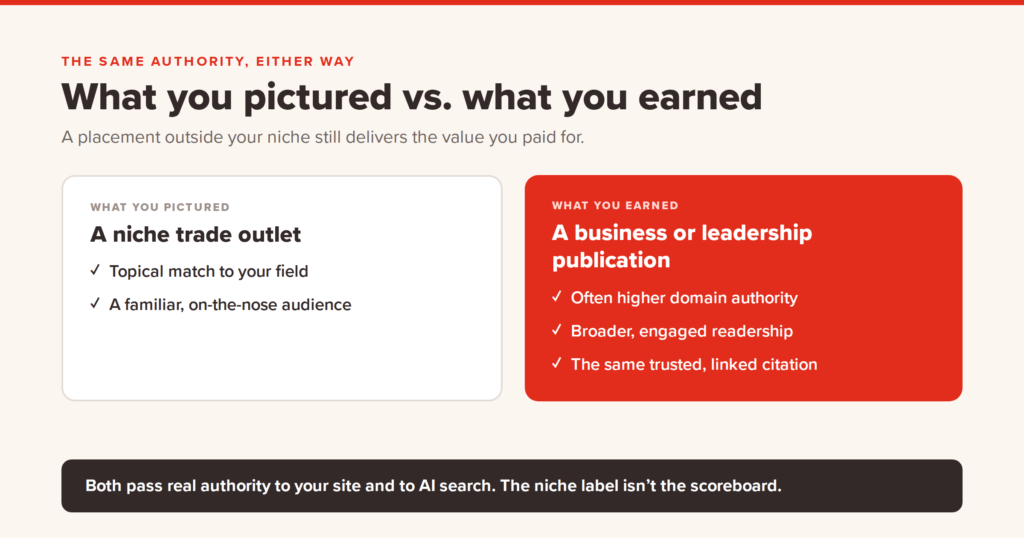
That means we can’t promise every placement will sit inside your specific vertical. What we can do is earn you mentions in credible publications where your expertise fits the story naturally. The value lives in three places: the authority of the backlink, the exposure to a real audience, and the trust a respected domain passes to your brand. None of those depend on the outlet matching your niche word for word.
So when a placement lands in a business or leadership outlet rather than a trade journal, you’re still getting the thing you paid for: a credible, earned citation tied to your name and your expertise.
Why a placement outside your niche is a win, not a consolation prize
This is the part worth sitting with, because it changes how you read every report we send.
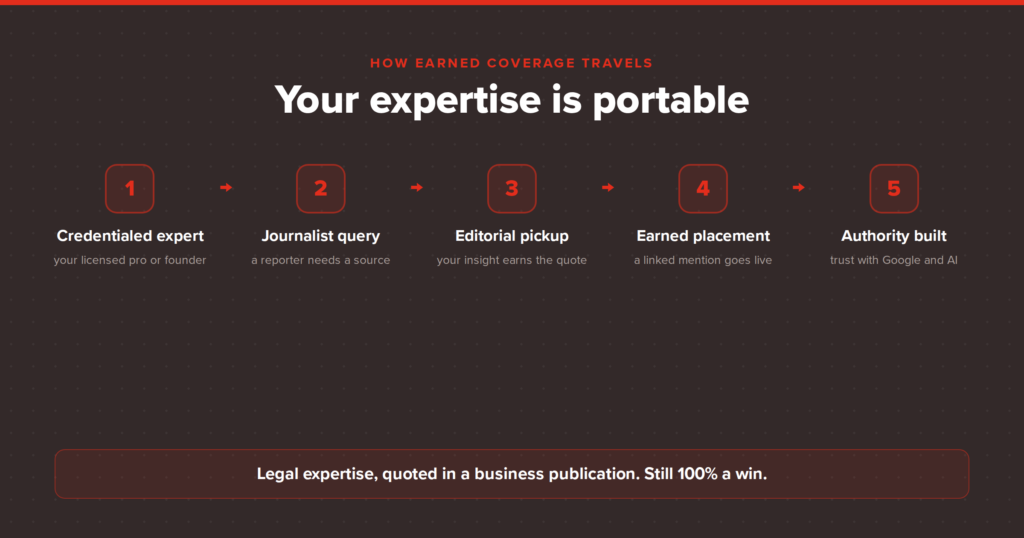
Editors quote credentialed experts on topics that reach well beyond those experts’ day jobs. A lawyer gets asked about negotiation. A financial advisor weighs in on leadership. A doctor comments on workplace wellness. The expertise earns the quote, and that expertise travels.
We saw this clearly with one law firm client. Across a single stretch, the same firm earned three placements. None were in a legal trade publication, and every one was earned specifically because of legal expertise:
| Grit Daily News Client: a law firm (name withheld) The firm’s attorney was featured in a leadership-development expert roundup, commenting on how professionals adapt to legal technology through intentional, ongoing learning. The angle was business leadership, but the credibility came straight from the attorney’s legal background. |
| Marketer Magazine Client: a law firm (name withheld) The same attorney was quoted on how to target niche audiences in advertising, drawing on real estate litigation experience (lease disputes, breach of contract) to speak to a marketing audience. A legal practitioner, quoted in a marketing outlet, because the expertise mapped to the topic. |
| Connectively (Featured.com network) Client: a law firm (name withheld) The attorney appeared in a negotiation-tactics roundup, using courtroom experience (jury persuasion, case outcomes) as the credibility hook in a general business context. |
Three placements, one firm, zero legal trade publications. And every placement is built on the firm’s legal authority. That’s the whole point. The publication is broad, but the expert is you, and the quote exists because your background made the story stronger.
If you’ve ever felt the urge to push back because a placement wasn’t in your exact field, here’s the reframe: a credentialed expert quoted on a broader topic isn’t a fallback. It’s a strong, earned placement that puts your name in front of a new audience while building your authority footprint across the web.
Your spokesperson is the engine
The single biggest factor in digital PR success is the spokesperson. Editors want qualified voices, so the stronger your expert’s credentials and title, the more coverage you earn and the wider it travels.
Reporters evaluating responses aren’t looking for just anyone at your company. They want a voice that signals authority. That’s why the spokesperson behind a campaign matters as much as the niche itself.
A few things make a spokesperson easy for editors to say yes to:
- A relevant license or credential when the topic calls for it (attorney, physician, CPA, licensed therapist, and so on)
- A title that signals authority, such as Founder, CEO, Partner, or Director
- Availability to provide timely, substantive quotes when a query comes in
- Expertise that lines up with the kinds of stories journalists are working on
Here’s the upside that connects back to the last section. A credentialed expert doesn’t just earn more placements. That expert earns placements across more topics. Your authority is portable, and that portability is exactly why your coverage reaches beyond your vertical.
Service-based and product-based brands: what to expect
Not every brand earns coverage at the same pace, and knowing where you fall helps set the right expectations from day one.
Service-based experts tend to see faster traction. Legal, medical, financial, home services, and consulting brands fit naturally into editorial stories because journalists are constantly hunting for expert commentary in those areas. The query relevance is broad, and the credentials are clear.
Product-based brands usually earn coverage through a different door. Instead of product-specific features, the strongest placements come through business, leadership, and operations angles. That isn’t a workaround. It’s how editorial coverage works for product companies, and the placements are just as real.
A few anonymized examples of product brands earning strong coverage on business angles:
- A sauna manufacturer was featured on warehouse strategy and trade-tariff agility (an operations leadership angle), and separately in an entrepreneurship piece on how business leaders choose their digital hubs.
- A B2B audio and communications brand was quoted on adapting communication styles for customer success.
- A manufacturing foundry appeared in a piece on how to ask for the sale, a business-development angle.
In every case, the brand is product-based, the placement is on a business or leadership topic, and the coverage is a real earned citation. If you sell a product, this is what good looks like.
How to judge whether a placement is a good one
It’s tempting to grade a placement by one question: was it in my industry? That’s the wrong scorecard. Here’s a better one.
Ask whether the publication is credible, with real domain authority and a real audience. Ask whether the placement ties your expertise to the topic in a way that makes sense. And ask whether it adds another trusted citation to your brand’s presence across the web. If the answers are yes, it’s a good placement, full stop, no matter whether the outlet sits inside your vertical.
There’s a second reason this matters more than it used to. The same earned mentions that build credibility with human readers are the trust signals that Google, AI Overviews, and tools like ChatGPT use to decide which brands to recommend. When your expert is quoted in a respected business publication, that placement is doing double duty: it builds authority with people, and it builds authority with the systems that increasingly answer your customers’ questions for them.
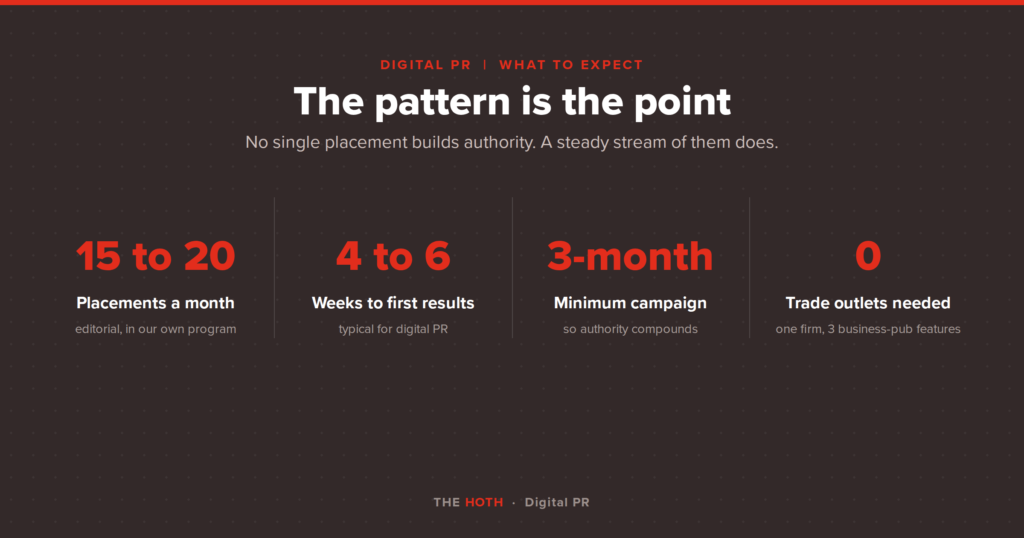
Authority also compounds. One placement is a data point. A steady stream of them across credible publications is a reputation. In our own program, consistent digital PR has earned 15 to 20 high-authority editorial placements a month on sites like Yahoo Finance, MSN, and HubSpot. No single placement built that footprint. The pattern did.
Setting expectations early pays off
The clients who get the most from digital PR are the ones who go in with the right picture. Before a campaign starts, it helps to align on a few things:
- Your spokesperson has credentials that match the topics we’ll pitch
- Coverage will appear in business, leadership, and general-interest publications, not only niche trade outlets
- Service-based brands typically see faster traction than product-based brands
- Placements are earned through editorial value, not bought or guaranteed
- A legal, medical, or financial expert may be quoted in a business publication, and that’s a strong outcome
- We agree on what success looks like across the first one to three months
None of these are caveats. They’re the operating manual for getting real value out of earned coverage.
Common questions clients ask
Why didn’t my placement appear in a publication from my own industry?
Because editors quote experts based on the value of their insight, not the label on their business. A placement in a credible business or general publication still carries the backlink authority, audience exposure, and domain trust you’re paying for, and it’s often easier to earn than a slot in a narrow trade outlet.
Niche trade publications run far fewer expert-commentary opportunities than broad business and leadership outlets. By pitching your expertise across a wider set of relevant stories, we earn more coverage, more often, for the same investment. Where a strong niche angle exists, we pitch it. We just don’t limit your coverage to it.
Does a mention in a business publication help my SEO and AI visibility?
Yes. A linked mention on a credible domain passes authority to your site the same way regardless of the publication’s topic. And because Google and AI tools weigh trusted editorial citations heavily when deciding which brands to surface, a placement in a respected business outlet can do as much for your visibility as a niche one, sometimes more, given the higher authority of many business and news domains.
Can my marketing manager be the spokesperson?
For broad business and leadership topics, a founder, CEO, or director works well. For topics that require specific professional expertise, like legal, medical, or financial queries, editors expect to hear from a credentialed professional (an attorney, physician, or CPA), not a marketing representative. Lining up the right expert before the campaign starts is one of the biggest predictors of how much coverage you earn.
How quickly will I see placements?
Most clients start seeing results in about four to six weeks. Digital PR runs on a three-month minimum because authority builds through a steady pattern of coverage, not a single placement. Service-based brands with a clear expert usually see faster traction than product-based brands.
Earn coverage that builds real authority
If you want your brand quoted in credible publications, our HOTH Digital PR team handles the journalist outreach and earns linked brand mentions on relevant media and news sites. Most clients start seeing results in about four to six weeks, with a three-month minimum so the authority has time to compound.
For brands ready to scale into broad coverage from a single campaign, HOTH Earned Media distributes an original editorial story across thousands of US publishers, earning dozens of pickups at once.
Want to see what earned coverage could look like for your brand? Book a strategy call and we’ll map it out with you.
Related read: Why Backlink Diversity and Relevance Build Lasting SEO Authority, which makes the same case for link placements that land close to your niche rather than exactly on it.
Leave a comment