

SaaS SEO is the practice of earning organic visibility for a software company across the full buyer journey, from the problem your product solves to the moment a buyer compares vendors. In the AI era, it also means becoming the source that Google’s AI Overviews and tools like ChatGPT cite when someone asks which software to use.
SaaS SEO is not regular SEO with a software logo on it. The buyer is a committee, the sales cycle is long, the queries span an entire funnel, and success is measured in signups and pipeline, not raw traffic. On top of that, the rules just changed: buyers now run a chunk of their research through AI that answers the question before they ever click.
This playbook covers the whole game. What SaaS SEO is, why it works, how to build a funnel-based strategy and content engine, how to handle links and technical SEO, how to win in AI search, and how to measure it all against revenue. It’s written for founders, heads of growth, and marketers who want a clear plan rather than a list of tips.
What is SaaS SEO?
SaaS SEO is search engine optimization built for software-as-a-service companies. It targets the keywords a buyer uses at every stage, from learning about a problem to comparing products, and aims to turn organic search into a repeatable signup and revenue channel rather than a vanity traffic number.
Every SaaS SEO program is trying to do one thing: make sure that when your buyer searches for the problem you solve, the category you compete in, or your competitors by name, your product is part of the answer. That happens across blog content, product and feature pages, comparison and alternative pages, and increasingly inside AI-generated answers.
The difference from generic SEO is intent and structure. A local plumber wants to rank for one city and one service. A SaaS company has to cover an entire topic universe, map it to a multi-step buying process, and connect it all so search engines and AI systems understand what the brand is an authority on.
Why SaaS SEO is worth the investment
SaaS buyers do most of their evaluation alone, online, before they ever talk to sales. Your content is the sales conversation, so the companies that show up across the research journey win the shortlist before a rep is ever involved.
The data on B2B buying makes the case better than any pitch. Gartner found that 61% of B2B buyers prefer a rep-free buying experience, and its broader research shows buyers spend only about 17% of the purchase journey meeting with potential suppliers. The rest is independent research and internal debate, much of it on your website or a competitor’s.
That research happens through a set of nonlinear buying jobs: identifying a problem, exploring solutions, building requirements, and selecting a supplier. SEO is how you get into the consideration set at each of those jobs. If your content answers the question a buyer is asking at the moment they ask it, you earn trust before anyone fills out a demo form. If it doesn’t, the deal is often lost before it starts.
What makes SaaS SEO different (and harder)
Knowing why SaaS SEO is its own discipline keeps you from treating it like a blog-and-backlinks checklist.
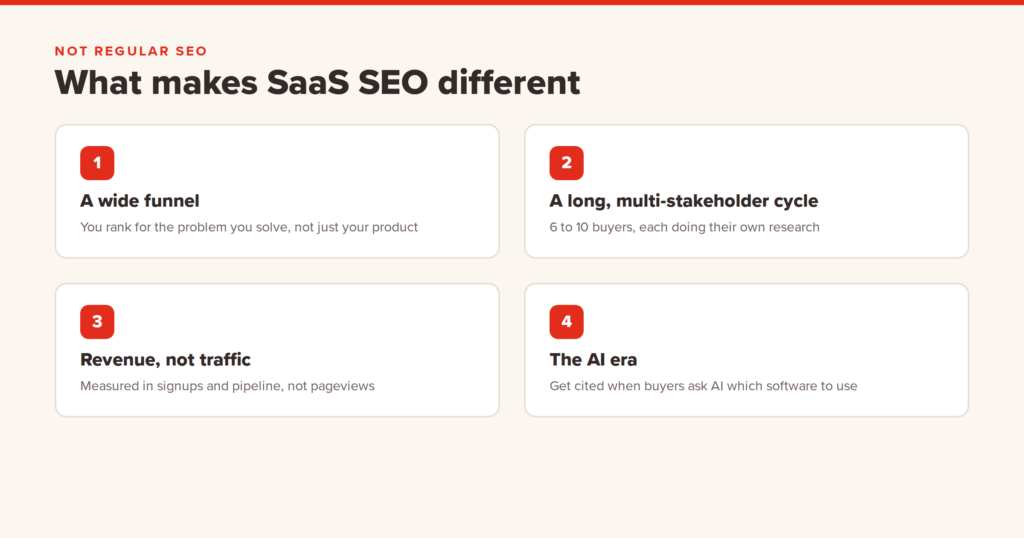
- The funnel is wide. You rank for the problem you solve, not just your product. A single buyer might search an educational question, a category comparison, and a competitor’s name across one evaluation.
- The sales cycle is long and multi-stakeholder. A buying group of six to ten people each gathers their own research, so your content has to serve several roles and personas at once.
- Success is revenue, not traffic. A post that pulls 10,000 readers who will never buy is worth less than a comparison page that converts 50 in-market buyers. SaaS SEO is judged on signups, trials, and pipeline.
- The competition is fierce and technical. Software niches are saturated with well-funded competitors and tech-savvy SEO teams, which raises the bar on both content depth and execution.
There’s also a real technical layer: product tiers that create duplicate content, JavaScript rendering, orphan pages, and sprawling architecture. We cover that fully in our SaaS technical SEO checklist, so this playbook stays focused on strategy.
Build your strategy around the funnel
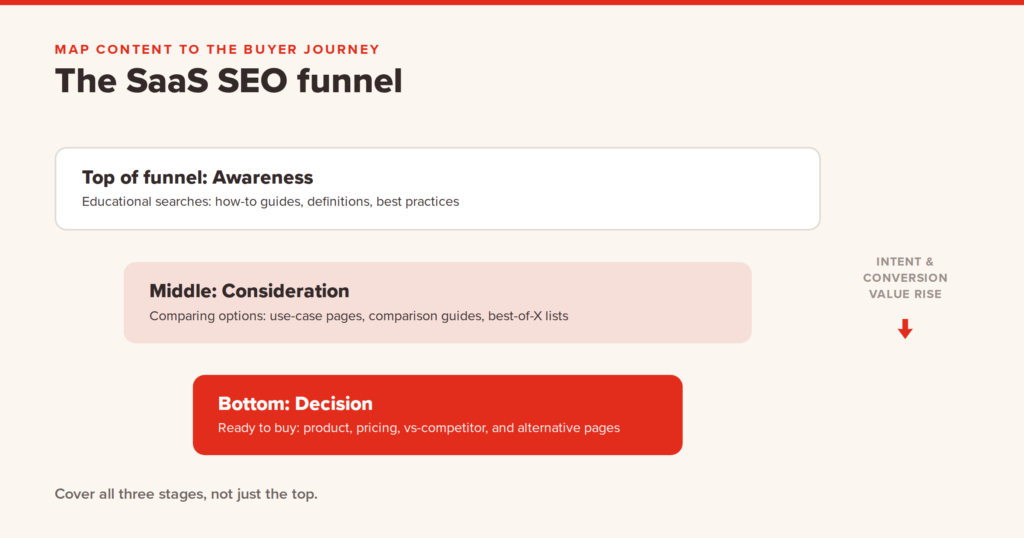
A SaaS SEO strategy maps keywords and content to the buyer’s funnel: educational content at the top, comparison and use-case content in the middle, and product, alternative, and pricing pages at the bottom. Each stage needs its own intent match.
The most common SaaS SEO mistake is writing only top-of-funnel blog posts, pulling traffic that never converts, and concluding SEO doesn’t work. The fix is to deliberately cover all three stages.
Top of funnel: build awareness
These are problem-aware, educational searches from people who may not know your category exists yet. Think how-to guides, definitions, and best-practice articles. The goal isn’t a hard sell, it’s to be the helpful first answer and enter the buyer’s awareness. Match the educational intent, then guide readers toward the next step.
Middle of funnel: drive consideration
Now the buyer knows the category and is weighing options. This is where use-case pages, comparison guides, best-of-X-tools lists, and content that maps your product to a specific job all earn their keep. These pages capture buyers who are actively shopping, so they convert far better than top-of-funnel posts.
Bottom of funnel: capture demand
These are the highest-intent searches you can rank for: your product and feature pages, pricing, integration pages, and the two that SaaS companies underuse most, comparison pages (your product versus a named competitor) and alternative pages (someone searching for an alternative to a competitor is a buyer in motion). A strong set of these pages quietly closes deals while you sleep.
The SaaS content engine
SaaS SEO rewards volume and coherence, not one-off articles. The engine that produces compounding results is built on topic clusters and a clear architecture.
Organize content around concepts, not scattered keywords. Build pillar pages for your core topics, surround them with cluster content covering every subtopic, and link them tightly so search engines and AI systems can see what you’re an authority on. This is the heart of semantic SEO, and for SaaS it’s the difference between fragmented rankings and a site that owns its category.
Product-led content is the SaaS multiplier. Instead of generic advice, show your product solving the exact problem the reader searched for. It satisfies intent, demonstrates value, and moves the reader toward a trial in the same breath. Integration pages, template libraries, and free tools also tend to earn links and rankings at scale.
The catch is consistency. A content engine only compounds if it keeps running, which is why many SaaS teams use a managed program like HOTH Managed Content to keep the calendar full without hiring an in-house team. Whatever the source, the priority is depth and coherence over a pile of unconnected posts.
Authority and links for SaaS
In a saturated software niche, content alone rarely wins. Authority is what gets a strong page over the line, and it’s what AI systems weigh when deciding which sources to trust.
The links that matter for SaaS come from relevant, credible places: tech and industry publications, digital PR and earned media coverage, partner and integration pages, and data-driven content that other sites want to cite. A single original research piece or benchmark report can earn more links than a year of guest posts. The formula our team has seen work across software clients is simple to say and hard to fake: high-quality content plus diverse, authoritative links.
SaaS SEO in the AI era
In the AI era, SaaS SEO means optimizing to be cited, not just ranked. When a buyer asks ChatGPT or Google’s AI Overview which software to use, the brands named in the answer win the shortlist, and getting there depends on authority, structured content, and third-party validation.
This is the biggest shift in SaaS SEO, and it’s tailor-made for software. Buyers now ask AI tools questions like which tool is best for a given job, or what the top alternatives to a product are. Those are pure SaaS buying queries, and the answer is a short list. If your product is on it, you’re in the deal. If it isn’t, you’re invisible before the prospect ever reaches your site.
AI visibility is also becoming winner-takes-most. Analysis of AI citation patterns has found that the top 10 domains in a topic capture nearly half of all citations, and AI systems develop lasting source preferences, so the brands that establish themselves now compound their lead. We break this down in our guide to AI Discover and AI search visibility.
Winning citations comes down to a few signals: content structured so a model can lift a clean answer, third-party validation from publications and review platforms like G2 and Capterra, consistent brand mentions across the web, and fresh, authoritative pages. These overlap heavily with good SEO, which is why a strong SaaS SEO program and a strong AI visibility program are really one effort.
How to measure SaaS SEO
Measure SaaS SEO on pipeline, not pageviews. Track organic signups, trials, and demos by funnel stage, the revenue influenced by organic, and how often your brand is cited in AI answers, then tie each back to the content and keywords that drove it.
Raw traffic is the easiest metric to grow and the easiest to fool yourself with. The numbers that matter for a SaaS company are organic-sourced signups and demos, assisted conversions across a long buying cycle, the keywords and pages that influence pipeline, and your share of AI citations in your category. Set those up first, and every content and link decision gets easier to justify.
What SaaS SEO results can look like
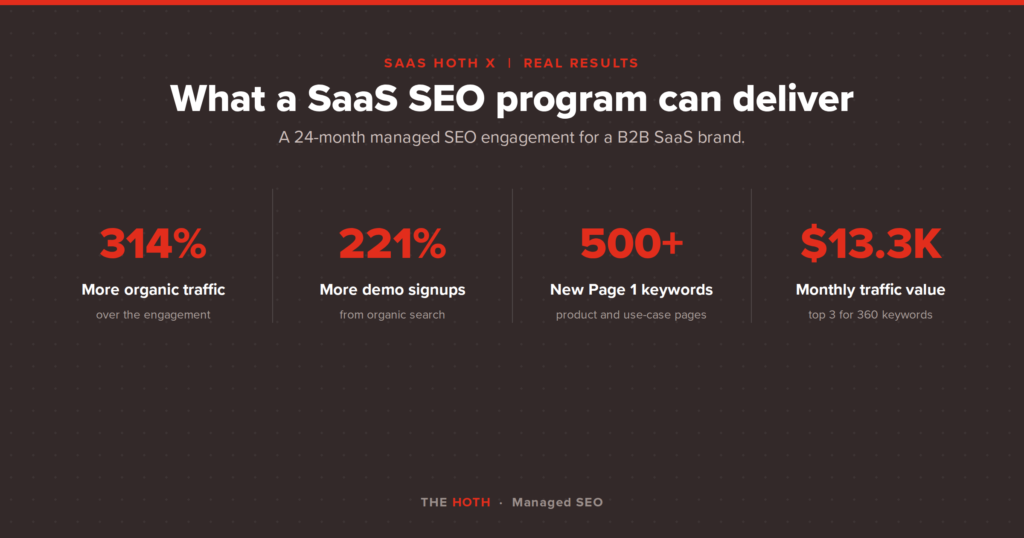
Here’s the playbook in practice. A B2B SaaS company serving mid-sized enterprises came to us with a strong product but weak organic visibility: minimal traffic to core product and use-case pages, thin mid- and bottom-funnel keyword coverage, and few authoritative links. Over a 24-month managed SEO engagement, we mapped keywords across product, feature, and industry pages, rebuilt the content architecture around use-case concepts, optimized for both decision-makers and technical users, and ran high-authority link building in the tech and SaaS space.
The results: a 314% increase in organic traffic, a 221% increase in software demo signups, more than 500 new Page 1 keyword placements, and top-3 rankings for 360 keywords, with monthly organic traffic value reaching $13.3K. The point isn’t the exact figures, it’s the mechanism. Funnel-mapped content plus authority links, aimed at a coherent architecture, compounds into pipeline.
The fastest path for most SaaS companies
You can run this playbook in-house, but it’s a lot to sustain. If you’d rather hand it to a team, HOTH Managed SEO (HOTH X) is a fully managed program that combines content, technical SEO, and authority link building under a dedicated campaign manager, built to drive visibility in both Google and AI search.
If your priority is making sure AI tools recommend you when buyers ask which software to use, AI Discover is our managed AI visibility program, with citation tracking so you can see your position in AI answers rather than guess at it. Most SaaS companies benefit from running content, links, and AI visibility together rather than in isolation.
Frequently asked questions
What is SaaS SEO?
SaaS SEO is search engine optimization tailored to software-as-a-service companies. It targets keywords across the full buyer funnel and aims to turn organic search, and now AI search, into a steady source of signups and revenue.
Is SEO worth it for B2B SaaS?
Yes, because most B2B buyers research independently online before contacting sales, and a majority prefer a rep-free experience. Your content does the early selling, so showing up across the research journey directly shapes who makes the shortlist.
How long does SaaS SEO take to work?
Plan for a horizon of months, not weeks. Most programs start showing momentum within a few months, with compounding results over a year or more as content depth and authority build. The case above ran over 24 months for its full effect.
What keywords should a SaaS company target?
Map keywords to the funnel: educational, problem-aware terms at the top; comparison, use-case, and best-of-X terms in the middle; and product, pricing, competitor-comparison, and alternative terms at the bottom. Bottom-funnel terms convert best, so don’t neglect them for traffic-heavy blog topics.
How is SaaS SEO different in the AI era?
AI tools now answer buying questions directly, naming a short list of products. SaaS SEO now includes optimizing to be cited in those answers through structured content, third-party validation, and brand authority, not just ranking blue links.
How do you measure SaaS SEO ROI?
Track organic-sourced signups, trials, and demos, the pipeline and revenue influenced by organic, and your share of AI citations, rather than raw traffic alone. Tie each result back to the specific content and keywords that drove it.
The bottom line
SaaS SEO is a full-funnel, revenue-focused discipline, and in the AI era it’s also a fight to be the source that AI tools cite when buyers ask what to use. Win it by mapping content to the buyer journey, building a coherent content engine, earning real authority, getting the technical foundation right, and measuring everything against pipeline. Do that consistently and organic becomes one of your most durable acquisition channels.
Want a team to build and run it for you? Book a call and we’ll map a SaaS SEO plan to your product, your funnel, and your goals.
Leave a comment