

If there are no keyword rankings or click-through rates, how do I know if I’m winning?
This is the situation many search marketers now find themselves in when trying to track AI search visibility.
Classic SEO metrics like position rankings and CTRs completely miss instances where your brand appears in AI-generated answers.
The fact is that traditional rank and traffic reports are lagging indicators in an AI-first world. Even classic search engines now prioritize AI Overviews and summaries, reducing the organic results to an afterthought in many cases.
Also, no impressions data exists for responses across platforms like ChatGPT and Perplexity, which makes tracking campaign progress difficult.
The good news?
With a new set of KPIs and monitoring tools, it’s entirely possible to measure your brand’s AI visibility.
In this guide, we’ll teach you the most effective ways to track your AI search visibility and share of voice without relying entirely on paid tools.
Why Traditional SEO Metrics Fall Flat for AI Search

Most SEO monitoring tools were built for the ‘10 blue links’ world, which is becoming antiquated.
Consider these statistics:
- Google’s AI Overviews now reach 2 billion monthly users and are available in over 200 countries.
- Approximately 60% of online searches now end in zero clicks, so CTRs have become less reliable indicators of visibility.
- The average AI search visitor is worth 4.4x more than a traditional organic search visitor. That means AI traffic converts well and is worth tracking.
While many platforms have added some new features for tracking AI citations, like Ahrefs and Semrush, the majority of their focus remains on organic search.
This puts marketers in a tricky position since they’re expected to quickly adapt to AI search while lacking reliable tools to measure their progress.
Here are the main reasons why organic search metrics fall flat for tracking AI visibility:
-
Rankings miss AI presence.
Rank trackers only measure keyword position rankings, but AI tools bypass this entirely. Theoretically, your content could power 70% of ChatGPT’s responses for ‘local gardening tools’ yet show zero rankings. No rankings, impressions, or CTR estimates means you’d be totally blind to massive brand exposure, which could lead you to falsely label your AI search strategy as a failure.Rankings miss AI presence.
-
Lagging indicators hide real impact.
Traffic and conversions trail AI visibility by weeks or sometimes months. Users tend to trust AI summaries first and then click only when needed. Rankings chase lexical keywords, while AI favors topical authority and third-party mentions from trusted sources.
-
No visibility into key signals.
Traditional SEO tools aren’t capable of parsing brand mentions in AI answers, brand sentiment, or competitor share of voice.
Because of these reasons, tracking AI search visibility requires a brand-new mindset and KPIs.
Redefining Online Visibility in AI’s Terms: The Four P’s

Instead of thinking in terms of rankings, you need to reframe visibility into the four dimensions that actually matter for AI search, also called the four P’s:
-
Presence
Are you appearing in generative AI answers and summaries?
-
Prominence
Are you framed as the definitive source or are you one of many?
-
Perception
What’s the sentiment behind your brand’s citation? (‘best,’ ‘trusted alternative,’ ‘budget option’)
-
Performance
Are your citations translating into real outcomes like more traffic and conversions?
As you can see, it’s not enough to simply appear in AI Overviews and summaries. For this form of online visibility to pay off, you need the right framing to convince users to click on your citation links or look you up later.
That’s what leads to tangible results like direct brand searches, AI-generated traffic, and single-session conversions (like a user trusting ChatGPT’s recommendation for your product or service).
Let’s take a closer look at the four P’s and how to track your progress for each of them.
#1: Presence: Showing Up in AI-Generated Responses
Unlike keyword rankings, which provide a spectrum of visibility, AI citations are more binary. Either your brand is mentioned in an AI-generated response, or it’s completely absent.
Presence is also table-stakes for capitalizing on AI search visibility. You can’t generate traffic and conversions if you aren’t appearing in AI-generated answers and summaries.
At the same time, presence alone is not enough to achieve real business goals.
If other brands are overshadowing you as the definitive source or LLMs frame you as ‘not the best option,’ your appearance in AI answers likely won’t amount to much.
Think about it this way: your presence in AI answers is your North Star metric. It lets you know that you’re on the right path, but prominence is your rocket, and perception is the trajectory that propels you to your final destination.
Methods to track your presence in AI responses
Here’s how to measure presence.
For key customer queries, track what % of AI answers (across platforms like AI Overviews, ChatGPT, and Perplexity) include you.
There are manual and automated ways to go about this.
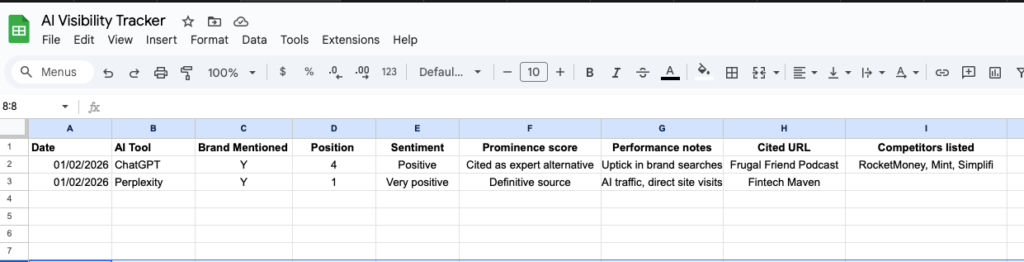
The manual method involves running 50+ customer-intent queries per week, and then documenting the results in a spreadsheet.
Here’s what that might look like using the prompt, “What’s the best budgeting app for beginners?”
Let’s assume we’re optimizing visibility for the brand YNAB (You Need a Budget).
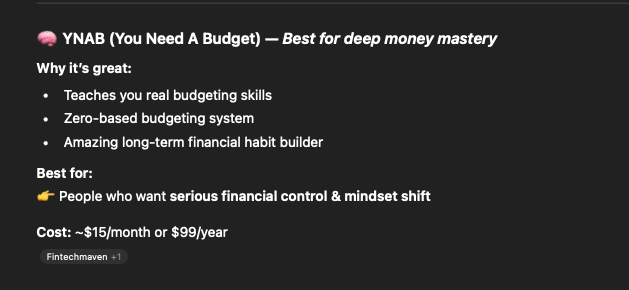
ChatGPT’s response:
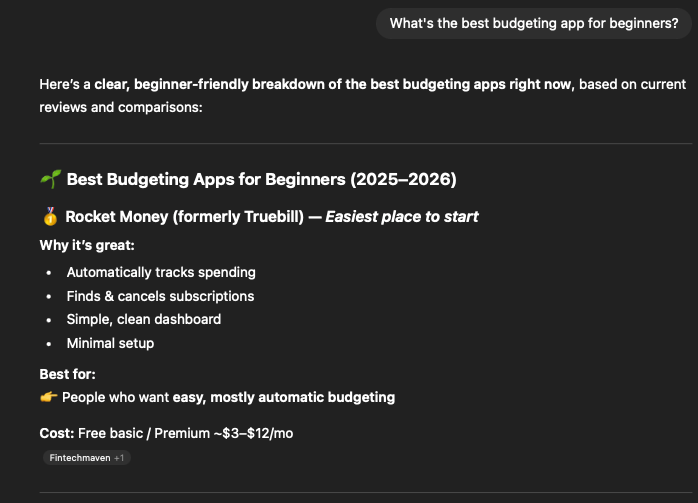
Here, RocketMoney takes the cake, but YNAB is mentioned in a lower position:
Here’s Perplexity’s response to the same query:
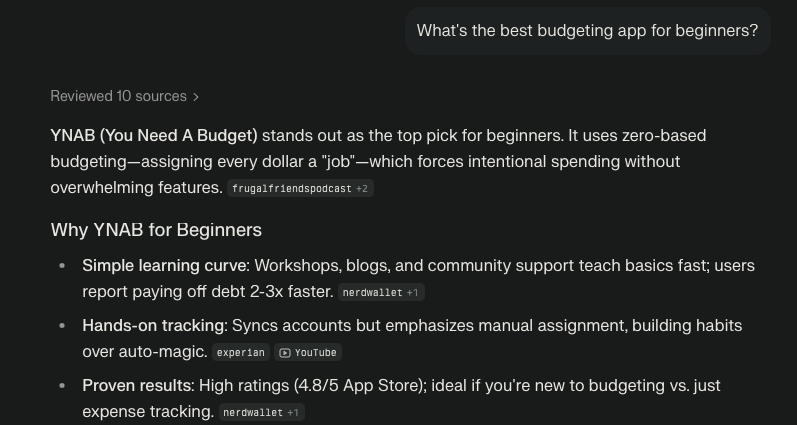
Perplexity has YNAB as the definitive source.
Here’s how you could document this in Google Sheets:
On the automated side, the following tools let you view your AI citations:
- Ahrefs
- Semrush
- BrightEdge’s AI Catalyst
#2: Prominence: Dominating the Conversation
Next, prominence refers to how much of the AI answer you control once you’ve earned a citation in the response.
Ideally, you want to dominate the answer as the definitive source provided. You don’t want to be the ‘budget option’ or ‘a worthy side mention.’
You want to be the top pick and the most trusted source.
Here’s what that typically looks like:
- Your brand is listed first or appears at the very top of the answer.
- More descriptive copy is dedicated to you over your competitors
- You’re framed as the top recommendation instead of an alternative.
Here’s an example of the prominent source in one of Google’s AI Overviews:
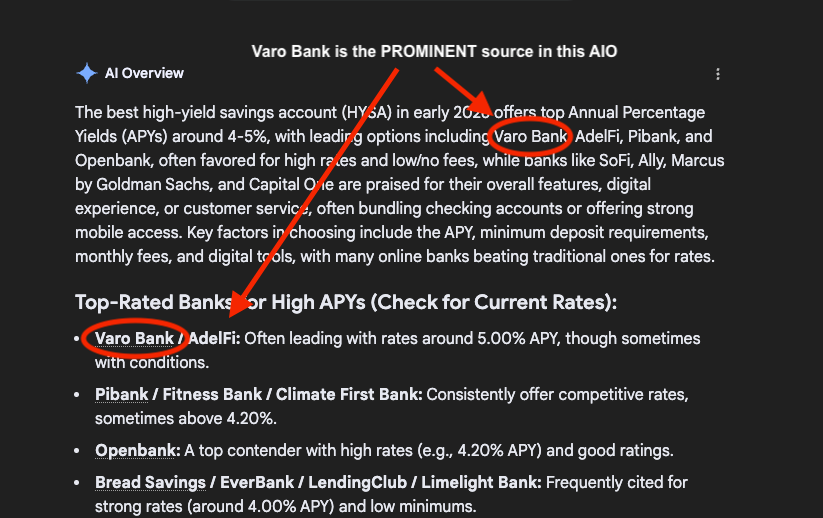
Varo Bank is mentioned first, contains the most descriptive text, and highlights the best interest rate. This is what’s considered prime page real estate for generative AI responses.
In other words, Varo Bank’s citation is the equivalent of ranking #1 in the organic search results.
Therefore, it should stand to gain the most from appearing in this AIO compared to the other banks. That’s not to say that the other brands won’t benefit some from appearing in this generated response, just that Varo Bank is the clearest ‘winner.’
How to track AI prominence
The most important KPIs for prominence are:
-
AI share of voice (SOV).
The formula for calculating your AI SOV is to divide your brand mentions across a set number of responses by the total number of brand mentions across the same set number of responses, and then multiply by 100.
For instance, imagine running ‘what’s the best budgeting app for beginners’ 50 times on ChatGPT and 50 times on Perplexity.
If your brand appears 25 times, and there are 100 total mentions, then your SOV is 25% (25/100 x 100).
Some tools allow you to calculate AI SOV for individual responses. So, if your brand is mentioned 3 times in a query that mentions 5 brands, your SOV is 60% for that response.
-
Average citation position.
Ahrefs Brand Radar enables you to view your average citation position, which is where your brand appears in the response. This lets you know whether you tend to lead or trail in AI citations.
-
Answer share of copy.
You can also use the Brand Radar to learn which pieces of your content are influencing citations the most, as well as how prominently your brand is featured in each response.
| Need help establishing your brand as a prominent voice in your industry? Sign up for HOTH X, our 100% managed service where we enact a custom search strategy on your behalf. |
#3: Perception
Brand sentiment plays a major role in the effectiveness of your AI citations.
In particular, it matters how LLMs frame you in the context of the query.
Some examples of perception include:
- Positive – Top pick, the best, proven experts, etc.
- Neutral – One option, something to consider, a provider, etc. (not framed as good or bad)
- Negative – Avoid, untrustworthy, shady practices, etc.
Obviously, the goal is for AI search platforms to frame your brand as honest, high-quality, and one step ahead of competitors.
Tools like Ahrefs and Semrush can help you gauge the perception behind your brand, but you can also track it manually through a column in Google Sheets (like the one pictured above).
#4: Performance
Lastly, performance ties your AI exposure to your desired outcomes.
This dimension closes the loop between AI mentions and business impact; the difficulty is that AI search visibility tends to precede clicks by weeks or months.
As an example, a budget app newbie may come across YNAB in an AI response and then put it in the back of their mind. A week later, they decide to visit the YNAB site directly without using an AI search platform.
This direct site visit is because of their exposure to the brand through AI search, but proving that attribution is impossible with current SEO metrics and reports.
Here’s an effective method to track performance:
- Filter GA4 for AI referrals or UTM-tagged queries that match your target prompts.
- Rising branded traffic and conversions after AI tests indicate assisted impact.
So, while there’s no direct assisted conversions report in GA4 or GSC, you can infer their impact through direct site visits, branded searches, and conversions that occur after spikes in AI visibility.
Wrapping Up: Measuring Search Visibility Without Rankings
In short, the four P’s are to AI search what keyword rankings and CTRs are to organic search.
They’re both how you measure your visibility, the effectiveness of your search campaigns, and the real impact on your business goals.
After all, it’s impossible to improve your search performance if you don’t know how to track your progress.
Do you want to leave your AI search visibility to experts like us?
Sign up for AI Discover, our new product that’s 100% focused on making your brand the one that AI search tools recommend.
Leave a comment