
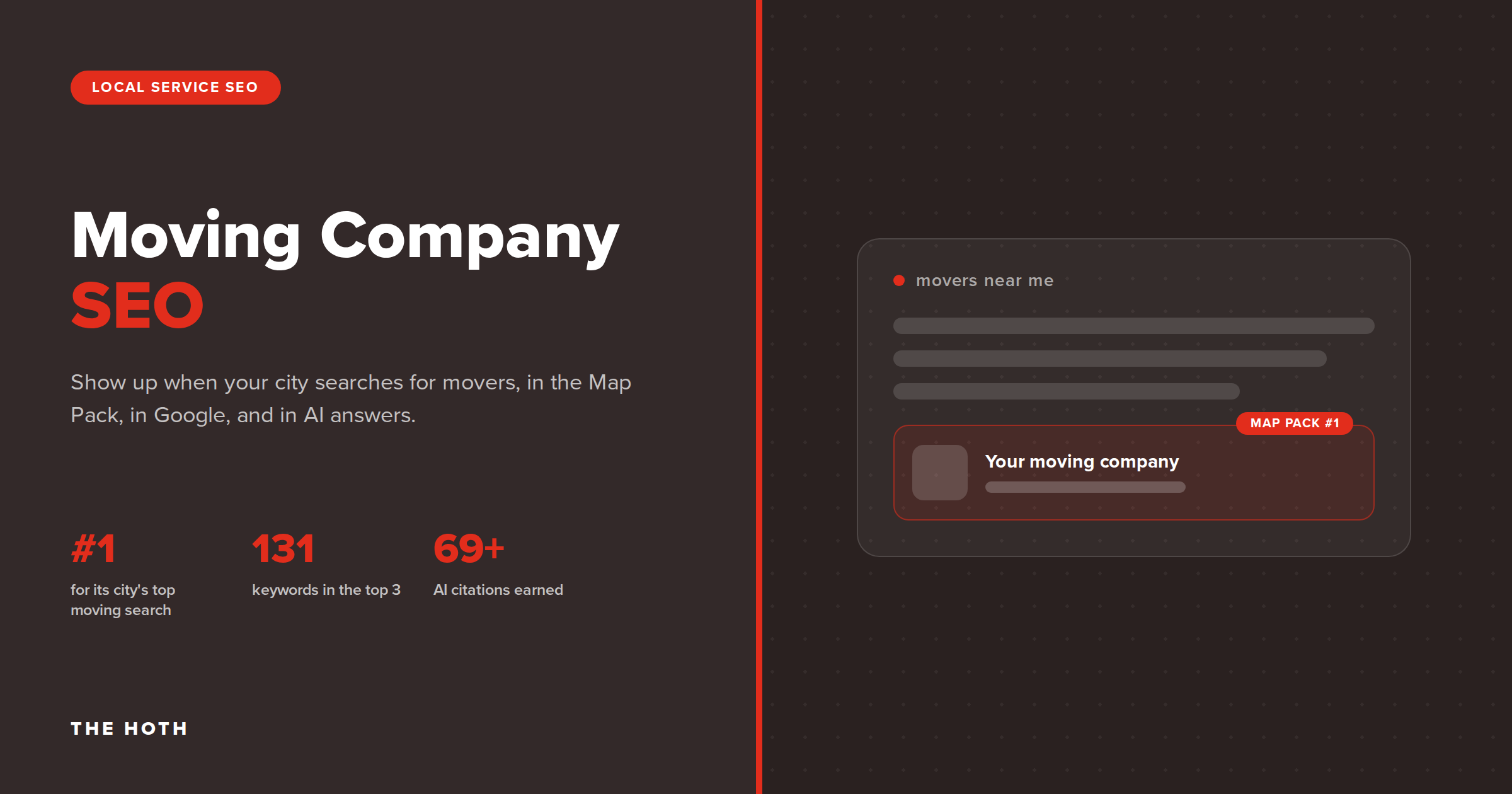

Moving company SEO is the work of getting a moving business to show up when people search for movers in its area, across Google’s Map Pack, the organic results, and now AI answers. For movers it comes down to local signals: an optimized Google Business Profile, consistent citations, real reviews, and location-specific content.
When someone needs a mover, they do not ask around the way they used to. They pull out a phone and search movers near me, or they ask ChatGPT who to call. Whoever shows up in that moment gets the quote request. Whoever does not is invisible, no matter how good their trucks and crews are.
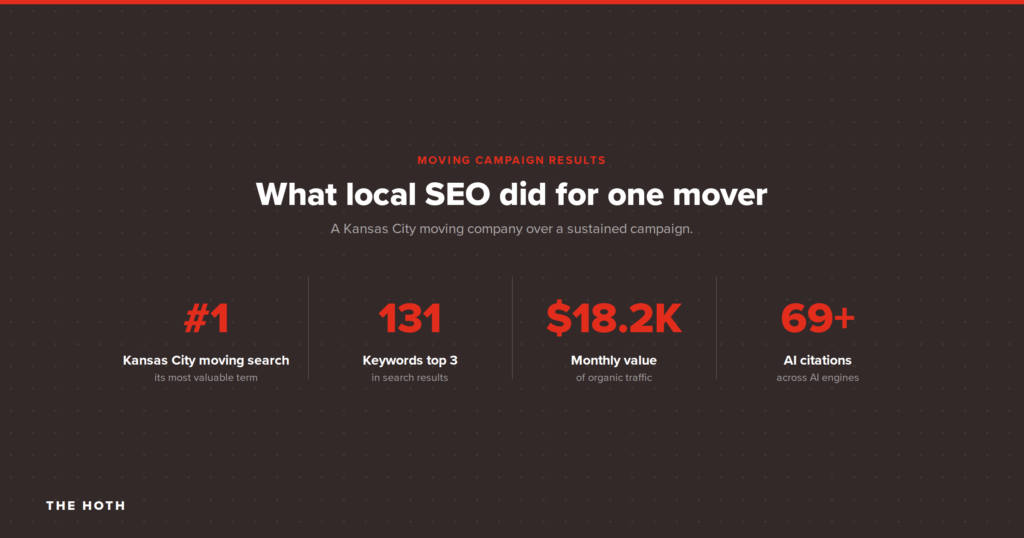
Here is what winning that moment looks like. A Kansas City moving company we worked with went from stagnant to number one for its most valuable search, moving company Kansas City. Along the way it earned 131 keywords in the top three positions, an estimated 18,200 dollars in monthly organic traffic value, and 69 or more citations in AI answers. This guide breaks down how moving company SEO works and how to get your business booked, in Google and in AI.
Why does SEO matter for moving companies?
Movers live and die by local search. The overwhelming majority of people find a moving company through Google or, increasingly, an AI assistant, so if you are not in those results, a competitor gets the call.
Around 97 percent of consumers use search engines to find local businesses, and 88 percent of people who run a local search on their phone visit or call a business within a week. For a moving company, that is the entire funnel. Nobody moves without searching first, and the searches are high-intent: someone typing movers in my city is ready to book, not browsing.
Moving is also seasonal and fiercely competitive. Demand spikes in summer, every metro has a crowded field of movers fighting for the same terms, and the jobs are high-value enough that one ranking can be worth thousands in revenue. That combination is exactly why local SEO pays off so well for movers: the intent is high, the jobs are valuable, and most competitors are doing the basics poorly.
How does moving company SEO work?
It combines local SEO, the Map Pack, Google Business Profile, citations, and reviews, with the content and links that rank your website, plus AI visibility so you appear when someone asks an assistant to recommend a mover.
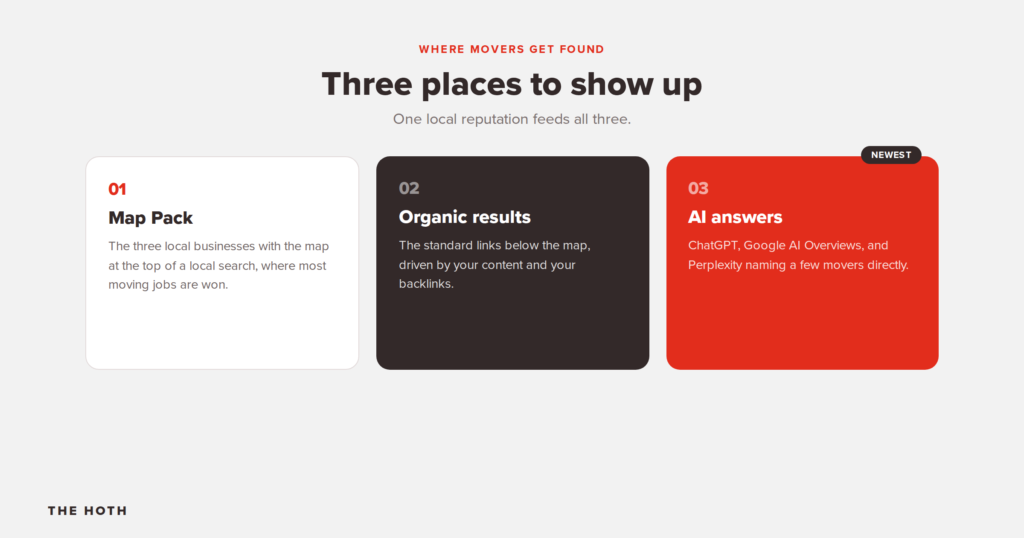
There are three surfaces you need to win, and they feed each other. The Map Pack is the block of three local businesses with the map at the top of a local search, driven by your Google Business Profile and local signals. The organic results are the standard links below it, driven by your content and backlinks. And AI answers are the newest surface, where ChatGPT, Google’s AI Overviews, and Perplexity name a few movers directly.
The good news for movers is that the same foundation feeds all three. Consistent business information, strong reviews, and useful local content push you up the Map Pack, help your pages rank organically, and give AI tools the trust signals they use to recommend you. You are not running three separate campaigns. You are building one local reputation that shows up everywhere.
The moving company SEO playbook
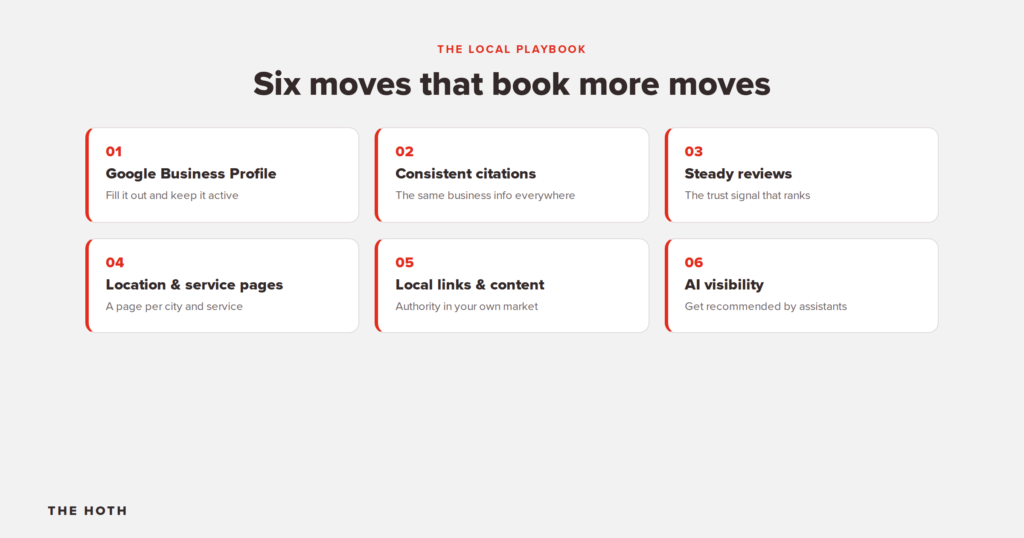
Optimize your Google Business Profile, make your business citations consistent, build a steady flow of reviews, create location and service pages, earn local links, and structure everything so AI tools can recommend you. Those are the levers that book more moves.
Here is the playbook in the order we would run it for a moving company.
1. Optimize your Google Business Profile
Your Google Business Profile is the engine of the Map Pack, and the Map Pack is where most local moving jobs are won. Fill out every field, choose the right primary and secondary categories, add real photos of your trucks and crews, keep your service areas accurate, and post regularly. An active, complete profile signals to Google that you are a real, responsive business worth showing first.
2. Make your citations consistent
A citation is any place your business name, address, and phone number appear online, from directories to review sites. When that information is inconsistent across the web, it confuses Google and the AI tools that read the same data, and it drags down your local rankings. A citation cleanup audits and corrects those listings so every source agrees on who and where you are.
3. Build a steady stream of reviews
Nobody hands their belongings to a mover with two stars. Reviews are one of the strongest local ranking factors and the single biggest trust signal a customer, or an AI assistant, weighs when choosing a mover. Ask every satisfied customer for a review, respond to all of them, and keep the flow steady rather than in bursts. A managed review and reputation program keeps that signal strong, which lifts your Map Pack rankings and your odds of being recommended in AI answers at the same time.
Cadence matters as much as count. A steady trickle of fresh reviews signals an active, healthy business, while a pile of old reviews and nothing recent reads as a company that has gone quiet. Aim to earn reviews every week during busy season, and reply to every one, positive or negative, because Google and customers both reward a mover that stays engaged.
4. Create location and service pages
Movers rank by matching real searches, so build a page for each thing people look for: your main city, the suburbs and metros you serve, and each service like local moves, long-distance moves, packing, and storage. A dedicated page for movers in each city you cover will always outrank a single generic page trying to target them all. Write each one for a real person deciding who to hire, not just for the keyword.
5. Earn local links and content
Links from local and industry sources tell Google your business is established and trusted in its market. Local sponsorships, partnerships, and useful content, like a guide to moving costs in your city, earn the kind of coverage that builds authority. For movers, a little local content goes a long way, because the competition rarely bothers.
6. Structure everything so AI can recommend you
Make it easy for AI tools to read and cite you. Clear service pages, a complete Google Business Profile, strong reviews, and accurate information everywhere are exactly what an assistant pulls from when someone asks for a mover. The local work you are already doing is what earns the AI recommendation, as long as the information is clean and consistent enough for a machine to trust.
What keywords should moving companies target?
Movers win on local, intent-heavy searches: your city paired with movers, near me searches, and specific services like long-distance or packing tied to a location.
Think in three buckets. Core local terms like movers in your city and moving company plus your city, which is exactly where the Kansas City mover took the top spot. Service-plus-location terms like long distance movers, apartment movers, or packing services paired with a city, which catch people who already know what they need. And near me searches, which Google answers largely through your Google Business Profile and proximity. Build a dedicated page for the terms that carry real volume in your market, and let your profile handle the near me queries. Do not chase national head terms like moving company with no location attached, since those are dominated by directories and carry little booking intent for a local mover.
How do you show up in AI answers as a mover?
The same local trust signals that win the Map Pack, an optimized Google Business Profile, consistent citations, strong reviews, and clear local content, are what AI assistants read when someone asks them to recommend a mover. Build them, and you get cited in ChatGPT and AI Overviews.
More customers now start with a question instead of a search box. Who are the best movers in my city, is this company reliable, who can move me long distance next month. AI tools answer those by leaning on the businesses that look most trusted across the web, which means your local reputation is now your AI visibility too.
This is why the Kansas City mover earned 69 or more AI citations from the same local work that drove its rankings. The reviews, the profile, and the content did double duty. If you want that AI visibility built and tracked for you, AI Discover is a managed program designed around exactly these signals.
What a moving SEO campaign can produce
Put the playbook together and here is the shape of the result. The Kansas City moving company built its Google Business Profile, cleaned up its citations, grew its reviews, and published local content and links over a sustained campaign. It ended up number one for moving company Kansas City, with 131 keywords in the top three positions, an estimated 18,200 dollars in monthly organic traffic value, and 69 or more AI citations. You can read the fuller write-up in our moving company case study.
A result like that is not a lucky break. It is what happens when a mover does the local fundamentals consistently while most competitors do them halfway. The bar in this niche is low, which means the opportunity is high for the company willing to show up every month.
Common moving company SEO mistakes
The usual mistakes are a neglected Google Business Profile, inconsistent business information across the web, ignoring reviews, and one thin page trying to cover every city and service at once.
A few traps quietly cost movers rankings. Leaving the Google Business Profile half-filled or letting it go stale, when it is the single biggest local ranking factor. Letting business information drift out of sync across directories, which confuses Google and AI tools alike. Treating reviews as an afterthought instead of a system. Trying to rank one generic page for every city and service rather than building a page per market. And ignoring AI search entirely, when a growing share of customers now ask an assistant for a mover before they ever open Google. Fix these five, and you are already ahead of most of your local competition.
How to get started with moving company SEO
You can run this playbook yourself, but most movers would rather be moving customers than managing citations and content calendars. Our Managed SEO program runs the whole local campaign with a dedicated strategist, and our local SEO services cover the Map Pack essentials on their own if you want to start smaller. When you want a plan built around your markets and your busy season, book a call with our team.
Frequently asked questions
How long does SEO take for a moving company?
Local SEO usually shows early movement within a few months, especially in the Map Pack once your Google Business Profile and reviews improve. The bigger organic and AI gains compound over six to twelve months of consistent work, which is why the strongest results come from sustained campaigns rather than one-time fixes.
What is the most important local SEO factor for movers?
Your Google Business Profile and your reviews. Together they drive the Map Pack, which is where most local moving jobs are won, and they are also the first things a customer or an AI assistant checks before trusting you with a move.
Do moving companies still need SEO if they buy leads from lead sites?
Yes. Paid lead platforms charge you for every lead and put you next to competitors bidding for the same customer. SEO builds visibility you own, so the leads keep coming without a per-lead cost, and customers who find you directly tend to trust you more than a name on a lead marketplace.
How do I rank for movers near me?
Ranking for near me and in-city searches comes down to a complete, active Google Business Profile, consistent citations, steady reviews, and location-specific pages. Google decides who to show for near me searches based on proximity, relevance, and prominence, and those signals are how you build prominence.
Can a moving company show up in ChatGPT?
Yes. AI assistants recommend local businesses based on the same trust signals that drive local search: reviews, an active profile, consistent information, and coverage across the web. One moving company in this guide earned 69 or more AI citations from exactly that work.
The bottom line
Moving company SEO is not complicated, but it rewards consistency in a niche where most competitors are inconsistent. Optimize your Google Business Profile, keep your citations clean, build reviews relentlessly, publish pages for the cities and services you cover, and structure it all so AI tools can recommend you. Do that month after month, and you become the mover that shows up first when someone in your city searches, or asks, who to call.
Leave a comment