


If you run a law firm, you already know how competitive the online landscape is.
Keywords like “personal injury lawyer near me” can cost $100 or more per click in Google Ads. Everyone from solo practitioners to massive firms is competing for the same handful of spots on page one. And with AI tools like ChatGPT, Perplexity, and Google’s AI Overviews now answering legal questions directly, the stakes have never been higher.
The firms that win online are the ones that invest in SEO — and increasingly, in Answer Engine Optimization (AEO) — to show up not just in traditional search results, but in the AI-generated answers that are rapidly taking over how people research legal help.
This guide covers everything you need to know about SEO for law firms: why it matters, what makes legal SEO unique, and exactly how to build a strategy that drives more clients to your door.
Why Law Firm SEO Is Different From Every Other Industry
Before we get into tactics, it helps to understand what you’re up against.
Legal SEO sits in a category Google calls YMYL, which stands for “Your Money, Your Life.” These are websites where the quality of information can have real consequences for people’s health, finances, or safety. Legal content fits squarely in that bucket.
What that means practically: Google holds legal websites to a higher standard than most. It’s not enough to publish content with the right keywords. Your site needs to demonstrate genuine expertise, authority, and trustworthiness — what Google calls E-E-A-T (Experience, Expertise, Authoritativeness, Trustworthiness).
That means attorney bios need to be detailed and credible. Content needs to be written or reviewed by licensed attorneys. And your backlink profile needs to come from authoritative sources, not low-quality link farms.
We’ve seen this play out in our own work. One employment law firm we partnered with had 250 years of combined experience among its partners and had helped workers recover over $1 billion in settlements — but their online presence wasn’t reflecting that authority at all. A technical audit revealed that crawlability issues, broken links, and poor site speed were all suppressing their rankings. Once we resolved those issues and started building quality backlinks, their domain rating climbed 2 points within 3 months and traffic followed. Read the full case study here.
The bar is higher for legal sites. That’s not a reason to avoid SEO — it’s a reason to do it right.
The Landscape: What Law Firms Are Competing For
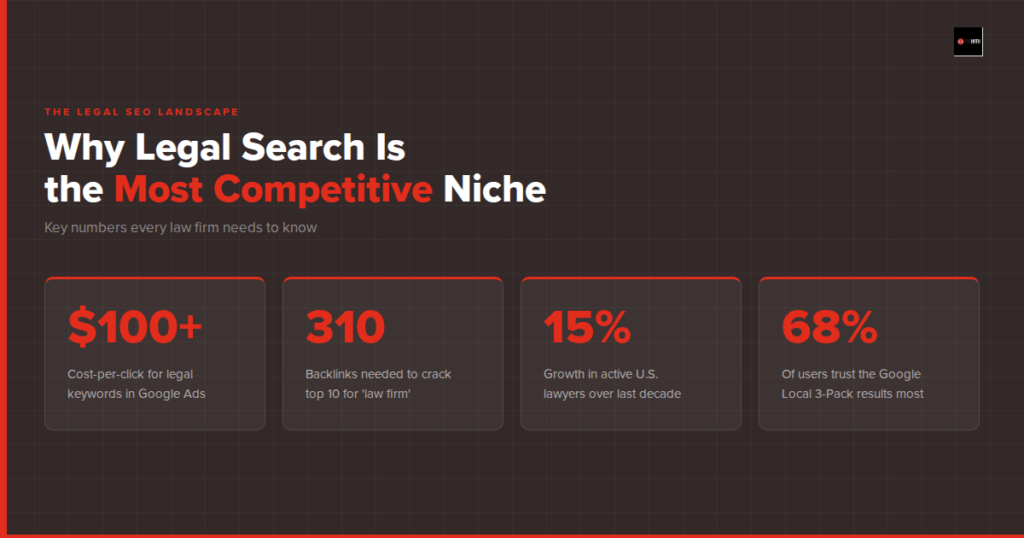
Here’s the reality of legal search:
The number of active lawyers in the U.S. has grown by roughly 15% over the last decade. More lawyers means more law firm websites competing for the same keywords. And legal keywords are among the most valuable in any industry — which is exactly why the competition is so intense.
One personal injury firm we worked with discovered that to rank in the top 10 for “law firm” in their city alone, they’d need an estimated 310 backlinks. At the start of their campaign, they had fewer than 50 referring domains. Closing that gap was the entire first phase of their strategy. Within months of consistent link building, their organic traffic grew from around 500 visitors a month to over 7,700, representing an equivalent traffic value of more than $11,000 per month if they had purchased that traffic through paid ads. Read the full case study here.
Another personal injury firm we helped was spending heavily on TV advertising with modest results. Their online presence wasn’t generating leads. After a few months working with us, they were ranking for over 2,000 relevant legal keywords and generating consistent monthly traffic worth $1,900 — without the overhead of paid ads.
The point: SEO done well is one of the most cost-effective growth channels available to law firms. But you have to build the foundation correctly.
The Four Pillars of Law Firm SEO
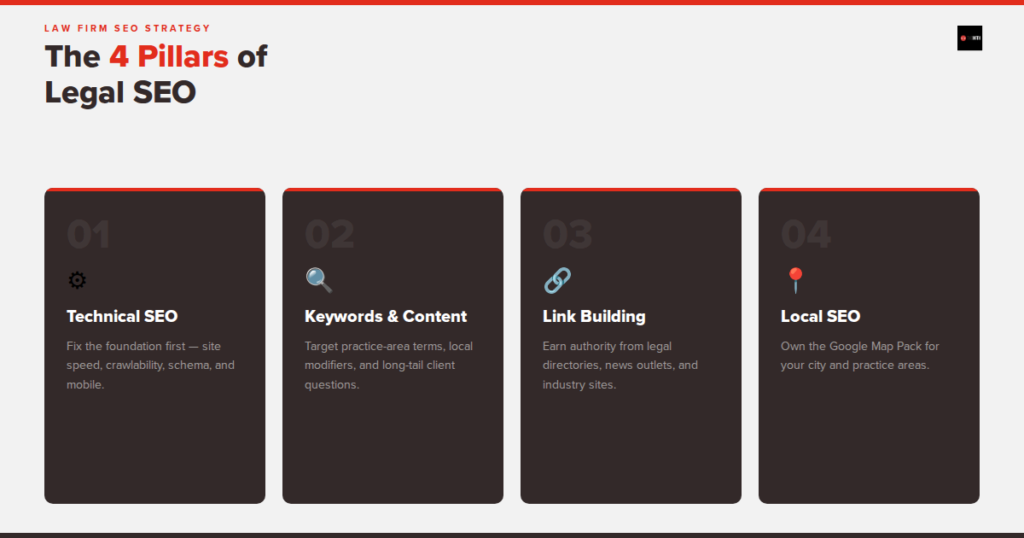
1. Technical SEO: Your Foundation
Before any other strategy will work, your site needs to be technically sound. For law firms specifically, technical issues are often the hidden reason a site isn’t gaining traction.
Common technical problems we find on law firm sites include:
- Slow load times caused by large image files or excessive JavaScript
- Crawlability errors that prevent key pages from being indexed
- Broken links that waste link equity and hurt user experience
- Missing or misconfigured schema markup (particularly important for local search)
- Poor mobile performance (most legal searches happen on mobile)
Every HOTH X managed SEO campaign starts with a thorough technical audit for exactly this reason. Technical issues, if left unresolved, undermine everything else you do. Fix the foundation first, then build on it.
2. Keyword Research and Content Strategy
Legal keyword research requires more nuance than most industries. You’re not just targeting broad terms like “personal injury lawyer” — you’re targeting specific practice area terms, location-modified keywords, and the questions real prospective clients are searching for.
A few principles that drive results in legal SEO:
Go after “easy win” keywords first. These are keywords your site already ranks for in positions 4 to 30. They’re within striking distance, and a focused push can move them to the first page quickly. We use this approach with every new client to generate early momentum while the longer-term strategy kicks in.
Uncover competitor keyword gaps. A competitive gap analysis reveals keywords your competitors rank for that you don’t. For one Texas law firm we worked with, this analysis uncovered 2,852 unique keywords they weren’t targeting — many related to marijuana law, one of their key practice areas. Building content around those gaps became a major driver of their traffic growth.
Target local keywords aggressively. Location-modified keywords like “employment lawyer in Sacramento” or “DUI attorney Chicago” are where clients are searching. Getting into Google’s Local 3-Pack (the map pack that appears at the top of local searches) can generate a significant volume of calls and leads. Studies suggest 68% of users trust the Local 3-Pack results more than standard organic listings.
Don’t ignore long-tail queries. Questions like “can I sue my employer for wrongful termination in California” or “what happens if I miss a court date” represent real searchers who are actively looking for legal help. Content that answers these questions builds topical authority and drives qualified traffic.
3. Link Building
Backlinks remain one of the most important ranking factors in SEO, and in the legal industry — where competition is extremely high and domain authority is everything — they’re especially critical.
The goal isn’t to accumulate links in bulk. It’s to earn high-quality, contextual links from authoritative, relevant websites. For law firms, that means links from legal publications, local news outlets, chambers of commerce, and industry associations.
One personal injury firm we worked with started with just 45 referring domains. Through a sustained link building campaign that included guest posts and contextual link outreach, we grew their referring domains to 500 — an 800% increase. Their traffic grew from 300 to 5,000+ monthly visitors. The equivalent advertising value of that organic traffic? Around $30,000 per month in paid search. Read the full case study here.
For an employment law firm in California, we leveraged our network of 300+ news outlets and media websites to secure a backlink from the LA Times (domain rating 92). Links like that carry significant ranking power and signal genuine authority to both Google and AI search systems. Read the full case study here.
Quality beats quantity. Every time.
4. Local SEO
Most law firms serve a specific geographic area, which means local SEO is not optional. It’s central to the entire strategy.
Key components of local law firm SEO:
Google Business Profile (GBP) optimization. Your GBP listing is often the first thing a potential client sees. It should be fully built out: correct NAP (name, address, phone number), practice areas listed, photos updated, and reviews actively managed.
Local citation consistency. Your firm’s name, address, and phone number need to be consistent across all directories and platforms. Inconsistent citations confuse search engines and erode trust.
Localized content. Blog posts and service pages targeting your specific city or region signal local relevance to Google. Think “motorcycle accident attorney in Phoenix” as a dedicated page, not just a passing mention in a generic practice area page.
Review management. Reviews are a ranking signal for local search. A steady stream of genuine, positive reviews strengthens both your map pack rankings and your conversion rate when prospective clients land on your listing.
AEO for Law Firms: The Next Frontier
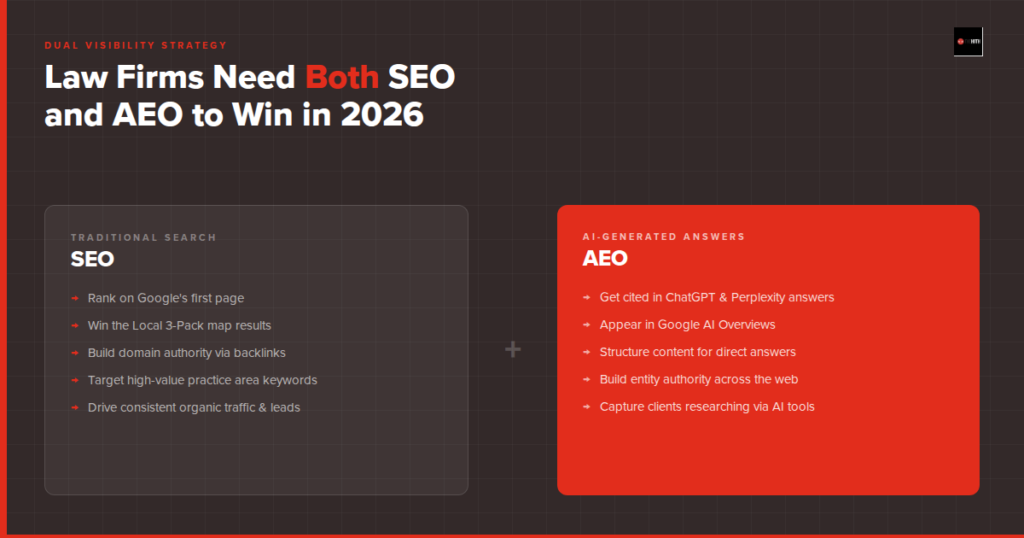
Traditional SEO gets you into Google’s search results. But in 2026, that’s only part of the picture.
AI tools like ChatGPT, Perplexity, and Google’s AI Overviews are increasingly becoming the first stop for people researching legal questions. These systems don’t just rank pages — they generate answers and cite sources. If your firm’s content isn’t structured to be cited by AI, you’re invisible to a growing segment of potential clients.
That’s where Answer Engine Optimization (AEO) comes in.
AEO is the practice of optimizing your content to appear in AI-generated answers — not just traditional search results. For law firms, this means:
Structuring content around direct questions. AI systems are trained to pull concise, authoritative answers to specific questions. Content that directly answers “What should I do after a car accident?” or “How long do I have to file a personal injury claim in Texas?” is well-positioned to be cited.
Using FAQ schema. Structured data helps AI systems identify and extract your answers. Adding FAQ schema to practice area pages and blog posts signals to both Google and AI platforms that your content is formatted for direct answers.
Building entity authority. AI models develop a model of your firm as an entity — who you are, what you specialize in, where you practice, and how credible you are. Consistent mentions across authoritative sources (news coverage, legal directories, local publications) build that entity authority over time.
Publishing original, experience-based content. AI tools prioritize content that demonstrates genuine expertise and real-world experience. Case results, client stories, and attorney perspectives all strengthen your content’s credibility in the eyes of AI systems.
One of our most recent legal case studies illustrates this directly: a motorcycle accident law firm partnered with us to build authority in a hyper-competitive, intensely regulated niche. The results included not just traffic and keyword gains, but AI citations — meaning their content was being pulled into AI-generated answers about their practice area. Read the full case study here. This kind of dual visibility (traditional rankings + AI citations) is exactly what forward-thinking law firms are building toward.
What a Winning Law Firm SEO Campaign Looks Like
Month 1: Technical Audit and Quick Wins
Every campaign starts with a full site audit. We identify technical issues, crawlability errors, broken links, and on-page opportunities. We also identify easy win keywords already within striking distance of page one. Fixing technical issues and capturing those quick wins builds early momentum.
Months 2 to 4: Content and Link Building
This is where the heavy lifting happens. We build out practice area content targeting priority keywords, create blog content targeting informational queries that drive qualified traffic, and begin a sustained link building campaign focused on authoritative, relevant placements.
Months 4 and Beyond: Scaling and AEO
Once the foundation is solid, we scale what’s working. That includes expanding into new keyword clusters, pursuing higher-authority link placements, and optimizing content for AI citation using structured data and direct answer formatting.
One employment law firm saw their traffic grow over 1,000% through this kind of systematic approach — combining technical fixes with content creation and consistent link building. Rankings climbed month over month, including a keyword that jumped from position 51 to position 9 after we optimized the page and built supporting backlinks. Read the full case study here.
Common Law Firm SEO Mistakes to Avoid
Thin practice area pages. A single paragraph describing your services isn’t enough. Google wants comprehensive, authoritative content. Each practice area should have a dedicated page that thoroughly covers the topic, addresses common questions, and demonstrates expertise.
Ignoring technical issues. Sites that have never had a technical audit almost always have fixable problems dragging down their performance. Don’t skip this step.
Chasing volume over quality in link building. A hundred low-quality links will hurt you more than help you. Legal sites are scrutinized closely. One well-placed link from a local news site is worth more than dozens of directory spam.
Setting it and forgetting it. SEO is not a one-time project. It requires consistent effort. Law firms that maintain a steady content and link building cadence over 6 to 12 months see compounding results. The firms that stop after 90 days rarely see the full payoff.
Neglecting AI visibility. If your content strategy doesn’t account for AI Overviews and AI chat tools, you’re already behind. AEO isn’t a replacement for traditional SEO — it’s an extension of it.
How The HOTH Helps Law Firms Win Online
We’ve worked with law firms across nearly every practice area: personal injury, employment law, criminal defense, family law, immigration, and more. We understand the YMYL requirements, the competitive dynamics, and what it actually takes to move the needle in legal search.
Our managed SEO service, HOTH X, gives law firms a dedicated campaign manager who builds and executes a custom strategy, including technical optimization, content creation, link building, and local SEO. Everything is handled for you, with full visibility into what’s being done and why.
The results speak for themselves:
- A Texas law firm grew from 500 to 7,700 monthly visitors in under a year.
- A personal injury firm went from nearly zero online presence to 2,000+ ranking keywords and consistent monthly traffic value.
- A California employment law firm earned 5,600+ keyword rankings, 120 top-3 positions, and a $7,400 monthly traffic value.
- A personal injury firm’s referring domains grew 800% — generating traffic equivalent to $30,000/month in paid advertising.
If you’re ready to build a legal SEO strategy that drives real clients to your firm, book a free consultation with our team today.
Frequently Asked Questions
How long does law firm SEO take to work?
Most law firms start seeing measurable results within 3 to 6 months, with more significant traffic growth typically appearing at the 6 to 12 month mark. The exact timeline depends on your site’s starting point, the competitiveness of your market, and the consistency of the campaign.
How much does law firm SEO cost?
Costs vary depending on the scope of the campaign and your market. Highly competitive metro markets require more investment than smaller regional markets. A managed SEO campaign through HOTH X is structured around your budget and goals — reach out for a custom quote.
Is SEO worth it for a small law firm?
Yes. In fact, SEO often provides better ROI for smaller firms than PPC, where legal keywords can cost $100+ per click. Organic rankings generate consistent traffic without ongoing per-click costs. The key is patience and consistency.
What is AEO and do law firms need it?
AEO (Answer Engine Optimization) is the practice of optimizing content to appear in AI-generated answers from tools like ChatGPT, Perplexity, and Google’s AI Overviews. As these tools become more popular for legal research, firms that optimize for AI citations will have a significant visibility advantage. We now incorporate AEO into all HOTH X legal campaigns.
Do I need a legal-specific SEO agency?
Not necessarily — but you do need an agency that understands YMYL requirements, the competitive dynamics of legal search, and what Google looks for in terms of E-E-A-T. The HOTH has worked with dozens of law firms and has a proven track record of driving results in this vertical. See our legal case studies here.
Leave a comment