

Every marketer has run this math at some point.
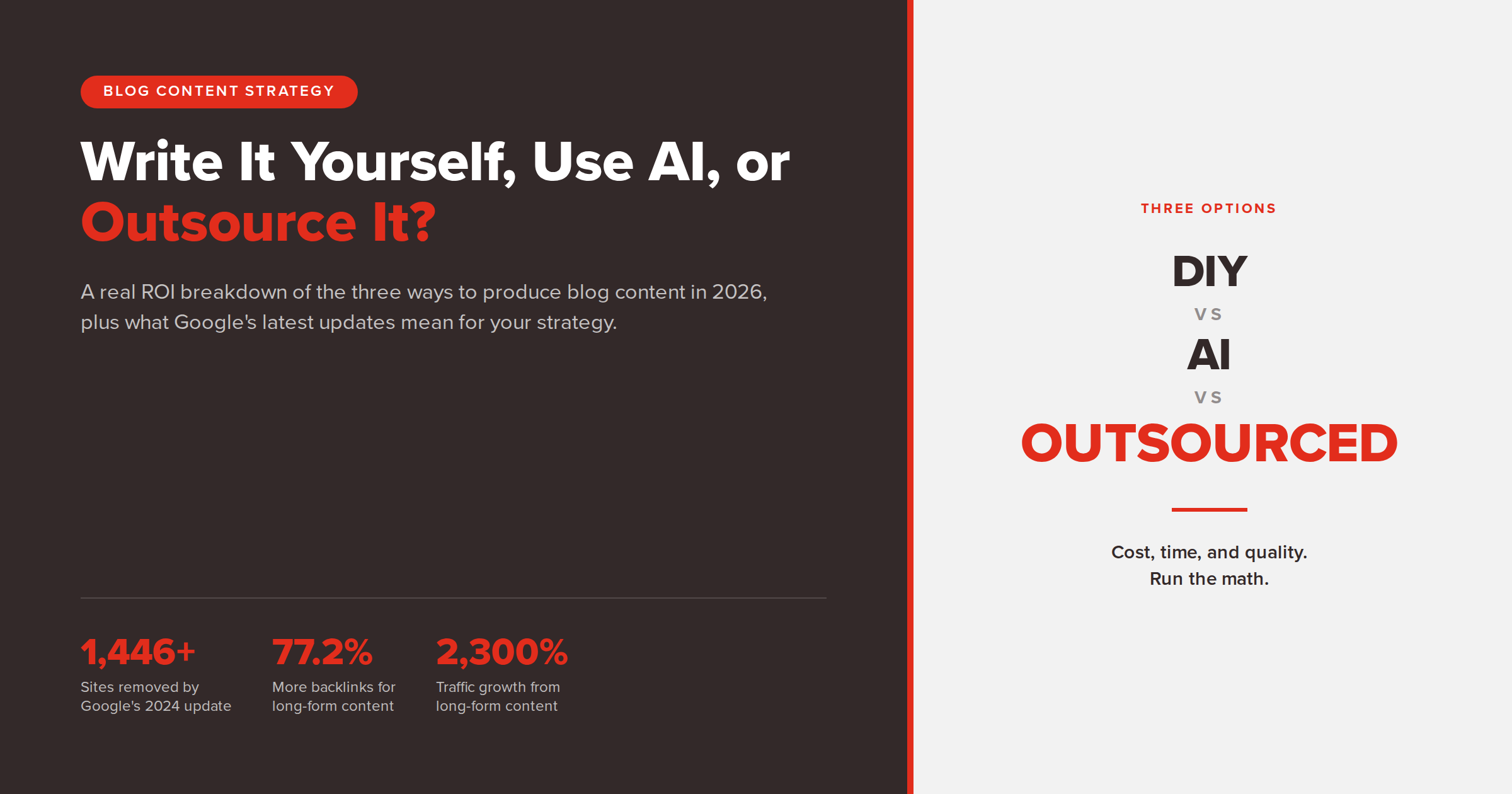
You need a blog. You have a budget. You have three options on the table: write the posts yourself, prompt ChatGPT to write them, or outsource the whole thing.
And the calculus has gotten weirder. Five years ago, this comparison was just “in-house vs. agency.” Now AI is in the middle, promising a 2,000-word blog post for the price of a ChatGPT subscription. The temptation is real.
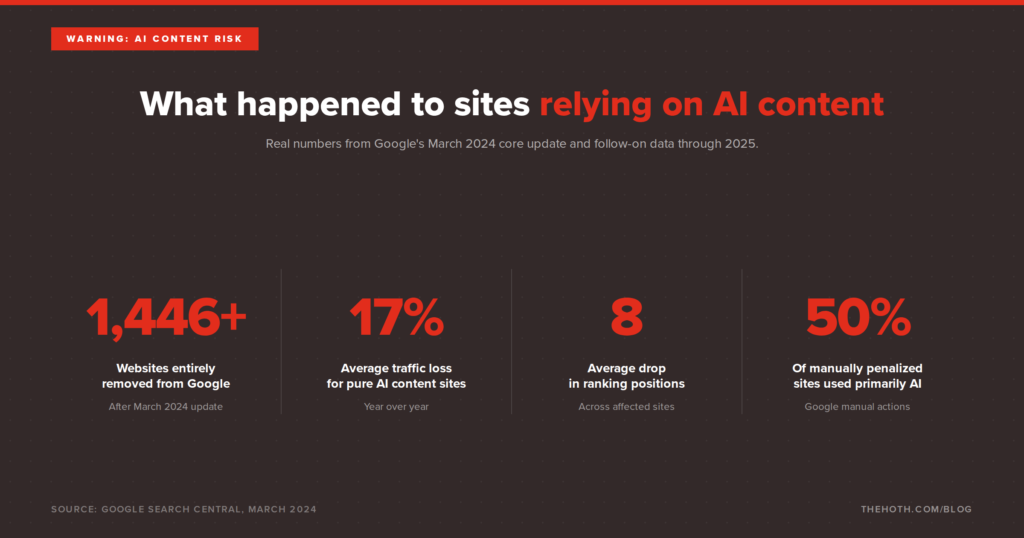
But the math has also gotten meaner. Google’s March 2024 core update wiped over 1,400 websites off the SERP for relying too heavily on AI-generated content. Half of the sites that received manual penalties had primarily AI content. Sites running pure AI content saw an average 17% traffic loss and dropped 8 positions in rankings.
So the question isn’t whether AI can write a blog post. It can. The question is whether the post will actually do anything for your business.
This guide walks through the real ROI math on all three options. Cost per post, time cost, E-E-A-T signals, and the long-term traffic value of each approach. We’ll be honest about where AI fits, where in-house writing makes sense, and where outsourcing pays off.
The three options on the table
Before the math, let’s be specific about what each option actually looks like in practice.
Option 1: Write it yourself (or have your team write it)
You or someone on staff writes the posts. Maybe it’s the marketing director. Maybe it’s the founder. Maybe it’s the intern. Either way, a human on your payroll is doing the writing.
Pros: full control over voice, depth, and accuracy. Real subject-matter expertise on the page.
Cons: it takes hours. Real hours, by real people, who could be doing other things. And it’s worth flagging that blogs aren’t the only content you’ll need. Service pages, landing pages, and product descriptions need a different kind of writer (which is why HOTH has a separate product, HOTH Web Copy, for that work). Your in-house team likely has to cover both.
Option 2: Prompt an AI tool
You open ChatGPT, Claude, Gemini, or whatever’s hot this quarter. You paste in a prompt, get a 2,000-word draft in 90 seconds, give it a once-over, and hit publish.
Pros: fast. Cheap. The cost is just a $20-a-month subscription.
Cons: this is the path with the most invisible risk, and we’ll get into the Google numbers in a minute.
Option 3: Outsource to a blog writing service
You hand off the topic to a managed service like HOTH Blogger, they write the post, and you approve it before it goes live. The work happens in the background. You get a finished piece, white-labeled, ready to publish.
Pros: human writing, professional editing, no time spent on your end, structured for SEO and AI search.
Cons: it’s not free. You’re paying for the service.
Each option has a place. Now let’s run the actual numbers.
The real ROI math
Let’s compare apples to apples. We’ll use a single 1,500-word blog post as the unit of measurement, since that’s the sweet spot most agencies and businesses target for content marketing.
Option 1: Writing in-house
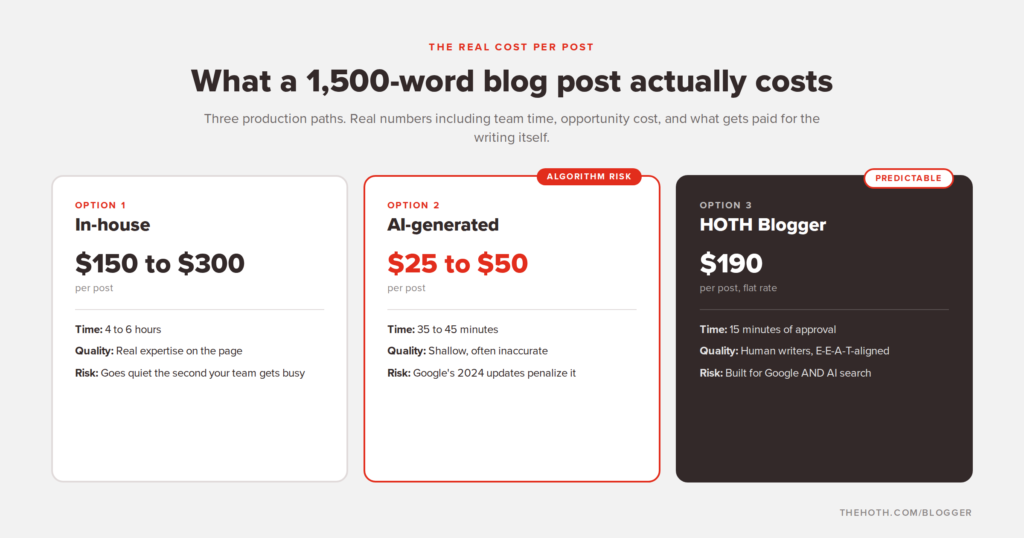
A solid mid-level marketer or content writer in the U.S. earns somewhere between $30 and $60 per hour (loaded, including benefits and overhead). A well-researched, optimized 1,500-word post typically takes 4 to 6 hours when done properly. That means keyword research, drafting, editing, fact-checking, and formatting.
Math: $30 to $60 per hour x 5 hours = $150 to $300 per post.
That’s just the writing cost. It doesn’t include the opportunity cost of what that marketer wasn’t doing while they were writing. Strategy, campaigns, client work, anything else on their plate. If your senior marketer is writing blog posts, you’re paying senior-marketer rates for blog production and getting fewer hours of strategy work in return.
It also doesn’t include consistency. The biggest problem with in-house writing isn’t quality. It’s that the blog goes quiet the second something else gets busy. Most internal blogs that started strong have a graveyard of “this site needs a content audit” energy because the marketing team got pulled into a launch and never recovered.
Option 2: AI-generated with light editing
ChatGPT Plus is $20 a month. Claude Pro is $20. Gemini Advanced is $20. Pick your poison.
Generating a 2,000-word draft takes about 5 minutes. If someone on your team gives it 30 minutes of editing (which is generous, most teams give it 10), you’re looking at maybe 35 to 45 minutes of human time per post. At $30 to $60 per hour, that’s $20 to $45 per post in human cost, plus a couple dollars in subscription overhead.
Math: roughly $25 to $50 per post.
That’s the cheapest option on paper. It’s also the option with the most invisible cost, which we’ll get to in a second. Because cheap content that doesn’t rank is not actually cheap. It’s just unpaid time.
Option 3: HOTH Blogger
Flat pricing, no hourly billing, no opportunity cost on your team.
- 500 words: $80
- 1,000 words: $140
- 1,500 words: $190
- 2,000 words: $260
- 3,000 words: $390
- 4,000 words: $480
- 5,000 words: $600
Math for the 1,500-word benchmark: $190 per post.
Your team’s time on it: about 15 minutes total. You submit the topic, approve the draft, and it lands in your CMS ready to publish.
Cost summary
So for a single 1,500-word post:
- In-house: $150 to $300 + 5 hours of your team’s time
- AI-generated: $25 to $50 + 45 minutes of light editing
- HOTH Blogger: $190 + 15 minutes of approval time
On price alone, AI wins. On time savings, AI and HOTH Blogger are close. But this is where the real math kicks in, because content cost is only half the equation. The other half is whether the content actually does anything.
The real cost of AI content (the part nobody puts on the invoice)
AI-generated content is cheap to produce. The problem is what happens after you publish it.
In March 2024, Google rolled out the most aggressive core update in years. Among other things, it merged the Helpful Content System directly into the core ranking algorithm and introduced a new spam category called “scaled content abuse.”
From Google’s own announcement: scaled content abuse is when many pages are generated to manipulate rankings rather than help users, “no matter how it’s created” (human, AI, or both). The update specifically targeted low-quality AI content, aiming to reduce unhelpful content in search results by 40%.
Here’s what happened to sites that ignored it:
- Over 1,446 websites were entirely removed from Google search results.
- Sites relying solely on AI content lost an average of 17% of their traffic and dropped 8 positions in rankings.
- 50% of websites that received manual penalties used primarily AI-generated content.
- Many of these sites had previously had millions of visitors.
Google’s position on AI content is nuanced, but consistent. They don’t penalize AI content because it’s AI. They penalize it because most AI content is shallow, unoriginal, and doesn’t meet their E-E-A-T (Experience, Expertise, Authoritativeness, Trustworthiness) standards for helpful, people-first content.
What AI content tends to miss
If you’ve worked with AI tools, you already know the shape of the problem. AI writes confidently. It writes fluently. It writes a structure that looks like a blog post. But it tends to fail on the things that actually drive search performance.
- Experience: AI cannot say “I tried this and here’s what happened.” It can only summarize what other people have said.
- Expertise: AI cannot tell you which technique works better in 2026 vs. 2023, because it doesn’t know what works. It knows what’s been written.
- Original data and insights: AI is, by definition, a remix of existing content. It cannot run a survey, interview a client, or pull internal data.
- Factual accuracy: AI hallucinates. Statistics get invented. Sources get fabricated. Quotes get attributed to people who never said them.
- Brand voice: AI writes like AI. Even with prompting, the cadence is recognizable.
- Recency: most AI models are trained on data that’s 12 to 24 months old by the time you use them.
None of this is news to Google. The March 2024 update was the algorithmic answer to a flood of AI content that hit the SERP between 2022 and 2024. And the August 2024 follow-up, plus the February 2025 update, kept tightening the screws.
Where AI actually fits
This isn’t an anti-AI post. AI tools have real, legitimate uses in content workflows:
- Brainstorming topic angles
- Generating outlines you’ll rewrite
- Suggesting keyword variations
- Drafting first-pass meta descriptions
- Summarizing long source material
- Checking for grammar and clarity
Where AI breaks down is as the primary writer. If your content workflow is “prompt, publish,” you’re on the wrong side of the algorithm.
The right framing: AI is a tool a human writer can use. AI is not a replacement for a human writer.
Why human writing still wins for blog content
When Google says they want “helpful, reliable, people-first content,” they’re describing what a human writer can produce that AI cannot.
Specifically:
Human writers can demonstrate experience
E-E-A-T’s first “E” stands for Experience, and Google added it specifically because it’s the thing AI cannot fake. A blog post by an actual paralegal explaining what changed about a statute hits differently than a paragraph generated from training data.
This is why niche-expert content has been the biggest winner of the post-2024 algorithm shifts. SMEs (subject matter experts) producing real insights from real practice are exactly what Google’s helpful content system was designed to reward.
Human writers do actual research
A good blog writer reads three or four sources before writing a single sentence. They check publication dates. They verify statistics. They cite original data, not just whoever else cited it. They notice when two sources contradict each other and they investigate why.
AI doesn’t do this. AI averages out what its training data says, which means yesterday’s consensus, often without the citations that made it credible.
Human writers structure for AI search, too
Here’s the irony of the AI content moment. The most reliable way to show up in AI-generated answers (ChatGPT, Perplexity, Google AI Overviews) is to publish high-quality, structured, authoritative content. The kind of content AI is trained on. The kind of content human writers produce.
That’s why HOTH Blogger structures every post for both Google rankings AND AI Overview eligibility. Question-based headers pulled from People Also Ask. AIO (Answer in One) snippet formatting. FAQ schema for posts 1,000 words and up. The format AI tools want to cite.
Human writing compounds. AI content decays.
Here’s the long-tail of the math. A well-written blog post can rank for years, attract backlinks, get referenced by other content, and quietly drive traffic for a decade.
Low-quality AI content gets buried by the next algorithm update. The Toronto law firm in one of
our case studies recovered 334% in traffic in 6 months after a Google update tanked their rankings. The recovery strategy? Replacing thin, unhelpful content with substantial human-written posts.
In another case study, a client grew organic traffic over 2,300% in just 6 months by leaning into long-form, human-written content. According to Backlinko’s analysis of 912 million blog posts, long-form content gets 77.2% more backlinks than short-form (more on the trade-offs in our breakdown of short-form vs. long-form content). And HubSpot’s own data shows businesses that blog 16+ times per month get 4.5x more leads than businesses that blog 0 to 4 times.
We’ve seen this compound for clients ourselves. YES Career Coaching & Resume Writing grew organic traffic by 1,200% and revenue by 45% on a sustained human-written content program. Their blog didn’t go viral. It just compounded, month after month.
That’s the compound interest on real content. It’s also why the per-post price isn’t actually the right metric. The right metric is cost per visitor over time. AI-generated content fails on that math almost every time.
So when does each option actually make sense?
Honest answer: it depends on what you’re optimizing for.
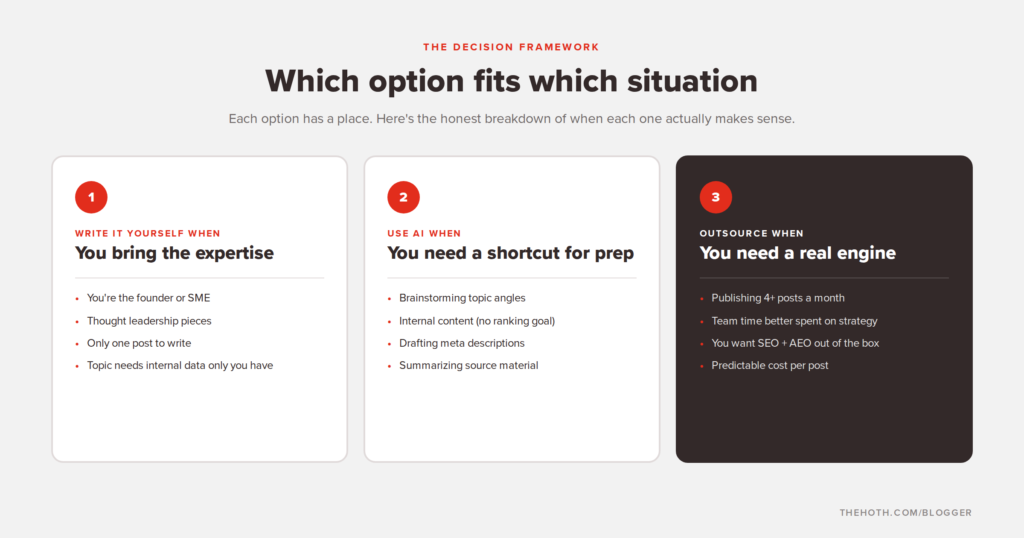
Write it yourself when…
- You’re the founder or true subject-matter expert and the post is about your specific perspective
- Your audience expects to hear directly from you (thought leadership pieces, founder essays)
- You have one post to write, not 50, and you actually have the time
- The topic requires original data or internal insights only you have access to
Even in this case, an editor on the back end is worth their weight. Founders are great at expertise, less great at SEO formatting. Write the draft, hand it off for the polish.
Use AI when…
- You need to brainstorm topic angles or generate a working outline
- You’re producing internal content that doesn’t need to rank (status updates, project briefs, meeting notes)
- You’re drafting first-pass meta descriptions or social copy
- You need to summarize long-form source material before you start writing
If the goal is search rankings, AI is the wrong primary tool. Use it to speed up the prep, not to do the writing.
Outsource when…
- You’re publishing more than 4 posts per month and consistency is starting to slip
- Your team’s time is more valuable doing strategy, sales, or client work than writing
- You want SEO-optimized content built for Google AND AI search out of the box
- You’ve tried in-house writing and you have a content graveyard from the last time things got busy
- You want predictable cost per post so you can budget content marketing the way you budget paid ads
What HOTH Blogger actually delivers
HOTH Blogger is a fully managed blog writing service. Real human writers, vetted with a 1% acceptance rate. Content built for E-E-A-T, structured for SEO and AI search, and delivered ready to publish.
Every post includes:
- A topic approved by you before writing starts
- Question-based headers pulled from People Also Ask data
- E-E-A-T-aligned structure (intro that answers the question first, supporting depth, clear authority signals)
- AIO (Answer in One) snippet optimization for AI search
- Mandatory FAQ section with schema markup for posts 1,000 words and up
- Internal links and proper formatting (titles, meta descriptions, focus keywords)
- Copyscape Premium plagiarism review
- Unlimited revisions until you approve
- Optional direct publish to your WordPress site
- White-label approval hub if you’re a reseller
And it’s all human-written. No AI generation, no auto-drafted content. The writers do the work, and our team reviews it before it ever hits your dashboard.
If you need niche-specific writing (legal, medical, travel, finance), Blogger Pro gives you access to a smaller pool of writers vetted for that vertical. Same workflow, same E-E-A-T structure, deeper subject-matter expertise.
The right answer for most businesses
For most businesses publishing real content marketing programs, the math works out cleanly:
Save in-house writing for founder voice pieces and SME-driven thought leadership. Use AI to brainstorm, outline, and prep, never as the primary writer. Outsource the production volume to a managed service so you get consistency, SEO structure, and human quality without the hours.
That blend gives you the best of all three. Real expertise where it matters most. AI efficiency in the prep work. Outsourced consistency so your blog actually exists in six months instead of going quiet after the first quarter.
And that’s what we see in the data. The businesses winning on content right now aren’t choosing one approach. They’re using all three intelligently. The ones losing on content are the ones who picked the cheapest option and assumed it would scale.
If you want to stop running this calculation every month and just have a content engine that produces reliable blog content, check out HOTH Blogger pricing and features. For existing content that’s underperforming, Content Refresh updates old posts for AI Overview eligibility and current search intent without rewriting from scratch.
Want to talk through how blog content fits into a bigger SEO program? Book a strategy call and we’ll walk through what’s working in your space and where blog content fits.
Leave a comment