
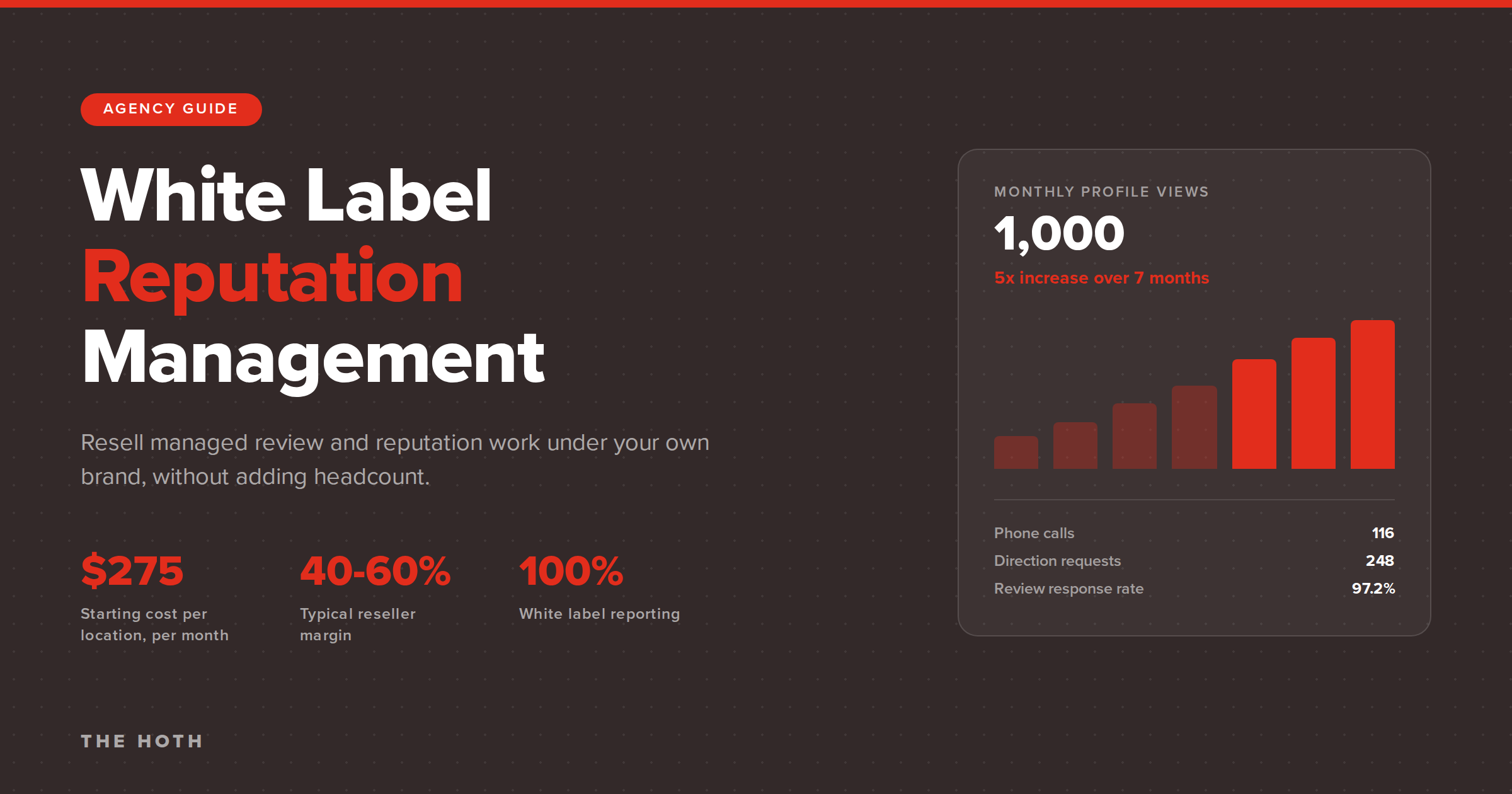

White label reputation management is review and reputation work that a specialist partner performs and your agency resells under its own brand. Your clients see your name on the strategy, the reporting, and the results, while the partner monitors reviews, writes responses, generates new reviews, and keeps listings accurate. It lets you add a recurring reputation line without hiring anyone to run it.
Reputation work is one of the few services a client notices every single month. A new five-star review shows up. A one-star complaint gets a calm, professional reply within hours. The Google Business Profile posts something fresh on Tuesday. It is visible, it is constant, and it is exactly the kind of work a busy business owner will never do consistently on their own.
That makes it a strong agency offer. It also happens to be the kind of work that eats a small team alive if you try to fulfill it in house. Monitoring reviews across dozens of platforms, writing personalized replies, running review request campaigns, syncing listings across directories, posting weekly to Google Business Profiles: multiply that by twenty clients and you have just hired two people.
White label reputation management is the way around that. This guide covers what the service includes, what it costs, how to price and package it, the compliance exposure most agencies do not know they are taking on, and how to pick a partner. If you are newer to reselling in general, start with our complete guide to white label SEO and come back here.
What is white label reputation management?
White label reputation management is a fully unbranded reputation service that your agency resells under its own name. A partner handles review monitoring, review responses, review generation, listing syndication, and Google Business Profile management, and delivers everything with no trace of their brand on it.
The mechanics are simple. You sell the service, you own the client relationship, you set the price. Your partner does the fulfillment in the background and hands back clean, unbranded reporting you put your logo on. Your client never learns another company exists.
The term gets used loosely, though, and the difference matters a lot for your margins and your workload.
White label software vs. a white label managed service
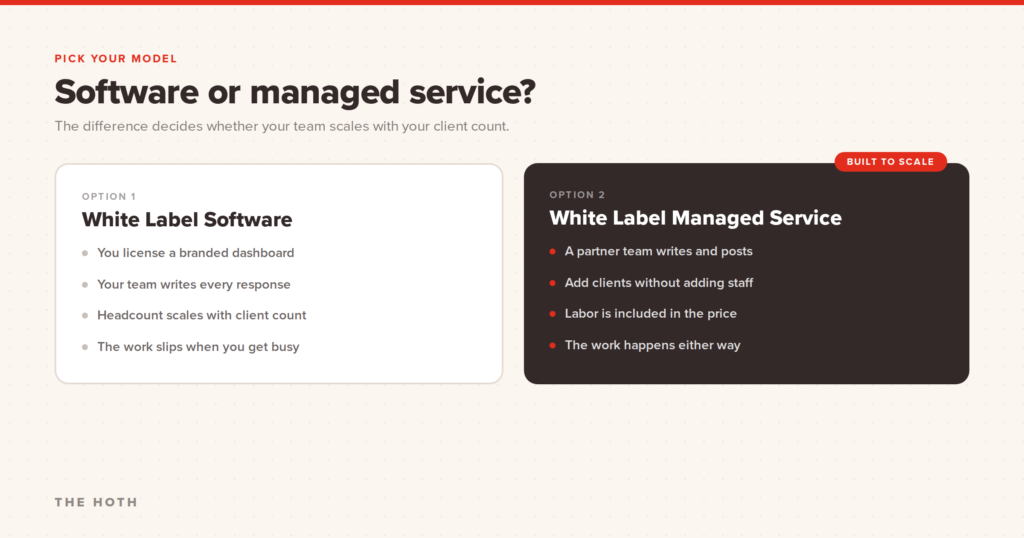
Most of what ranks for this term is software. You license a dashboard, put your branding on it, resell seats to clients, and then someone on your team logs in and does the work: writing the review responses, chasing the requests, fixing the listings.
A managed service takes the work itself off your plate. A team monitors, writes, posts, and syncs, then reports on it. You are reselling labor and outcomes, not a login.
Here is the honest trade-off for an agency:
| White label software | White label managed service | |
|---|---|---|
| Cost to you | Lower monthly platform fee | Higher per-client fee, labor included |
| Who writes the responses | Your team | The partner |
| Scales with client count | Your headcount has to scale too | Add clients without adding staff |
| Risk | The work slips when your team gets busy | The work happens whether you are busy or not |
| Best for | Agencies with a dedicated reputation person | Agencies who want the revenue without the ops |
If you cannot name the specific person on your team who will log in every week and reliably respond to reviews for every client, you want a managed service. That is the whole test.
Why is reputation management a good service for agencies to resell?
Reputation management is recurring by nature, produces visible monthly proof, and requires almost no client input once it is running. That combination makes it one of the easiest recurring lines to sell, one of the stickiest to keep, and one of the least demanding to fulfill through a partner.
Four reasons it works better than most add-ons:
- It is recurring by design. Reviews never stop coming in, listings never stop drifting, and profiles never stop needing fresh posts. There is no natural end date, which means no awkward renewal conversation.
- The proof is visible every month. Profile views, phone calls, direction requests, and review counts are all things a client can see with their own eyes on their own profile. Compare that to explaining a domain rating change.
- It is low-friction to fulfill. Unlike content or web work, reputation management needs almost nothing from the client after onboarding. No approvals, no interviews, no waiting on assets. That is rare.
- It opens the door to bigger retainers. A $500 reputation program is an easy yes for a client who is not ready for a full SEO engagement. Once they see the calls come in, the managed SEO conversation gets a lot easier.
That last point is not theoretical. A regional ad agency that started with a single link outreach order through our reseller program eventually doubled its year-over-year net income by layering services across 28-plus client domains. Reputation management is one of the cleanest entry points to that same pattern, because the barrier to a first yes is so low.
What is included in a white label reputation management program?
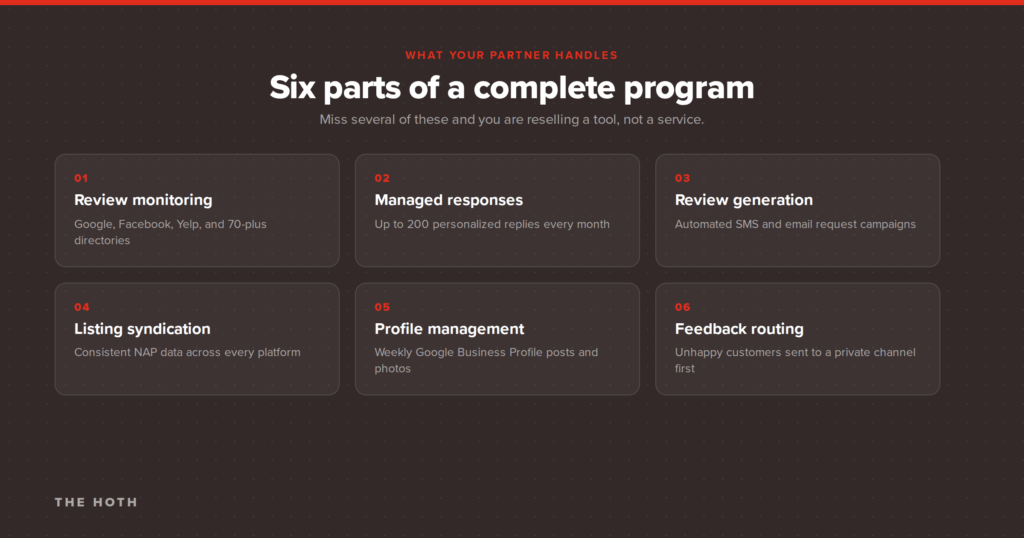
A complete program covers six areas: review monitoring across platforms, professional review responses, review generation, listing syndication, Google Business Profile management, and negative feedback routing. If a provider is missing several of these, you are reselling a tool rather than a service.
Here is how the pieces map to who does what:
| Deliverable | Who does it | What your client sees |
|---|---|---|
| Review monitoring across Google, Facebook, Yelp, and 70-plus directories | Partner | Nothing slips through |
| Personalized review responses, up to 200 per month | Partner | Every review answered, in their voice |
| Automated SMS and email review requests | Partner | A steady stream of new reviews |
| Listing syndication and NAP consistency | Partner | Accurate info everywhere |
| Weekly Google Business Profile posts and photos | Partner | An active, current profile |
| Negative feedback routed to a private channel | Partner | Problems handled before they go public |
| Strategy, pricing, reporting, relationship | You | Your agency, doing great work |
If you want the buyer-side view of these components, including how to evaluate providers as an end client, our review management services buyer’s guide covers it in more depth.
How much does white label reputation management cost?
Wholesale pricing for a fully managed white label reputation program typically starts around $275 per month per location, with custom pricing for multi-location brands. Agencies commonly resell it in the $500 to $900 per month range, which is where the 40 to 60 percent margins most resellers see come from.
Our Review & Reputation Management service starts at $275 a month for a single location and includes managed responses, review generation, listing syndication across 70-plus platforms, and weekly Google Business Profile updates. Multi-location brands get custom pricing built around their footprint.
Most agencies in the HOTH reseller program land somewhere between 40 and 60 percent margin across the services they resell. Reputation management sits comfortably in that band because the cost is fixed and predictable while the perceived value scales with how much the client’s phone rings.
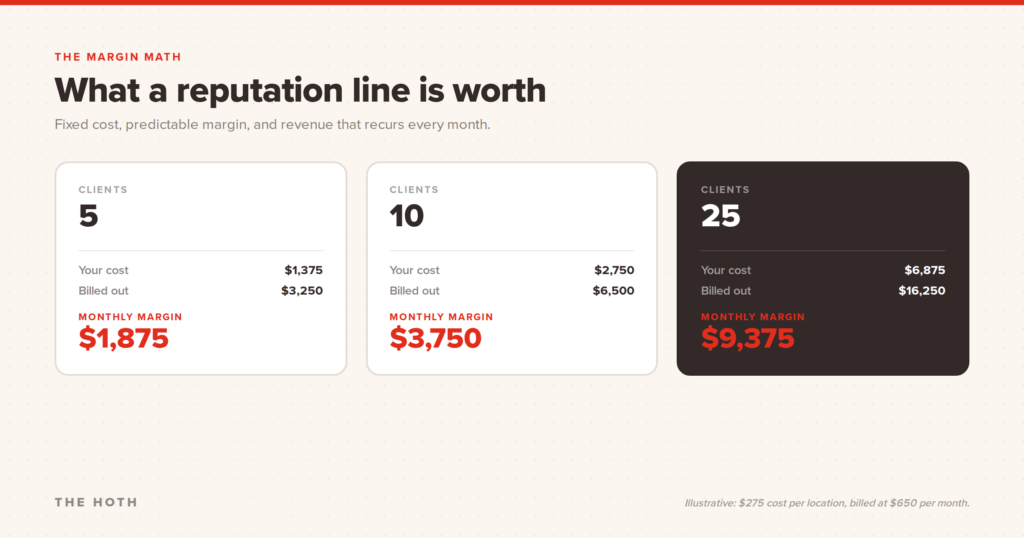
A rough model, using a single-location client at a $275 cost:
| Clients | Your monthly cost | Billed at $650/mo | Your monthly margin |
|---|---|---|---|
| 5 | $1,375 | $3,250 | $1,875 |
| 10 | $2,750 | $6,500 | $3,750 |
| 25 | $6,875 | $16,250 | $9,375 |
Illustrative only. Your actual pricing depends on client size, location count, review volume, and what else you bundle in.
Two things move that math in your favor. Multi-location clients raise the ceiling considerably, since a 40-location brand is a single sales conversation for forty times the footprint. And volume pricing helps: our bulk buyer program adds bonus credits on top of wholesale rates, which you can apply to any service.
How do you package and sell reputation management to clients?
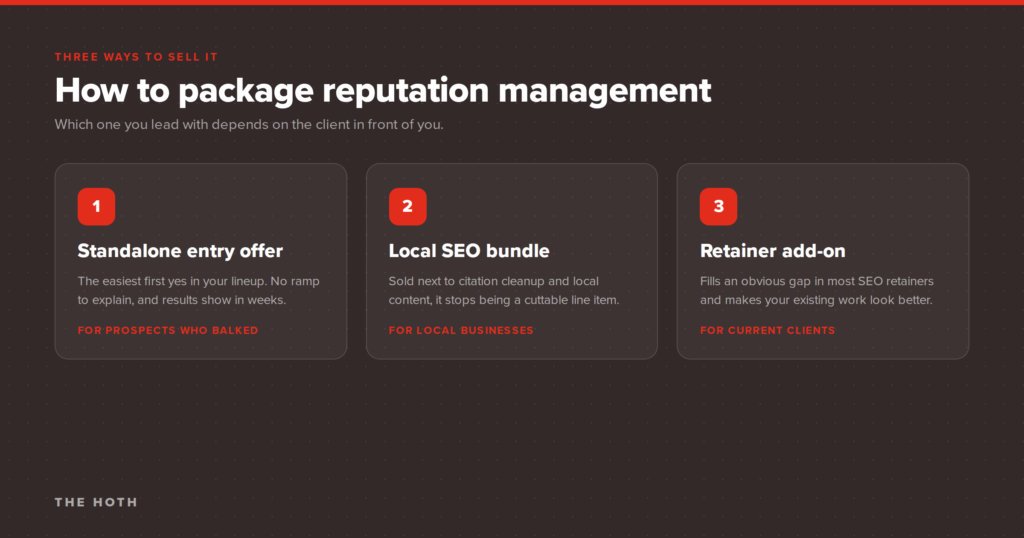
The three packaging models that work are a standalone entry offer, a local SEO bundle, and an add-on to an existing retainer. Which one you lead with depends on whether the client is new, local, or already paying you every month.
1. As a standalone entry offer
This is the easiest first yes in your lineup. A local business owner understands reviews without any education. There is no six-month ramp to explain, no ranking caveats, and the first results show up in weeks rather than quarters.
Use it to convert prospects who balked at a full SEO proposal. Price it as a low-commitment monthly, deliver visibly for ninety days, then have the bigger conversation with three months of proof in hand.
2. Bundled with local SEO
Reputation and local visibility are the same fight. Google’s own guidance says more reviews and positive ratings can help your business’s local ranking, and lists responding to reviews among the things that help a profile stand out. Selling reputation next to citation cleanup and local content is a coherent package rather than a bolt-on.
A standard local bundle: citation cleanup as a one-time foundation, reputation management as the monthly engine, and local SEO services for the pages that need to rank. Price it as one number and the reputation piece stops being a line item the client can cut.
3. As an add-on to an existing SEO retainer
Your current clients are the cheapest expansion revenue you have. Reputation management is an easy upsell because it fills an obvious gap most SEO retainers ignore, and because it makes your existing work look better. When the profile starts generating calls, that shows up in the same report as your rankings.
Which clients to target first
Reputation management sells hardest where reviews directly gate the purchase decision. Prioritize:
- Home and field services. Pest control, HVAC, plumbing, moving, cleaning. High-intent local search, fast decisions, reviews as the tiebreaker.
- Restaurants and hospitality. Multi-location groups especially, where review volume across sites is unmanageable by hand.
- Specialty and independent retail. Direction requests translate almost directly to foot traffic.
- Healthcare, legal, and financial practices. Trust-heavy categories where a single unanswered complaint does outsized damage.
- Multi-location and franchise brands. The best margin in the category, and the hardest to serve without a managed partner.
Watch for trigger moments too. A bad review streak, a new location opening, a rebrand, or a franchise rollout all create urgency that a cold pitch never will.
What results can you promise clients?
Promise process and profile performance, not star ratings. Managed reputation programs reliably move profile views, phone calls, direction requests, website visits, and review volume, and those gains often show up within the first few months. Promising a specific rating or review count is both risky and a compliance problem.
Here is what three managed campaigns produced, so you know what a realistic pitch sounds like.
A Phoenix-area pest control company
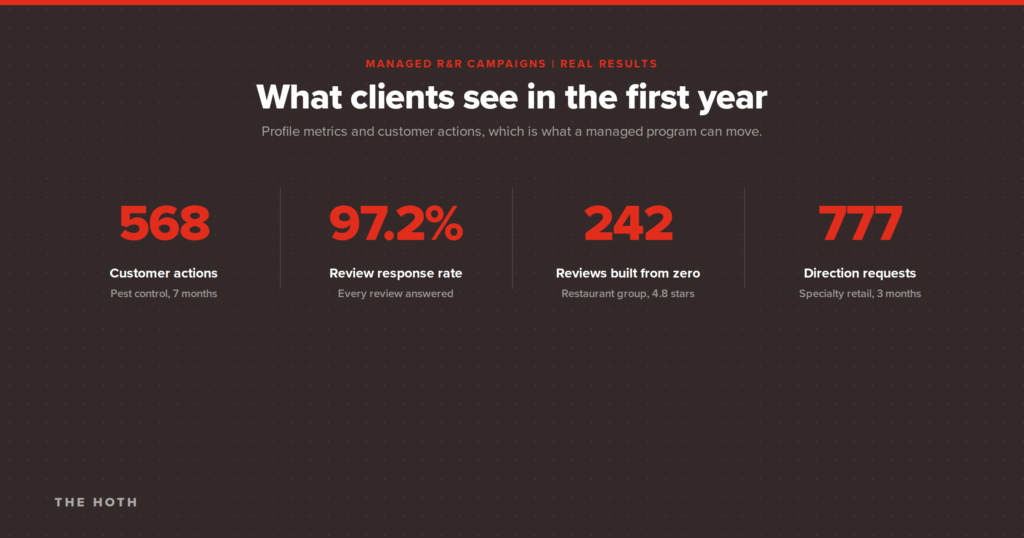
Strong offline reputation, underperforming profile. Over a seven-month campaign the Google Business Profile generated 568 customer actions: 116 phone calls, 248 direction requests, and 204 website visits. Monthly profile views climbed from roughly 200 to roughly 1,000, a 5x increase, while the team held a 97.2% review response rate and maintained the 4.9-star rating. Organic traffic rose 280% over the same window and page-one keywords tripled. The owner did nothing but keep doing pest control.
A UK multi-location restaurant group
The opposite starting point: zero reviews, no optimized profile, no organic visibility. Built from scratch, the brand reached 242 Google reviews at a 4.8-star average with a 73.6% response rate, 82,000 profile views, and 6,910 total customer actions including 1,760 direction requests and 4,870 website visits. It now ranks on page one for 27 local terms. No ad spend.
An independent specialty retailer
Over three months, 12,750 profile views and 1,710 customer actions, including 777 direction requests, which is roughly 60 potential walk-ins a week from the profile alone. The review profile grew to 135 reviews at 4.6 stars.
Notice the pattern. Every one of those numbers is a profile metric or a customer action, which is what a managed program can move. That is what belongs in your proposal.
What not to promise: a specific star rating, a guaranteed number of new reviews, or the removal of legitimate negative reviews. A good partner can flag policy-violating reviews for possible removal. Nobody can delete an honest one, and any provider who says otherwise is a liability you do not want attached to your brand.
Why do reviews matter for AI search now?
AI systems read reviews as trust signals, not just star counts. Large language models parse review text for sentiment, depth, and specificity, and use it to decide which businesses to recommend. That makes review quality part of your client’s AI visibility, not only their local rankings.
This is the part of the pitch most agencies are still missing. Classic algorithms treated reviews as a numbers game: volume, recency, average rating. AI systems read the actual text, weigh detailed reviews far above one-line praise, and fold what they find into your client’s entity profile. We broke down the mechanics in how reviews influence AI recommendations.
The practical consequence for a reseller: reputation management is no longer just a local SEO product. It is a trust-signal product, which means it belongs in the conversation with every client who cares about showing up in AI answers, including ones with no storefront at all.
It also pairs cleanly with the rest of an AI visibility program. Consistent listings, active profiles, and a deep review base give AI systems something to verify against, which is the same foundation AI Discover builds on.
What compliance risk do agencies take on?
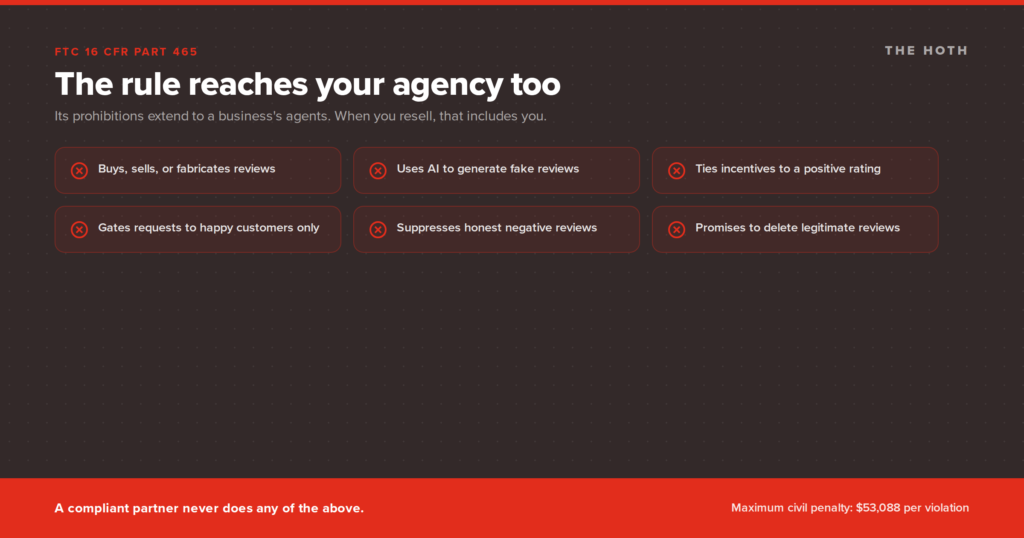
The FTC’s Rule on the Use of Consumer Reviews and Testimonials applies to a business’s agents, which includes marketing agencies and reputation management providers. If your fulfillment partner buys, fabricates, or suppresses reviews on a client’s behalf, that exposure can reach your agency.
This is the single most important thing to get right, and it is barely discussed in the reputation software space. 16 CFR Part 465 took effect in October 2024 and prohibits fake or AI-generated reviews, buying reviews conditioned on a particular sentiment, undisclosed insider reviews, company-controlled review sites posing as independent, and suppression of honest negative reviews.
Read the rule text and you will notice how often the word “agents” appears. The prohibitions are not limited to the business itself. They extend to the parties acting on its behalf, which is precisely what you are when you sell reputation management under your own brand and pass the work to a partner.
The penalties are not symbolic. The maximum civil penalty for the relevant FTC Act violations is $53,088 per violation, and the agency has not defined a violation as narrowly as a provider might hope. A campaign built on gated or incentivized reviews can produce a lot of violations.
Practically, that means your partner selection is a risk decision, not just a margin decision. Before you resell anyone’s reputation service, confirm they:
- Never buy, sell, generate, or fabricate reviews, including with AI
- Never condition an incentive on a positive review
- Do not gate review requests so only happy customers get asked publicly
- Do not suppress or filter honest negative reviews
- Flag policy-violating reviews for platform removal rather than promising deletions
- Disclose material connections when anyone connected to the business leaves a review
If a provider’s pitch leans on burying bad reviews or manufacturing good ones, walk. The margin is not worth the exposure, and it is your name on the invoice.
How do you choose a white label reputation management partner?
Evaluate partners on four things: whether the work is truly managed or just software, whether the white labeling is complete, whether they can handle multi-location clients, and whether their review practices are compliant. Everything else is negotiable.
A working checklist:
- Fully managed, not a dashboard. Confirm a human team writes and posts responses and runs the review requests. Ask who writes them and how fast they go out.
- Truly unbranded. Every report, email, and deliverable should carry no logos, no phone numbers, and no “powered by” footers. Ask for a sample report before you sign anything.
- Platform coverage that matches reality. Google alone is not enough. Look for monitoring across Google, Facebook, Yelp, and syndication to 70-plus directories.
- Both generation and response. A partner that only collects reviews leaves your existing ones unanswered. One that only responds leaves growth on the table.
- Google Business Profile management included. Weekly posts and photos are what keep a profile prioritized in the Map Pack and in AI answers.
- Multi-location support and clean reporting. Your biggest deals will be multi-location. Make sure the partner can price and report at that scale before you pitch one.
- Documented compliance posture. See the section above. Get it in writing.
- The rest of the stack under one roof. If the same partner also handles links, content, and managed SEO, you expand a client without onboarding a second vendor.
Add a reputation line without adding headcount
Our Review & Reputation Management service is 100% white label. Our team monitors reviews across Google, Facebook, Yelp, and 70-plus directories, writes and posts up to 200 personalized responses a month, runs automated SMS and email review requests, syncs listings, and publishes weekly Google Business Profile updates. Unhappy customers get routed to a private channel before they post. Every report comes back unbranded and ready for your logo.
It starts at $275 a month for a single location, with custom pricing for multi-location brands, and it sits inside the same reseller program that already covers link building, content, and managed SEO. One dashboard, one invoice, one partner.
If you want to map out what a reputation line would look like in your service lineup and what you could realistically charge for it, book a call with our team.
Frequently asked questions
What is white label reputation management?
It is review and reputation work performed by a specialist partner and resold by an agency under its own brand. The partner monitors reviews, writes responses, generates new reviews, syncs listings, and manages Google Business Profiles, and delivers everything unbranded so the client only ever sees your agency.
How much does white label reputation management cost?
Fully managed programs typically start around $275 per month per location at wholesale, with custom pricing for multi-location brands. Agencies commonly resell in the $500 to $900 per month range depending on the market and what else is bundled in.
What margin can an agency make on reputation management?
Most resellers see 40 to 60 percent margins across white label services, and reputation management sits in that band because the wholesale cost is fixed and predictable. Volume programs and multi-location clients push it higher.
Is white label reputation management software or a service?
Both exist, and the distinction matters. Software gives you a branded dashboard and leaves the work to your team. A managed service includes the labor, which is what lets you add clients without adding staff.
Can a white label partner remove bad reviews?
Not legitimate ones. A reputable partner responds professionally and can flag reviews that violate platform policies for possible removal, but honest negative feedback cannot and should not be deleted. Suppressing genuine reviews violates FTC rules.
Is my agency liable if my partner breaks review rules?
Potentially, yes. The FTC’s consumer reviews rule reaches a business’s agents, and agencies and reputation management providers are not exempt. Vet your partner’s review practices before you put your brand on their work.
How quickly do clients see results?
Profile activity usually moves within the first month or two, with meaningful action volume by month three. In the campaigns above, one profile went from roughly 200 to roughly 1,000 monthly views over seven months, and another built 242 reviews from zero.
The bottom line
Reputation management is one of the few agency services that is recurring by nature, visible to the client every month, and almost entirely fulfillable by a partner. That is a rare combination, and it is why it works so well as either a first sale or an expansion sale.
The two decisions that matter are the same two most agencies skip. Choose a managed service over software unless you can name the person who will run the dashboard. And vet your partner’s review practices like your brand depends on it, because under the FTC’s rule, it does.
Leave a comment